Crescents

November 1st, 2006 1 comment

I love stuff like this:

Venusmoon Eder Med
Click to see the whole image

From NASA, this photo struck me as interesting. I expected that it was a way zoomed-out photo of the moon, with some large, strange cloud formation mimicking its shape.

However, that large crescent in the photo is the moon. The small crescent is Venus, which can not only appear in the daytime sky, but even shows phases. Go ahead and click on it to see the full-sized image.

Categories: Uncategorized Tags: by

Madison

October 31st, 2006 Comments off

Seen on This Modern World:

“I believe there are more instances of the abridgment of freedoms of the people by gradual and silent encroachment of those in power than by violent and sudden usurpations.”

–James Madison

We always think that things like this are more relevant in our times than ever before… but something tells me that it’s more than just a feeling this time.

Categories: Political Ranting Tags: by

Diebold and Broward: Stealing the Election Starts Early

October 31st, 2006 Comments off

If you hear the two names “Diebold” (the voting machine company) and “Broward” (the county in Florida) together in a news story, then you know it’s going to be about election fraud.

And so it is–even a week before election day.

Diebold, of course, is run by a fervent Republican and Bush supporter who promised to deliver Ohio for Bush (and he probably did), whose voting machine company is not only incredibly reluctant to leave paper trails, but their machines are dead easy to hack and are infamous for “mistakes” in tabulation which “coincidentally” always favor Republicans.

Broward County was one of the two in Florida in 2000 which illegally allowed Republican Party operatives to take home invalid Republican absentee ballot forms and, again illegally, alter them to qualify. In 2004, the county went gung-ho in following an order to invalidate voter registrations over technicalities (PDF file) which would weigh against legitimate voters who were less literate (e.g., immigrants), which disproportionately disqualified Democrats.

So, seeing both these names in a news story today, what could possibly be going wrong?

Well, it seems that Diebold machines in Broward County are mysteriously switching votes from one candidate to another candidate. And again, coincidentally, it is switching votes for Democrats into votes for Republicans. What a shock!

Debra A. Reed voted with her boss on Wednesday at African-American Research Library and Cultural Center near Fort Lauderdale. Her vote went smoothly, but boss Gary Rudolf called her over to look at what was happening on his machine. He touched the screen for gubernatorial candidate Jim Davis, a Democrat, but the review screen repeatedly registered the Republican, Charlie Crist.

It took the man three attempts, with the help of a poll worker, to get the vote correct.

But this was not an isolated incident:

Mauricio Raponi wanted to vote for Democrats across the board at the Lemon City Library in Miami on Thursday. But each time he hit the button next to the candidate, the Republican choice showed up. Raponi, 53, persevered until the machine worked. Then he alerted a poll worker.

All the incidents reported were, coincidentally, people trying to vote Democratic and instead being recorded as voting Republican. And frankly, I would not trust that even the final “corrected” vote was recorded in the machine’s records accurately, just because the confirmation screen said so.

And what was the lame-ass explanation? According to Broward Supervisor of Elections spokeswoman Mary Cooney, the “screens on heavily used machines to slip out of sync,” leading to the wrong vote being recorded.

How the hell can a screen “slip out of sync”? These machines rely on the same technology used on ATMs, which are used in similarly heavy fashion; have you ever heard of the screens on ATM machines “slipping out of sync”? Have you ever asked for $40 and gotten $80 instead? Not to mention that, even if your machines are of such crappy quality that “slipping” occurs, you would naturally space the virtual buttons apart widely enough so that a vote for one candidate would never register as for another–that it would, instead, not register at all, or register as an error, immediately alerting the voter, and not waiting for the voter to hopefully catch the slip-up at the end of the process. Bad engineering on top of bad engineering–unless, of course, it is deliberate engineering.

But not to worry: the easy-to-follow “15-step process is outlined in the poll-workers manual.”

Also, Cooney said that it’s all OK because “It is resolved right there at the early-voting site.”

Yeah, all the slip-ups that are noticed and corrected. The others, however, go on record as votes for Republicans by Democrats.

Coincidentally.

Categories: GOP & The Election Tags: by

Another Internet Pet Peeve

October 30th, 2006 2 comments

There are some elements of web page design that really annoy me. Text boxes you must write long missives into, but they’re the size of a postage stamp; pages filled with moving images, the most notorious ones Flash animations, which are almost impossible to turn off; pages that automatically begin loading and playing music and/or movies without giving you a choice; designs which slavishly follow one browser’s authoritarian dictates, making the page unreadable by other browsers. And so on.

One common theme in all of this is the design element of taking control away from the user. When a user visits a web page, they should have ultimate control over what they see. They should be able to resize text boxes, turn off animations, set their browsers so that no audio or video plays without their approval. Not having any of that is like having a TV with no “mute” control. If surfing the net means having to put up with uncomfortable dictations of others, then it stops being fun and starts getting annoying.

Fortunately, a lot of the flaws I have outlines above have been dealt with; browser features and plug-ins/extensions exist that can deal with most or all of these irritants. However, one usually has to wait a few years between an nuisance being created by some idiot web page designer, and the cure becoming widely available. One recent example is CSS text sizing; browsers are unable to change the standard text size on a web page if it is CSS-based, which means that in order to make web page text readable on my 24-inch screen, I have to increase the text size manually on almost every page I visit.

Another common theme is designing web pages to a specific browser, almost always Internet Explorer. As I recently wrote within a post on a clueless switcher, “optimizing” a web page to IE simply means that instead of using universal design elements that every browser (and therefore every visitor) can parse, you instead use design elements that only work in IE, created by Microsoft so that lazy web page designers would design sites that would shut out competing browsers.

And yet, even people who use HTML commands which are universally recognized and yet still are holdbacks to drawbacks in the only recently-upgraded IE6 browser–which brings me to my pet peeve of today: links which open into a new window.

The culprit is the TARGET=”_BLANK” attribute to the link command. If a link is given that attribute, then a click on that link will make the browser open the new page in a separate window. The original intent of this feature was to allow the original web page to remain open while the user was presented with a new page to look at.

This feature became outdated, however, with the introduction of two browser design elements: first, the ability to open a link in a new window by right-clicking on a link and selecting that feature from the contextual menu; this allowed the user, not the web page designer, to make that choice. When that feature came out years ago, people should have stopped using the “target” attribute then and there. The second and more significant new element to outdate the “target” attribute was tabbed browsing, the entire reason for which was to eliminate extra windows, something which obviously annoys people. Under tabbed browsing, command-clicking a link (control-clicking for Windows users) will open the link in a new browser tab.

Either one of these accomplishes the task which the “target” attribute does, but better, they give the user the choice of what happens.

Web designers who use the “target” attribute, however, limit the user’s choices. Very often, I don’t want to see a new window (the entire reason for tabbed browsing, after all!), and I don’t want to keep the originating page open; the “target” attribute doesn’t give me these choices, at least not easily. In order for me to circumvent it, I have to first notice that the tag has been used (you have to keep an eye on the status bar which displays the target of a link your cursor is hovering over; it will tell you if a link will open “in a new window”), then you have to override the “feature” by command-clicking the link so it opens in a new tab instead of a new window, and then you have to close the offending page, then go to the end of your row of tabbed pages to get to the page you just linked to. A hassle.

Good web page design does not include the “target” attribute, and a good browser should have the option to disable that attribute.

Categories: Computers and the Internet Tags: by

The Saddam Verdict and Political Timing

October 30th, 2006 Comments off

Karl Rove is probably crapping his pants in rage over this news: the chief prosecutor in the trial of Saddam Hussein says that the court is encountering difficulties and may have to delay the announcement of the verdict. The original date set for the verdict was November 5th, a date clearly influenced (despite all the fervent denials) by the Bush administration, as it would turn the American news cycle pro-Bush and perhaps pro-Republican for two days just before the midterm elections.

In a perfect world, the verdict should not benefit Bush. It should remind people that Iraq is a disaster, that Saddam Hussein, even as the butcher that he was, was less bloody a despot in Iraq than Bush is turning out to be. And let’s face it, does anyone doubt what the verdict will be? It’s practically as formulaic as any Hollywood script could be, the mother of all anti-climaxes. But it’s a PR show piece, just as fake as the now-legendary toppling of Hussein’s statue, but also just as illogically influential on public opinion.

One has to wonder at the possible delay in the verdict: are the Iraqis responding to the criticisms that they are political puppets of the Bush administration and holding back the verdict as a way of showing that they run the show? Or is it simply yet another case of events in Iraq not running as the administration planned? It would certainly serve them right–if the Bush administration can’t make Iraq function correctly, why should they expect their political machinations there to work any more smoothly?

Meanwhile, the “liberal” media, instead of investigating the timing of the event, and instead of reporting on legitimate domestic concerns about the Bush administration’s hand in the timing of the verdict’s scheduled release, and instead of noting how time and again, the Bush White House has timed and orchestrated event after event in Iraq on a political calendar–instead of any of that, the press is highlighting a complaint by Saddam’s attorney that the timing of the verdict is political. Instead of paying attention to the compelling facts which lead one to the obvious conclusion that this is indeed all timed politically, the “liberal” media is branding that idea as one held prominently by Saddam Hussein–a decision that could not be better designed to make people disbelieve in what is clearly the truth.

Categories: GOP & The Election Tags: by

Nutritional Information in Japan, or the Lack Thereof

October 29th, 2006 4 comments

One thing that you miss quite a bit if you come from America to live in Japan is the more detailed nutritional information on food packaging. This is where that dreaded “big government” massively interferes with poor American businesses in ways conservatives hate–but which most Americans very much prefer, even if they do take it for granted most of the time.

Here in Japan, nutritional information on food packaging is spotty at best. I still haven’t figured out why some foods have the information and some do not (is it entirely voluntary?). I think there is at least a requirement to list ingredients. Many foods do have limited nutritional information, in a small table on the back or side of the product, which lists:

エネルギー • “energy,” or calories
たんぱく質 • “tampaku-shitsu,” or protein
脂質 • “shishitsu,” or fats
炭水化物 • “tansui kabutsu,” or carbohydrates, and
ナトリウム • “natorium,” or sodium.

And that’s it. No information on the fats (how much is transfat, saturated fat, etc.), no information on fiber, cholesterol, or most vitamins and minerals–unless the producer wants to advertise them. And even then, it’s a matter of simple readings in grams–no “daily recommended allowance.” If you’re not used to thinking about how much of each dietary element you need in grams per day, then you’re outta luck.

That’s why I was so surprised to see this on the back of a bag of lightly salted cashews that I bought recently:

Cashews1

Not only did it give a longer list of nutrients, but it also gave a bar graph of the nutrients as part of a DRA calculation. That startled me, and encouraged me as I thought that this might be a new thing I’d see a lot more of in Japan.

Then I knew those were false hopes when I looked down below and saw the maker:

Cashews2

…Which means that it’s a purely voluntary carry-over from the U.S. which will probably not be followed by anyone else in Japan. Ah well.

Before I leave this topic, there is one pet peeve I’d like to unload, and if you’re an American living in Japan, you’ll probably share it. When American goods are imported to Japan, the Japanese government requires a Japanese-style ingredients sticker be affixed to the package. This is all good and well. What peeves me is where they affix the sticker: almost universally, they put the Japanese sticker right on top of the English-language USRDA label on the package, completely obscuring the far more complete nutritional information. This is done even when there is plenty of blank space elsewhere to put the sticker. And the sticker is almost always impossible to peel off in a way that reveals the original information.

I have this problem at Costco in Japan all the time. I’ve complained about it, and they always agree that I am completely right, but apparently it is done by the shippers, who presumably would rather their customers not be turned off by that damning evidence–why list something you don’t want people to see when it’s so easy to cover up?


Postscript: “Natorium”?

Categories: Focus on Japan 2006 Tags: by

Cool Mac Features You May Not Know About: Dictionary

October 28th, 2006 2 comments

DicticonMac owners might not be aware that a feature introduced in Tiger (OS X 10.4) is a built-in Dictionary and Thesaurus, based on the New Oxford American Dictionary (2nd Edition) and the Oxford American Writers Thesaurus. If you are aware of the app, you might not be fully familiar with the extent it is integrated into the system.

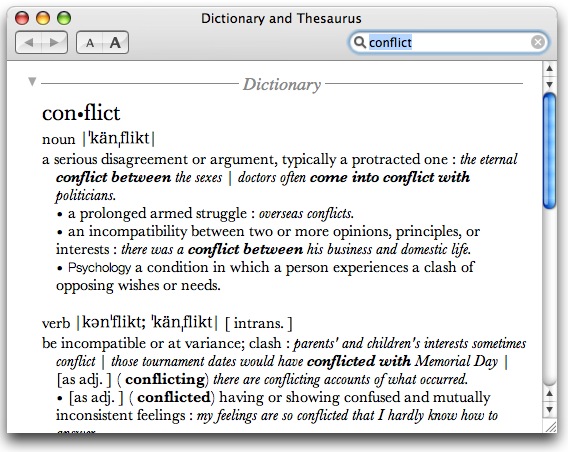
First, there is the app itself:

Mac-Oed

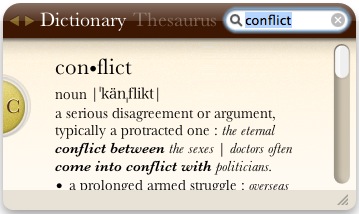
Its use is pretty much straightforward and self-explanatory. Of course, it is handy and convenient to have a complete and detailed dictionary app on hand, especially if it is a free one that comes with the OS. But you can access the dictionary in other ways as well. One is via the app’s Dashboard widget:

Mac-Oed-Dw1

Mac-Oed-Dw2

This might not impress you, however, as you may not be a Dashboard fan, and it is just as fast to open the Dictionary program directly, unless you use the Dashboard frequently or simply prefer it outright.

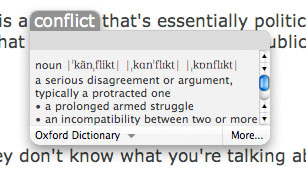
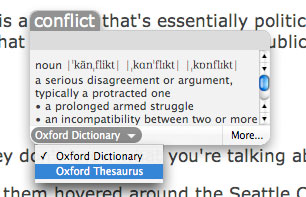
But there is at least one more way to access the dictionary app which is very, very cool. Apple made the decision to integrate the dictionary into the system, and allows for it to be applied “inline,” within any app written to accept it. Take Safari, for example. Let’s say that you want a definition of a word you see on a web page. You might expect that you would have to either type the word into the Dictionary app, or select and copy the word from the page, open the dictionary app, and paste it into the lookup box. Apple’s integration cuts that down to a simple keyboard shortcut.

Just type the shortcut Command-Control-D (you can customize that–I changed it to a simple F-key) while the cursor is floating over the word in question:

Macdict-1

And viola, the definition pops up in a little inline window. Cool!

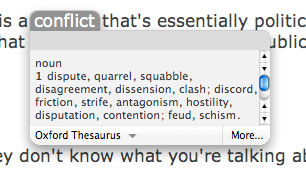
To get the thesaurus:

Macdict-2

Select that, and you get:

Macdict-3

If you click on the “More…” button at bottom right, the Dictionary app will open to the word you selected.

As I mentioned, it will work in any app that is coded to accept the feature, which unfortunately means that any app written before Tiger was released might not allow it to work (e.g., Microsoft Word 2004–though that particular app has its own built-in dictionary).

Where it is written in, it is a great feature, executed beautifully by Apple. My blog editor (Ecto) allows it to work, and I use it constantly, particularly the thesaurus element–very helpful when I have used the word “dishonest” too many times when writing about Bush, for example, and I need other ways to say the same thing.

FYI: fraudulent, corrupt, swindling, cheating, double-dealing; underhanded, crafty, cunning, devious, treacherous, unfair, unjust, dirty, unethical, immoral, dishonorable, untrustworthy, unscrupulous, unprincipled, amoral; criminal, illegal, unlawful; false, untruthful, deceitful, deceiving, lying, mendacious; informal: crooked, hinky, shady, tricky, sharp, shifty; literary: perfidious.

Categories: Mac News Tags: by

Shut Up and Sing

October 28th, 2006 2 comments

Wow. Talk about not being ready to back down. There’s a new documentary coming out (limited release today, national release on November 10) called Shut Up and Sing, which shows what happened to the Dixie Chicks after the famous “we’re ashamed that the president of the United States is from Texas” statement at a concert in England. The film looks back in retrospect at Both the Iraq War and the experiences of the band as it happened, providing for some interesting reminders of how people felt back then versus how people feel now.

One scene in the trailer in particular stands out, as the Dixie Chicks get lectured by a man who tells them, “Try not to be judgmental of the President. I’ll tell you why: he’s got sky-high approval. The war couldn’t be going better.”

One can imagine that this was at the very start of the Iraq War, probably late March or early April 2003, when American forces were on a roll into Iraq (the “ashamed” comment was made on March 12, eight days before the opening of the war). It was probably before the looting started after the fall of Baghdad. At that point in time, one might have thought things were going great–if one didn’t think ahead to the future too much. But to hear, now, someone say what that guy said then, comes as a jolt–as probably a lot of things in this documentary will be.

The contrast between the heady pro-Bush, gung-ho Iraq invasion days and the present Iraq disaster with Bush in the doghouse shouldn’t be too surprising–after all, we all lived through them. But the past three years, in terms of how people feel, has seen such a huge shift that it may shock people to remember how different things were so recently.

But not everything has changed too much. Via DKos and Think Progress, a story from Variety that NBC is refusing to air ads for the documentary. Why? Because “they are disparaging of President Bush.”

Let’s hear that again: NBC is refusing to air an ad because it is disparaging of President Bush.

Update: Sean makes an excellent point in the comments below: NBC runs the show Saturday Night Live, which regularly includes sketches that are, to say the least, “disparaging” of the president. This more than a little knocks down the network’s excuse for not running the ad. It also marks the fact that their real reasons are not on the up-and-up, otherwise why lie about them?

You can see the ad on Think Progress, or the whole trailer on the film’s MySpace site.

Yet more damning evidence that the media is radically liberal!

Categories: Political Ranting Tags: by

Gay Marriage–Will It Work for the GOP Again?

October 27th, 2006 1 comment

Running out of options and heading for the doghouse but fast, the GOP was heartened by a New Jersey Supreme Court judgment the other day which said that while gay couples are not entitled to marriages, they are entitled to equal benefits. The GOP was not heartened by the denial of marriage, they were filled with joy that a high court gave any union rights at all to gay couples–that gives the GOP ammunition to scare the evangelicals with. While the ruling was not in favor of gay marriage, it was close enough for a desperate Republican Party to grab it and run with it. Gay marriage having worked so well to their advantage in the past, they’re hoping it will work the same way again.

There may be a problem with that, however. In light of David Kuo’s new book which uncovered the contempt that Republicans have for the religious right, tied together with the fact that while gay marriage is trotted out every election year to scare people, after the election the GOP abandons the issue (having gay marriage even be possible is too valuable for them to actually outlaw it), evangelical voters might actually be catching on, finally, to the scam.

And, as it has been pointed out, gay marriage has been legal in Massachusetts for two years now, and there has been no sign of heterosexuals abandoning the ceremony because gays can marry. The stats for marriage (PDF file) in Massachusetts in 2003-2005 tell the story. In total, 36,225 couples were married in 2003, 41,549 in 2004, and 39,074 in 2005. In 2004, 6200 gay and lesbian couples got married as soon as it was legalized there; 1900 gay and lesbian couples married there in 2005. Subtract those numbers from the totals, and you have:

2003: 36,225 heterosexual marriages
2004: 35,349 heterosexual marriages
2005: 37,174 heterosexual marriages

Average out the numbers for 2004 and 2005, and it equals 2003 almost exactly (36,261.5). So far, the stats bear out the notion that gay marriage has zero effect on heterosexual marriage. None whatsoever. You might argue that the effects could be long term–but you would have no evidence to back you up. The only data out there so far points in the opposite direction.

Not that Republicans ever had any problem with using a good scare tactic that was completely unsubstantiated by fact.

Categories: GOP & The Election, Political Ranting Tags: by

Construction Mannequin

October 27th, 2006 8 comments

Perhaps one of the most visible jobs one could have in Japan is the person who works at a construction site, waving traffic along with a flag or a flashlight cone. I’m not talking about the kind where they direct traffic, but rather the kind which simply stand in front of the traffic cones and work crews and gesture traffic to the other lane. That particular job tends to stand out for two reasons: first, you almost automatically imagine how easy and yet mind-numbingly boring and unrewarding such a job must be, and second, because 95% of the time, the position seems utterly unnecessary.

Now, there are some situations in which a person standing there controlling traffic is vital–like when the road construction is right around a sharp bend in the street, and you wouldn’t see it until it were too late. But most of the time, you can see the construction cones and heavy machinery from a mile away, and the person standing there waving you to avoid hitting them seems completely lame. But you gotta figure there’s a law that requires it.

Fairly often, you’ll encounter a site which is using a mechanical signaler–usually a simple stylized-figure cutout with a mechanical waving arm with a light on the end of it, as in the photo below. Nothing to write home about.

Const-Cutout

But once in a rare while you’ll see a rather interesting sight: a mechanical dummy, complete with arms that goes up and down, with a flag in hand. Talk about having your job taken over by a machine… but when your job is so completely simple and mechanical in the first place, one should pretty much expect to have a simple motor take over the position.

Constman-450
Click for larger image

The funny thing about this particular dummy was that the flag he’s waving had to be strapped onto the end of his arm–apparently, it’s not set up to hold one normally.

Constman2-450

Nor are these mannequins unique to construction sites. One sometimes sees fake policemen as well. Back in my touring days, when I drove across Japan on a motorcycle, I would see both cutout photographs of policemen and mannequins dressed up as cops placed in strategic locations on roads to try to fool drivers into slowing down. Sometimes they were very realistic, but sometimes they were laughable, including one mannequin who was clearly strapped to a pole–it looked like he was both frozen absolutely rigid and tied up by a kidnapper or something.

Categories: Focus on Japan Miscellaneous Tags: by

Video iPod

October 26th, 2006 6 comments

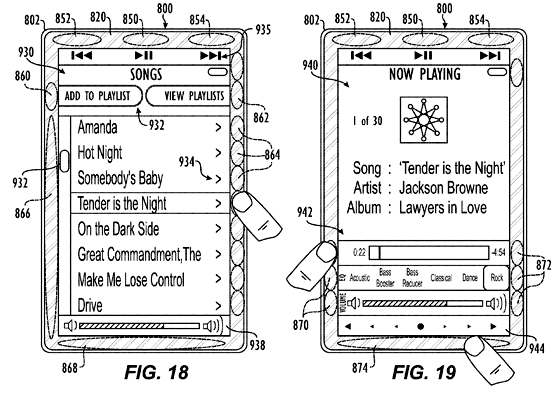
A lot of the time, future Apple tech is revealed by patent applications, so the rumor community keeps a close eye on the patent office. One application that Apple made recently had this image:

Ipodbezel2Gif

One of the things I had wondered about was how a full-screen, touch-screen video iPod would be able to maintain a clear enough screen to allow for enjoyable viewing, if one’s hands were constantly touching it. This is the answer.

Here’s the way it would work: instead of the user touching the screen, one would touch the frame (“bezel”) surrounding the screen. The circles around the edge of the device are not physical buttons, but rather touch-sensitive areas. For example, the three circles at the top of each of the screens shown above would correspond to the controls shown just below them on the screen itself. When you see a control on the iPod video screen, just touch the part of the screen frame closest to the button, and that will do the job. The buttons appear and change dynamically to suit the image on the screen and even the orientation of the device (if it’s in portrait or landscape mode).

In this way, the user has full control without physical buttons, but the full-face screen remains smudge-free. A pretty clever design, I think–though it belies prior patents that have the virtual clickwheel displayed on the screen. The mockup below shows the exact hardware design shown in these patents, but has the virtual clickwheel.

Ipodbezel2Gif

More drawings from the patent application can be found here.

Categories: Mac News Tags: by

Google Blogs Down

October 26th, 2006 2 comments

Wow. Google blogs have been down big-time… of the air for at least a few hours now. Just saying…

Categories: Computers and the Internet Tags: by

Stay the Course

October 26th, 2006 Comments off

Check out the latest Democratic ad, which nails Bush for denying he ever said “stay the course” about Iraq. The ad compiles no fewer than 15 times Bush, Cheney, and Snow said that we must “stay the course” in Iraq–11 of those times Bush himself said it. Were it not for the ominous music, it would play like a Daily Show segment, because right after seeing Bush repeat “stay the course” so many times, the ad shows Bush saying, “look, we’ve never been ‘stay the course.'” Outstanding.

One critique–the ad should have changed the music and looming titles at the end when it says to vote Democratic. But that’s a small nit. Otherwise, the ad is perfect; it not only points out the failed strategy in Iraq, a resonating theme among voters this Fall, but it also shows Bush up as the liar he is. Not so much a criticism of congressional candidates, but as a criticism of the party–which has followed Bush’s lead almost slavishly–it should work quite well.

Update: apparently, the ad only had limited time to show Bush saying “stay the course” 11 times. Keith Olbermann (via C&L) showed Bush saying it 29 times, after Tony Snow claimed he could only find eight such instances–all this after Bush claimed he never said it. A Google search of the White House press release directory found 160 hits for the term.

Categories: GOP & The Election Tags: by

Republicans Use the Troops, but Clearly Hate Them

October 25th, 2006 Comments off

I pointed out here, here, here, and here, Republicans disrespect and work against the interests of Americans serving in the armed forces. While they use them shamelessly as campaign props and human shields, Republicans then turn around and cut their pay and their benefits, whilst doing little or nothing to get them sufficient body armor or other supplies (no shortage of resources sent to Halliburton), not to mention giving a crap about any strategy in Iraq or Afghanistan beyond their own self-serving political agenda.

But now there’s new startling, hard, cold evidence beyond the newspaper reports and uncovered scandals: a non-partisan veteran’s organization took a list of bills presented in the Senate which would impact troops and veterans (veterans’ benefits, healthcare, medical research dedicated to injured soldiers, etc.), and rated senators based upon how they voted on these matters. Although the veteran’s group did not show the rankings by grade, Bob Geiger published an ordered list sorted by how each senator performed–and the results are striking:

Iava Senate Ratings

As you can see, the top of the list is dominated by Democrats–with only independent Jim Jeffords breaking up the monopoly–and Republicans exclusively fill up the bottom of the list. No Democrat scored worse than “B-,” and no Republican scored better than “C.” The strongest veterans’ advocate among the GOP faithful scored worse then the lowliest Democrat. (This list is strikingly similar to one showing how Republican and Democratic presidents performed in job creation–with the worst Democrat outperforming the best Republican, with Republicans populating only the bottom half of the list.)

There’s your proof, right there. Republicans will use the troops for their selfish political manipulations, but they won’t lift a finger to actually support veterans who have served our country.

This leaves no doubt: if you want to support the troops, vote Democratic. If you want the troops to get shafted, vote Republican.

Hat tip to DKos.

Categories: GOP & The Election, Political Ranting Tags: by

Old Shows, New Shows

October 24th, 2006 2 comments

Well, the alien-invasion-style series have all died off, it seems. Threshold was the first to go (formulaic, but interesting). Invasion died off next (too soap-operaish for my tastes). And Surface (very promising, at least it was) seems to have quietly passed away, without even word of its cancellation, as far as I can find at least. Its star, Lake Bell, is back on Boston Legal. At least The 4400 is still around, even though it runs only 13 or 14 hours per year.

The West Wing finished its run last year, and Commander in Chief died in the cradle (rightly so–it could have been very good, but was very poorly written). CinC might actually come back for a TV movie sendoff next year, though. Stargate SG-1 will end after the current season, after ten years on the air. And despite its promise, Rome seems to have been a one-shot, unless HBO is going for a very long-delayed second season.

In the meantime, I have found some other new series, ranging from the very iffy to the good enough to watch.

Torchwood is the latest, just having premiered. A British series, it’s a spin-off of the most recent Doctor Who. It takes from several Doctor Who episodes over the past two years. The lead male character, Captain Jack Harkness, was introduced in the 2005 Doctor Who two-parter, The Empty Child and The Doctor Dances; he was introduced as an American time traveling mercenary, last seen in WWII (an appearance which is referenced to in the premier). He is presented in Torchwood as an immortal being of sorts with a mysterious past. The name “Torchwood” comes from the Doctor Who episode Tooth and Claw, where Rose and the Doctor meet with a not-amused Queen Victoria at the Torchwood estate; when Victoria sees the Doctor as a danger, she establishes Torchwood as an institute to collect extra-normal evidence and technology–an institute which shows up in the second-season two-part finale, Army of Ghosts and Doomsday, where Torchwood is presented as a highly advanced super-secret agency with all the latest in alien tech.

The series Torchwood establishes that there are different branches of the institute, the one we encounter consisting of just five people, led by Captain Jack; their digs are dingy and dungeonesque, in stark contrast to the modern high-rise fortress shown in Doctor Who. But the goofy alien technology is very Doctor Who-ish. The main character of the new series is Gwen Cooper, a constable who gets drawn into Torchwood as a newbie and has to learn the ropes.

The show has the same entertaining edginess of the new Who, and shows promise; I’ll keep my eyes on this one.

Next newest is Heroes, which is sort of a TV rip-off of X-Men with a smattering of The 4400 (also derivative of X-Men). Just like X-Men, Heroes has humans evolving super powers, a different superpower for each mutant. A central character is Mohinder Suresh, a non-mutant (so far as we know) scientist from India whose father was onto the whole mutation thing, but got killed by forces unknown. The father might not actually be dead–one photo of him was shown, and it was Erick Avari–a character actor (from the Stargate movie and TV shows, and countless TV appearances) of enough note to not just be limited to a photo reference (IMDB actually has him listed as guest-starring in three upcoming episodes). There is also a mystery agent going around collecting the mutants and doing… something with them–and discovers his daughter is a mutant. She’s a cheerleader who can’t be killed, despite fatal falls, running into a burning train wreck, and having a tree branch impale her skull. The last gets her dead only long enough for the coroner to have partially dissected her; pulling the branch out of her brain brings her back to life. You can see that this series has a dark edge to it.

Other “heroes” include Hiro, a Japanese otaku salaryman, into Star Trek and The X-Men (no hiding of borrowed influences here) with a high-pitched voice and goofy character; Hiro can bend space and time, stopping the clock or moving to other continents or time periods by squinting real hard. Nathan Petrell is running for Congress when he finds out he can fly; his brother Peter thought he could, but in actuality, he just borrows the powers of mutants he gets near to. One of them is Isaac Mendez, an artist who can paint the future, but only when high on heroin. And Niki Sanders is an Internet sex-cam model in Las Vegas who owes the mob big-time, with a little boy whose father is in jail. Her “power” is, apparently, to have a split personality, her alter-ego being able to rip men apart while Niki is blacking out. Apparently the series will introduce more “heroes” as time goes on; making a late appearance is Matt Parkman, a mind-reading cop.

The series is building up to a climax involving a mutant villain named Sylar who, among other things, impales victims with household objects, and maybe removes mutants’ brains from their skulls. Or maybe that’s some other villain, who may or may not be responsible for a nuclear bomb destroying New York, an event foreseen by two different characters. Stay tuned.

Less science-fictiony is Studio 60 on the Sunset Strip. This show has the most promise, and may be the most short-lived. Aaron Sorkin is commanding this one like he did with Sports Night and The West Wing, and it is classic Sorkin. Not so much walk-and-talk stuff that Tommy Schlamme was known to bring in The West Wing, but the Sorkin story-and-dialog touch is unmistakable. If the series survives, it’ll be great. However, it’s not getting off to a blazing start, and could be an unfortunate early casualty of the season.

The show is about a Saturday Night Live-style weekend comedy skit show. In the first episode, Judd Hirsch guest stars as a Lorne Michaels type of executive producer who melts down on live TV (like Peter Finch’s character in Network) after he sees the suits and the censors reduce his show to mindless pap. A new network president promises to remake the show and brings in Danny Tripp (Bradley Whitford) and Matt Albie (Matthew Perry), a close writer-producer team who left Studio 60 a few years ago, and now can’t continue their successful new career of making movies for two years because Danny violated a drug probation; being free, they accept the challenge of re-making Studio 60. Sorkin’s writing is top-class as usual, but one unfortunate side issue is that Sorkin can’t write sketch comedy nearly as well as he can write good drama; the skits on the show don’t come across as very funny.

Other characters include Timothy Busfield (also a producer) as the show’s chief engineer (or whatever you call it); Sarah Paulson as the star of the show and Matthew Perry’s love interest (they broke up years ago, thus creating the present sexual tension), Evan Handler as a chief writer who pissed off Matt Albie years back, and D.L. Hughley and Nathan Cordry among the show’s leading talent.

Strangely similar in concept, 30 Rock is about a late night comedy skit show run by Tina Fey, whose job is overrun by a new network executive played by Alec Baldwin, who takes the woman-driven “Girlie Show” and makes a half-insane, controversial black male comedian the new star of the show. 30 Rock is off-the-wall, and, frankly, not very funny at all. I got through the premiere, but couldn’t watch through the whole second episode. Alas, this bad show will probably out-survive Studio 60, unless there’s any tastefulness left in TV.

One more new show is Ugly Betty, a series brought in by Salma Hayek, who cameos in every episode as a star in a telenovela, a job she used to have some time ago. Ugly Betty is based upon the hit Colombian telenovela, Yo Soy Betty, la Fea (“I Am Betty, the Ugly”)–this is even playing on TV in Japan. The story is about Betty, an unattractive young woman with blue braces and a terrible fashion sense. A Latina from Queens, she aspires to work in the magazine industry. She is initially brushed off just because of her looks, until she is hired because of her looks–the publisher of a fashion magazine called “Mode” has installed his playboy son as the new chief editor and wants him to have an assistant he won’t be tempted to have sex with. Betty stands out like a sore thumb among the ultra-chic snobs that populate most of the staff.

The melodrama has two arenas: Betty’s home and her work. At home, there is her charming father, her attitude-prone sister, and her smart young nephew, who adores high fashion. There is also her boyfriend, who in the first episode runs off with the manipulative neighborhood slut, who also figures strongly in the show. The boyfriend must win his way back into Betty’s heart after the slut dumps him after using his employee discount to buy a plasma TV.

Then there is the office: Betty’s boss, Daniel, after initially trying to make Betty quit, comes to respect her, but they are pitted against conniving office staff. The chief villain is played by Vanessa Williams, who should have gotten the editor’s job and regularly schemes to sabotage Daniel, with her effete, sycophantic assistant Marc, and the snooty, slutty receptionist, Amanda. Williams’ character reports to Daniel’s mother, former editor of “Mode,” thought to be dead in a car crash perhaps engineered by Daniel’s father, who is assisted by a shady henchman.

Usually I would not watch stuff like this, but I heard some good things about it and decided to give it a try. So far, I like it; it has just the right balance of goofy comedy and good storyline, and doesn’t go too far off the dramatic edge into melodrama.

That’s it for the present. Along with other continuing shows, it’s more than enough to fill up one’s free time…

Categories: Media & Reviews Tags: by

Cool Mac Features You May Not Know About: Keyboard Shortcuts

October 23rd, 2006 Comments off

Well, if you read this blog, then you know that I am a bit of a Mac advocate (please stifle coughs of scorn at the understatement, thank you). In order to show why I feel this way, I thought I should start a series on Mac features that many don’t know about which would help you understand why I like the OS so much. Some of these might even be bits a lot of Mac users don’t know about, especially beginners who haven’t fully figured out the system yet.

The first feature is one that is probably under-used: the ability to change and create keyboard shortcuts. I use keyboard shortcuts a lot; they represent a way to do things a lot more quickly than with menus or toolbar buttons, which require you to transfer your hands from the keyboard to the mouse–a seemingly trivial task, but one that can slow you down more than you might realize.

One problem with keyboard shortcuts is that they don’t always exist for things that you want to do, or they might not be shortcuts you want to use. Many programs allow you to configure the shortcuts within that app, but many don’t, and there are holes in others. Mac OS X allows you to configure shortcuts in a relatively simple way.
Keyb-Mous
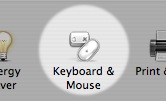
The feature is found under System Preferences (found in your Apple Menu, at the left end of the menu bar at the top of your screen). Open the “Keyboard and Mouse” preference pane, and in the tabs along the top, select “Keyboard Shortcuts.”

Kybms-Tabs

You’ll see a list of most of the system-level keyboard shortcuts. Not only is this a way to edit the shortcuts, it could also serve as a handy list of shortcuts if you forget them, and it might even put you on to discovering some features of the Mac OS you weren’t even aware of before.

Kybshrtcts

From this list, you can activate or deactivate shortcuts, and by clicking on a command and typing a new shortcut combination, you can change any of the shortcuts to your liking. A yellow warning triangle will appear next to a shortcut if it conflicts with an existing one.

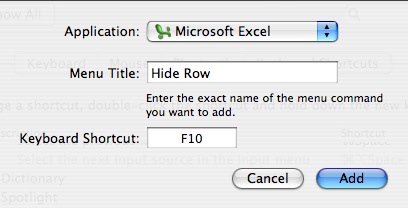
But there is an extra, very useful element to this feature that I think many people miss: you can use this preference pane to set any keyboard shortcut to any command in any application. For example, I use Microsoft Excel (hopefully not for too much longer). One action I take very often is to hide and reveal rows and columns in a spreadsheet. These commands have no keyboard shortcuts. Now, Microsoft Office allows you to set shortcuts using the Customize dialog box–but for some reason, hide and unhide rows and columns is not included, so you can’t set a shortcut for them. Considering that these commands are embedded in a submenu, it’s a major hassle to navigate the menu and submenu each and every time I want to hide or unhide something.

In OS X’s Keyboard Shortcuts feature, at the bottom of the list of shortcuts, there is an additional option:

Appshrtcts

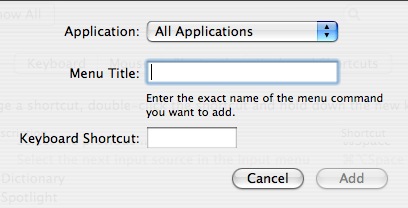
See the plus and minus buttons? If you click on the “plus” button,” it will activate a dialog box:

Appshrt-Db

First, select the application you want to affect (though you can leave it at “all applications,” and any menu item of the same name will be universally affected). Then type in the exact name of the menu item, and then type the shortcut you want to create. Capitalization, spaces and even ellipses must be faithfully typed.

Appshrt-Db2

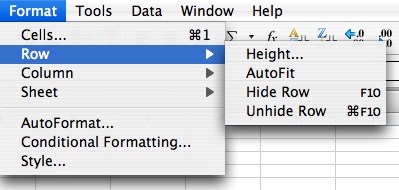
After making your changes, start/restart the app you changed. The new shortcut will appear in the app’s menu.

Excel-Newsc

This can be applied to any program. Another example is a simple text editing program I use, called iText; the app is very nice, but for some reason, they did not include a shortcut for “Hide iText” in the app’s main menu. OS X’s Keyboard Shortcuts feature allowed me to create one.

Categories: Mac News Tags: by

Humility and Truthfulness

October 23rd, 2006 2 comments

I’m sure you’ve heard this quote by now:

We tried to do our best but I think there is much room for criticism because, undoubtedly, there was arrogance and there was stupidity from the United States in Iraq.

Poor guy. You couldn’t trade his job security now for the proverbial political warm pitcher of spit.

The view was given by Alberto Fernandez, director of public diplomacy in the Bureau of Near Eastern Affairs at the State Department , in an interview with Al Jazeera. While many would disagree with the “tried to do our best” part, the rest of the statement is more than simply true. The ironic thing here is that, were the U.S. to officially endorse statements like that (the White House has already denied this, saying “Those comments obviously don’t reflect our position”), the U.S. would be in far better shape in the Middle East.

What the Bush administration has not shown in Iraq or the rest of the region is humility and truthfulness. Had we been as humble from the beginning (remember Bush, in the 2000 debates, said we should be humble to other nations?), we wouldn’t have half the problems there that we have today.

This diplomat is going to get crushed because of what he said, which was simply the truth. The fact is, we need to emulate this guy, we need to promote the views he espoused, instead of the arrogant, stupid take that Bush and his people have tried to shove down everyone’s throats. If any plan in Iraq has a chance of working, humility on our part like this would be a necessary component.

Just don’t expect it from Bush.

Categories: Iraq News Tags: by

Yet Another Misleading “Mac Attack” Story in the Media

October 23rd, 2006 Comments off

CNN is running a high-profile piece today titled, “Security analysts: Mac attacks rare but may rise.” The URL for the piece contains the words “apple virus.”

Their evidence? The story that a few iPods were shipped with a virus. A virus that doesn’t affect Macs, or iPods, but the Windows OS only. This is a “Mac attack”?

But they give more evidence:

Oliver Friedrichs, director of security response at Symantec, a leading anti-virus software vendor, said 72 vulnerabilities were discovered in the Mac’s OS X operating system in 2006, up from 19 in 2004.

And Symantec identified six threats of malicious code written for the Mac OS X operating system in the first half of 2006, versus zero in the second half of 2005 and two the year before that.

In other words, the same old re-heated misinformation spread by a company that wants to frighten Mac users into buying their unnecessary software. Vulnerabilities are all good and well, but every OS has them, and they don’t mean much if they are not exploited before they are discovered; it means that Apple is doing a good job of finding and patching them. So far, no vulnerability on OS X has been successfully exploited in any harmful way. As for the “threats of malicious code” (just threats? not actual malware?), whatever “malicious code” has been released has been in proof-of-concept form only–never in the wild, never harmful, and never released in a way that could infect more than just a handful of machines. The day will come when the first piece of malicious code written for Mac OS X which actually does some damage will spread to more than just a handful of Macs. But that day has not yet come.

Ironically, the fact that the Windows virus was able to get onto the iPods (via a third-party contractor, not directly by Apple) is a testament to the weakness of the Windows OS, not the Mac OS. That iPod-virus story has no place in an article about Mac security, except to bolster the fact that the Mac itself is secure.

And yet people misuse the news, like this writer (who clearly has a chip on his shoulder and a stick up his butt about Macs), who speaks of “the myth of total Mac invulnerability to viruses and spyware” and “self-righteously invincible Mac users” who believe they will never be hit by a virus. Ironically,hit s view is not held by Mac users so much as it is held by Windows users who are contemptuous of Mac users. They hear Mac users express pride and satisfaction about the relative security on the Mac and resentfully exaggerate that to mean “Macs are perfect, and will never have any problems at all.” As I have mentioned on many occasions, and any knowing Mac user will tell you, the Mac is not invulnerable–it simply has better security than Windows. It benefits also from its current obscurity, but even were it to reach 50% market share, it would still not get as much malware as Windows does.

Categories: Computers and the Internet, Mac News Tags: by

So, What Were You Saying about Murtha and Kerry?

October 23rd, 2006 3 comments

In the news today:

AMERICA has responded to spiralling violence in Iraq by preparing an exit strategy that will allow coalition troops to withdraw by forcing the government in Baghdad to take responsibility for security.

According to a story in the New York Times, the Pentagon is drawing up plans for a “forcing mechanism” that would set target dates for handing control to the Iraqis. American troops would pull back to their bases, leaving military advisers “embedded” with the Iraqi security forces.

So, the Bush White House is looking at carrying out a plan where we would force the Iraqis to shape up because ready or not, we will withdraw most of our forces from Iraq, except for training forces, by a specific deadline.

Hmmm. Where have I heard that before?

Iraqi politicians should be told that they have until May 15 to put together an effective unity government or we will immediately withdraw our military. If Iraqis aren’t willing to build a unity government in the five months since the election, they’re probably not willing to build one at all. The civil war will only get worse, and we will have no choice anyway but to leave.

If Iraq’s leaders succeed in putting together a government, then we must agree on another deadline: a schedule for withdrawing American combat forces by year’s end. Doing so will empower the new Iraqi leadership, put Iraqis in the position of running their own country and undermine support for the insurgency, which is fueled in large measure by the majority of Iraqis who want us to leave their country. Only troops essential to finishing the job of training Iraqi forces should remain.

Yeah. That sounds like the exact same plan. With one difference: it was put forth by John Kerry, in early April of this year, that plan echoing John Murtha’s.

So, are the Pentagon and the White House now admitting that Murtha and Kerry, who they mocked and derided as “cut and run defeat-ocrats,” were actually right all along?

The Bush White House is already weaseling, by making a non-denail denial to the story; they say the Times story is not “accurate,” but carefully did not deny the basic premise. Clearly, they at the very least had this plan up and front, and still may use it. If they do, you can be damned sure they won’t give credit where credit is due.

Categories: Political Ranting Tags: by

Caught in the Act

October 23rd, 2006 1 comment

I came down to get my scooter to go shopping, and caught the little tykes in the act. The cats that have been using my scooter’s seat as a bed/toilet were sitting right there. The tabby was on my seat, and the black one was on the next scooter over. I shooed them away and rode off to go shopping, and when I came back, they were both on the neighboring bike–and stayed there while I got my camera and came back to shoot them, photographically speaking.

10-22-06-Cats1-450
click to see larger image

In fact, a cat that’s probably their momma even dropped by–she’s usually absent. But it’s raining tonight, and the cats look for shelter.

10-22-06-Cats2-450

To guard against the seat-sitting, I’ve taken a few measures. First, I bring my full-face helmet inside with me every day–if I don’t, the tabby will sleep in it, leaving it full of cat hair and what was probably cat slobber, inside the helmet where my head is supposed to snugly fit. Eww. Second, I drape a towel over my seat, and splash water all over it. This keeps the cats off overnight, though if left for any longer, it’ll dry off–like it had by tonight, when the tabby used it as a sleeping mat; I hadn’t used the bike for two days. But that’s OK–as a secondary protection, the towel at least keeps the paw prints, hair, and pee off the bike seat itself.

10-22-06-Cats3-450
click to see larger image

I’m pretty sure by now that they’re strays. If they’re owned by anyone, that someone would hardly ever have them in their apartment. Possible–people can be that irresponsible, having temporary pets and then inflicting the hassle on the whole neighborhood–but I just get the impression that these are noraneko.

Categories: Uncategorized Tags: by