Archive

Author Archive

Tired of Being Jerked Around Yet?

February 20th, 2010 3 comments

Missmeyet

The above is an actual billboard located on I-35 near the town of Wyoming, Minnesota. It’s been garnering quite a bit of attention, and has become the new big gag among the right-wingers. Do a Google Image search of “Bush Miss Me” and you’ll see that it’s been reworked as one of those “motivational posters” and slapped on half the wingnut blogosphere.

Considering that half the stuff people are “tired” of are direct results of actions taken by the Bush administration, and the other half are the result of right-wing hysteria and Republican obstructionism, the suggestion of “missing” the Bush era is more akin to blackmail than a call to better times.

It’s like a kid who wants to sit in the front seat of the car on a family trip, and when he gets put in the back seat does nothing but scream, kick, and throw things until everyone else just gives up and gives him what he wants.

The difference is that with the punk kid, he eventually gets tired and shuts up.

Windows Phone Series 7

February 17th, 2010 5 comments

Named only as awkwardly as Microsoft can name a thing, the new Windows Mobile OS is out, and making quite a bit of a fuss in the gadget community. What strikes me is that virtually everyone on the major tech sites is raving about this, saying it’s the greatest thing since sliced bread–and virtually no one is panning it. Looking at all the major sites, I can’t find a single person saying, “I don’t like this.” Which is immensely suspicious, because somebody always hates something new, and it’s not like there’s nothing to criticize about the new mobile OS. It’s almost as if people feel obligated to give the product raving reviews, either out of guilt (I don’t want to seem unfair after praising Apple’s products), relativism (this is great because it’s far better than WinMo 6.5!), or simply because it’s not by Apple.

The WPS7 (seriously, what will become the shorthand for this thing?) is based on the Zune, using its interface style and including the DAP within the new structure. Notably, Microsoft doesn’t want these to be called “Zune Phones,” for obvious reasons. Not that the Zune HD was bad–it was Microsoft’s first good version of the machine–but it was way too little, way too late, after having established a very bad image for the brand name. They have not banished the Zune name, but they are definitely burying it somewhat.

Microsoft definitely did a several things right with this OS. The design elements are very well done, taking the best from the Zune and adding more good stuff. The elemental colors are a Microsoft standard, but they are done with a classy, understated elegance which is hard to dislike. There are cool animated transitions that dazzle, at least at first. Microsoft seems to be adding Office functionality, but not much is out on that yet–if you can view and edit Word, Excel, and PowerPoint on this, it’ll be a huge plus (albeit difficult on such a small device). But Microsoft’s smartest move is making the phone integrate seamlessly with social networking features, bound to be a big hit with the younger crowd–the one especially into the iPhone right now. And that’s a big giveaway–this is not aimed at Microsoft’s usual business crowd, this is a broadside directly aimed at the iPhone’s user base. Centering the OS around activities, defined under ‘hubs,’ Microsoft is trying to make this a user-centric, experience-based machine.

So, is it as good as everyone is raving? One very telling point is found in all the praise. There are several recurring themes that are common to the gush:

It’s not the piece of crap WinMo 6.5 was. This should be damning with faint praise–almost nobody liked the previous version of the OS. A blind chimp with Tourette’s could have designed a better OS for a touchscreen phone. But the improvement is commonly touted as a big deal, though usually with the added note that, “it’s not only not a piece of crap, it’s actually pretty good.”

It’s got great graphics. Fair enough–a lot of people loved the iPhone for similar reasons. The thing is, the same people now in love with the eye candy were the same ones dismissing it with the iPhone. The iPhone persevered because it functioned well in real use, something that only a few people issue caveats about concerning WPS7.

Praise for the same things the iPad was knocked for. Many are praising the WPS7 for borrowing an existing (Zune) style and functionality, something the iPad was criticized for. Nobody is saying, “Oh, it’s just a phone version of Zune” like they’re saying that the iPad is just “an oversized iPod Touch,” despite both going well beyond the original models in functionality. Similarly, people are avoiding criticism of WPS7 for things they gnash their teeth at where Apple’s products are concerned. No multitasking? We’ll mention it, but not whine about it like we’re doing with Apple’s gear. No Flash? Oh, who cares? In fact, nearly all potential points of criticism are muted, where they were highlighted not just with the iPad, but with the iPhone since it was first announced. Paucity of apps? Lack of an SDK? No details on major elements of the product? These were major complaints raised again and again after the iPhone was announced, and yet no one seems to mind or care much with WPS7. Why not? Then there’s the ecosystem: a major complaint about Apple mobile gear is that Apple controls it. Well, WPS7, with it’s hub-rather-than-app focus, seems designed even more to lock in control by Microsoft–but nobody’s getting on their high horse about it. Why not? Why fall all over Apple for all of these things, and then just a few weeks later have no objections when Microsoft comes out with a product with the exact same features? just about the only criticism I can find about WPS7 across more than one site is for the name. Even under the incredibly positive hype when the iPhone originally debuted, there was still far more focus on the negatives than Microsoft is getting now. Is this an IOKIYM deal?

Praise for nothing new. “You can see how many emails and phone messages are waiting right on the main screen!” Um… that’s been on the iPhone forever, dudes. “It’s minimalist!” Same deal. “It has a touch screen, multitouch no less!” Uhh…“It has cloud computing!” OK, maybe all of this belongs under the “It’s not the piece of crap that WinMo 6.5 was” category.

Unreserved Praise without hands-on. In contrast to people hating the iPad despite testimony that you need a hands-on to appreciate it, people are gushing about the WPS7 without really experiencing it. From Microsoft’s “Mojave” campaign, we know full well that Microsoft is very good at making their product look 100% better under strictly controlled conditions.

Finally, one should note what is absent from the praise: the OS’s functionality and ease-of-use. Everyone is talking about the appearance and the features, but no one seems to be talking about what it would be like to use it. Nobody is saying that it looks like it’s easy to use. Nobody is mentioning the smart design of the menus, or how simple it would be to navigate. All this despite the essential information on that being out there in full view. And I think the reason is because functionality seems to be the major flaw in this device. It’s designed to look cool, not to function well.

This is where the iPhone excelled: ease of use. Turn it on and there are the buttons. Flipping the screen to the next page is easy to learn. That’s it–the user takes over from there by adding the apps that they want and arranging them how they like. The iPhone is designed to be easy to understand, easy to use. It’s designed to simply function and then get out of your way. Lest we forget (and it looks like people have), that was the revolution that the iPhone brought: smartphones made simple.

The WPS7 seems to be oblivious to the design philosophy.That stands out right away: both the iPhone and the WPS7 OS try to be cool, but the WPS7 OS tries to be cool for the sake of being cool, at the expense of functionality. That’s a big no-no. When Apple has cute animation features, it stays within the confines of functionality; for example, when you scroll to the end of a list on the iPhone, it goes a little beyond the end so it can “bump” against the bottom and spring back. That’s a cutesy animation, but it is also functional and stays within good design parameters. It’s a visual reminder that you’ve reached the end of something, and it doesn’t detract in any way. When you want to rearrange app icons, they shake. Again, cutesy, but functional–it tells you that you’re in layout mode. Look at almost every animation in any Mac OS, and you’ll find that it conforms to this basic philosophy: in some way, each animation dovetails with the function.

Looking at the WPS7 animations, I see something comepletely different: cutesy animations purely for the sake of looking cool. For example, sometimes you tap on something, like a name, and it moves in an arc to a new location on the screen. For what purpose other than to be snazzy? Not much. How does that inform you about what you’re doing? Not at all. Then there are the too-wide scrolling screens, with five or six times more content than can show on the phone at once, where you have to wipe back and forth several times to see what’s there. the number of panes is not standard for any area, so you’ll be constantly wondering how far it goes. Worse, there’s no index from which you can jump to the part you want, nor any indicator to see what all the parts are. Then there’s the thing about a sliver of the next area being visible at the edge–which to me feels like a design flaw, not a feature. It’s a counter-intuitive way of handling what is essentially a bad design idea: presenting too much information in too small a space.

Then how about navigation? The WPS7 seems to have a steep learning curve–you have remember what’s buried in the too-big panels and get accustomed to a non-linear fashion of moving around. It does not look like the simple, easy interface that makes the iPhone stand out. Again, that was it’s big point–before the iPhone, smartphones were a dizzying maze of functions that took forever to learn. Most users didn’t access even a small percentage of the features for that reason. The iPhone was a hit not just because it looked snazzy–that was a plus, not the main point. It was a hit because it made using your smartphone easy.

People seem to have bought into the criticism that the iPhone depends primarily on eye candy, and Microsoft seems to have completely forgotten the simplicity part of the equation. While people who hate the iPhone or love social networking may be willing to accept WPS7’s design flaws, it could be that many will not. Or perhaps I am overestimating the apparent complexity of the OS. But I still ask the same question: why aren’t the tech sites talking about this? Does Microsoft get a bye simply because they’re not sucking as bad as usual? Is it the Apple guilt syndrome?

One last note: everybody is oohing and ahhing the animations now. Will they still be smitten when they’ve had to use this interface for a month or more? Like the “blink” tag, animated GIFs, and Flash animations, such overstated cutesyness is initially fun or even impressive, but after using them for a while, they positively grate on you. I can see the WPS7 animations doing the same thing–especially since they are not in the least bit functional. Hopefully, Microsoft will give you the ability to turn them off if you prefer.

As I’m sure someone will point out, this review will be suspect coming from me. I have a long history of liking Apple and not liking Microsoft, and own Apple stock to boot. So by all means, take this with a grain of salt–but that means to question it rationally, not to dismiss it out of hand. While I have been described as a “mindless” Apple fanboy, I beg to differ–my enthusiasm for the iPad has been expressed in great depth on this site in very specific terms regarding the design, function, and potential of the product. Far from just, “Oooo, something new from Apple, it’s gotta be kewl!,” I looked at it with the same initial skepticism I did with the Apple TV, with pretty much every Apple mouse that’s come out, and with Apple Mail app. If the WPS7 phone is much better than I think, please explain in terms as specific as those expressed above.

To help get a better idea, you might want to see this live demo, under less-controlled circumstances but still without letting non-Microsoft hands touch the device. Even with a trained and practiced Microsoft rep handling it, note how much trouble he has. Not a good sign. Microsoft does, of course, have 10 or 11 months to work out the kinks (huge lead time, that). Also note how the guy ignores a few specific requests to show features.

Categories: Gadgets & Toys, iPhone Tags:

Dumb or Dishonest

February 15th, 2010 3 comments

You begin to wonder if right-wingers actually believe their own claims against global warming. I know that many of these people are simply knee-jerk reactionist idiots, but even idiots can figure out simple stuff from time to time.

They know as well as anyone else by now that “global warming” does not mean that it never, ever gets cold enough to snow anywhere.

They know that warmer average temperatures means more water evaporates.

They know that more water evaporated means more precipitation, and that where it gets cold enough, more snow.

So they know that global warming can cause greater snowfalls. Snowfalls like the very one they claim disproves global warming.

The question is, are they really so astonishingly stupid, or are they fully aware of their BS and are astonishingly dishonest? If one were to give them the benefit of the doubt, which way would it go?

Brave New World

February 14th, 2010 2 comments

As people talk more and more about the ups and downs of the Apple ecosystem–the closed nature of the App Store on the iPhone and soon the iPad–one theme always comes about: Apple is being oppressive and controlling. This viewpoint, however, comes from the perspective of what we have had up until now, which is not entirely objective–nor is it without its own ups and downs. It helps to step back and take a look at the bigger picture, trying to understand the forest instead of noting vague shapes beyond the individual trees we’ve come to feel comfortable around.

Think of the current system and then the App Store ecosystem as societies. Our current setup is, to be frank, kind of like a Joss-Whedon style dystopian anarchy with overtones of corporate oligarchy. Competing major corporations (Microsoft, Apple, Google, etc.) offer the only real structure to what’s happening, and the denizens of this society often align themselves with these organizations. However, most of society is independent, trying to live freely on their own in the anarchy that exists outside the immediate corporate structures–but they can’t escape some level of corporate control as they depend on what the corporations produce. They grumble about the prices they have to pay to the oligarchy and they way things are run.

For that reason, many join the pirate culture, stealing from the corporations because they can, and because they feel they have paid enough already and are entitled to. But anarchy means that it’s not just the pirates stealing from the corporations–lawlessness abounds everywhere. Most people are beset by malware and scammer crime, and live amongst mountains of spam littering the streets lined with gaudy neon Flash billboards. They must hire anti-virus bodyguards and yet still watch their wallets and not fall prey to lures. Once in a while you may even be targeted by a professional hacker, god help you. Just as the anarchy allows you to be a pirate without much fear of punishment, the anarchy lets the element aimed at you work just as freely. Some avoid this by living closer to the oligarchy and paying full price for everything, others attempt to inhabit the Apple and Linux islands of relative stability. The Apple island has high rent, but it’s even easier to be a pirate and you’re safer from the anarchy pointed at you–but you get branded as an elitist snob who is a willing slave to Apple. The Linux island is sparsely populated and not well-supplied, but has more independence and is less stigmatized.

At some point, Apple declares that they’re forming a new state, the App Store Federation. It’s a territory pioneered by the iPhone contingent, soon to be joined by the iPad population, and who knows where it will expand to next. This new state has a rather structured form of government, introducing regular but not too excessive taxes–you’d be paying about the same most of the time in the anarchy anyway, unless you were really good at working the system just right. Apple is the government, and the OS is the constitution. They exert a certain amount of control, and they make the laws. It’s not a Democracy, it’s more like a benevolent dictatorship. But it’s clean, safe, and simple to live in. They’re not oppressive–they don’t arrest you or impose fines for misbehavior–but they do try to make you live the way they feel is best. You may not agree with what the government dictates, but most of the time it’s pretty good. There’s a certain amount of censorship to go along with it.

The society is nice, modern, bright. and relatively clean. As with the Apple island in the anarchic oligarchy, the rent is high. However, food, clothing, and entertainment are pretty cheap–mostly cheaper than you paid for before. It’s harder to be a pirate, but there’s also a police force to keep you safe. While there’s still quite a lot of spam litter and some scam artists lurking around, government regulation keeps Flash ads from making things seedy and the police force keeps most of the crime under control. You feel safer walking the streets. It’s a more comfortable life, but those who enjoyed the freedom under the anarchy feel chafed by the level of control exercised here. That’s the trade-off. If you don’t like that level of control by the government, you can always go back to the anarchy–but you lose the benefits of living here. There are some in the anarchy who try to replicate the Ecosystem without having the control, but they tend to be expensive themselves, and as copycats trying to get a quick buck, they tend not to be as stable, with shaky foundations and only superficial wealth. Google is making the best go of it, but is a bit disorganized and split between their Chrome and Android personalities.

But people often want the best of both worlds–they want the nice, clean, safe, and modern lifestyle the Apple ecosystem provides, but they also want the free-wheeling, independent, live-as-you-like and do-what-you-want lifestyle the anarchy afforded. So a splinter group formed the Jailbreak community, setting up in the foothills just outside the Apple ecosystem, living off the controlled lifestyle but at the same time sticking it to the man–who discourages the practice and tries to cut off their supplies from time to time, but otherwise just kind of lets them be. Most people commute, living partly in the Apple Ecosystem and partly out, so the control isn’t so bad even for those whom it chafes. But people can foresee a time when they may have to choose permanent residency, and are wary about what that would be like.

Apple is experimenting with a new computing culture, and computing society is reacting to it, forming new communities around it. The other major corporations are looking on warily, knowing their most of their business is still safe at the moment, but also aware that this could grow into something bigger later on. If enough people are drawn to the Apple ecosystem, it could become the new paradigm, replacing the old anarchic oligarchy with something new. Google is trying to set up its own ecosystem, but they’re less organized. Microsoft, meanwhile, just wants to maintain their current dominance in the oligarchy, but is willing to change systems if they see that things are moving that way–they’re used to watching Apple’s lead and moving in if there’s profit to be had.

Expect Apple to eventually bring the Ecosystem culture from the mobile community to computing at large–either by bringing it to laptop and desktop computers, or by having mobile devices become primary computing machines. I doubt very much that they’ll want to stop with the iPad–this system is too good for them, if they can make it work.

Where would you like to live in this world?

Categories: Computers and the Internet, iPad, iPhone Tags:

The iPhone/iPad Ecosystem

February 12th, 2010 2 comments

The iPhone-style app environment is another aspect of the iPad which tends to be overlooked. In fact, many cite this as a complaint about the iPad, saying that it’s not a “real” computer, that Apple has “locked” you in or out, that it’s an oppressively controlled environment. Sure, it has its down points–a famous one is Apple’s sometimes arbitrary (not to mention self-serving) censorship and lagging delays for app approvals, but that is something that users are barely even aware of.

The truth is, the environment, for all its foibles, works. People have accepted it for the iPhone, but few have looked forward and really thought out what this will mean for the iPad, which is much closer to being a “real” computer.

Begin by thinking about the issues with installing apps in Windows, on a netbook or any other such platform. While many apps can be downloaded from the Internet, those tend to be shareware/freeware apps, and must be screened for malware of all sorts–not all of which can be caught by anti-virus software, which must be bought or acquired and always represents a drag on the system. Most vital software must be bought, usually at a significant price, either at a store or by mail order, and then installed. Almost all such apps have serial numbers that have to be entered, and many have “activation” procedures; in short, a legitimate purchaser is treated with suspicion by those who sell to them, as if they were guilty until proven innocent. Then there are software learning curves as well as frustrating documentation (or lack thereof), not to mention facing the interference often times thrown up at the user by the OS itself. Windows is also notorious for losing stability with repeated installs and uninstalls; I recall once installing software on an office PC to test it out, and having someone who worked there become furious at me for it–as a Mac user, I was completely blind to this person’s concerns.

Now move forward to the software paradigm for the iPad.

One-stop Shopping: for all the complaints about Apple’s control, it means that searching for and finding software is a heck of a lot easier. It’s all in one place, categorized, searchable, and with a good number of user reviews right there which give you a good idea of what you’ll think of it after you buy it. Demo software will likely be included this time.

Abundance of Software Titles: Ironically, this is the major reason people used to give for why they used Windows over the Mac–that Windows had all the titles, and the software they wanted just wasn’t available for the Mac. Well, now the tables will be turned: developers are going full-speed to develop for the iPad (even Microsoft hinted today that it was “looking at” porting Office to the iPad–c’mon, you know they’ve already started working on it). The App Store for the iPhone already has 140,000 titles available (OK, maybe only 40,000 which are actually what you’d call a “useful” app, but that’s still a huge number), and that number will explode when development for the iPad gets truly underway. “There’s an app for that” is more than just a catchphrase. If you ever used the “more software” argument for Windows, then you can’t not use it to argue for the iPad.

The iPhone ecosystem opened up software development like nothing before. I used to know one, maybe two people who developed software; now I know at least a dozen who do so for the iPhone, including people I never suspected of belonging to that club. And although my own progress has currently stalled on this, I fully intend to continue studying programming and joining that club myself–something I never expected to do before. Certainly I never expected to be able to sell anything I could make.

Cheap: prices on the App Store will be lower than what you would normally pay for equivalent software elsewhere, to a great degree because there will be less piracy, but also because of the legacy from the iPhone store, as well as from outright competition. Seriously, a commercial office suite (iWork) for thirty bucks? Expect to buy apps for maybe half or a third of the price you’d pay elsewhere. (Question: will Apple’s iTunes Store policy of authorizing up to five machines for iPad apps? If so, that solves the “family pack” issue.)

Secure: Anti-virus? What’s that? It’s already redundant on the Mac platform, it will be meaningless for the iPad. A huge advantage of a controlled ecosystem is that it’s controlled.

Fast and Dead Simple: You want an app, you find it in minutes and install it in seconds. No serial numbers, no activation, no install wizard. At most, you type in your iTunes Store password, and bam, it’s loading. Uninstall is even easier, won’t corrupt your system, and the app will always be there waiting in your account if you want to re-install it (no more “where did I put that install CD?”). Using the software will also be simpler: the iPad environment is geared towards intuitive, easy-to-use apps. Think about your iPhone: how often do you have to resort to the instruction manual? Same principle. The multitouch UI will make computing easier just as the GUI did.

The iPad will be a cheap, mobile computing device with a big enough screen to run most of the software you’ll need, and will have all the advantages of a multitouch UI. The software for it will be cheap, abundant, easy to find, a snap to install, and easy to learn, free from worry about malware. Tell me that this description is (a) inaccurate, or (b) not a huge plus for the device.

And if you prefer having more control over your computer, or secretly wish to pirate your software rather than buy it, then just wait a few weeks–maybe even just a few days–after the iPad is released, and get the jailbreak software. I guarantee you, it’ll be there. Of course, you’ll lose many of the advantages listed above, but if that’s how you swing, then so be it.

Categories: iPad Tags:

This Guy Makes Me Look Unenthusiastic about the iPad

February 11th, 2010 1 comment

Jason Schwarz at Seeking Alpha thinks the iPad will explode in the business sector, becoming Apple’s “flagship product.” He explains:

The iPad is Apple’s upgraded version of a netbook, only it’s better than any netbook ever built. Netbook computers took the market by storm in 2009 by growing over 100 percent year over year to sell approximately 34 million units. The real game changing element of the iPad is that it’s the first computer ever designed to be held with one hand. This simple fact is a very big deal. Because of this, the iPad is primed to usher in a new era of mobile computing efficiency that will take the business world by storm. Nobody is talking about the iPad as a must have business device but that is exactly what it is.

Anyone who previously relied on a notepad or clipboard will adopt the iPad. Doctors will use the iPad as they move from room to room and interact with patients, teachers will use the iPad as they lecture, coaches will use it as an in game video/scouting tool…think of all the real estate agents and other salesmen who operate at point of sale. Anybody who walks around at work will want an iPad to hold directly in their hands.

I’m not sure if such enthusiasm is warranted, but I do know one thing with a fair amount of confidence: it will be popular at colleges. It will make e-textbooks far more widely used, and will be the best tool that a student or teacher could hope for. I would not be surprised if it is adopted campus-wide at some colleges.

Meanwhile, there’s talk of Apple lowering prices for TV shows to $1 per episode in time for the iPad release. This just makes sense, and not just for the iPad, but in general. $2 for a single TV episode has always been a ludicrous price, and the main reason I don’t even look at their offerings. Almost every TV show becomes available on DVD (and Blu-Ray) soon after the season concludes, usually for a total price that comes to less than $2 per episode (Lost’s Season 5, for example, costs $23.50, about $1.50 per ep.), and is stocked with a plethora of extras, including commentaries, bloopers, and deleted scenes. To pay more for that without any of the extras is just dumb. If the episodes were available via Apple at a reasonable resolution for $1 an episode, it would almost certainly more than double sales–not just drawing in more customers, but getting existing customers to purchase more content.

Categories: iPad Tags:

Dejá Vu

February 10th, 2010 Comments off

Seeing all the negative talk about the iPad brought to mind the early days of the iPhone (not to mention the early days of the iPod or even the Mac itself), in which so many people responded by saying, “ahh, it’s not so great as all the hype, it won’t sell, and certainly I wouldn’t want one.” I figured that it would add perspective if we looked back at early 2007 and saw what people were saying after the announcement but before the release. So I went to Gizmodo, checked out page 175 of their “iPhone” tag, and found lots of comments that sound like they could have been about the iPad. Here’s one person complaining that the real thing didn’t live up to the imagined hype:

I think Apple may have overshot the mark with the iPhone. Everyone was expecting an iPod Nano-sized device, which was an iPod and a phone. People were also expecting a widescreen full-sized iPod. By combining the two devices into one, they’ve created a device that everyone thinks they want, but in reality and in the cold light of day a lot of people will realise they don’t want a phone they can’t fit in their pocket, or a widescreen iPod with only 4 or 8GB of storage.

People were dismissive of the initial model’s sparse specs, and thought that existing devices would do a better job:

The iPhone is useless as a video player now because of the small hard drive, I already have an ipod video, and I use a cheap ass pay as you go phone that’s small enough to fit in my front coat pocket with out me realizing it’s there. Also, I’m worried about the scratches and smudges on this iPhone. If it’s anything like EVERY OTHER ipod, it’s dead to me. I’m tired of having a nice clean iPod for a week, and then all of a suddenit’s crapola. NOW if it doesn’t scratch/smudge and they cut out the phone part/increase the hd, then i’d probably get it, but until then… :-\

Oddly enough, some complained that having multiple separate devices was better–and this guy even combined that now-defunct preference with a complaint that the one device took up too much pocket space.

I prefer mutiple devices that’s focusing on their functions, rather than just gathering them up and have an average performance… Besides, most of the devices can’t really muti task well… plus, in consumes the overall total battery life… As for iPhone’s function… I can find most of them on Sony Ericsson and other phones… I don’t want to pay extra hundreds of dollars for something I already have. Besides, there are other MP3 players that’s better and cheaper than iPod anyways. For ex. Creative… Heck, even Sony is cheaper than iPod sometimes.

Being big, clunky, expensive and with no new innovations except the multi-touch screen I would say the claim that this bloated iPod will “revolutionize” the cell phone market is slightly dubious.

However history has shown that when enough people want to appear “different” and “special” by buying the “it” gadget of the day the company that makes said gadget has the last laugh. Such is the case with the iPod and there is a chance it will be the case with the iPhone as well.

However (point 2) the iPhone is both big, expensive and will be up against some extremely well established and aggressive competition not to mention that any owner will have to purchase an expensive pouch/case/skin accessory to avoid scratching and/or cracking that huge unprotected screen.

And I doubt it’ll sell well in Europe – the competition is far worse there, not to mention Asia where it won’t sell at all.

Did I mention it’s huge? I don’t have pockets that big in my pants.

That was a recurring theme: no way it’ll revolutionize the smartphone market, much less cell phones in general. A major oversight: future versions of the device. Few were able or willing to look a year into the future.

It’s gonna revolutionize the whole phone industry the same way Duke Nukem Forever was supposed to revolutionize gaming. Sorry, but a phone without 3G and no third party apps is nothing to get excited over.

I’m glad that I followed my instincts and not guys like this for stock advice:

This whole phone from Apple thing is a bad idea. Sure, fanboys want it real bad, but they will have to pay through the nose to get it the way they want it. Everyone needs to realize that the existing market is “FAT” with cell phone diversity to meet the public demand for different needs. It is foolish to even think that a cool looking phone that costs 3 or 4 times as much to purchase/operate will make a dent in the current market. If you just bought Apple stock thinking you will have a hold of one of the cash cow’s teats for a big drink, you’d better do some quick selling now. A dry teat gives no milk for sure.

Many thought it would die because it was more expensive than perceived alternatives, was only appealing because of hyped “coolness,” and would always be too expensive:

I have said it before, and I am an obnoxious fool that will say it again: The reason there is not a consumer smart phone on the market is because Joe Consumer can not afford them. You can bet that Apple will sell every iPhone they can make in 2007 because it is ‘cool’. In 2008? That is when the iCrap hits the iPhone as consumers realize that it is not something they can afford.

Ironically, 2008 is when iPhone sales started to really rocket.

Others just couldn’t understand it at all:

Do people still want this thing?

:/

Why?

This commenter didn’t see anything new in the product:

i hate everyone on here that act like they’ve never seen the features on the iphone before.

this is going to be a debacle just like the ps3 was. lets make sure they everyone on here who talks about getting one of these phones true to their word. this will never ever work out because i guarantee the price of the 1st gen iphone will never go down because apple has no stake in the money that cingular makes from the service and cingular has no stake in the phone whatsoever. cingular will come out on top with a few extra customers while apple will be sitting on a pile of unused iphones.

Some were closer to the mark, but again seemed to believe that prices would never fall:

Yeah, a few users will be able to justify the cost, and a few will buy it just to have the “latest and greatest” – but the vast majority will pick it up, and go “Eh. It does some neat things, but nothing I need to spend $600 and sign up for a $2400 contract for.”

And that’s why you won’t sell 10M units.

Others expected it to be a handheld PC:

Also, let’s talk about application support. WinCE is essentially an open platform. I could buy a Blackjack or Motorola Q and play Super NES on it right now. While the iPhone is supposedly running OS X, it won’t support regular OS X applications, I guarantee it. So, where does that leave application support? Even the Sidekick has more apps than the iPhone will for a long time.

Boy, was that guy off the mark. Unless by “for a long time” he meant “less than two years.”

Once again with the “nothing new here” theme, who just couldn’t wrap their heads around the idea of “gestalt”:

Almost every mobile phone available can play MP3s, download email, take pictures. There are already phones out that integrate with iTunes. There are phones with a touchscreen, phones that run Linux, phones that run WM. Other than a snazzy interface and OSX what am I getting with my iPhone? If this were three or four years ago when we first heard buzz about an iPhone, I’d say sure 10 million. I just think it’s too little too late.

The “10 million” references Apple’s prediction that it would sell 10 million iPhones by the end of 2008. They hit that mark and passed it, selling 13 million by Q4 2008. Today, the total stands at 42 million and counting, with Apple selling 8.7 million iPhones in the last quarter alone.

So, will the iPad repeat this success? Not exactly. It’s a different kind of product; most people need a cell phone and figure why not get an iPhone if I’m paying for the contract anyway? In contrast, the iPad is a new product line Apple is trying to create a market for, a harder thing to do. But there are a lot of parallels–people unimpressed by what is seen as a paucity of features or capabilities, few seeing the potential of future improvements, and so on–where the comments made about the iPhone compare very closely with why people say the iPad will fail.

To wrap up, here is a comment by someone in early 2007 who saw the future with stunning accuracy:

People need to relax. Dont worry, in three years everyone will be iChat’ing on the various iPhone models about how lame the 2010 MacWorld keynote was and how the new iWare will never cut it.

Categories: iPad Tags:

OS Adoption

February 10th, 2010 2 comments

A recent survey taken by a gaming site claims that Windows 7, after just three months in retail, has already been adopted by 29% of Windows users. That sounds impressive, except for a few small points: first, the survey was of gamers, and although the site tags gamers as “deeply suspicious,” they are nevertheless not a representative sample of the market as a whole and are more, not less, likely to adopt a new OS version than the general public. And second, the same report shows 43% of PC users still using XP, an OS nearly a decade old. Not an impressive statistic.

More objective numbers tell a worse story for Windows: according to Net Applications (which changed its Mac-to-PC methodology recently, but still is a good indicator of use within each OS sphere), a full 72% of all Windows users are still using XP, an OS that was released in 2001. And while gamers may have already voted for Windows 7 over Vista, most people haven’t; 19% still run Vista, as opposed to 8% running Windows 7.

What’s really odd is that Windows 7 has almost exclusively grown at the expense of XP–which means that while Vista isn’t growing (not surprisingly), neither are Vista users switching to 7. Virtually all of the people switching to Windows 7 are those updating from a 9-year-old OS–and much of that would be due to people just buying a new computer and getting Windows 7 installed by default. And while Windows 7 is seeing a growth rate double that of Vista, it’s still only 2% per month–meaning that at this rate (which seems to be holding steady so far), Windows 7 will see 50% adoption in 21 months. So, after Windows 7 will have been out for two years, only half of Windows users will likely have switched to the OS–even though it started with 70% of Windows users stuck with a decade-old OS.

On the Mac side, adoption of new OS versions is much stronger. Despite Snow Leopard offering very few visible new features, already 35% of Mac users have upgraded (an average of 6% per month). OS 10.5 users dominate with 46%, meaning that 81% of Mac users are running an OS released since 2007 (as opposed to 27% of Windows users doing the same), and adding in Tiger (10.4), 96% of Mac users have an OS released since 2005. Snow Leopard is currently growing at a steady 4% per month, meaning that it will have reached 50% adoption in just 9 months since release.

Just FYI.

Categories: Computers and the Internet Tags:

Any of This Sound Familiar?

February 9th, 2010 2 comments

After months, even years of speculation and rumors, Apple introduces a brand-new product intended to revolutionize a neglected product category. Upon the release, naysayers all buzz that it doesn’t have enough features, is way overpriced for what it does, and competitors will soon outstrip it with cheaper models. And since the announcement, surveys claim that fewer people say that they are more likely to buy one.

So, which does that describe–the iPhone or iPad? As you probably guessed, it describes both. After the iPhone was announced, only 15% of those surveyed said they were “very likely” or “extremely likely” to buy one, while 26% had answered that way just before the announcement.

With the iPad, the number who said they plan to buy one stands at 9%, up from 3% before the announcement–but many who were previously interested decided they were not so much interested after seeing it, similar to the iPhone.

Still, that 9% figure is a key one. 9% is a pretty big chunk of people. Just like the iPhone in Japan, where a similar 9% was projected before the launch here; many dismissed the number as anemic, but that’s a lot of people. And for a tablet computer, 9% is higher than any interest shown for any other model.

But let’s also remember that in all of these cases with the iPhone, actual purchases after release far outstripped what the surveys expressed. Even in Japan, where the iPhone occupied #2 and #3 of the top-selling smartphones for December, before occupying the #1 and #2 slots last week. In the U.S., the iPhone continues to gain market share, having blown past the survey predictions about who is likely to buy one. The iPhone is now ubiquitous.

And then there’s the App Store, which took the iPhone’s success and made it stronger. The App Store will do more for the iPad’s popularity than it did for the iPhone’s, as the apps delivered will be one of the biggest reason for getting the tablet, in addition to the draw of holding and using it, something people also can’t experience yet.

Just a reminder for those predicting a flop. The iPad may well not take off like a rocket–in fact, I expect more of a slow but steady rise–but it is way too soon to count it out yet.

Categories: iPad Tags:

Great Moments in Hypocrisy

February 6th, 2010 1 comment

Senator John McCain on October 18, 2006:

My opinion is shaped by the view of the leaders of the military. … We have the most qualified, the bravest and most capable military we‘ve ever had in our history, and so I think that the policy is working.  And I understand the opposition to it, and I‘ve had these debates and discussions, but the day that the leadership of the military comes to me and says, Senator, we ought to change the policy, then I think we ought to consider seriously changing it because those leaders in the military are the ones we give the responsibility to.

Admiral Mike Mullen, Chairman of the Joint Chiefs of Staff, on February 2, 2010:

Mr. Chairman, speaking for myself and myself only, it is my personal belief that allowing gays and lesbians to serve openly would be the right thing to do. No matter how I look at the issue, I cannot escape being troubled by the fact that we have in place a policy which forces young men and women to lie about who they are in order to defend their fellow citizens. For me, personally, it comes down to integrity — theirs as individuals and ours as an institution.“

Robert M. Gates, Secretary of Defense, on February 2, 2010:

Last week, during the State of the Union address, the President announced that he will work with Congress this year to repeal the law known as ”Don’t Ask Don’t Tell.“ He subsequently directed the Department of Defense to begin the preparations necessary for a repeal of the current law and policy.

I fully support the President’s decision. The question before us is not whether the military prepares to make this change, but how we best prepare for it. We have received our orders from the Commander in Chief and we are moving out accordingly. However, we also can only take this process so far as the ultimate decision rests with you, the Congress.

Senator John McCain, Ranking Republican on the Senate Armed Services Committee, upon hearing Secretary Gates and Admiral Mullen say that we ought to change the policy:

I’m deeply disappointed in your statement, Secretary Gates. … your statement obvious as one that is clearly biased, without the view of Congress being taken into consideration…Again you are embarking on saying it’s not whether the military prepares to make the change but how we best prepare for it, without ever hearing from members of Congress, without hearing from the members of the Joint Chiefs and, of course, without taking into considerations all the ramifications of this law. Well, I’m happy to say we still have a Congress of the United States that would have to pass a law to repeal Don’t Ask Don’t Tell, despite your efforts to repeal it, in many respects, by fiat.

This lame-ass excuse–that the military is moving without permission of Congress–after Gates expressly said that ”the ultimate decision rests with you, the Congress.“

To Mullen, McCain had words just as weasely:

We owe our lives to our fighting men and women, and we should be exceedingly cautious, humble, and sympathetic when attempting to regulate their affairs.  Don’t Ask, Don’t Tell has been an imperfect but effective policy.  And at this moment, when we are asking more of our military than at any time in recent memory, we should not repeal this law.

In the same statement, McCain accused Admiral Mullen of playing politics, after Mullen had specifically said that it was his personal opinion and had nothing to do with presidential decree.

I guess McCain only respects the leaders of the military when they agree with him.

Categories: McCain Hall of Shame Tags:

The British Jon Stewart

February 6th, 2010 Comments off

Favorite news headline:

“World gasps as nerd unveils most expensive rectangle in history!”

— Charlie Brooker, Newswipe

Only seen a few episodes, but it’s quickly becoming my favorite show. Brooker makes just as sharp critiques of the MSM than Jon Stewart himself, except with a British accent. His humor is more hit and miss, but when he hits, it’s hilarious. And I love the Doctor Who references.

Categories: Media & Reviews Tags:

Atheists and Foxholes

February 6th, 2010 4 comments

You have undoubtedly heard the expression, “there’s no such thing as an atheist in a foxhole,” used to the point of cliché. It has been proffered by many in the outwardly religious set to flaunt what they perceive as the true ubiquity of faith–that, when it comes down to it, everybody believes in god, and atheists are just fooling themselves when they say otherwise.

Me, I find that a terrible argument, and a conceit which is as flawed as it is condescending. When you consider it, what it really means is that religious faith for many is primarily a reaction to the fear of death. The natural concept of death is that we cease to exist and it would be as if we never were, and that scares the crap out of people. Offered an alternative, people will want to believe that they continue to exist after death, so instead of hanging on to that itching, near-crippling fear, many accept a worldview that instead allows them to feel reassured. Many resist this fear by simply denying it, by avoiding thinking of death–but when confronted in a way that the idea of death cannot be avoided, as one might be in a foxhole under enemy fire, they undergo the transformation then and there.

I see this as a cop-out. If you believe in god simply because you fear oblivion, then you believe for the wrong reasons. Something is not true simply because you want it to be true. If someone doesn’t like you, but then claims to be your best friend only because you won the lottery, how much would you trust and respect that brand of friendship? Faith for self-serving reasons is not faith at all, it is empty of meaning. Any religion that thrives because people will grasp at any alternative to confronting the end of their existence is a sham.

The same thing happens with “deathbed conversions,” or with people who become religious after a near-fatal illness or accident–or even just from dealing with fears of their own mortality. I can fully respect someone who takes a broad, objective look at religion, considers deeply what it is, and concludes that it is something which they feel is true. I can respect someone who has a revelatory experience not associated with fear and sees this as a sign to pursue religious beliefs. But I cannot respect faith born of fear, and cannot imagine how anyone else can, either.

So in my view, to tout one’s religion by saying that people believe it for that reason is hardly a good argument. The next time someone uses the “atheist in a foxhole” saying as a way of supporting religious beliefs, bring the argument to them. “So, you’re saying that religion is just a reaction to the fear of death? Isn’t that shallow?”

Besides which, it just simply ain’t true. Not only are there many, many atheists who have dwelt in foxholes without converting, there are some people who became atheists while in foxholes. At least that is what happened in the case of Milton Christian, celebrated and decorated WWII veteran, who earned a veritable collection of honors: Purple Heart, Good Conduct Medal, European-African Middle Eastern Campaign medal, Victory Medal, Combat Infantryman Badge 1st Award, Honorable Service Lapel Button, and a Marskman Badge. Christian received, belatedly (better than posthumously!), the Bronze Star which he earned more than 60 years earlier. After the ceremony, he said this:

They say there are no atheists in foxholes. But as we sat in those holes, praying that God would save us, I thought about the fact that the other side was doing the same thing. And then I wondered if God is just playing some kind of game with us. Pretty much I decided at that point there was no God.

Now, that’s something I can respect–the formation of a belief, through reason, in spite of the fear of death. He noted that in order to believe in god, however comforting it may be, there were contradictions that he simply could not accept. Courage is to do what you know is right even though it scares you more than you can say; Christian was courageous. Those who went the opposite way were, well, not.

Categories: Religion Tags:

iPad Killer App

February 4th, 2010 2 comments

Textbooks. At least, that’ll be just one killer app, for anyone in higher education.

Right now, the students at my school hate the whole textbook game, and I bet they’re not alone by a long shot–I remember the same thing back when I was getting my degree, and got another taste recently with a few online courses that required expensive textbooks. $100 for a single text is often the low end.

But prices are just one of two major complaints. The other is the weight and bulk of the books. More and more you see students who use travel cases on rollers, like carry-ons for airplanes, because backpacks are just getting too heavy for them. My school has lockers, but not enough; everyone wants to store their textbooks in them. Sometimes they’ll even store texts in classrooms, stashing them away around the room. They even refuse to bring in their laptops, as they just add to the weight.

What they need is something like this:

ScrollMotion takes digital files provided by publishers for the iPad, adapts them to fit on the device, and then adds enhancements such as a search function, dictionaries, glossaries, interactive quizzes and page numbers.

The features of its iPad deal with publishers include applications to let students play video, highlight text, record lectures, take printed notes, search the text, and participate in interactive quizzes to test how much they’ve learned and where they may need more work.

If my students could get access to those textbooks and use them on the iPad, I think a lot would go for that deal. Even if textbooks were priced identically to physical copies, a lot would want it–but if there were a discount on the texts, it would likely be a very hot item. If, for example, they could save enough over the course of a year to pay for the iPad, then it would be a no-brainer. And there are several ways they could save–no physical printing of the texts, no shipping to Japan, and the potential for buying chapters instead of whole textbooks all are possibilities for savings. The built-in dictionary, ability to search text, and multimedia add-ons would all be features they currently either lack or have poor substitutes for, and would be extra enticements. Add a cool touchscreen computer with all of its abilities and a planned school-wide Wi-Fi network… you get the idea.

The Wall Street Journal reports that McGraw-Hill, Houghton Mifflin Harcourt, Pearson Education, and Kaplan Inc. have all signed on, and one would guess that whomever is left will buy in later on. Just the ones announced today would account for most textbooks in my school, I believe.

My own question: will desk copies for instructors still be part of the new paradigm? Gotta find out about that.

Categories: iPad Tags:

Itazura or Theft?

February 3rd, 2010 2 comments

Today, after finishing work a bit late, I got suited up and ready to go home. As I left the building, I walked up to my scooter, parked–as always–next to the side of the building. But the helmet wasn’t there. Huh, I thought, I must have left the thing upstairs. Didn’t make too much sense as I usually take it up to the office only when it’s raining, which it wasn’t–otherwise, I lock it to the bolt under the helmet well.

I supposed that I must have absent-mindedly taken it with me this time. So, I turned around, went back up to the office… and it wasn’t there, either. I looked a bit more closely, thought of strange places I might have put it, but… it’s a big item, a full-face motorcycle helmet. You can’t hide it very easily.

At that point, I started considering scenarios about where I could have left it. Did I take it to the elevator, put it on the floor to take off my jacket, and then forget it there? Maybe a student saw it and put it somewhere. Or did I take it to class for some bizarre reason? Or maybe it was in the office, but I put it on a desk without thinking and someone put it away somewhere? I went up and down, trying to figure out where I could have placed it. Nowhere, it seemed.

Finally, I went back out to the bike. Could a car have sideswiped it, hitting only the helmet and knocking it off the bike, depositing it in the street where someone disposed of it? No, there would had to have been more damage to the bike had that happened; at the very least, the mirror would have been bent.

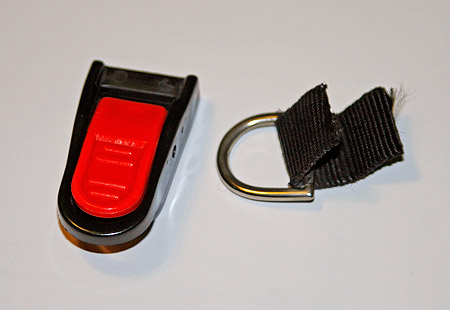
But as I looked more closely at the bike to look for damage, I noticed something: the helmet’s chinstrap clasp was still there. I unlocked and opened the helmet well, and lo, the end of the chinstrap was still locked to the bolt.

Helmet Remains
All that’s left of the helmet.

Someone had come along with a sharp blade, and sliced the helmet off at the closest possible point to the lock, close enough that barely any strap was left. That would require holding the hemet back while maneuvering in with the blade under the edge of the seat. Probably a practiced hand.

But that puzzled me even more: who would bother slicing off that helmet? Seriously, it’s no prize. About the cheapest full-face helmet I could find, oversized for Japan, and old & worn to boot, the face shield plastic scratched. Not a prize to be coveted, even if they could easily and cheaply replace the sliced chin strap. And they left the clasp, which was hanging by a thread and easy to take–an item which would cost more to replace than just some length of strap. Not to mention that slicing it so close to the lock makes little sense–it’s harder to do and doesn’t seem to help them at all.

There are only two possibilities I could think of. The first is referred to in Japan as “itazura,” a prankster or vandal. I have never understood that mentality: you don’t know this person you’re hurting, will not be around when the deed is discovered, but you will ruin something of theirs or steal it to no benefit of your own, greatly inconveniencing or angering them. Is it the thrill of doing something wrong? I know some people get jollies by imagining how mad someone will be, but seriously, I just don’t get it.

Not to mention that had an itazura wanted to be destructive, they would have been far better off slashing the seat itself, or slashing one or both of the tires. It would have been easier to boot. They didn’t–instead they carted off an old helmet, more work for them, and a much lesser expense to me.

But as I stood out there with a student and staff member who were helping me puzzle it out, another possibility occurred to me. The staff member asked if my scooter would be OK outside overnight, as I couldn’t ride it home. In Japan, it’s illegal to not wear a helmet on a motorbike, so I was kind of stuck. But then I realized that the helmet theft might have been designed to do exactly that: get the scooter to be left outside overnight. The school is not on a major street, but there’s enough traffic out there most of the day to discourage the theft of something as big as a 125-cc scooter. But if the scooter were still there at 3:00 am, then maybe a small flatbed truck loading up a scooter wouldn’t be noticed as much. How to make it stay put? Just slice off the helmet and trash it somewhere so the owner couldn’t ride off with it, and the bike would be much easier to steal later on.

So as a precaution, we made room in one of the building’s storage rooms right nearby and locked the bike up for overnight. Just in case.

Tomorrow I hope to contact the cops at the local koban, not in hopes of getting the helmet back, but instead to alert them as to what’s going on–and maybe they’ll be able to tell me what the most likely purpose of the crime was. But I don’t count on them to do anything about it–not their usual gig, to be honest. In fact, I could have driven the scooter home if I wanted–cops never stop bikes at night except in highly unusual cases; I am pretty sure I could have driven straight home had I wanted. But the night air right now is freezing cold–I’d have been seriously uncomfortable bare-headed (and fully expect to be when I drive the scooter home tomorrow using my spare helmet, which is essentially just a plastic cap).

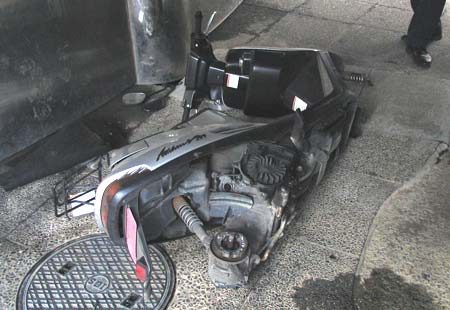
This is not the first time something like this has happened to me here in Japan. Three and a half years ago, someone stole my last scooter from the parking place on the first floor, carted it off to a shielded location in a nearby mini-park, and stripped it for parts:

A few years earlier, I had to pay for repairs when someone had apparently jammed a screwdriver into the ignition, making it impossible to start. Not an attempt to steal, apparently, but either an itazura having fun, or else a local bike repair shop looking for business. Apparently it was a common enough form of vandalism that current models now have an “itazura guard,” a metal plate you can slide to cover the ignition with by using the back of your key.

Apparently, Japan is not the safest country ever for motorbikes.

Categories: Focus on Japan 2010 Tags:

Send in the Clowns

February 2nd, 2010 Comments off

It’s inevitable: Apple releases what is to be a hit device, so smaller companies line up to sue Apple for “copying” or “stealing” from them, hoping the deep-pocketed company will settle and cough up the cash. In fact, it is so established an industry that some companies are designing their wares so they are set up to sue Apple. It only took a few days for Wu Xiaolong, the president of “Shenzhen Great Long Brother Industrial Co.” to announce that they were furious:

I was very angry and flabbergasted when I saw the news of the iPad presentation two days ago… It is certainly our design. They’ve stolen because we present our P88 to everyone six months ago at the IFA (International Electronics Fair in Berlin).

Now, if you’ve seen the iPad, you may be wondering: how can you copyright that design? I mean, it’s a rounded rectangle with a metal bezel and black border. You can’t get more simple than that. Zillions of devices have that basic look; it describes half the monitors on laptops today. Besides which, one of the major grouses people have been lobbing at the iPad is that it looks exactly like an oversized iPhone or iPod Touch–so if Apple’s design is just like the P88’s, then isn’t the P88’s a copy of Apple’s handhelds?

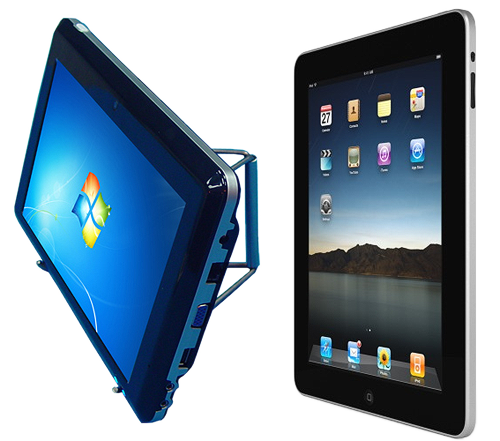
According to Wu: “[Our machine has] nothing to do with it, as they have completely different functions.” Ah, I see. And so the P88 and the iPad have identical functions? Well, not quite. The iPad has a 9.7“ capacitive multitouch screen, the P88 has a lower-resolution 10.2” resistive touch screen (no multitouch) and uses a stylus; the iPad runs the iPhone OS on flash memory in a closed ecosystem, the P88 has Windows on a HDD and is essentially a PC crammed into a tablet form; the iPad gets 10 hours of battery life, the P88 less than 2 hours; the P88 is thicker, heavier, and sits on an ugly metal bracket. But the real difference is in appearance:

P88-Ipad

P88-Ipad-2


Whoa! Spooky, huh? I mean, I can hardly tell the two apart!

What was even more funny was that when the P88 was released, it was called a “non-existent Apple Tablet Clone,” as it resembled most mock-ups and estimations of what the iPad was supposed to look like.

But it gets even better. Want to see another computer made by the Chinese company?

Nottheimac

OMG! Apple stole the iMac from them too!!

Expect this lawsuit to fizzle. As Wired so aptly put it, “Anyone confusing the two products deserves the P88.”

Where the Debt & Deficit Came From

February 1st, 2010 1 comment

This part of Obama’s response to Republican accusations bears repeating often:

Jeb, with all due respect, I’ve just got to take this last question as an example of how it’s very hard to have the kind of bipartisan work that we’re going to do, because the whole question was structured as a talking point for running a campaign.

Now, look, let’s talk about the budget once again, because I’ll go through it with you line by line. The fact of the matter is, is that when we came into office, the deficit was $1.3 trillion. — $1.3 [trillion.] So when you say that suddenly I’ve got a monthly budget that is higher than the — a monthly deficit that’s higher than the annual deficit left by the Republicans, that’s factually just not true, and you know it’s not true.

And what is true is that we came in already with a $1.3 trillion deficit before I had passed any law. What is true is we came in with $8 trillion worth of debt over the next decade — had nothing to do with anything that we had done. It had to do with the fact that in 2000 when there was a budget surplus of $200 billion, you had a Republican administration and a Republican Congress, and we had two tax cuts that weren’t paid for.

You had a prescription drug plan — the biggest entitlement plan, by the way, in several decades — that was passed without it being paid for. You had two wars that were done through supplementals. And then you had $3 trillion projected because of the lost revenue of this recession. That’s $8 trillion.

Now, we increased it by a trillion dollars because of the spending that we had to make on the stimulus. I am happy to have any independent fact-checker out there take a look at your presentation versus mine in terms of the accuracy of what I just said.

It shows up the stunning hypocrisy of the GOP: to take a budget surplus and a promise to start paying off the debt, and immediately turn that into massive deficits and $8 trillion in debt–but the moment Obama takes office, pretend that he created it all and was fully responsible for it being there. Garrison Keillor expressed the Republicans’ mendacity best:

The bums have tiptoed out the back door and circled around to the front and started yelling, “Throw the bums out!”

Let’s make it clear: this is not Obama acting like Bush and trying to blame his current failures on the previous administration. Obama owned up to what he added to the debt. But he also pointed out that you could not blame him for losses incurred before he had the chance to act, nor could you fault him for having to start working deep down in a hole created by someone else. Republicans may be desperate to do so, but Obama’s having none of it, and rightly so.

Remember, Clinton left office with a jobs report that had only 16,000 jobs lost in one month, after several months of sporadic gains and losses (the gains were greater), with only a possibility of downturn; it took Bush 16 months before he broke even with that level of job creation, and it took him two and a half years before he had regular job growth again.

Obama, on the other hand, was handed job losses which for 3 months straight had exceeded 680,000. In just one year he has almost brought us back to jobs being gained again, and by relative terms, is about 600,000 jobs per month in the black from what Bush left him. In fact, the news may be better than that: job numbers for November were revised up to show the first job gain in two years, and although December job numbers came back down to 85,000 losses, that number could also be revised upwards, if things go well.

Unemployment rates are high mostly because of the massive losses that Bush generated, and Obama had to make huge strides upward and go into positive job gains again before the number could come down–and Obama is nearly there after only one year.

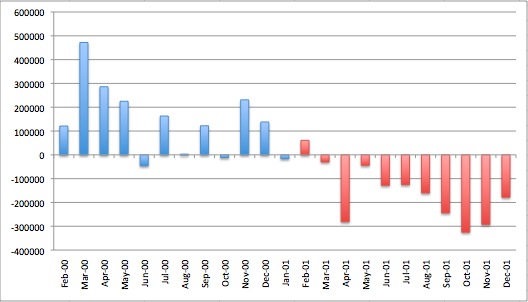
Take a look at the differences; below are two charts, showing job gains and losses for one year before the transition, to 11 months after the transition (the latest numbers we have for Obama), keeping in mind that the December ’09 job numbers are preliminary:

Jobs gained/lost: Clinton to Bush
Screen Shot 2010-02-01 At 12.33.48 Pm

Jobs gained/lost: Bush to Obama (Dec. 09 may be revised)
Screen Shot 2010-02-01 At 12.36.58 Pm

See the difference?

Add to that the surprisingly high Q4 2009 GDP numbers, even after mitigating factors are removed, and you have very strong promise for the economy right now. Hopefully, the jobs report due out in a week will show the first growth since December 2007.

Make no mistake: Obama’s economic performance so far has been astonishingly good, extraordinarily better than Bush’s at this point–despite the fact that Bush had already committed the country to far more debt at that point with his tax cuts than Obama has at the same point with his stimulus.

The idea that Obama is not doing a good job with the economy is purely an illusion created by the deep pit Bush had dug for him, an illusion that the Republicans are attempting to reinforce and amplify. And Obama was 100% correct for swatting them down.

Categories: Economics Tags:

Why the iPad Is Deceptively Good

January 31st, 2010 5 comments

A lot of people are panning the iPad, voicing a variety of complaints. It’s not revolutionary, they say; there’s nothing new here, it’s just a giant iPod Touch. It’ll be too heavy, too awkward, I don’t see how I will hold it or use it for such-and-such an application. It doesn’t replace other devices like the iPhone did, putting the features of the cell phone, iPod, and PDA all in one place. There’s no multitasking, no front-facing camera for video conferencing, there’s no USB or video out without an adaptor, no HDMI at all, and Flash doesn’t work on it. The battery can’t be replaced. The screen is a bad aspect ratio for watching widescreen video, I hate touchscreen keyboards, and an LCD monitor is bad for my eyes when I read. And the name is terrible, just look at all the feminine hygeine jokes.

So, the iPad is the biggest disappointment in history relative to its hype, right? From how these people are complaining about it, you would think so. It seems like articles based on the “iPad sucks” thesis are in vogue now. The question is, are they right? Is the iPad being trashed for good reason? Well, you can easily see from the title of this blog entry that I disagree. So let me explain why. It helps to break down the complaints into categories: lack of features, lack of novelty, and the user experience.

Lack of Features

Many people are upset that the iPad lacks many things they expected. This is often because they heard about such features in pre-release rumors, and came to think of them as part of what the iPad should be. It has a powerful enough CPU, so there should be multitasking; why won’t Apple support Flash animations; the device is a natural for video conferencing so where’s the camera; and why doesn’t it have the ports I want?

There are three answers to cover all of these questions. First, some features are software-specific, like multi-tasking. As with the iPhone, multitasking can and will be added with a software upgrade. If you get an iPad today, expect improvements to come without having to purchase a new device. Just like early iPhone adopters eventually got features like the App Store and cut-and-paste despite them not existing on the original device, your iPad will similarly receive updates, and multi-tasking is an obvious one–not to mention that it is implied in OS upgrades even now being tested.

Second, some physical features were not included in the original model, but they will be eventually. Yes, there’s no camera–but you can fully expect the feature to come with a future model. Again, just like the iPhone originally had no GPS, no video camera, and no compass, the iPad comes with a relative paucity of features. This was an obvious thing to expect; I predicted it myself in a blog post published ten days before the iPad was announced. This is simply the way many products are released. If you feel that a front-facing camera is a must-have, then simply wait for the next model to come out.

Third, some features were not included for design and esthetic reasons. We all know that Steve Jobs is a stickler for seamless designs; it’s the reason he never added a separate, physical right-click button to any Apple mouse. Few people agreed with him, and maybe this aspect of his design preferences is unnecessarily off-base. But this is part of the overall package, both the good and the bad, and what it means in the end is just that there’s no seam for a removable battery, and fewer ports along the edges. Fewer ports may also be a pricing or manufacturing concern, but whatever the case, most of these issues can be worked around, or don’t matter as much as many may think. You can add USB, SD card, and video out with adaptors. HDMI adaptors may come in the future (just as third-party HDMI adaptors came out for the MacBook Pro), but VGA should suffice in most situations if you want to use it as an output device. As for the battery, ten hours is more than almost anyone would use the device in a single day, and plugging in the device to recharge at night is not a hardship.

Some people complain about the lack of sufficient storage. I myself am peeved by Apple’s pricing tiers: $100 is way too steep for an extra 16 or 32 GB of memory. They clearly want to lure people in with the base price, but get them to end up spending the extra cash on more memory after having decided to buy one. However, there is a possible reason why the amount of internal storage won’t matter as much: networking. The iPad is not designed to be a storage device any more than the iPhone is. You don’t store your entire film and music libraries on the iPhone, you leave them on your main device and then sync the media with iTunes; same with the iPad. With the iPhone, wireless syncing was not included due to certain issues, battery life being the most significant. With the iPad, that may not be an issue. If you need a file, then from what I hear, you will be able to get it from your main computer using the WiFi network. Most stuff will be stored over the network, and so more storage on the iPad won’t be a big issue.

That leaves the lack of Flash support, and that was not an oversight: Apple intentionally left it out. They did so because they see Flash as more of a vulnerability than a benefit. Flash is slow, buggy, and opens up security holes. Personally, I detest Flash; although it can be used beneficially in controlled moderation, most Flash designers go way overboard, creating a web-surfing blight unmatched by any other, including the animated GIF and the “blink” tag. Apple is right to abandon it–and not just because it would open up the iPhone and iPad to hacking attacks, which is a good enough reason by itself. Flash is so Internet Explorer 6, it’s the Floppy Disk of software. Apple abandoned floppies years ahead of Windows PC makers, and they are similarly ahead of the curve where Flash is concerned. HTML5 is where it’s at.
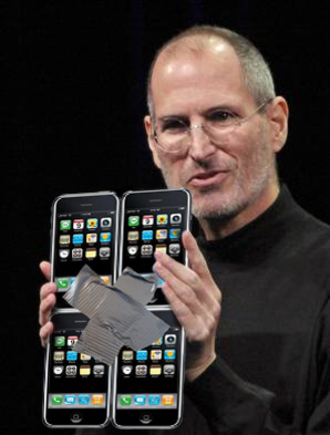
IducttapeLack of Novelty

The next category of complaint is that the iPad isn’t revolutionary. We again see the problem–once more, as I predicted before the iPad was debuted–where expectations raised by the rumor mill led to disappointment. Everyone was looking forward to something completely new, a revolutionary OS or a stunning new design. Instead, Apple came out with what was essentially just a big iPod Touch. Why did it takes years for the Apple design team to start from scratch several times over to come up with something so basic?

It helps to remember that Apple’s challenge here was not to make something completely new and unexpected; Apple’s challenge was to make a tablet computer that would be practical and fun to use. People just assumed that this would naturally involve something new and revolutionary. I was personally nervous about the rumored “steep learning curve” of the tablet: if Apple made it too revolutionary and different, then people might not be able to use it. Just look at the iPhone’s touchscreen keyboard–hardly a huge new concept, but people freaked out at the idea.

The lack of novelty in the iPad might be explained by the old saying, “That’s a feature, not a bug.” As Steve Jobs pointed out in the unveiling, there are about 75 million people who will know exactly how to use this device from the word go. Apple chose the exact opposite of a steep learning curve, and once you think about that in light of the challenge of making a tablet computer easy to use, it makes perfect sense. The iPad is not intended to wow you with its novelty, it’s intended to be comfortable and convenient. People who complain that it’s just a big iPod Touch are completely missing the whole point of this new device.

One other consideration along these lines is the iPad’s place in the spectrum of usability. Many have noted that it doesn’t replace anything, save possibly for ebook readers. The iPhone, for example, replaced the need for lugging around a cell phone, PDA, ipod, digital camera, and video recorder. That’s wonderful, but that doesn’t mean that every device has to accomplish the same goal. The iPad was not design to replace existing products, it was designed to fulfill an existing need. That need was for a mobile device which was more capable than a smartphone, but easier to tote and carry than a laptop. It may not be the widest category of need you can imagine, but a lot of people will greatly appreciate and desire exactly such a device. Students will go nuts over what this will do for textbooks, for example. People who want color, backlit ebook readers will love it. How many people have complained about laptops being too heavy, or burning their legs with the excess heat, but can’t do what they want on a tiny smartphone screen? And then there are the uses that nobody thinks they need right now, but the iPad will open up for them–a holy grail in product design.

The User Experience

That brings us to the last category of complaint: it looks like I won’t like it. It looks too heavy and awkward to hold, the size is wrong, the screen won’t be good for me, the touchscreen keyboard is no good. The problem is, people who have only seen the device and have never held one in their hands are already making judgments about what it feels like to use one. That may be why almost all of the criticisms are coming from those who have never had a hands-on with the device. Look at the reviews by those who have played with the device, however, and you’ll encounter the same advice that Jobs gave: you have to use it before you understand how right it is. Once you use it, you may find that your concerns were unwarranted or have easy solutions. It may be heavy, but so are some books; we compensate by holding such objects while resting them on our laps or whatever surface is available. The touch keyboard may seem awkward, but so did the iPhone’s, and most people seemed to have little trouble adapting to that. I myself took just a few hours to get used to it, and now type on my phone almost as fast as I do a full-sized keyboard (a miracle relative to the numeric-keypad hell that I avoided for so long). The screen may be brightly backlit, but that’s what the brightness control is for.

This is not to say that the iPad will be for everybody. Some will never get used to a virtual keyboard; others will never be comfortable holding it; many may be bothered by any level of light from a backlit LCD screen; some may hate the design and esthetics, or may never get over their high expectations from the pre-launch days. Apple has always had its haters, and always will. That doesn’t mean that the product is bad or doomed to failure.

Dispelling Criticisms Is Not Proof of Excellence

You may have noticed that I have spent the entire blog post so far explaining why the negative reviews are off base, and have not really explained why the iPad is “Deceptively Good,” as I claim in the title. So let me take a whack at it. The answer lies in two aspects: the user interface, and the product’s future potential. Both are inextricably linked, and both are right now vastly under-appreciated.

The UI
OlduisWhen the first “personal computer” came out, it was fully a geek’s plaything. The Altair computer had no monitor, no keyboard–just a few rows of switches and blinking lights to allow for communication in binary code. Very few people could actually use one for anything. A few years later, the “trinity” of PCs–the Apple II, the Commodore Pet, and the Tandy TRS-80–introduced a “CLI,” or a text-based interface. You either remember or have somewhere seen the old “green-screen” text displays. This allowed people who were not comfortable in binary to use the machines, although you did usually have to learn the language that the computer understood, which still kept most people too distant from the PC experience.

It only took seven years after that for the first commercially popular PC to use the GUI–the graphics user interface with visual metaphors like the Desktop, folders, icons, and menus–that we have become so accustomed to. The GUI was a godsend because it made the computer interface more recognizable, something we could relate to more easily. We understood that a desktop is a place where you begin your work, that you choose from menus, and that folders contain documents. Suddenly, almost everybody could use a computer, and PC sales took off. But we’ve had the GUI for a quarter of a century now, and it’s beginning to show it’s age. What’s next?

The answer is multitouch. Using a mouse may be a step up from a text-only interface, but it is still uncomfortable and clunky. Surely you have seen people trying to move something on the screen farther than their mousepad gives them room for, and clumsily attempt to pick up the mouse and reposition it–in fact, you may well have been that person, several times. The flaw with the mouse, and the trackpad as well, is that you are not directly controlling the content on the screen. It is one step removed from a “hands on” experience.

To get a good sense of how significant that is, try drawing a picture. Do it on paper first–I draw a pretty good Snoopy, for example. Then open a drawing app on your computer, and with the mouse, try drawing the same picture. You’ll most likely find the results appalling. A trackpad may not fare much better, unless you’re experienced at it. Whenever your hands and fingers are removed from the immediate action, you lose dexterity and control. Current cursor devices like the mouse and trackpad are remote devices; multitouch allows direct access, which is far more natural, comfortable, and accurate. However, you won’t realize this until you’ve actually used a device like the iPad where multitouch comes into far more appropriate use than it does with the smartphone.

The problem with multitouch is how the screen is placed when you’re doing your hands-on controlling. A desktop screen is much too distant, and even a laptop screen would require holding your hands out in an unnatural fashion. A smartphone screen is more suited for that, but it’s too small to do much with. The tablet PC is, if you’ll forgive the cliche, just right. Anything you control with your hands has to be in your hands. Yes, there are disadvantages, but the payoff in control will far outstrip any of those.

A good example is Apple’s multitouch trackpad on the MacBook Pro. When it came out, I thought it was cool, but not really revolutionary. I figured that I’d be able to do a few new things on it, but did not expect it to change they way I use computers. However, I only recently realized that I had completely stopped using a mouse–something I had depended upon for years with previous laptop models. The multitouch screen is the next step up from that; after getting used to it, you’ll laugh at how clunky a mouse is. But the catch is, you won’t realize it until after you’ve used it for a while. The true utility of the touchscreen sneaks up on you.

One Word: Potential

That brings us to the real promise of the product. A lot of people look at the iPad’s current state, and what we already know about using iPhone apps, and see that as the end result. That’s a big mistake. What you have seen is only the beginning. Most of what the iPad will wow you with hasn’t come out yet.

To get a better sense, watch the keynote, and pay special attention to the software demos. Pay attention to how Jobs used the photo viewing app. Watch what Phil Schiller does with programs like Numbers and Keynote, how the multitouch comes into play. Watch the Nova game demo, and note the grenade-throwing and door-opening gestures. Be sure to watch the users’ hands, not just the screen. These are just a few examples of what can be done, but there is far, far more. It is limited only by what software developers can come up with, and you’ve seen the amazing stuff people have come up with on the iPhone App Store. The closed ecosystem provides a sheltered environment which not only helps prevent malware incursions, but slows piracy so that apps can be sold more cheaply. But most significantly, it allows the individual, the small-time software tinkerer, to immediately offer their wares for sale in one of the biggest marketplaces in the world. And now the iPad blows that wide open by combining the novel and powerful multitouch interface with enough real estate to make almost anything possible.

I can appreciate the benefit to apps whose layouts have traditionally been hard to control, like Filemaker Pro for instance; creating, resizing, and placing fields and buttons has always been a bit of a pain. I can easily imagine multitouch being used to make that not only easier, but a lot of fun to boot.

Conclusion

The features most people have focused on so far–the music playing, movie viewing, browsing and email, and even the ebook reading–are all just background. They are little more than examples of what can be done with the machine. Once you take in the full potential of the device, you will come to understand that the concerns people are airing today miss the point entirely. Panning the iPad because the screen size doesn’t fit the aspect ratio of certain movies is like saying that your Porsche is abysmal because the gas cap is the wrong shade of grey. The iPad is way, way more than just one application. Watching movies on it is a perk, not a raison d’etre. Same goes for many of the other concerns.

Apple’s mission was very simple: make a platform, and they will come. The idea was not to introduce something with whiz-bang flashing lights that would knock people’s socks off, it was instead to do what computer makers have been trying for nearly a decade and failing at: creating a tablet computer which has enough going for it that it can succeed as a product category. Apple has, by all appearances, succeeded in doing that. By building on the achievements of the iPhone platform and the introducing full-scale multitouch UI in a low-cost product where that feature can flourish, Apple has created something which is truly groundbreaking.

Remember, ground-breaking innovations are not always appreciated or understood when they come out. A lot of people sneered at the original Mac, many thought the iPhone would fizz out after the buzz dissipated–heck, even the PC itself was dismissed as an expensive toy at first back in the late 70’s. So don’t count the iPad as DOA before it even arrives. It’s far more than it seems.

Hey

So, by now, you have probably thought, “If you’re criticizing others for coming to conclusions about the iPad sucking before they get their hands on it, how can you claim that the reverse is true if you’ve never held one yourself?” Well, you got me. Part of it is an educated assessment–I’ve been looking at this kind of technology for a while. But that’s not enough.

Call it an article of faith.

Obama and the Republicans

January 30th, 2010 6 comments

Obama went to the Republicans’ home turf and fielded unscreened questions from House Republicans at their retreat in Baltimore. Below is the full White House video (video and transcripts part one & part two) of his opening remarks and of his one hour and seven minutes of answering questions lobbed at him by his political opponents.

Now, one thing I would like to observe: when did Bush do this? Right-wingers make claims that Obama and Democrats are “afraid” of “journalists,” meaning they won’t allow Fox News to stage a right-wing political ambush under the pretense of a debate hosted by a “news outlet.”

The thing is, Obama has put himself not just up in front of the media, he has put himself directly in front of very aggressively challenging right-wing forums. Obama went on O’Reilly’s show on Fox; did Bush ever go on Olbermann? Hell, no. Now, maybe I missed something, but I sure as hell don’t recall Bush ever opening himself up to answering more than an hour’s worth of unscreened questions from Democratic lawmakers on live TV. No, I think I would have remembered that.

So, right off the bat, you have to give Obama huge props for going where no Republican leader would ever have the guts to go, namely into the lion’s den of opposition. On this, Obama is the courageous, bipartisan leader, and Republicans are the weak-kneed sissies afraid to be held accountable by the opposition. There can be no argument on that.

Next, watching the opening remarks and much of the questioning, you have to give Obama big marks for bipartisan outreach. He made several excellent points about how he has compromised and worked across the aisle, gave Republicans their due on many things, and publicly committed to working with the other side. Compare that to most of the questions, and you’ll see that while the Republicans in the room had some conciliatory remarks, they most definitely were way more partisan in their remarks than Obama was. Clearly, they felt that Obama had stumbled into their crosshairs and they were going to make a shooting gallery of it. But under the most challenging of questions, Obama more than held his own. He did not allow his record to be misrepresented, and did a good job of beating down the untrue accusations lobbed at him.

And there were quite a few incredibly biased and unfair “questions” (often couched in partisan speechmaking–just listen to the first “question”). I nearly gagged when one guy actually had the balls to say “We have not been obstructionist.” I had to remember that a few moments before, he had said that he represented freshmen in the House. I don’t know what their record is, but maybe among that small group, there has not been the same level of obstructionism as has been iron-clad amongst Republicans as a whole, and especially Senate Republicans. What this guy said may have been true in its very limited sense, but coming from a Republican lawmaker, and clearly intended to represent Republicans in general (note how he did not say “House freshmen have not been obstructionist,” but instead removed the classification to a preceding sentence therefore giving a false impression in the claim), it is one of the more outrageous claims ever spoken. And sure, freshmen House Republicans may not be as obstructionist as their party as a whole, but that’s because they can afford to be: there’s no filibuster in the House, and the Democrats have a clear majority, so 100% opposition is not necessary, and they can afford to cross lines more often. But if Democrats held a razor-thin majority, you can bet your ass that these guys would be exactly as obstructionist as their Senate brethren are.

Obama scored huge points in pointing out how Republicans have demonized Obama:

Now, you may not agree with Bob Dole and Howard Baker, and, certainly you don’t agree with Tom Daschle on much, but that’s not a radical bunch. But if you were to listen to the debate and, frankly, how some of you went after this bill, you’d think that this thing was some Bolshevik plot. No, I mean, that’s how you guys — (applause) — that’s how you guys presented it.

And so I’m thinking to myself, well, how is it that a plan that is pretty centrist — no, look, I mean, I’m just saying, I know you guys disagree, but if you look at the facts of this bill, most independent observers would say this is actually what many Republicans — is similar to what many Republicans proposed to Bill Clinton when he was doing his debate on health care.

So all I’m saying is, we’ve got to close the gap a little bit between the rhetoric and the reality. I’m not suggesting that we’re going to agree on everything, whether it’s on health care or energy or what have you, but if the way these issues are being presented by the Republicans is that this is some wild-eyed plot to impose huge government in every aspect of our lives, what happens is you guys then don’t have a lot of room to negotiate with me.

I mean, the fact of the matter is, is that many of you, if you voted with the administration on something, are politically vulnerable in your own base, in your own party. You’ve given yourselves very little room to work in a bipartisan fashion because what you’ve been telling your constituents is, this guy is doing all kinds of crazy stuff that’s going to destroy America.

And I would just say that we have to think about tone. It’s not just on your side, by the way — it’s on our side, as well. This is part of what’s happened in our politics, where we demonize the other side so much that when it comes to actually getting things done, it becomes tough to do.

Truer words have not been spoken. Watch the whole video, and I think you’ll be impressed with how Obama does. I have to say, he is very motivational; listening to him speak, especially seeing him stand up to and hold his own and then some against a crowd so pitted against him almost gives me hope again. But then I remember that it’s not House Republicans who are the problem, it’s Senate Republicans, and for all the tiny morsels of outreach the crowd claimed they were offering, none of that means squat if Senate Republicans don’t end their record-breaking filibuster marathon and stop their monolithic obstructionist campaign.

UPDATE: Amusing point: Obama was doing so good a job at defeating Republican attempts to make him look bad, and doing it so adroitly and effectively, that Fox News, which was airing the event no doubt in hopes that Obama would get his ass handed to him, cut away from the event 20 minutes early. To those who would claim that they planned to or had to go to another event, I ask this: if Obama were getting embarrassed instead of the other way around, do you think they would have cut away? Not to mention that they cut away to “analysis” of the event, and spent a lot of time bitching about how Obama was “lecturing” Republicans. Um, yeah.

Japan and eBooks

January 30th, 2010 Comments off

This reporter makes an interesting observation I hadn’t thought of before: Japanese people don’t do ebooks. You just don’t see them here. And the idea is that it’s not because they just haven’t arrived, but rather that Japanese people are not really that interested in them. From what I can gather, Japanese do read quite a lot (though not as much as 30 years ago), but most ebook reading is done on a cell phone. What drives most ebook reader sales in Japan is obvious–I knew even before I looked it up that manga would be what drives the ebook reader market. They come out often, and come in thick tomes that resemble gaudy, small-format telephone books. The bulk, graphic format, and large number of constant releases would make manga a natural ebook target.

So people do read ebooks here. And from what I found from a quick search, the market is taking off–it just hasn’t developed nearly as much here as it has in America. So the question is, will the iPad change that. The answer might be similar to what we saw with the iPod, then the iPod Touch, and then the iPhone: an initial lukewarm reaction, everybody says that Japanese people aren’t interested… and then a few years later, you start seeing them everywhere.

Categories: Focus on Japan 2010, iPad Tags:

iPad vs. Kindle

January 29th, 2010 3 comments

Unless you have some very specific needs, I can’t really see how the Kindle could outclass the iPad as an e-book reader, especially if you compare like sizes–the iPad vs. the 9.7“ Kindle.

Now, that’s all subjective, and depends on what you prefer and what you can stand. Some people will prefer the Kindle no matter what because the e-ink screen is less a strain on their eyes. Others will very much prefer a backlit display (my father sent his Kindle back because he couldn’t read in bed with the lights off).

I decided to make an impromptu chart to compare the two. Advantages are colored in orange. Note that I did not give either machine an advantage for the screen type (depending on visual preferences), WiFi vs. 3G (Amazon’s 3G connectivity is free), keyboard type (some people will always prefer a physical keyboard), or even the USB / VGA comparison (despite the video out, the iPad requires adaptors which many dislike).

The Kindle DX has an advantage with slightly higher resolution and pixels per inch (ppi) screen density, a slightly lighter body, and far superior battery life. If e-ink and long battery life are critical for you, then the Kindle wins hands-down–with all cylinders firing, it gets more than 4 days of continuous use; with the 3G used only sporadically and when used even at heavy reading rates, the Kindle can last weeks on a single charge. Some also claim that weight is an issue when you’re holding that device up for hours on end, and a 5-ounce difference is a difference some will balk at.

The iPad, meanwhile, is not limited to being an ebook reader, but if only used for that, it could still hold its own. For the same price as the Kindle DX, you get full color, a backlit screen, and four times the storage in a smaller form factor. But in addition, you get… well… a computer. You get to run apps, read email, play games, and most anything else a computer can do. You can run an office suite, watch movies and TV shows, all that and more–virtually no limits within the allowances of the hardware.

iPad vs. Kindle
  iPad Kindle
Overall Size 9.56" x 7.47" x 0.5" 10.4" x 7.2" x 0.38"
Screen size (diag) 9.7" 9.7"
Screen Type backlit LCD ISP touch e-ink, no backlight
Colors millions (?) 16 grays
Resolution 1024 x 768 (132 ppi) 1200 x 824 (150 ppi)
Weight 24 oz. 18.9 oz.
CPU 1 GHz custom 532 MHz Freescale
Storage 16 GB 4 GB
Battery life 10 hours "1 week" (4 days)
Wireless Wi-Fi (n), Bluetooth 3G (free)
Main connectors iPod USB
USB / VGA yes / yes (adaptor) yes / no
Book Store yes (? vols.) yes (400,000 vols.)
App Store yes no
Browser Safari "rudimentary"
Email Mail no
Games yes no
Plays music yes yes
Plays Movies/TV yes no
Keyboard touchscreen physical
Price $499 $489

So the question becomes, what are you looking for? Just an ebook reader geared toward general ebook reading preferences? Or an all-in-one device with loads of potential? Comparing the two is a bit jarring because they are different beasts, but like comparing the iPhone and the Zune, they both cover the same territory, and then one goes a lot further, for about the same price. And we all know how stunning a success the Zune has been.

Categories: iPad Tags: