Archive

Archive for the ‘Mac News’ Category

Bad Reporting re: Mac “Virus” Scare

February 27th, 2006 Comments off

Reading Google News, I’ve been watching a steady stream of “news” reports go by that make me doubt how seriously I should take most of the computer reporting out there. There are just so many stories out there which are completely misinformed, I have to wonder how many of these people went to journalism school. Let me give a few examples:

Apple’s OS X Suddenly Not So Secure After All (FOX)
Security scares mount for Apple Macintosh users (USA Today)
First ever virus for Mac OS X (Ferret.com)
Apple Mac Virus Is Real Threat – The Apple Mac malware threat is real, according to anti-virus experts (GameSHOUT)
Second Mac virus in the wild (SC Magazine)
McAfee Provides Protection Against Mac Os X Exploits and Viruses (Hardware Zone)
First Mac virus found in wild (Globe and Mail)
Has the “Mac virus” struck your computer? (Austin American-Statesman)

Read most of these and you’ll find out about “viruses” hitting the Mac as told by “experts.” Well, not exactly. First of all, there are no viruses. A trojan, a worm, and a vulnerability. The “experts” and “researchers”? People who work for anti-virus software and security companies, who have a vested business interest in making people think they have viruses so they can sell their product.

But the trojan, worm and vulnerability are real, right? Depends on what you mean. The trojan and worm are “proof of concept,” and don’t do any damage (though Symantec, another anti-virus vendor, is claiming the trojan does damage files and the OS, completely unsupported from what I have ascertained). Furthermore, the trojan requires the user to enter a system admin password in order for the trojan to work, unlikely since the user will have just tried to open an image file. And the fake image file has to be downloaded (not viewed on a browser) or sent as file transfer by iChat, which not too many people ever do. The worm, meanwhile, requires not only two Macs using Bluetooth to be in the same room, it also requires both Macs to have an OS almost a year out of date, when most Macs update automatically. And it requires you to actively accept a file transfer over Bluetooth, which can be immediately confirmed as fake by asking the other Mac user in the room if they’re really trying to send you something. Oh yeah, and it self-destructs tomorrow, leaving no damage. And the vulnerability? Just that–it’s an opening, not an actual exploit. It means that no one is actually trying to damage your computer, it’s simply possible that such a thing could happen.

Which is really what all three of these represent: potential malware, not actual malware. Two harmless proof-of-concepts and one vulnerability. With the proof-of-concepts being almost ridiculously hard to acquire. Frankly, I doubt I could acquire either of them even if I went out on the Internet and aggressively tried to. And what’s more, you don’t need anti-virus software to guard against them–though the news stories, which could easily be just copies of press releases by anti-virus vendors, don’t tell you that. The vulnerability? Go to Safari’s preferences and turn off the “Open ‘safe’ files after downloading” option. The worm? Update your software through the Software Update control panel (it’s free, and probably it’s already been done–if there’s nothing in Software Update to install, you’re OK). The trojan? Don’t enter your admin password unless you are knowingly installing software or changing system preferences. To be completely safe, know that the filename suffix “.tgz” (signifying compressed files) is one you should avoid opening unless you know what you are doing.

Strange that all these stories trying to scare you don’t mention these simple protections against the malware, which doesn’t do any harm anyway. So, should you buy anti-virus software? Not yet, certainly. In fact, the Solution published by Sophos, an anti-virus security firm, actually didn’t work, mistakenly identifying the Bluetooth worm where none existed, sending users into a false panic and wasting their time. In the future, when Mac malware actually poses a threat, you’ll need security. But not yet. The problem is, when all these news outlets are reporting misinformed stories generated by businesses out to make a buck, how will you know when it’s really unsafe out there? I guess you’ll just have to research hard and read as many stories as you can–there are some out there that tell the real story, though not many.

Or you come come to this site–when I think I need anti-virus protection, I’ll certainly blog on it.
Categories: Mac News Tags:

Oompa, Inqtana–Any Real Threat?

February 18th, 2006 2 comments

Well, it certainly seems like someone has been quite the busy beaver recently. Not even a day after the big alarm about the “Oompa” (alternately called “Leap-A”) trojan, and already a second piece of Mac malware has surfaced. This one is apparently a worm designed to use Bluetooth to spread itself, but like Oompa, is harmless, and even has a February self-destruct date. Both Oompa and the new malware, titled Inqtana-A, are “proof of concept” malware, meaning that they are just there to see if they can work, and are not intended to do any real damage.

In fact, the Inqtana worm exploits a vulnerability that was patched by Apple eight months ago, so it will only affect you if you don’t have your Software Update turned on, and are still using OS X v. 10.3. Otherwise, Inqtana can’t touch you even if it were loose “in the wild”–which it is not.

So here’s the question: do these two pieces of malware mean that the Mac is no longer “malware-free”? That’s kind of hard to say. The Mac has had a few “first” malwares, including the rootkit hack called “Opener” about a year ago. So technically, there is malware out there for the Mac. On the other hand, none of it is anything that you are remotely likely to get. Both the Opener and the recent Oompa trojan trigger the administrative password protection, making it unlikely that they would ever get spread; Inqtana also prompts the user for acceptance, making it much less likely to spread. The “Opener” hack was never seen in the wild, and the Oompa trojan probably didn’t get past the first or maybe second generation of iteration, due to Apple’s security measures. The new Inqtana would only affect non-updated Macs, and most Mac users update–and even then, it doesn’t spread very well and will self-destruct soon.

All three of these are proof-of-concept and not intended to actually cause harm. All they do is make clear that malware can infect a Mac–which is something we’ve all known from the start. None will be infecting your computer. So from that perspective, the Mac can still be said to be malware-free (with zero viruses, even in proof-of-concept form).

But the release of Oompa and Inqtana within just a few days of each other does show that something is going on. Possibly it is one hacker churning this out. Or possibly the Inqtana hacker released their malware-in-progress when they saw reports of Oompa. Possibly Inqtana was out there and was only noticed after the Oompa publicity. Or maybe it’s simply a coincidence, with one or perhaps both pieces of malware being out there for some time and just being discovered at about the same time.

Conclusion: you don’t need anti-virus software for your Mac–yet. But you should keep an eye on Mac security news (maybe add “Mac virus” to your configurable Google News page), because eventually there will be Mac malware, it’s just a question of when.

Does this mean that the Mac is no longer more secure than Windows? Well, consider that Windows malware numbers around 60,000, and that the Mac’s security is still intrinsically better than Windows. Even if a hundred actual and harmful Mac viruses were to be released tomorrow, the Mac would still be safer than Windows.

Categories: Mac News Tags:

First Mac OS X “Virus”? Not Quite…

February 17th, 2006 2 comments

A lot of noise is being generated by web news sites clamoring about the “first virus” discovered that attacks OS X. A closer look at the stories, however, reveals that the alarm is coming from a company that wants to sell Mac-based anti-virus software or services–something we’ve seen before, unreliable because they have a vested interest in scaring people into buying what they are selling.

An even closer look shows that this “virus” or “worm” is nothing but a very ineffective trojan horse. It is not a virus. First of all, it is not self-propagating, despite claims in the media; it requires active, two-step user intervention–no, user authentication–to set it off. Second, the user authentication must be highly ignorant: the file is supposed to be an image, but when you double-click on it, it asks for your administrative password, which any Mac user of more than one week would instantly recognize as system-level event. Such a ruse is immediately obvious–a photo never requires a password, certainly not your password, a password that then opens up access to your operating system. If you’ve used a Mac and installed anything at all, you recognize the password as necessary to install software or gain access to the inner workings of your computer, something a photo should not be doing. The security company ringing the alarms calls “ridiculous” the point that user authentication is required: “Many PC viruses needed user interaction to set off infection, he pointed out, and this was no different.” Baloney. This one requires an administrative password, not just a double-click on a file. Not even close to being the same thing.

So, yes, if a person is stupid enough to then enter their password, then–shock!–their system is compromised. But this is less a case of malware than it is of extreme user gullibility. I mean, I could direct any computer user to delete their system files or initialize their hard disk, and if they’re naive enough, they would do it. Does that constitute a “virus” or any weakness of the OS? Hell no. It means the user is not too bright. And to propagate, it would require a string of dumb users to contribute their security passwords to pass it on each and every time. Not too bloody likely. Such a trojan horse could never propagate very far at all.

Compare this to Windows, where double-clicking on a virus file immediately infects the machine, without asking for verification. That’s one big difference between the two systems; one gives you due warning and requires your willing assistance, whereas the other one allows you to be easily taken in unless you are very careful or knowledgeable. Anyone might try to open an image file, and on Windows, that’d be enough to infect the computer. How many would open an image file and then actively type in a password that allows access to their operating system?

An analogy to better understand might be an intruder at your door. You hear someone at the door, and have no peephole; you simply open the door and the intruder barges in and ransacks your house. That’s Windows. On the Mac, you hear someone at the door, and there is a peephole; you see that it’s someone dressed in a ski mask, poised to break in. If you then decide to open the door, it’s your own damned fault.

Apple could “plug” this “hole” simply by adding text to the password dialog box: “You have opened an application which could access your system resources and cause damage. If you did not double-click an application, or do not fully trust the source of this software, then do not enter your password.” Problem solved.

A final point: I can’t find any story on the issue which even describes any damage done by the file–many even reported that the trojan even failed to execute properly. Meh. Some threat. As I’ve always held, the Mac is not invulnerable–but it does have good security, which, if anything, this whole episode proves.

Categories: Mac News Tags:

Core Duo iMac Review

January 18th, 2006 Comments off

Ars Technica, a great tech site, has an excellent and comprehensive review of the new 17″ Core Duo iMac. The bottom line: it’s fast if you’re using “universal” apps (ones designed to work on both PPC and Intel chips), and acceptable if you’re using PPC-only apps (which is still most 3rd-party apps). At $1300, it’s an excellent value, according to the reviewer. Check it out.

Since I recently bought my Powerbook (less than a year ago), I have no great motivation to buy a new Mac any time soon. However, once I find that someone has a real and workable solution to dual-loading Mac OS X and Windows XP on an iMac, I will be sorely tempted–and may give in–to buying an iMac to replace my aging Celeron Windows box.

Categories: Mac News Tags:

But Do They Do Windows?

January 11th, 2006 4 comments

Okay, Steve Jobs introduced two new Intel Duo Macs today–an iMac and “MacBook,” both sporting dual-core CPUs, iSight built-in, and the usual round of goodies. But conspicuously absent from the keynote–and, to my surprise, also from the post-keynote web coverage–was the question of whether the new Macs can run Windows, and if one will have the ability to launch both side-by-side, switching easily between the two, without overtaxing the CPU. Although Microsoft’s representative appeared on-stage during the keynote and promised that MS Office for Mac would be supported for another five years (I could have sworn they’d stopped development with the last version, but apparently I’m wrong), neither she nor Jobs uttered a word about how cool it would be to run both systems on a Mac computer.

In fact, I had to do a search before I found anything on the subject, and found an AP story on Forbes reported that Apple has reiterated its claim that it will not “thwart” users who want to install Windows on the Mac. However, it’s pretty clear that Apple is not facilitating that option–yet.

Which means that if dual-boots and switching are possible, it’ll be a third-party hack, for now, at least. Intel’s Virtualization Technology promises something more advanced, and you’ve got to figure that Apple is going to jump on the bandwagon once people start doing it more.

One possible reason that Apple is holding back is the foreseen developer’s conflict, where software makers may drop Mac versions of software if they feel that Mac users will all be running Windows in tandem anyway. Perhaps Apple is not quite ready with it’s Dharma project (if true), and wants to introduce and popularize the development toolset before actively encouraging the dual-boot idea.

Categories: Mac News Tags:

Goodbye, Powerbook

January 11th, 2006 Comments off

Not mine. The whole line.

So the keynote is over, and we have quite a few new toys to play with. I’m not going to go over the software, because frankly, from the sound of it (reading the feed from MacRumors), all the software updates sound marginal. It’s the hardware that’s going to make the difference. New Intel iMacs and… MacBooks, the (slightly questionable) new name for the high-end portables (no more PowerBooks). Dual-core iMac and MacBook. Very fast-sounding, cool-sounding machines.

Just one thing. There was no mention whatsoever of dual-booting OS’s.

What’s up with that?

It’s late, and I gotta get to sleep. I guess I’ll find out in the morning, if anyone knows by then….

Categories: Mac News Tags:

Back to School

January 9th, 2006 1 comment

So tomorrow is the first day I have going back to work after the Winter vacation. I caught a break in timing, in that the semester started on a Friday, and I don’t have classes on that day. This week, Monday is a holiday. Tuesday, tomorrow, will be my first day back. And a good semester it should be. I have three classes, but they are back-to-back on two days of the week, which means slightly longer but many fewer days. I’ve got the web site up to speed, and it all looks well-prepared and ready to go. I just have to figure out how to deal with it all with a broken foot.

One particular point of interest will be the MacWorld Expo in San Francisco, with Jobs’ keynote coming at (I believe) 2 a.m. on Wednesday morning, Japan time. (Rumor roundups here and here.) If, as is predicted, the new Intel Macs come out, this should change the computing landscape some, and that’ll mean changes possibly for my students as well. It’s always good when something big is happening in the field you’re teaching, it gives you a chance to go over all the aspects with your class.

In the past, I have set aside half of one class session each semester to demo the Mac OS, in part to give students another point of view to better understand what an OS is, and in part to show them how cool the system is. Perhaps more than that, they see how I use it myself every day–my monitor is almost always mirrored on the class monitor, and they can see how I navigate through things. And every semester, a good number of students come back very interested in the Mac, despite having seen little else but Windows machines all their lives. I know that if I could tell them they could get Mac and Windows all in one package, a lot more of them would make the switch.

So it should be a fun semester. Heck, if I’m lucky, I’ll be able to convince my school of the wisdom of shelling out a few bucks for a Mac Mini, should it become available with Intel and Windows. Our IT people wouldn’t know what to do with a Mac, but hey–I can do maintenance that side of things a lot easier than they can. It’ll take me a lot less time, and be cheaper for the school to boot!

Flash! MRAM?

January 5th, 2006 2 comments

Here’s a bit of Mac news, some more speculation on what will be released at MWSF in a few days. They’re saying that new Mac laptops may use flash memory associated with the CPU so that startup and general performance is increased.

Huh? Let’s go over that. First, you have to understand what “volatile” means in computerese. See, a computer’s CPU and RAM (like its ‘brain’ and ‘memory’) can only hold data while they are turned on. Switch off the power, and they go blank. That’s “volatile.” Imagine it’s like you lose all your memory whenever you go to sleep, and have to re-learn everything when you wake up. That’s why a computer takes so long to start up: it’s loading all the data from the relatively slow hard drive (which is non-volatile) back into the relatively fast RAM and the CPU–a lot of information taking a long path to its destination. The main point is that when you boot up, the computer has to ‘re-learn’ how to work.

Using flash memory speeds that up. Flash memory is both chip-based and non-volatile. Shut down the computer, and the flash chip still retains all the data. Turn the computer on, and the data (stored in a “cache,” located on or near the CPU) is instantly available. Your computer should be able to start faster and perform better.

This would simply be the first step in a line to even faster computers, however. Many researchers are working to perfect something called “MRAM,” a magnetic-based chip technology which would make CPUs and RAM (not just the caches) non-volatile. In other words, if you turned off your computer, it would never forget anything. Turn on the power, and the computer turns on instantly, like a light switch.

You would probably still need to re-boot the operating systems from time to time as they get unstable when used continuously over time. Still, it would be a great feature–like changing from a crank-start automobile to a push-button Prius.

But until MRAM becomes a common reality, flash caches will do quite nicely, I’m sure. It does make me wonder, however, at how many innovations will really come out of Apple at the MWSF, so many have been reported. Probably, as usual, fewer than half will be true. But the closer we come to the keynote, more accurate information will start leaking out.

The Dharma Project

December 29th, 2005 1 comment

When I last blogged on the Mac going Intel, someone made a comment that made me stop and think: essentially, that if one could run Windows apps on a Mac, that there would be no reason to make a native Mac port. Just write for Windows, and you’d get everybody; the Mac people could just switch to Windows to run your app.

There wasn’t much I could say to that, really. I could argue that the Mac OS is more stylish, intuitive, etc., and while that might be a draw for users to go to the Mac, to a software company looking at the bottom line, these would probably not be nearly important enough to spend time and money for a Mac build. A better argument would be that the Mac OS is usually 2-3 years ahead of Windows in adding features, so developers that want to be more at the cutting edge would have an incentive to port to the Mac–not to mention security and other advantages. Whatever way, it seems inevitable that the Mac will allow a simultaneous Windows boot–but I couldn’t imagine that Steve Jobs would overlook a hole as big as the one my commenter mentioned (one that is now being discussed at length in many Mac forums).

This is where Dharma comes in, formerly called “Yellow Box.” It’s a development environment which allows programmers to develop Windows and Mac OS X versions of software with much greater ease. It’s just a rumor at present, but it would make sense. It would be an equally if not more appealing alternative to simply making everything Windows-only. It would be more universal (not everyone with a Mac would also run Windows), and would be less expensive than a full second version of the software for another OS. Other enticements would be a better programming environment; I will not pretend to understand, but I’m reading many programmers saying that they’d love to program using Apple’s Cocoa environment. If true, and if using Yellow Box for that purpose would allow programmers to produce a Mac port with much greater ease, you’d probably see far more Mac-compatible software than you do now, and more reason for users to make the switch.

As evidence that it’s more than just a rumor, this image has started showing up–one of Apple’s Safari browser running on Windows. Unless it’s a well-made hoax, this matches up with reports that Yellow Box could allow for good multi-OS ports being produced with relative ease.

It is still far from the time we can know if such a strategy would be effective, or if it is even true. Maybe Jobs has something else in mind entirely–but one thing for sure, he’s got to be aware of this eventual possibility, and must have a strategy for dealing with it.

Categories: Mac News Tags:

iPredict

December 22nd, 2005 3 comments

So the current consensus is that it is all but certain that Jobs will introduce the new MacTels at the MacWorld Expo in San Francisco two weeks from now. Probably it will be a Mac Mini and/or an iBook with a Yonah processor.

Not as much ballyhoo is being made of this as I would expect, and I don’t understand why not. This could be a huge move by Apple, and possibly could deal a serious blow to Microsoft, even though it may seem like Apple is sidling up to the software giant.

Here’s why: in the past, switching meant a big investment: new machines, new OS–but mostly, new software, which could cost thousands of dollars.

With MacTel, you can switch with simply your next natural purchase of a new CPU box, which you would do anyways.

All of this depends, of course, on Apple providing a smooth and slick way to easily switch between operating systems. That when you start up your new MacTel, both Mac OS and your choice of Windows or Linux would start up simultaneously, and you could just jump between them at a button’s touch–probably with a Command-key that you could customize.

The key to this could be a new Intel announcement about something the call the “Intel Virtualization Technology“:

Virtualization enhanced by Intel Virtualization Technology will allow a platform to run multiple operating systems and applications in independent partitions. With virtualization, one computer system can function as multiple “virtual” systems.

Since Windows will run natively on Intel chips, it is probable that by a keystroke, possibly using the Mac OS’s fast user switching capability, you could go from iMovie on OS X to MS Access on Windows XP in a flash, or if you wish, by a nice 3-D transition. Apple would probably be smart to bundle Windows with any new Mac purchase, seeing as how many Windows install discs are keyed to one piece of hardware and won’t work on other Windows-ready machines.

The benefits should be obvious. Malware attacks Windows, not the Mac, and spread via Internet activity, especially email. So a user could do all their web and email work on OS X (as I do now). Similarly, the iLife suite is far better than the scattered 3rd-party software for Windows that achieves the same end, so that would also be Mac-based. On the other hand, business-based apps as well as gaming would occupy the Windows side of the partition. But with easy switching, that would be a very fine distinction, and the two would flow almost seamlessly.

Almost. The control-versus-command hotkey dichotomy would confuse a good many people until something could be worked out. Perhaps the keyboard could be mapped so that the Windows control key could be the same as the Mac command key; the Mac’s control key could then be a secondary one. Any way you look at it, some keys would change place, but at least you wouldn’t have to re-learn the keyboard every time you switched between OS’s.

But that’s just the beginning, and where the real battle begins. After a few years, if enough people are using hybrid Mac-Windows machines, the question for developers would become whether Mac or Windows was the best place to plant their products–at least enough to create a Mac port of the app. This has been a big strike against Apple, maybe the biggest, that software makers haven’t seen enough of a market in the Mac to cater to that community. Yes, Explorer and Office will not be made for the Mac anymore, but Apple is very close to finishing their own office suite, and Explorer has always been a terrible browser in any case. Other reasons may also push 3rd party companies to the Mac, including security and the difference in environments.

It will also be a question of whether users will prefer Windows or Mac OS. Today, many prefer Windows, but do so as they claim that the Mac OS is “harder to use.” I don’t know how many times I’ve heard that, and wondered in amazement. The Mac OS is clearly easier to use (fewer steps, more consistency and intuitiveness, better visual interface). The perceived “difficulty” is due to the fact that these people are simply used to using Windows, and the Mac OS runs differently. That will likely change as more people get around to using the Mac–especially after they try doing a simple find-file with the two systems.

It won’t happen suddenly, but I would expect the Mac’s market share to increase a great deal within the next two to three years. At the very least, this new shift will change the whole OS paradigm.

Categories: Mac News Tags:

Google Earth Beta for Mac OS X

December 10th, 2005 Comments off

Just ran into this link to download Google Earth for OS X. It is a very cool app. It’s the one that flies around the globe, zooming in and out of any photographed area, with tons of notation and bookmark features. Very fun to play with. The link I provided just above takes you to a blog that links to a download site. The download site is a pay-for-immediate-access and free-if-you-wait type; just go to the bottom of the page, click the “Free” button, wait about half a minute, enter the anti-spambot code, and it’ll download. The app is slightly buggy, but very usable. Enjoy. (Note: this very recent beta version will probably run only on 10.4.3 (the current OS X version), and might be sluggish on an iBook or older Mac.)

MacTel Early?

December 4th, 2005 1 comment

Apple’s announcement of their Intel-powered line of computers claimed the new Macs would not start appearing until June of 2006. It is becoming more and more likely, however, that at least one and maybe a few Intel Macs will be released as early as next month, half a year early.

Though Apple, as always, is keeping closed-mouthed about this, rumors have proliferated that a Mac Mini, an iBook, and/or a keynote the expo. Since all the Macs and iPods have recently been updated and the usual reason for a keynote by Jobs is to release a new product, it seems likely that this will indeed be the case.

Just a few days ago, Think Secret reported that not only will the MacTel Mini be released in January, but that it will be reborn as a digital hub, including a built-in iPod dock and DVR-like video recording software, presumably to allow you to record any show and then see it on your iPod. That rumor has a flaw, however: Apple just recently opened up the video section at the iTunes Music Store, with new TV episodes downloading for $2 a pop. Why give people the means to do it for free? Yes, the pat version would be without commercials, but it seems counterproductive for Apple to give people such an easy alternative to buying their latest iTMS offerings–especially if the Video iPod would allow viewers to fast-forward past commercials. Not to mention they’d be greatly ticking off the media companies they’re trying to arrange an association with.

A non-DVR and non-iPod-docking MacTel Mini, on the other hand, seems far more likely, mostly because of the general Apple sales strategy that was apparent from the start. Think about it: buy one computer, a cheap one, no less, and you can have the Mac OS and Windows. Make those easily switchable (which might be hard on RAM), and you have a killer product.

In order to switch to a Mac, people used to have to throw away everything they had previously bought, and start over with new hardware and software. When the Mac Mini was introduced, they could keep their monitor and keyboard, and only had to throw away their software and start over again. With the MacTel Mini, they will not have to throw anything away. They can have it all–run their existing Windows apps, and switch to Mac OS X whenever they feel like it.

But why do that? Why go to the Mac OS at all? One easy answer is to avoid viruses and other security headaches–a major concern for a lot of people. They can do their email and Internet work on Mac OS X using Mail and Safari, or buy/download other software solutions, and then switch to Windows for other stuff. Keeping networking tasks on Mac OS X would make virus infections near impossible (until hackers start targeting Mac OS–though there’s no guarantee they’ll have nearly as much success as they had getting through Windows’ sieve-like security). Safe computing without having to buy Anti-virus software.

And that’s assuming that they won’t be tempted by Apple’s own snazzy style and impressive software suite. With a Mac, you’d get an integrated suite of iLife apps with the computer–iTunes, iMovie, iPhoto, iDVD, and Garage Band, as well as Safari, Mail, Address Book, iCal, iChat, Dictionary, and the QuickTime/DVD Player video apps. Not a bad free package to come with the computer.

True, many PCs come with Word and Excel (though usually not PowerPoint). But Apple offers the iWork suite for $80, and while the current bundle only includes word processing and presentation software, a spreadsheet program called “Numbers” is rumored to be on the way. Say they introduce that app at the January Mac Expo and up the iWork price to $99. That’s still way below the $365 price tag for the standard version of MS Office, even well below the $220 you’d pay just for an MS Office upgrade. And all of the iWork apps are compatible with MS Office docs, able to both open and save in the formats most people use. When you’re buying a computer, an extra $100 for that kind of suite is not something that would slow most people down. Of course, if Apple were smart, they’d bundle iWork with the MacTel Mini for free for at least the first year or two.

The reason that’d be a smart move is because (at least I believe) the MacTel move will prove to be the biggest threat to Microsoft’s domination of the computer market that we have ever witnessed. Providing a platform which can house both operating systems is the first truly viable switching environment–and as I’ve stated before, I think that a lot of people will say that for a few hundred extra bucks, getting a MacTel Mini will be well worth it. From there, it’s just a matter of people getting hooked on the Mac OS as they use it side-by-side with Windows and see the difference. (I wonder, will the new MacTel Keyboards have a Windows key?)

Heck, it may not even be a price hike to buy a Mac–the only serious WinTel contender against the Mac Mini is AOpen’s Mini PC, a virtual physical clone of the Mac Mini–and it’s priced significantly higher than the Mac. A Mac Mini would set you back $500, but an almost identically outfitted AOpen would cost you $620; the high-end Mac Mini is $700, but the similar high-end AOpen is $890. For the same form and performance, Apple’s Mac Mini is actually 20% cheaper. And the AOpen doesn’t even come with TV-video output.

Will it really be that tough a choice?

Categories: Mac News Tags:

New Powerbooks, Power Macs Out

October 20th, 2005 2 comments

It’s getting late and I have to give midterm exams tomorrow, so I won’t say much. But I will say that I am not disappointed that I went ahead and bought my Powerbook when I did, four months ago. The new upgrades that came out just a few hours ago are not really much to write home about. They have higher-resolution displays (1440 x 960 on the 15-inch, as opposed to my 1280 x 854, for example) which are supposed to be brighter; they allegedly have a longer battery life, but these claims are always highly questionable, no matter who makes the computers; and they have made the optical Superdrive standard for all Powerbooks, which just means the lowly 12-incher now has one, too.

Aside from that: pretty much nothing. No processor upgrade, not even the smallest speed bump. Essentially, they improved the display and juiced up the battery a little. Ho-hum. Apparently they couldn’t get squat from IBM for the last of the G4 PowerPC Powerbooks.

The Power Macs, on the other hand, have what may be a more significant upgrade: dual-core CPUs. The CPU clock speeds also remain the same, like in the Powerbook, but the dual core has got to count for something. Already, the G5 performs very well, hertz for hertz, compared to Pentiums; a dual-core, dual-processor “Quad” Power Mac will likely be an impressive beast. 4 MB of L2 cache, yikes. Of course, the price matches the hardware: $3,300 for the top-of-the-line Power Mac Quad, and that’s before shelling out at least $300 for at least another 2 GB of RAM (Apple’s 512 MB included is clearly not intended to be enough for anyone–it’s a given people will add RAM by the gigabytes).

But hey, I shelled out that much on my last Powerbook, the Titanium, three and a half years ago. If I did not need a portable for work and could spend the money for a home computer, this one would not in the least be a disappointment for me. It’d certainly make my Powerbook’s single-core single-G4 CPU look, well, pathetic. Not that I’m complaining. And frankly, I wouldn’t use the speed and power enough to justify going that far. But raw CPU power for a computer geek is like raw engine power for a car geek. It’s just so cool to have.

Categories: Mac News Tags:

No Osborne Effect

October 19th, 2005 2 comments

I recently reported on Apple’s increase in market share, which has been qualified since then: Apple’s increase was 30%, not 50% (Apple increased sales by about 45% as the market as a whole saw an increase of 17%). Apple’s market share has increased from 3.3% to 4.3%. This may seem small, but even beyond the fact that many individual PC makers would like that kind of market share, the increase has significance.

This is particularly significant considering something that nobody seems to be mentioning now: just a few months ago, people were predicting the Mac’s doom because Jobs announced that Apple was switching to Intel one year later. The idea was that Jobs had gaffed into an Osborne Effect in that no one would want to buy Apple computers until the new model came out, thus sending Mac sales into the toilet. Obviously this didn’t happen–in fact, the opposite was the result.

Add to that the fact that Apple has now and has traditionally held the top spot in customer satisfaction, often scoring way higher than any other maker.

And now we’re getting Apple’s third new-product-fest in six weeks tomorrow, where new high-end Power Mac and Powerbook models are expected to be announced (the last ones before the Mactels come, according to Apple’s standard 9-month product cycle)–and there may be another “one more thing” surprise, as Apple has the biggest exhibitor’s space at the PhotoPlus Expo in New York. No one is sure what Apple is planning to release, though the venue suggests it may be a digital camera of some type (Apple not-so-successfully marketed a QuickTake camera years back), or perhaps new photo-editing software (biting the hand of Adobe which so well feeds the Mac?).

So many people have written Apple’s obituary so many times, so consistently over the years that it has become a bit of a running gag. Who’ll be next?

Categories: Mac News Tags:

The Video iPod, or vPod

October 13th, 2005 2 comments

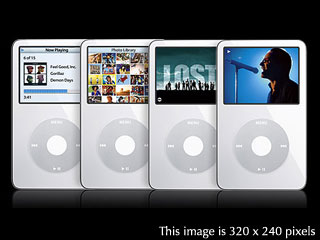
VideopodSo the predictions were right, and it was a video iPod that Apple came out with today (along with some new iMacs, which was less predicted). And there’s a lot of hoopla about the video, in that you can download not only movie previews and music videos, but TV shows as well–in particular, Lost and Desperate Housewives. (It seems pretty clear that Jobs used his Pixar influence on Disney to open up their video vault to Apple for this.) The price: $2 an episode, or $35 per season. Not bad pricing, similar to a DVD set. And like with music on iTunes, you can download them to your iPod (if you have the new video iPod, of course) for portable viewing; you can share them between five computers; and you can burn them onto a CD for safekeeping.

Sounds good, doesn’t it? However, most people who have checked the details aren’t too impressed, and I’m one of them. First of all, how impressive is video on a 2.5-inch screen? Not very. If you don’t mind a tiny picture in exchange for watching TV on the train, then OK. But I don’t think many will really be wowed by that, at least not consistently. And with the iPods already bearing color screens, who didn’t fully expect them to go video at some point? The bigger draw for videophiles would be the ability to watch video on one’s computer, and perhaps hook it up to the TV for viewing.

The key advance here is the TV and movie downloads (the music videos are a step, but a small one). It would mean that video is going the way of music: instead of downloading TV shows and movies via BitTorrent or other piracy networks, people could download them via iTunes and pay a nominal fee for it. It would be a great alternative for people like me living overseas where some media takes forever to get here. The pricing scheme is just about right (on the high side of “right,” however). Buying a DVD set would have advantages, like the special features (commentary, subtitles, special videos, outtakes, etc.), but the iTunes version would allow for immediate downloads of the episodes a day after they air–on-demand availability that will be key for a true video downloading paradigm.

There is one big caveat, however, and it will be a deal-breaker for most, including myself: video quality. If you go to Apple’s web page for the new video feature, they studiously avoid mentioning anything about the video quality on a computer screen, aside from the highly misleading claim that the video are in “high-quality, H.264 QuickTime format.” That’s misleading, because people will think that “high quality” refers to the size of the video. It doesn’t. HDTV quality is 720 pixels tall on a computer screen. 480 pixels tall is commensurate with non-HDTV size, and would look great on a normal TV screen. But that’s not what you get with the new videos–instead, it will be 240 pixels tall, and 320 wide (see image at top of this entry as an example). That’s 1/2 of regular video, and 1/3 of HDTV. You pay for the DVD, for example, the 1st season of Lost, and not only is the quality much higher, but you get a truckload of special features to boot, and the price is only $4 more.

Apple and Disney would have to make the quality a lot better and the special features present before a lot of people will buy into this. Right now it has more curiosity appeal than anything else, but that will soon pass. One can only assume that the small video size is mostly to guard against piracy. OK, fair enough. But you’re probably going to drive more people to the pirated videos, which can be downloaded in 720-pixel HDTV format, and the DVD special features are often available for download as well. People who already pirate won’t be tempted to go legit, and some people who were not aware of video downloads on demand actually might be attracted to the idea but will want more quality and could be led to download the content from BitTorrent instead.

That’s why the iTunes music sales model has worked so well: the quality is as high as or higher than the pirated stuff, and it’s easier to get. If the iTunes Music Store provided music with low-quality audio, no one would buy it. If Apple and Disney really want to fight video piracy, they have to offer something at least as good or even better than BitTorrent. Not worse.

Apple Gaining Ground?

October 12th, 2005 1 comment

There’s a new article from a publication called The Streets which claims that Apple’s retail market share shot up about 50% in the past year, from 4.3% to 6.6%. If true, that’s a significant amount. however, there are a few caveats. First, the article, linked to by many sites, has either been edited or changed–the quoted statistic no longer appears. Whether simply an error by the publication, an address mix-up, or a knowing decision to edit the article and leave out the information is not clear. I can’t find the claim made elsewhere (without quoting that changed article), so it’s up in the air. Other qualifications include the fact that this figure only quotes retail and not online sales, which would lower the number a bit, but would still represent a significant difference.

Nonetheless, there are factors that suggest that Apple’s market share is actually higher than most report. For example, Apple computers tend to last longer. If one company makes tennis shoes that are popular but wear out in a month and must be replaced, and another company makes higher-quality shoes that last for years, the former company would see more sales–but it does not mean that so many more people actually use the shoes. It just means they sell more. This is suspected with PCs and Macs, where Apple has maybe 5% of all computer sales, but more than 5% of computer users own an Apple.

Certainly Apple is still faring well with people who buy them. Customer satisfaction for Macs not only exceeds all other makers, but it exceeds all other makers by a wide margin–in both laptop and desktop models.

The current increase is seen as an iPod “halo” effect–people who buy iPods but use Windows see the high quality of the product and want to try the computers out as well. But starting next year, Apple will have a new inroad which will probably propel its sales even faster than they are increasing now. That will be the switch to Intel chips, making it possible to run not only Mac OS X, but Windows OS as well–both on a Mac, both at native speed. You can bet that there will be the ability to switch OS’s on the fly, by typing one key or another. And with that, a great many people will be perfectly willing to shell out a few hundred more bucks for a machine that has both in one. People can continue to use their old software on Windows, while at the same time get new software for the Mac OS, using both operating systems toward their strengths. It will suddenly become a lot cheaper to “switch” from PC to Mac.

Music Labels Cry Crocodile Tears

September 27th, 2005 Comments off

Now that the initial contract between Apple and the music labels for iTunes Music Store sales is expiring, and the experiment has been so successful, the music labels want to do what have have been doing for a long time: screw over their customers like they screw over their artists. The labels want to allow for pricing tiers, charging variably per song and album. Already they are making more from iTMS sales than they make from brick-and-mortar sales, given there is no need for CD production, casing, packaging or physical distribution, and Apple likely takes a lower cut of the price than music stores do.

Yes, Steve Jobs is making a lot of money off of the iPods, no mistake about it. And yes, keeping the price of music to a dollar a song and ten for an album is helping him sell more iPods so people can use the iTunes Music store with it. So he has a bias to keep song prices low, while he charges a premium for the iPod itself.

This is the argument made by Warner Music Group CEO Edgar Bronfman Jr., who says that some music is more valuable than other music, and that mandating one price for all is “not fair to our artists, and I dare say not appropriate to consumers.”

While he’s right about Jobs, it has zero bearing on the pricing structure argument at large. So what if Jobs is making big bucks selling iPods? The music labels make far more selling music, even at current prices. And he is completely full of it when it comes to artists and consumers. What he wants to do is keep 99 cents as the rock bottom and charge more for hot songs. How is this “appropriate” for consumers, at least from the consumers’ point of view? As for artists, the labels give them next to nothing unless they are really big-time and able to negotiate–but on the whole, they rip them off royally, and there is no chance that the labels will give any but the most powerful artists a pay boost from higher iTMS pricing.

This is nothing but a naked grab for profits by the music labels, with no benefit for the artists and certainly no benefit for the consumer–quite the opposite.

Mac-Friendly Bluetooth?

August 7th, 2005 1 comment

802SeI’ve been waiting a very long time for some kind of cell phone to come out in Japan which both has Bluetooth and can communicate with Mac software. It seems like that phone is here–the Sony Ericsson Vodaphone 802SE. According to Apple’s Japanese iSync page, the 802SE can communicate via Bluetooth with the Mac’s Address Book and Calendar (which I take to mean iCal, but I’ll have to check that). How easily it syncs or what else can be done between the Mac and cell phone is also a possible issue. At least this guy got it to work (and apparently it’s been out for 2 months now, and has worked natively with Macs since Tiger was released).
Something I’ve been waiting to use is an app like Sailing Clicker, which turns your Sony-Ericsson or Nokia Bluetooth cell phone into a remote control device for your Mac. Apparently, the models available in Japan aren’t on this app’s supported list, but might be with the next version–or perhaps it is supported, as the Sony-Ericsson V800, which some people are saying is the same phone.

Hmmm. Sounds danged iffy to me. I’ll have to look into this more, call up the company or something. Anyone out there know anything about this?

BtmouseThere’s also one other problem: price. Is it all worth it? Right now, I have a PHS phone (the main cell system in Japan is called “keitai,” PHS is a lesser-used system), and I pay 2000 yen a month for the account, and 10 yen a minute for calls. To change to the Vodaphone with Bluetooth, not only would I have to pay maybe 10,000 yen for the phone itself, I’d also have to pay 3000 yen a month for an account and on top of that, 60 yen per minute for calls. Is it worth that price just to have my cell phone’s calendar updated via iCal, and maybe use my phone as a remote control?

In the end… probably not.


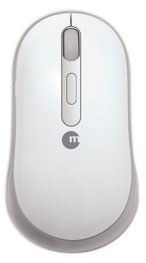
One other new Bluetooth product for the Mac: BTMouse by MacAlly. For $40 to $50, it’s a cheap mouse for Bluetooth, but I like the design very much–also that it’s full-size (I can’t get used to the mini-mice).

Problem is, it seems to be in perpetual “on its way” mode. Mail order houses have it listed as being a wait of 1 to 3 days in some places, and 10-14 days in others. MacAlly’s own web site still has the words “coming soon” on the product’s page. I finally got tired of waiting, and sent an email to MacAlly; they replied, saying the mouse would be ready by mid-September. How can those sales houses, who have listed this as a 3-day wait since May, get away with claiming a 3-day wait when the manufacturer is publicly saying it’ll be months before the thing comes out??

But as soon as it does comes out, I am getting one. Because I won’t have to pay 60 yen per minute to use it.

Categories: Mac News Tags:

Windows Vista Virus

August 5th, 2005 2 comments

Windows Vista, hyped for its “security,” is 18 months away and already it has more viruses than Mac OS X. An Austrian virus writer has published a how-to work to show others how to make viruses, and included five viruses, which is five more than the Mac has right now. It’s still in its conceptual stage, really proof-of-concept stuff, and Vista will undergo changes. But to have viruses designed to attack a “secure” system a year and a half before its even released is not so reassuring a sign of the system’s “security.”

iTunes Music Store Japan

August 4th, 2005 Comments off

It’s about time.

Yesterday, Apple Japan rolled out the long-awaited iTunes Music Store for Japanese customers. Clearly in a compromise with record labels who don’t want there to be too much of a disparity between physical and online sales, the Japan iTMS will have two-tier pricing, with some songs on sale for ¥150 and others for ¥200 ($1.35 and $1.80, respectively). Albums, meanwhile, are priced at ¥1500 to ¥2000 (obviously, $13.50 and $18).

While this may sound expensive, keep in mind that new CDs often cost ¥3000 to ¥3300 here (up to $30), so the music store still represents a significant price cut, not to mention the fact that Japanese music shoppers can buy music by the song now for lower prices than before.

The Japanese music labels, meanwhile, have been even more restrictive in some ways about protecting their music from ripping, sharing and pirating; some CDs here are spiked so that they’ll munch up your optical drive if you put them into your computer (I know it’s out there, but don’t know how common it is). They have always had an even higher markup on music here than their counterparts in the U.S., and they are loathe to give that up completely. But that is also their downfall: in Japan, CD rental stores are legal, so a great many people just rent their music CDs from the stores for a few hundred yen, and then copy them at home. They even sell CD-Rs at the rental shops.

The selection at the JiTMS is still a little sparse, and is lacking in many areas (no movie soundtrack area yet, for instance). Many English-language artists are not represented (one example: Billy Joel is not there at all, despite having most if not all his work on the U.S. iTMS).

I just created an account for the new store, and had a bit of trouble: when I tried to go through the steps to create an account, I got “504” errors at each step, telling me to try again later. However, trying again just a few seconds later would do the trick. If you run into that error, just keep clicking. And by the way, iTunes detects if you’re using an English, and everything is kept that way even though you’re in the Japanese areas. They sometimes change the musicians’ names or song titles if they’re in Japanese, but not always (it’s a mixed bag); however, all the dialogs and such are kept in the language you’re using–the account sign-in was like that.

Podcasts seem to be universal, by the way–I’m still listed, even in the Japanese store.

Obviously, this is a work in progress; in some ways, it is amazing that Apple was able to get this far, considering how strongly Sony has been trying to lock Apple out of the portable player market. So we’ll just have to see how things come along–but this is, of course, a good first step.

On a side note, Apple is opening the new Shibuya Apple Store tomorrow, August 6th.

Categories: Mac News Tags: