Tokyo Butterfly (Okay, “Moth”)

I found a moth on the stairway this evening, quite a pretty one. Being this close to the forest, we get tons of insects flying and crawling in, especially at night.

I found a moth on the stairway this evening, quite a pretty one. Being this close to the forest, we get tons of insects flying and crawling in, especially at night.
According to a new poll, three-quarters of Californians believe that the recall election is “headed in the wrong direction,” vividly illustrating Californians’ grasp for the bloody obvious. Just this visual alone is enough to make one wonder why more signatures were not needed for a candidate to get on the ballot.
Not that some of the more “serious” candidates should be taken too seriously. Arnold has come out with more “specifics” in a new press conference, in which he declares he will not cut education nor will he raise taxes, but he will make cuts–he just won’t say what he is going to cut. What substance.
On July 16th, on Market Street in San Francisco, a few hundred people swarmed to a busy downtown crosswalk, and commenced walking back and forth across it, spinning around and waving their arms in the air.
On July 24th, between 100 to 300 people gathered at a bookstore in Rome and started asking bewildered assistants for books with imaginary titles and authors.
On July 30th, in Germany, about 75 people spontaneously appeared in a public area, and at the direction of a man with a rainbow-colored umbrella, started performing gymnastics or spun around in circles with their arms spread.
On July 31st, about 200 young people converged on a bookstore at Harvard, all looking for a greeting card for someone named “Bill.” All at once, everyone burst into applause, and the promptly left.
On August 7th, a furniture store owner returned from a visit to the pub to find 200 people gathered outside his small store. He let them inside, and everyone praised his furniture. When ten minutes had passed, every single one of them abruptly left the store and went home.
The Internet and associated telecommunication technology are acting as a catalyst to new, interesting–and potentially scary–phenomena, called “flash mobs.” Currently, the trend is relatively harmless, on the scale of pranks, in fact. And who knows, this might very well just die down and disappear after a few more months if people get tired of it.
However, there is another side to this, as organization may stem from searchable web pages, attracting a few hundred people with the same radical views into creating flash mobs for less than humorous reasons. What would happen, for example, if such a crowd were to appear and commit a crime? With so many people traipsing through a busy public area, how could any reliable evidence be collected? How could any eyewitness report who exactly did what? It could be used for any number of purposes–one can imagine the more radical anti-abortion groups making use of the technique, an example of one of many social groups not afraid to violate the law and hurt people for their cause.
I am not one of those clueless people who would decry anything negative coming from Internet technology to be a reason why we must curb the technology. It is, however, an eventuality that will likely occur, and the reaction to it should be seriously considered.
New developments in California…
Schwarzenegger claims he is ready to debate, and interestingly includes Gray Davis in the proceedings. No doubt he wants an easy, unpopular punching bag on the other side of the political divide, as aside from Cruz Bustamante (less easy to knock over), all of the other likely debate candidates are Republicans also (McClintock, Simon and Ueberroth–and Simon has already opened fire on Arnold). If it were just to be the top five candidates, it would be four Republicans against one Democrat, obviously an advantage for Bustamante. I’ll bet that if Davis is either disqualified (for not being a candidate) or unwilling to come, Schwarzenegger’s people will demand that the standards be lowered to let in Arianna Huffington, Green Party candidate Peter Camejo and porn publisher Larry Flynt.
In the meantime, Republicans, who at first elated in the perception that (a) the Democrats were split and the GOP was represented by a single strong candidate, and (b) that Schwarzenegger was an actual Republican (being against the Clinton impeachment, pro-gay rights, pro gun-control and pro-choice, they are trying to figure out exactly where he is right-wing), are a bit less enthused now that the situation has reversed itself and it is the Republicans who are split.
Cruz Bustamante is accusing Gray Davis of interfering with his campaign, a charge that, at this point, might only help Bustamante, given Davis’s low standing in the polls.
Fox News (Motto: “We Can Call Ourselves Fair and Balanced Six Times out of Ten with a Straight Face”) is reporting that the Democrat-controlled California Assembly will try to ram through “Davis-friendly” legislation in case a Democrat is no longer in office after October. No news yet on whether the Republican minority will be heading to New Mexico.
The election is not even locked down yet, however, as two different challenges are being heard in federal courts. At least one is set to delay the elections for another six months in order to update polling places in six counties which have outdated equipment.
I almost expect the case to be taken to the Supreme Court, where they will declare a Republican the default winner in a 5-4 decision…
Hiromi and I really were looking forward to a hike today, but once again, we got rained out. We even got up before 5am, got all ready to go, cooking gyoza and other goodies to bring along–but the weather just never got any good, at least not that early. Despite constant predictions of an end to the rain, it just keeps on coming, making this the rainiest and coolest summer for Japan in recent memory.
Hiromi knows a really nice waterfall to picnic under in Oku-Tama. I guess we’ll have to wait until September to go (Hiromi has to go to Osaka to do research for her thesis). At least my new school schedule gets me Mondays off (as well as the weekends), so we’ll have ample opportunity then.
More and more, retired general Wesley Clark, former commander of NATO and Vietnam veteran, is making sounds like he is going to run for office. He just bashed Bush, saying, “We went into Iraq under false pretenses. There was, you call it deceptive advertising, you’d be taking him to the Better Business Bureau if you bought a washing machine the way we went into the war in Iraq.” Many have been trying to “draft” the general into service as a candidate.
He says that he’ll decide in the next two or three weeks. I don’t know too much about him, but the prospect of having a veteran military commander going up against Bush is highly appealing. Next to Clark, Bush’s flight-suit carrier-landing fake-soldier routine will look a lot more like Dukakis riding in a tank, as it should. After dodging the draft, going AWOL from the Guard and lying to invade Iraq, he should be lambasted, and Clark seems to have the authority to do it thoroughly and without it backfiring on him in anyway. The GOP, still fantasizing about Al Sharpton being the nominee, will have to sit up and take serious notice if he enters the race.
Another scenario is if Clark becomes a vice-presidential candidate. Can you picture Dean and Clark, from Vermont and Arkansas? That wouldn’t be too shabby, either.
The cause of the major blackout in the eastern United States is being tracked down to Ohio.
Ohio’s power company is First Energy, headed by Tony Alexander.
Tony Alexander is a “Bush Pioneer,” a major fundraiser for the Bush administration and a member of the Bush-Cheney Energy Transition team.
First Energy also has just lost a lawsuit filed by the Clinton Administration for violating the Clean Air Act.
Bush calls the blackout a “wake-up call” to modernize the energy grid. One citizen asked, “what were the California brownouts, a snooze button?” But Johnny-come-lately accusations aside, who will pay for the modernization, and who will take the blame and pay reparations for the damage? Bet it’s not the Bush fundraiser.
Is Ken Lay in jail yet? Nope. He’s enjoying his money quite nicely, thank you, President Bush.
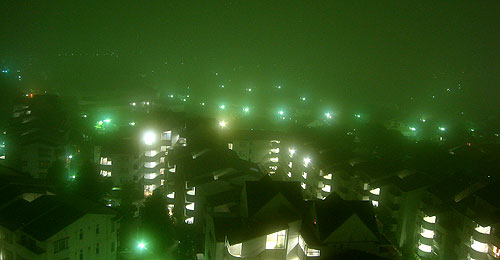
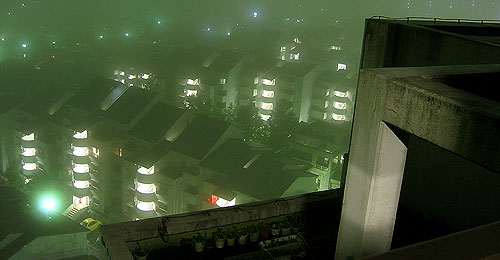
We had unusually foggy weather up here on the heights tonight. A few 15-second time exposures to show off the view.


Tom Clancy used to write well, but somewhere along the way, he lost it. Everything up to Without Remorse was pretty good, but then it started going downhill pretty fast. Debt of Honor was interesting to read because it deals heavily with Japan, which I am very familiar with. Predictably, he got tons of stuff wrong, but surprisingly little right when it came to characterizing Japan and the Japanese. He even has the prime minister saying of Jack Ryan at one point, “He is a samurai.” Please.
Executive Orders continued the slide. Clancy should stick to military fiction, not political; he embarrasses himself in this book. Rainbow Six returned to John Clark, but unsuccessfully; the book starts with Clark and another commando on their way to England to start an anti-terrorist group–and their plane just happens to get hijacked. It gets worse from there. The Bear And The Dragon was just plain unreadable, with the battle scenes, which Clancy once wrote with aplomb, uninteresting and just plain confusing.
So now Clancy has come out with another new book, The Teeth of the Tiger (at least I assume he wrote it–there are so many books with his name big on the cover but really he just authorized other authors to write them). I’m not even going to read this one secondhand or even if it’s loaned to me, not unless I hear reviews that claim that Clancy has made a miraculous comeback or something. Doesn’t look like it.
A few updates on stories mentioned in the past week or so:
Alabama Chief Justice Roy Moore tells thousands of supporters that he believes taking down the ten commandments from the state judicial building would be “treason.” This makes it pretty clear that he regards the laws of God to outweigh the Constitution within the court system, as far as I’m concerned. This guy needs to be pulled off the bench and put behind a church pulpit.
Trying to squirm out of heavy criticism for trying to cut the pay of U.S. troops overseas, the Bush administration started backpedaling like mad to spin the travesty into something that looked less like the obscenity that it was. A spokesman said that the “Pentagon planned all along” to add new “incentives” to replace the imminent danger pay that they asked to have cut, and it would just happen to balance out to the exact same pay levels. Yeah, right.
On my gyoza recipe, something I forgot to add: Mozzarella cheese! I found that if you add maybe half a cup of shredded cheese to the mix, the resulting gyoza taste even better. An experiment to sprinkle pimenton on top of the gyoza as they cooked in the frying pan did not succeed, however–tasted a bit strange.
Al Franken’s Book, “Lies and the Lying Liars Who Tell Them: A Fair and Balanced Look at the Right” shot up 50 places to become the number one bestseller at Amazon for at least two days–even though it’s not out until September 22, more than a month from now. Today it ranks #3 in the Amazon bestseller list. Fox news has “sued itself in the foot” on this one; its frivolous lawsuit that has no chance of winning has instead made fools of them while giving Franken’s book which lambastes them the biggest boost in sales possible. What a hoot!
Arnold Schwarzenegger is no longer the sole frontrunner in the California recall election. Democratic Lt. Governor Cruz Bustamante, the only official Democrat to file so far, is catching up fast. On August 13, Gallup has him at 22% vs. Schwarzenegger’s 42%, but a more recent Field Research poll has Bustamante at 25% with Schwarzenegger at 22%, with more of Schwarzenegger’s voters likely to switch their votes than Bustamante’s.
Um… well, maybe the rainy season isn’t quite over yet. After just a few days of sunshine, we got a typhoon, and then a few days after that a 5-day rainstorm that will last through Sunday. It is the middle of August, and yet we not only have rain but low temperatures as well. Temps were in the low 20s C (low 70’s F).
However, the rain is supposed to break Sunday night, and at least a week of sunny weather is supposed to come from Monday. Too late for many Japanese revelers–the O-Bon season was at its height last week, and most people had that time off. The slowly-recovering Japanese economy has taken a bit of a hit from this: sales of beer and other cold beverages, summer clothing, air conditioners and other hot-weather items have fallen. I myself just picked up a pair of short pants and two nice short-sleeve cotton shirts, all for less than $30, at a department store in Minami Osawa the other day–discounted due to poor sales.
The rice crops have been hit by the weather as well, but not as hard as in 1993, when Japan had to resort to the unbelievably radical measure of actually importing some rice. I remember that time; I was here. I remember especially that American and even Australian rice, though imported, were very hard to find in pure form. Any foreign rice that neared or matched the quality of Japanese rice was mixed together with long-grained Thai rice, thoroughly unpopular here, in an attempt to protect the impression Japanese people have that Japanese rice is the best in the world and cannot be equalled.
Anyway, we won’t see anything as drastic as rice imports, but all the same, the toll is being taken. The question is, what does this unusually cool summer bode for the Fall and Winter?
Recently, the RIAA (Recording Industry Association of America) has been going after illegal downloading like a crazed ferret with rabies. Downloaders, they claim, have been responsible for their economic demise of late (which, coincidentally, began just as the recession started, but don’t think that there is any connection to that). In response, the RIAA has tried to shut down the online services or ban the software that facilitate the illegal downloading of intellectual property, like the music that they own. Since that has failed, and KaZaA is going strong, they have gone even further, trying to get legal permission to write viruses that will cripple user’s computers, and issuing subpoenas to hundreds, even thousands of people who have used KaZaA or the other P2P software.
The movie industry is only somewhat less worried about illegal downloading, and even the makers of television shows are worried about their freely-broadcast content being shared, with the recent profits being made from DVD sales of these shows’ archives.
So to these content providers, the idea of content-on-demand over the Internet is at least a bit scary. If they make everything they have available online, what will stop people from making files of them and then sharing them?
Let us drop the issue of the music industry for this article, as I am focusing on video distribution. However, the issue remains the same. Will the makers of TV shows and movies lose huge amounts of revenue when all videos become available online? How will they make money off of it? How can they be secure when any security measures can, and ultimately will, be defeated by hackers?
Before answering that, let me bring up another issue: advertising. Everybody despises spam, and to a lesser degree, we dislike commercials. Most annoying are those damned commercials that are popping up even on things that we already pay for. When we go to movies, despite shelling out as much as $10 per ticket and more for snacks ($15 a head in Japan, though less for concessions), the last thing we want to see is fifteen minutes of TV commercials. Movie previews are fine, so long as they are kept in check–no more than three, please, and try to make them of a similar genre to the movie being shown. But unfortunately, we are getting bombarded with spam in the theater. Even when you buy a movie to own, on a DVD, you get commercials. The studio that made the movie may crowd in previews for the films they want you to buy, and to add insult to injury, many of the DVDs will not allow you to jump past the commercials–you have to sit through them every time you hit “play.”
Even computers are not free from this. A friend of mine recently paid about 200,000 yen (about $1700) for a new computer, only to find that every time she started up her machine, Fujitsu had built in commercial images that would pop up, and she was unable to get rid of them until she called Fujitsu up and got them to tell her how to disable them.
More and more, commercial advertising is popping up everywhere, and we are getting sick and tired of it. But it does not have to be that way.
Advertising is the core generator of revenue for television, and not a little for movies as well. Paying for content simply by suffering through commercials has long been the standard in the United States and elsewhere. And considering the thirst for free entertainment (partly evidenced by file swapping on the Internet), it is doubtful that this approach will be abandoned.
I can think of a system of free narrowcasted content, with high-revenue advertising that would be effective and not greatly disliked by the audience, yet would also stop illegal downloading of that very content.
The technology needed would, as I mentioned previously, require universal (or near-universal) high speed broadband connections within the country; large storage nodes throughout the country; and programming to weave in personalized advertisements into each narrowcast. This should all be available in the near future.
It would also require the ability to send the video signal from your computer to your television screen (not difficult with the upcoming generation of digital TVs).
Here’s the idea: owners of video content, including major studios and networks, would make all television programs and most movies available for free download on the Internet. Using the aforementioned system of video-on-demand narrowcasting, users could ask for and immediately receive a real-time, high-quality video signal for that content.
What each user would give is information. At first, a registration giving information on who lives at the residence and demographic information concerning them. Every month, one would have to re-input limited information, including what major purchases they would like to make, and which kinds of commercials they would prefer to watch. This information could then be used to target the commercial advertising far more effectively than it is at present.
You might instantly see some a problem with this: what about privacy? Well, the information could be anonymous–after all, the name of the person involved is not too relevant–and besides, we already give out that kind of information on a regular basis. Do you have a discount card for your local supermarket? Guess what–you’re giving out that information already. Adequate safeguards could be given, and the networks and studios could keep the information anonymous and secure and private, not sharing it with other advertisers, chiefly because the profits involved could be enormous.
Let’s look at the positives here:
Advertisers would get a far richer return on their investment. Today, an advertiser would be lucky if even a few percent of the audience of a broadcast to millions of people were interested in their product and able to buy it. Almost all of the advertising in this country falls on deaf ears. But personalized ads in narrowcasting would present a nearly 100% interested target audience. This would reap far better results than before; advertisers would be willing to pay more for this advertising, and would get even more for their money.
The content providers (networks and studios) would be in much better shape. Instead of having to rely on the highly inaccurate and opaque system of demographics they now suffer with, they would instead have an almost perfect view of their audiences. Instead of wasting unwanted advertising on mass audiences, they could hit the target every time, finding much more interest, generating much more advertising time, charging higher rates, and therefore getting far more revenue. Furthermore, they could cut out the middleman–local stations–completely, keeping even more for themselves.
And finally, the viewers would be in better shape: instead of having to be slaves to the TV schedule or to their VCR/DVR programming devices, they could call up any show or movie any time they want, and have full VCR-style control (save that you would not be able to fast-forward through or skip the commercials). Want to watch every episode of M*A*S*H from the beginning? Want to see an old episode from a TV show, but not wait around a year for it to show up on reruns? Hear about a great new show from a friend, but it’s already in year 3 and you need to watch from the beginning? This solution would be perfect for all of those situations. It would be very much like having a video library with all TV shows and movies, without having to keep any tapes or buy any DVDs.
And even the commercials would be better. Are you a woman who is tired of all the car and beer commercials? Guys, tired of the feminine hygiene ads? What if all the commercials were ones that you wanted to see? I’m a movie fan, and I like computers. If the commercials were all movie trailers and computer ads, I would probably watch those instead of heading out to the kitchen or bathroom. But if you still hate ads, there is still the kitchen and bathroom to visit.
But best of all for the content providers is that piracy for these items would be virtually eliminated. After all, piracy takes time and trouble, and is usually of lesser quality. Why do all that when all you have to do is watch a few ads that you probably will enjoy anyway?
There will be some victims of such a system, most notably the local TV stations; they will lose their most of their audience and content. Not much can be done about that. And there is the danger that, between now and then, everything from arguments over standards to just plain greed will disrupt the process. But what I have outlined above is what I see as being a pretty good end product.
Any thoughts? Please comment if you see any potential problems with this.
Robert Novak, the lovable curmudgeon and conservative pundit, reported recently that we have found evidence of WMD in Iraq, and that the information will be released in mid-September. He claims that the administration is waiting for more discoveries to be made before revealing what they have. The information purportedly includes “substantial evidence of biological weapons in Iraq, plus considerable missile development.”
If such information will in fact be released in September, this raises natural suspicions about what is being done to the information and whatever evidence there may be in the meantime; it is unlikely that anyone outside Bush supporters will feel that evidence tampering could be ruled out, not to mention the unethical move of withholding vital evidence for political reasons.
The fact is that the Bush administration has botched the job. By lying so often to the people and the world, by pushing trumped-up evidence and claiming validation, by selling off Iraq profits not just to American industries but especially to those with ties to Bush and Cheney, and by refusing to allow any non-American weapons inspectors into Iraq, the administration would have to be fantasizing if they thought they will be believed by the world when they show up with anything of substance, even if it is real.
Of course, this is all assuming Novak has something here.
But personally, I have the strong feeling that there is nothing to this story at all. Why?
It’s been claimed before. Senators returning from a junket to Iraq claimed on July 3 that “there’s going to be breaking, positive news on that front in a very near term,” and urged Bush to release the information. Of course, nothing came out.
And then there are the news stories: parts for an atomic bomb program were dug up in an Iraqi scientist’s backyard (but were found to be older then the Gulf War and, instead, proof that the program was not reconstituted); two truck trailers were found which the administration told us were mobile labs for creating bioweapons (but it turns out no trace of bioweapons were found, though they would have been if the trucks had been used for that purpose).
We keep hearing these stories, that evidence is on the way or has been found, each time the story being reported wide, far and loud, and each time the fact that it is a bust being reported in a much smaller voice. And I don’t think that these are random errors.
I bet that if you performed a survey of all Americans and asked if we’ve found evidence of WMD in Iraq, that a sizable percent–not over 50%, probably, but still sizable–would say that we have. You spread rumors enough and people start to believe something is there.
I thoroughly agree with the idea that church and state should be as separate as humanly possible. Whatever negative experiences some people may have had, religion has had an overwhelmingly positive effect on countless people in their personal lives. However, whenever religion has mixed with politics, government, and the military, the results have been almost universally and completely disastrous. One can think of many examples of religion and state combining to result in injustices and atrocities, but it is difficult, if not downright impossible, to come up with a single example of the marriage of church and state resulting in a positive outcome.
And yet, there are still a great many people, all over the world, who wish to see such marriages multiply (where only their religion is concerned, of course, and not others). This is particularly so in the United States, where the president himself is trying his best to blur the lines with faith-based and other Christian-friendly programs being funded by the state. This is not to say that these programs are not good, I am certain they are great programs. The problem is that they are the camel’s nose under the tent. We have a principle of keeping religion and state separate, and, as any Christian should understand, once you start compromising “a little” on principles, you might as well be “a little” pregnant.
So we come to situations like we have in Alabama, where Chief Justice Roy Moore, supported by a great many religious groups, is defying a federal court order to remove a monument depicting the ten commandments from the state’s judicial building.
The reason given by Moore is that the commandments “represent the moral foundation of American law.” This reasoning is a bit flawed; first of all, the first four commandments regard religious observance, the fifth requires devotion to a hierarchical system, and the tenth is less a legal foundation than a behavioral one. Really only the remaining commandments, concerning killing, adultery, theft and lying, have any connection with our current legal system. But to say that the ten commandments is the foundation of these four laws laws is to say that these rules did not exist before, which is not exactly correct. These are basic foundations in any and all cultures, no doubt dating back way farther than Moses.
And if the claim is that the ten commandments were an influence to the system in general rather than the direct cause of a few laws central to our legal system, it must be pointed out that our system “is also deeply rooted in the pantheistic cultures of Greece, Egypt and Mesopotamia” (Interfaith
Alliance, “Hang Ten Campaign” PDF file), as well as other cultural influences worldwide.
All the excuses seem to me to be a false front–that our legal system is based on the commandments, that they are a historical document and so on. People who give such reasons are, in my opinion, covering for the real reason: it is their religion, they feel it is the most important thing in the world, and they want to proselytize the word of God, and putting up the ten commandments in public places will help to do that. But it is not usually admitted as the rationale for the same reason why people who oppose abortion because of their religion find other secular grounds (which usually make little sense), or why those who oppose cloning for religious reasons turn to the “army of robots” fallacy to make their point. It is because they know that in a society with the principle of separation of church and state, religious arguments are not acceptable. That is the core of what they are trying to change.
I do not see this as some evil conspiracy or the like; to these people, it is right, reasonable and just, and if those who oppose it only saw the light, we’d be thankful. Many people believe that their religion is The Answer to all problems, just as it was The Answer for them in their personal lives. They believe that the laws of God outweigh the laws of man. I can understand this and sympathize with this. However, the problem with this situation is that when one tries to put into effect these beliefs in the form of laws furthering the Christian or any other religion, one violates one of the most important tenets of American society, one that has made us successful as a nation, one that has held this country together. In a multi-belief society, one cannot have a theistic government without disenfranchising members of all other faiths and agnosticism (I count atheism as a belief–but that’s just me).
You can’t have a school with prayers without opening children of agnostics, atheists, or even faiths that forbid public prayer up to taunting, abuse and ostracism (and you can’t ignore the fact that such things are the result). You can’t claim that the system of justice will be a Christian system and provide justice for all others. By definition, a system which includes one religion excludes all others, and that is contrary to the foundations upon which our country was built.
That’s the big picture, and it drives the necessity to do all the small things. Some people feel outrage that Moore is being ordered to take down the ten commandments. Many criticized the judges who forbade the “under God” part of the pledge of allegiance. People who do so fail to see the big picture–or they see it, and disagree with it.
Finally, my own personal opposition to many of the drives to put up the ten commandments is for the one reason stated in public that is not overly religious and yet is an honest one: people believe that putting the commandments up in yards, schools and state houses will curb the loss of morals and the rise of crime, and will teach the youth of our nation morality so they will be good people. Of course, the problem with that is the unspoken assumption that morals cannot be taught without religion, and therefore people who do not have religion cannot be moral.
If you think that I am going overboard with this claim, read this. Also, I have known several people who come from the evangelical camp, some who actually have to check themselves when they realize they are applying religious viewpoints to others in secular situations (such as a friend who accused me, an agnostic, of “backsliding”), and some who don’t check themselves at all. I personally am insulted by this, as I am an agnostic, was not raised on the ten commandments, and yet–I believe–am a moral person. It is more than possible to instill morality and rightness without having to resort to biblical references.
We need an eleventh commandment, specially built for our society, if we wish to retain religious freedom: thou shalt not proselytize on the public’s dime.
The Pentagon and the president, already in hot water for cutting veteran’s benefits and education for their kids after sending scores of them to fight and die for Halliburton, are now digging themselves an even deeper hole: they want to directly cut the already measly pay given to soldiers in Iraq.
Why? Because it would cost another $300 million if they don’t.
Now, I never supported the whole Iraq invasion thing, but our men and women who are there deserve all of our respect and support, and that includes paying at least minimum wage, for crying out loud.
Somehow Bush feels it is a travesty to not give a trillion dollars back to the rich, and that it is acceptable to run up a deficit of $450 billion every year, which this country will soon gag on, just so he can have his political agenda played out–but when it comes to paying a tiny fraction of that to the Americans who are dying for his botched policies, suddenly this is just too much and we have to cut back somewhere.
I’m sorry. You know that I criticize Bush for all sorts of horrible stuff that he does. But this is just plain, stinking obscene.
Okay, settle down here, because this will be a long post–not necessarily in words, but in inches (or centimeters, as the case may be. A friend recently taught me how to make gyoza (sometimes spelled ‘gyouza’), often called ‘potstickers’ in English. They are essentially a vegetable mix, with meat optional, encased in a small dough wrapping and steamed or fried before serving. I like gyoza, but the ones I get at stores tend to be far less than satisfying–but I found that I really like the homemade ones. The ones I’m showing today are made with chicken. Please note that the amounts of ingredients are approximate–they can easily be increased or decreased to suit your taste. Keep in mind I am no cook, nor a cookbook writer, so this could be a bit messy! Here is the basic setup for cooking:

1/2 head of cabbage or less (you won’t use it all by a long shot, but usually you can’t buy less)
1/2 onion
part of a clove of garlic (use however much you prefer)
one bunch “nira” (leeks)
one bunch “negi” (umm… also leeks, but a different kind. I like the thin type, shown above)
1 to 3 packages large gyoza wrappings (depends how many you plan to cook now)
Sesame oil (“gomayu”)
Seasonings (I use salt and pimenton)
Ground chicken meat (around 250 grams, or half a pound, roughly)
You’ll also need a little flour with water, a largish mixing bowl, a long, sharp knife, a regular spoon, and a frying pan with a cover. Keep in mind that these are just the suggested portions. You can change the amount of any ingredient to your taste, and even add or subtract filling ingredients.

First, slice some cabbage, perhaps three or so quarter-inch thick slices from the middle of the head. Discard any bulky pieces too close to the stem, then start chopping, until you’ve reduced it to tiny pieces. The amount you’ve chopped should amount to about a cup, slightly packed. When finished, throw them into the mixing bowl.
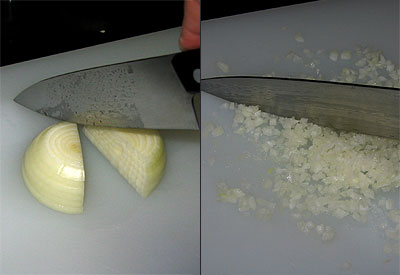
Next, take half an onion (just a regular white onion), and chop it into similarly small pieces. Then throw those into the bowl, too.

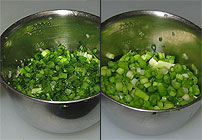
Then chop the leeks, not just slicing the bits off, but chopping those into finer bits as well. Each type should produce about a quarter of a cup. Into the mixing bowl they go.
Take whatever amount of garlic, if any, that you prefer–I took three lobes, or whatever you call them–and grate/crush them. Add this to the mixing bowl as well.

This is what you should have by now.
Now, for the meat, I like to use ground chicken. Ground beef was way too dry; ground pork was OK, but chicken makes the gyoza much juicier, in my humble gourmet opinion. I use the fattier ground chicken, in fact.
Update: At this point, you may want to add cheese. I have found that shredded cheese, added to taste, can make the gyoza even more tasty. I use mozzarella, grated, about half a cup.
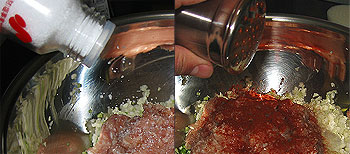
After the chicken is added, top it off with the seasonings you prefer. Salt and pepper are safe bets. I use pimenton (smoked Spanish pepper spice) because, well, I use it on everything. So on it goes.

Finally, pour on some sesame oil. Don’t be stingy, but don’t create a flood, either. Maybe 1/4 cup or so will do, though I’m just estimating here. And then–eeewwwwwww!!–go in with both hands and squish, squash, and knead all of it together until it is well-mixed. Then go wash your hands, for god’s sake!
OK, here are the shells to use. They come in different sizes and thicknesses. I always go for the large ones, partially because I like big gyoza, but also because the smaller ones create a lot more work–you have to make more, and as you’ll see, the shell crimping can be time-consuming. I have no preference between the thick and thin types. Here I am using the thin ones. You can usually find them in your (Japanese) supermarket near the ground meats; if not, ask. The ones I use come in packages of 20.
Have the gyoza filling mix in the mixing bowl handy, as well as an empty plate to put the finished gyoza. Get a small dish or saucer, and put a small amount of flour (a teaspoon, perhaps, no more) onto it, then add a little water; mix some flour into the water until it becomes milky, but not very thick. Open the gyoza shell package, and take out some of the round shells; we’re gonna wrap some potstickers!
Here comes the difficult part of the recipe; it may take you several attempts to get decent at it, so be patient. First, take a shell into the palm of one hand, and then spoon out some gyoza filling into its center; see the photo above for the amount. Less than a spoonful to be certain–for the first few, less is better than more (when you close the shell, a few steps later, there should be maybe a third or half an inch of border around the filled center). There’s lots of filling here, so go ahead and waste a few if needed.

Next, dip the tip of your finger into the flour-water, and apply this to the border of half the gyoza shell (the same side the filling is on), so as to mark out a semi-circle. Only spread enough with your finger to cover the surface of the edge and make it sticky; it should not run wet. This acts like a glue, and is to get the shell to stay closed. In the photo above, I have set the shell on the cutting board only because I needed a hand free to snap the photo; usually, I wet the edges while holding the shell in my other hand.
Next can be the trickiest part:
You’re going to have to close the shell, but not just in a smooth, straightforward manner. You will have to crimp one side of the border, making creases along the way. Different people have different techniques for this. My way is to bring the two halves of the shell together and close them just at the center point, leaving the sides temporarily open. Then, working from the top/center, I take some slack from the far side of the shell (as you see in the above illustration, I start on the right side), creating the crease–then pressing down hard to seal them together. I do this twice on the right, and twice on the left, for four creases; you do what suits you.
The finished product should look something like this:

Note the creases in the shell are only on the one side (call it the “top” now), and the other side should be flat. Note also that the filling should not come close to the edge, with a 1/3 or 1/2 of an inch border.
Continue dalloping, gluing, folding, crimping and pressing, until you have the desired number of gyoza. Usually 12 or so are enough for someone with a good appetite; Hiromi, my friend Ken and I found that 40 gyoza serve three people quite nicely, along with a salad and drinks. The amount of filling that this recipe generates is enough for 40 gyoza, possibly 45 (or even 50 if you use less filling in each). If there is filling left over after you finish (as I had tonight), then drop it into a ziploc and refrigerate it; more gyoza for tomorrow!
In the end, your plate might look like this:

I made 14 here, just for myself (me, hungry).
Now, prepare the frying pan by pouring a small amount of oil (olive oil would be great here) into the pan, then spread it around with a square of paper towel; there should be enough to slightly ‘wet’ all the gyoza as you place them down. Do not pour so much that the whole pan bottom is covered; to the contrary, keep it very light, so that all the oil can be absorbed easily into the gyoza.
Next, place the gyoza into the pan; up to twenty should fit at a time. Don’t worry if they touch. Fry the gyoza at low heat without a cover, until the bottom of the gyoza are brown; then raise the heat a touch for a moment. Then, with the pan cover in one hand, take a cup of water in the other and pour it into the frying pan, then quickly cover the top as the water turns to steam.
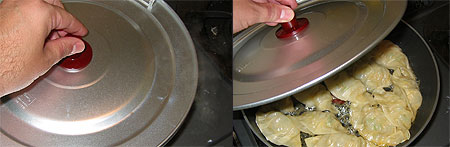
Keep the top on for five minutes at least, perhaps more, checking periodically; when the water has all but steamed off and there is just a bit of water and oil left in the pan, the gyoza may be done. If the water has gone but you think more cooking may be in order, add a bit more water and cover again.
When the gyoza are done, take the pan to your kitchen sink. Drain any excess water (there shouldn’t be any if you did it right), then uncover the pan, and put a dinner plate, upside-down, over the gyoza. Holding the plate with one hand, turn the pan over with the other, then remove the pan from atop; the gyoza should now be nicely placed on the plate.
Congratulations–you’ve got gyoza! Gyoza need a dipping sauce, so in a small saucer, pour some soy sauce, and then some sesame oil. I top that with (of course) a little pimenton. Serve the gyoza from the central plate, allowing everyone to take from it and dip in their saucer.
Enjoy!
On these rainy days with not much to do, one has more time to surf and find some interesting information.
The web site AWOLBush.com has an interesting list of prominent Democrats and Republicans and what their military service records are. It has long been a widely-disseminated and yet little-known fact that Democratic politicians have far better record of serving their country than Republicans do. I haven’t done the research, but the list is certainly tilted towards showcasing Dems that served and Repubs that didn’t; still, when you look at it, a surprising number of Republicans have shirked their duty, including:
George W. Bush (joined celebrity unit of Texas National Guard, then went AWOL)
Dick Cheney (deferments, said he had “other priorities”)
John Ashcroft (seven deferments to teach business)
Speaker of the House Dennis Hastert (avoided the draft)
Senate Majority Leader Bill Frist (college deferment)
Former Senate Majority Leader Trent Lott (avoided the draft) … and many others
Democrats who did serve, on the other hand, include Tom Daschle, John Kerrey (Silver Star, Bronze Star, three Purple Hearts), Ted Kennedy (Korea), Daniel Inouye (Medal of Honor), Charles Rangel (Bronze Star), Al Gore (served as journalist in Vietnam), Tom Harkin, and let’s not forget Gray Davis (Army Captain in Vietnam; received Bronze Star).
Republican pundits are also listed, including non-servers George Will, Bill O’Reilly, Bill Bennett, Pat Buchanan, Rush Limbaugh, Michael Savage, Pat Robertson, Bill Kristol, Kenneth Starr, and so on.
The point, of course, is that conservatives are usually very hawkish when it comes to sending the youth of our country off to fight foreign wars, but chicken when it comes to signing up themselves–thus the term “chickenhawks.”
Does the president, who dodged the draft and went AWOL when drug tests were instituted, for whom someone else served and perhaps died, have the right to spend one million taxpayer dollars to slow the aircraft carrier Abraham Lincoln down and delay the homecoming of 4,000 men and women who are serving so that he can have a government-paid photo-op for re-election in which he declared victory in Iraq, even though 60 soldiers and counting have died since then? A convoluted question, but well worth asking.
Imagine if Clinton had done something similar. Republicans would have impeached him just for that.
When Steve Jobs, iCEO of Apple Computer, gives his trademark keynote speech at whatever Mac convention, Apple Computer has, for the most part, streamed the event over the Internet. What that means is, if you want to see his presentation, you can visit a page at Apple, which then instructs your computer’s QuickTime software on how to access streaming video of the event. Streaming video is essentially like a TV station on the Internet, allowing video to come directly to your computer (without having to save it as a file on your hard drive), albeit presently at relatively low quality and small size. Make the video image full-screen and it looks pretty bad.
Originally, I could only view the video stream at whatever point the broadcast was at when I came in. In other words, just one video signal was being sent out, and viewers tapped into that.
However, when I watched the streaming video of Jobs’ last keynote, I noticed something different from before: I could access the video stream from the very beginning at any time I wanted. This time, the stream started when I wanted it to, and would start new for anyone whenever they accessed it.
This makes a big difference. The prior style was the kind of distribution we are all used to: broadcasting. That means that only one video stream is sent out to a vast multitude of people at the same time. This is what happens with cable and broadcast television–one TV show at a time is sent out to everyone, and everyone sees the exact same thing at the exact same time. We are so used to this style that it seems only natural, and we might have a hard time imagining anything else.
The “anything else” would include what I saw in Jobs’ last keynote: narrowcasting. That means that each viewer receives a completely unique and independent video stream, a private feed from the video provider just to you. It’s as if the TV station is just waiting for you to turn on your TV set, so they can send you whatever TV show you like, whenever you like it. This is the paradigm that the World Wide Web works under, since usually the text and pictures are small enough to be sent to you personally even over a dial-up connection. Narrowcast video signals work the same way, just instead of web pages, you get videos.
The advantages of narrowcasting television shows are great for the viewer. Best of all is that you are no longer tied to a schedule. Today, you have to either plan your evenings around your favorite TV shows, or have the patience and discipline to use your video recorder. VCRs are actually quite difficult to use, aside from the normal programming issues–you also have to have blank tapes ready, cued up to the right point, and have to remember to put those tapes in and set the timer after watching videos in between. DVRs, or Digital Video Recorders (like TiVo or Replay TV) are much easier, as the video is saved on a hard drive, and you don’t have to set and reset to program mode–but there are still difficulties and trade-offs, not to mention the expense of the machine and the legal issues surrounding the content once it is on your DVR.
Narrowcasting provides you with the best solution to scheduling: you don’t have to record anything. Throw out not just your VCR, but your DVR as well. Don’t bother to plan your Wednesday night to see The West Wing, and don’t bother to set your recorder to play it. Simply wait for the network or production studio to release the episode, then request to view it at any time you like. The show will start on demand, any time you want to see it. It is exactly like having any and every TV show already recorded on your computer/TV–just call it up and it plays. Pause it whenever you like. Fast-forward, rewind, play frame-by-frame, whatever.
What’s more, you are not just limited to whatever happens to be “on,” not just for the day, nor for the week, the month, the year or even the decade. Storage media and compression solve this problem.
I remember about ten years ago, I wanted to buy an external hard drive for my Mac. I bought one with a capacity of 105 MB, for about $300. Earlier this year, I noticed that a 120 GB hard drive could be bought for about the same price. In less than ten years, the price of hard drive storage had decreased a thousandfold. Similarly, the size and quality of video files has been progressing, though somewhat less spectacularly. MPEG-4 video streams are of far better quality and are much smaller in size than video of the past, and that will only get better.
By the time narrowcasting becomes feasible, it will not be difficult to store vast amounts of television shows and movies at various ‘nodes,’ or storage centers, across the country. Which means that when you ask for your video on demand, you won’t be limited to “this week’s shows,” but rather will have all of television and film, from the oldest Howdy Doody kinescopes to the latest CNN news briefs, at your fingertips.
This is where universal broadband comes in, allowing those vast stores of video to be accessed by anyone and everyone at any time they please.
All that remains after that is the economics of the beast. Depending on how it’s done, it could be a great success or a resounding failure. At some point, a system will be worked out–but will it be the best possible?
The present administration is currently getting more and more into trouble for “sexing up” intelligence reports, either distorting them or making them up out of whole cloth, in order to further a political and ideological agenda. The intelligence community has taken a hard hit for these political incursions into what must, for the sake of national security, be a non-partisan endeavor. This naturally does not faze the Bush administration, which has shown no hesitancy to shred our national resources in order to get their goodies.
So it should come as no surprise that the Bush people have been even busier “sexing up” another vital source of information, that being the scientific research done by government agencies.
Want an abstinence-only sex education program due to your political and religious beliefs, even though it has proven a failure? No problem. All you have to do is stack a key panel with your own ideologues, censor information that disagrees with your beliefs, and re-write the rules for measuring success so that your program “achieves” it.
Your education policy is not as successful as others that you oppose? The answer is simple. Send out an order to censor any and all information presented to the public that “runs counter to administration priorities” (actual quote), including all information that does not support the president’s plans or is counter to his philosophy.
You don’t like drug treatment, despite the fact that it has been found to be “7 times more cost effective than domestic law enforcement method, 10 times more effective than interdiction, and 23 times more effective than the ‘source control’ method“? No sweat. Just require all members of the nation’s council on drug abuse to pass a litmus test. If they don’t support faith-based programs, if they support abortion rights (that’s not an error, they ask that for some reason), or if they have not voted for Bush–then give them their walking papers. The candidates you have left after this filtering process will miraculously find that science supports exactly what you want it to. Simple!
A recent report from a ranking member of the House Committee on Government Reform tears into the Bush administration for its malfeasance in subverting science to serve political ends–and this is just what has come out so far. Not that it should come as a surprise–we’ve known Bush has been cooking the books since he got into office–but this report details some of the abuse quite nicely.
On February 5 of this year, U.S. Secretary of State Colin Powell gave a presentation at the U.N., documenting what the Bush administration was pushing as “the smoking gun” that would prove the case to invade Iraq. The evidence was, according to Powell, overwhelming and ironclad.
This article at CommonDreams.org takes apart that speech item by item and demonstrates how it was just as much a collection of lies as Bush and Cheney had been spouting for the many months before.
A few comments on truthfulness in government: we have standards that are ridiculously low. A senator can be against issue A on Monday, receive a large contribution from a lobbyist who profits from issue A on Tuesday, then be all for issue A on Wednesday–and cannot be arrested for bribery. Why not? Because the law–written by lawmakers like him–essentially says that we must know the state of mind of the senator to charge him with a crime. In other words, in order for him to be arrested, he has to declare, on the record, that he changed his vote because he received money or favors.
If the same standards were applied to other crimes, the effects would be ludicrous. People could trade on inside information, and avoid prosecution simply by claiming that their stock buy had nothing to do with the hot tip they received. Police officers could openly take ‘contributions’ to a police officer’s retirement fund, and then just ‘happen’ to let the ‘contributors’ go free after having committed an offense. For these reasons, the “state of mind” defense is not often allowed. [Note that it is most used for crimes we feel are obscene but still are greatly unchecked, such as rape (“gee, I thought she was struggling and screaming ‘no’ as a game”) and discrimination (“I just happened to hire all the white people and none of the blacks; it had nothing to do with color”).]
But the state of mind loophole is open wide for politicians, and therefore we get rampant, blatant bribery. I recall one instance where Clinton accepted money from a black caucus, and met with them–but then decided to not do what they asked. When he did this, politicians from both sides of the aisle openly decried his decision. Bribery is so ingrained in politics that politicians will cut into one of their kind simply because he did not take a bribe!
At least with bribes, the cost is usually financial. It is worse when the cost is counted in lives. And so we come back to the Bush administration’s lying for the war in Iraq. Can they get away with the blatant lies simply by claiming, “gee, we really and truly believed all that stuff that turns out to be fabricated and false”? Can the ‘state of mind’ argument be used to excuse massive and obvious fraud to the people, which cost the nation hundreds of billions of dollars in addition to so many lost lives?
In a just world, this would not be the case. But this is not a completely just world. So our young soldiers die, and they kill a great many more. And the liars keep on reaping the rewards.