Archive

Archive for June, 2005

It’s Official

June 7th, 2005 4 comments

The Steve has just announced at the WWDC that Apple is indeed switching to Intel, because IBM simply cannot deliver–can’t give us 3 GHz in the PowerMac, can’t put a G5 into a PowerBook (tell me about it). What he also said was that Apple has been compiling OS X on Intel chips for five years now, and the Tiger presentation he is giving the audience as he speaks is a Pentium 4. Even though they can work Apple software on Pentiums today, the transition will go as reported in the press, from June 2006 to June 2007. Nevertheless, both IBM and Intel processors will be supported for “a long time to come,” undoubtedly making a lot of people happy that they will not be forced to switch.

As for how long developers will have to work to port their programs to Intel chips, Jobs is claiming that it just takes a few hours, using Mathematica as an example. The app apparently is very complex with millions of lines of code… but only 20 or so had to be changed for the app to work. The question is, will all apps be so easy to change?

Apple will add two points: first, an emulation mode called “Rosetta” that will allow all PPC software to work transparently on Intel Macs (Mactels?), and new software written in Fat Binary, able to run on both PPC and Intel chips. This is all very, very familiar to those of us who followed through the Motorola-to-IBM, 680×0-to-PPC transition some time back.

Even Microsoft is in: an Apple press release quotes a Microsoft exec as saying that they will develop a fat binary version of Microsoft Office for the Mac–a surprise to me, I had heard that they stopped developing that particular suite for the Mac platform.

interesting: no mention of .Mac despite the coincidental blackout; no mention of whether or not Intel will vary its chips specifically for Apple or if Apple will use off-the-shelf Pentiums; no mention of Transitive (probably they’re just not using them); no mention of whether Windows would run on Macs; no mention of using Windows apps more easily in OS X/Intel.

Sounds to me like there’s a lot of stuff going unsaid…

All of this, of course, leaves me in a tough spot. It seems rather apparent that I will not be getting a G5 PowerBook, or even a dual-core G4 or Freescale PowerBook. Probably nothing but minor-speed-bump G4s until the Big Switch is made. It is not even certain that a Pentium PowerBook will be released in 2006, it could take as long as two years for it to come around. And I’m stuck here with an 800 MHz PowerBook. Which means I can get a new PowerBook with a slow chip and be stuck with that for another 3 years… or I can suffer with a slow CPU for as long as 2 more years and get one of the new Pentium PowerBooks as soon as they come out.

It’ll take a bit of thinking about, but I’ve already figured a few things out. First, I don’t think I’ll want to be using a 5-year-old PowerBook. And second, new computer designs often have bugs that don’t get smoothed out until a few revisions down the line. If I get a PowerBook now, then it will probably be ready for a replacement model at just about the time when Pentium PowerBooks have gotten their kinks worked out.

I think I’ll start taking a look at what’s out there…

Another note: OS X version 10.5 will be called “Leopard,” and will be out by late 2006 or early 2007–around the same time Longhorn is scheduled. That should be a challenge to Microsoft; Apple has gotten their releases out fairly regularly and on-time, while Longhorn has suffered serious delays (even though they cut out two of the biggest new features so they could release it earlier).

Categories: Mac News Tags:

.Mac Changes Coming?

June 7th, 2005 Comments off

By the time most people read this, it will probably have been officially announced in the WWDC keynote, but…

An alert reader at Spymac noted that Apple’s .Mac service is going off the air at the exact time as and for the exact duration of Steve Jobs’ keynote at the WWDC. From reports, the service has almost never gone down before, and the timing is almost certainly not coincidental; there may be some significant .Mac service changes coming, and soon.

Maybe.

In any event, it’s half an hour before the keynote right now, with probably any big announcements coming some time after the start.

Categories: Mac News Tags:

Hopeful, but Wary

June 7th, 2005 2 comments

Last month marked the most excessive period of referral spam I’ve experienced so far for this site. (See here for an explanation of referrer spam.) The problem itself started a year and a half ago, in November 2003, with a grand total of 7 “hits” from a Paris Hilton site. It was #36 on my referrer list, with the referrers before it all legitimate, adding up to an aggregate 1167 hits from 35 referrers before the one spam showed up.

I didn’t even notice it.

December’s experience was almost identical: the Hilton spammer was #35, with another 7 hits, 1153 other hits coming from the prior, all-legit referrers.

But then Hilton advanced: in January 2004, one Hilton referral was at #18 with 13 hits, while another Hilton spammer was at #18 with 8 hits (interestingly, the RIAA seemed to spam my site just in front of the first Hilton site, coming in at #17 with 14 hits–certainly faked, I doubt the RIAA linked to me from their main page).

This went on for a few months, but the spammers stayed out of the top 10–until April 2004. Suddenly, the top three referrers were spammers with a total of 333 hits, with others beginning to litter the spots below. For a few months they died down, scattering several dozen hits in the lower rankings, until in July, someone mysteriously spammed me 1556 times. It was mysterious because the spammer made it look like the links were coming from the IAEA, and I know the International Atomic Energy Agency was not linking to me from their home page. The only thing I can figure is that it was a spammer testing out a new script before using it to get referrers to point to his site. I am assuming it was Burnham, but I may be wrong–there is a lot of scum out there.

Spam referrals continued to persist in the lower rankings, sometimes hitting as high as the #4 spot, but outrageous spam held off–until October, when the infamous Burnham Internet Sales Cockroaches hit full-force, dominating not only the top 5 spots, but also 25 of the top 27 (and probably more that I couldn’t pin down as Burnham), their top 25 spam referrals totaling a record 3758 hits. This prompted me to blog about them, reporting on their scumminess, and I am happy to report that Google still ranks that post of mine as #1 in a search for “Burnham Internet Sales,” with their own site ranking #2. Score one for the little guy! Try to spam me to get high Google rankings at my expense, you do so at your own risk!

Although Burnham stopped harassing me, other spammers started glomming on, and since late last year my stats have been clogged with the lowlifes. I tried everything I could to get around them. I tried IP Deny in my site’s control panel, but it didn’t work. I tried to create an .htaccess filter myself, and it worked, but only for about 24 hours, after which the spammers blew through it like tissue paper. I wasn’t publishing a “top referrer” list which the spammers hope they will appear on, nor was my stats page open to public view (it’s in a password-protected directory), so I wasn’t encouraging them in any way. But this is a blog, and blogs are spam magnets. Spammers care little if one site which they’re decimating isn’t getting them any profit, it costs them next to nothing to do, and they probably enjoy defecating over sites that deny them a return. So I got more and more spam, and there was no way to block it.

Here’s where I get to the “Hopeful, but Wary” part. Last month, as I mentioned at the top, was the most excessive month of referrer spam. 24 of the top 25 referrers were spammers, accounting for more than 10,000 fake hits. So I looked into it again, and found a possible solution. There is an AwStats (the program used to get statistics) patch on SourceForge which claims to “check comment spam blacklist for referer spam.” The information on the patch is incredibly sketchy; I thank the author for making it, but I would think they could spend more than 50 seconds to type the instructions. There is no explanation beyond the title as to what it even does. But someone on a forum claimed it “scrubbed” the referrer logs of all spam, which sounded great to me.

What was clear was that the patch used the same blacklist that MT-Blacklist used to delete comment and trackback spam. All I would have to do was add the referral spammers to the blacklist (easy enough to do with MT-Blacklist’s interface–and many of the spammers were already there).

It turns out that I had even seen this before and blogged on it, but had not used it because it required admin skills I frankly do not have. As I said, the instructions were sketchy at best, and I could not come close to deciphering them. But after May’s spam numbers drove me to search some more, I found someone who suggested the web host’s tech people install it instead of the site owner. Worth a shot, I thought, so I asked–and they did it.

At first, I was disappointed; I expected the existing spam to melt away, leaving nice, clean stats behind, but alas that was not to be. Before the patch was installed, the top 26 spots were filled by spammers who had hit me a total of 867 times, and that was just after 5 days. After the patch was installed, the spam was still there. Failure again, I thought. But half a day later I noticed something: the spammers I had added to the blacklist had not hit me in that time. Other spammers, not on my blacklist, had hit me again. So I added more spammers from the referral logs to the blacklist, and they stopped adding hits to the list as well.

If my understanding now is correct, the patch does not clean up old spam, but it stops new spam that you’ve blacklisted from getting in. And that will do quite nicely in the interim. I’ll just have to keep an eye on the stats (which I usually do anyway) and blacklist spammers as soon as they hit me. With luck, the flood will return to the relative trickle that I was experiencing a year ago.

I’m also checking out ways that AwStats might be tinkered with to get rid of older spam, too. Perhaps by removing the AwStats log file for the month, a new one will be generated automatically, this time fully applying the blacklist filter. I’m almost afraid to try it, though, for fear of screwing things up.

Still, hopeful news. But I’m not counting my chickens yet–spammers have blown through defenses before. Time will tell. I’ll keep you posted.

Categories: BlogTech Tags:

Now Your Dog Takes You for a Walk

June 6th, 2005 Comments off

An interesting invention here. Do you have a dog, but don’t like having to exert so much energy walking the pooch every day, struggling to hold him back? This device takes care of that: strap Fido into the harness, and let him pull you along while you steer.

Kalana8

A movie showing the device in action is also available on the product’s site.

This may not be in line with what most canine lovers may accept as doggie-friendly, but it’s better than some ideas I’ve seen before, like one guy I saw “walking” his dog from his car, holding the leash out the window. The makers of this “urban mushing” device claim that it actually gives “identity and pride for your dog,” though somehow I’m not fully sure that this is what the dogs are thinking.

If you want to spread the workload of dragging your fat ass around, there’s a model of the Dog-Powered Scooter which allows for two dogs. Though frankly, I might not want to be on that scooter when Spot and Rover lay their eyes on Fluffy the Cat and decide to go for it.

Categories: Gadgets & Toys, The Lighter Side Tags:

Well, That’s a Little Disturbing

June 6th, 2005 5 comments

If you’ve read this blog for a while, then you know that I got a Toshiba TiVo-like box late last year, one that not only records shows digitally, but then archives them on DVDs.

But in April, the DVD burner started producing multiple disk errors, just as the hard drive filled up. I got it repaired–but now, only a month and a half later, the drive sputtered out once more, again producing disk errors. So I called up, and again, they sent a techie out to replace the DVD drive.

Now, just the fact that the DVD burner craps out twice, once after four months and again after one and a half months, is bad enough. But then the tech guy doing the replacement was kind enough to be honest with me: the drives, he said, are built to last only for about 600 burns. Prior models, he said, could last for 1000, but this one does about 600. And he was giving me a refurbished unit–no way of telling how far along the odometer was. And I burn a lot of DVDs. I could easily run through 600 in less than two years. So that’s the lifetime on the unit I bought?

Of course, I could always have the DVD unit swapped out, like I’m having now under warranty. But that costs about $300, adding 50% to the cost of each DVD I burn, from $1 a pop to a buck fifty. In addition to the original cost of the machine, which was over $1000.

Not exactly what I thought I was getting, and I’m none too happy about it. Is this considered the norm for DVD burners?

Categories: Gadgets & Toys Tags:

Wired on Macs on Intel

June 5th, 2005 2 comments

Wired has a story out which may explain Apple’s willingness to make the platform jump: Transitive.

Transitive is a new product, introduced last year, which purportedly allows any software to run in emulation mode on any hardware without any perceptible speed cost:

In demonstrations to press and analysts, the company has shown a graphically demanding game — a Linux version of Quake III — running on an Apple PowerBook.

“One of the key breakthroughs is performance,” [CEO] Wiederhold said. “You can’t tell the difference between a translated application and a native application.”

Presumably, Apple will use Transitive’s technology to make the Intel switch painless for both themselves and for developers; this has actually been rumored for months now. If possible, it would explain why Apple would be willing to make a switch that normally would cost it more than it could afford.

Not only might it allow Apple to run OS X on an Intel chip more easily, but it might also allow Apple to run practically any Windows application under OS X as well–meaning that switching to the Mac OS could be completely painless–no need to buy new versions of software.

Wired is presently musing that Apple is not just looking at Intel’s fast chips, but more so their DRM technology, as a platform to allow Apple to become a movie peddler in the same way they’ve started selling music so successfully.

Apple with Pentium Inside?

June 4th, 2005 13 comments

Everyone was wondering what big announcement Steve Jobs will be making at the WWDC scheduled to start on Monday. Will it be hardware, software, a new gadget, or nothing except a status report on existing product? Will the PowerBook line finally get a G5 or at least a multi-core G4? Will there be a new video iPod? A new home media center?

Well, C-Net now claims to know the big news, and everyone is reasonably shocked by it: Apple, they say, is abandoning IBM and is switching to Intel’s chips for future Macs. While rumors of this nature were reported recently, no one gave them any credence. After all, we’ve been hearing Apple-Intel rumors for quite some time now, a few years at least, and no one took it seriously. But C-Net isn’t your common rumor site; they have a reputation for good reporting. Even so, most people are still holding back belief until Stevo makes an official announcement at the World Wide Developer’s Conference.

According to the report, Apple will switch its Mac Mini to Intel by mid-2006, and will have the PowerMac line on Intel chips by mid-2007. Concerns include the possible loss of software developer support and customer attrition that could come with a switch to a different chip architecture. However, Mac OS X runs on Unix BSD, which is not altogether incompatible with Intel’s architecture. And Intel seems to have interest; note this interview by the IDG News Service with Intel VP Anand Chandrasekher:

IDGNS: The Wall Street Journal recently reported that Intel has been trying to get Apple to use its processors. Has Intel been talking with Apple?

Chandrasekher: We always talk to Apple. Apple is a design win that we’ve coveted for 20 years and we continue to covet them as a design win. We will never give up on Apple.

IDGNS: What would you be willing to do in order to win Apple’s business?

Chandrasekher: Well, nothing unnatural that we wouldn’t do for other design wins. It’s got to make sense from a business standpoint. We would do what makes economic sense. If we can do that and still get the design win, we’d do it.

What people don’t seem to be assuming much is how much Intel would customize chips to be used in Macs. Some people are talking as if the Mac will somehow use off-the-shelf Wintel chips, allowing for easy cloning by other hardware manufacturers. While this is an option, I hardly believe that Jobs will go that route; he has seen the hardware as proprietary for far too long, basing too much of Apple’s business on that paradigm to simply open wide the doors to mass cloning of Macs. I am almost certain that if the Intel rumor is true, then the chipmaker will be producing a specific line of chips, probably including necessary changes to accommodate PPC and pre-PPC architectures, perhaps allowing for some emulation as when Apple switched over from Motorola’s 680×0 line to the PPC.

An interesting effect of such a switch would be the relative equalization of CPU speed when comparing Macs and Windows PCs–we might even hear the term “Mactel” in comparison with “Wintel.” It would certainly make for a more notable contrast between the two operating systems, even if Intel makes some modifications to suit Apple’s needs. And it would bring Apple one step closer to the eventual possibility of making the hardware non-proprietery, opening the doors to direct competition with Microsoft, should it be possible that the Mac OS would run on any PC box, or even if AMD were left out in the cold. It will be interesting to see how much Intel will do for Apple.

Certainly, Apple has not had the greatest luck with chip manufacturers; both Motorola and now IBM have left Apple hanging in the wind when it comes to updating the product lines and delivering on promised goods. The PowerBook line, for example, has been languishing in the G4 backwaters for far too long–the main reason I have not bought a new ‘Book despite the relatively slow performance of my 800 MHz machine. New PowerBooks at present only have double the processor speed, despite my current machine being 3 years old. I am holding out for a significant upgrade to the line before buying a new one, hoping for either a multi-core G4 or some form of G5, possibly liquid-cooled (even if it is thicker and heavier than the present line–I can live with that). This news about Intel, if true, might even be an indication that IBM has completely let Apple down and will not be able to supply them with and big new products at all–which could set back a big PowerBook upgrade for a few years, possibly.

But, as I said, it’s not set in stone, not confirmed yet. We’ll see what The Steve has to say. Maybe it’s true, or maybe C-Net got snookered. Maybe even if it is true, there will still be a multi-core/G5 PowerBook anyway. Or maybe nothing at all will happen.

Stay tuned.

Lose Watergate, Win Vietnam?

June 3rd, 2005 3 comments

Sometimes right-wingers can go ludicrously far in their claims. Wait, what am I talking about? “Sometimes”?

The latest example is a string of wingnuts reacting to the news that W. Mark Felt was “Deep Throat.” Pat Buchanan, Rush Limbaugh, Ben Stein and Peggy Noonan (and probably more I haven’t found) are all claiming that Felt’s betrayal of the White House felons resulted in the loss of the Vietnam War and the genocide in Cambodia. Felt, Woodward and Bernstein, apparently, are guilty of causing the murders of millions of people.

Let’s set aside the fact that Nixon and his people were the criminals, that what they did was their own fault and responsibility; that Felt was telling the truth, that Woodward and Bernstein were doing their jobs, jobs that most Americans feel is vital (including most Republicans, so long as the president being exposed is a Democrat).

For now, let’s just focus on the one claim: Watergate caused us to lose in Vietnam. Noonan wrote, in support of Stein:

What Mr. Felt helped produce was a weakened president who was a serious president at a serious time. Nixon’s ruin led to a cascade of catastrophic events–the crude and humiliating abandonment of Vietnam and the Vietnamese, the rise of a monster named Pol Pot, and millions–millions–killed in his genocide.

Are they serious? We could have won in Vietnam, if only Nixon weren’t distracted and disgraced for crimes he committed? The U.S. had already pulled out of Vietnam by the time that Watergate as a scandal was just getting started. The only argument that could be made is that by weakening Nixon, Watergate prevented him from re-entering Vietnam in full force. As if that was going to happen, Watergate or no Watergate. Vietnam continued to get economic aid from the U.S., but most of that disappeared because of corruption within South Vietnam.

The fact is, American troops left Vietnam by March 1973, two months after the Paris Peace Accords. The famous films we’ve all seen of Saigon in 1975, with the people streaming up to the helicopter on the roof of the U.S. embassy, was the evacuation of U.S. civilians and embassy staff and marine guards–it was not the military pullout. That had happened in early 1973.

Contrast that to the Watergate chronology: in November 1972, Nixon was re-elected in a landslide; it wasn’t until January 30 that Liddy & McCord were convicted, only days after the Paris Peace Accords were signed. Haldeman and Ehrlichman didn’t resign until a month after the last troops left Vietnam. And the televised Senate hearings didn’t start until May.

So by the time Watergate really got going, we were already out of Vietnam. Our people had left. Are we really to believe that if Watergate had not happened, then Nixon, in late 1973 to early 1974 would have brought us back into Vietnam, sending tens or perhaps hundreds of thousands of U.S. troops into yet another act of a massively unpopular war? Or that we would have poured troops into Cambodia to fight Pol Pot?

Riiiiiight.

Naturally, none of these wingnuts actually goes so far as to spell out specifically how Watergate remaining secret would have led to our victory in Vietnam and a strong U.S.-led peace in Cambodia. They remain remarkably nebulous in what is the very thesis of their claims.

Look, you can question Felt’s motives, but you can in no way claim that he caused Vietnam and Cambodia to fall. Even for the wingnut crowd, these claims are way, way around the bend.

And that’s saying something.

Categories: Political Ranting Tags:

Worth the Trouble?

June 2nd, 2005 14 comments

Yet another article from a disgruntled Wintel user. This one, in Fortune Magazine, about a maddening invasion of pop-up-generating spyware and the inability of the hardware and software sellers to eradicate it:

It started about a month ago. A blue window appeared on my screen. It was flashing, which is always a bad sign in Cyberville. The alert stated that my system was possibly invaded by spyware and that I should click on the ok button to scan for problems. I’m not a fool. I did not click. I am aware that viruses, like vampires, must be invited across the threshold to gain entry.

Over the next few days the blue window kept reappearing. I ignored it. But you can’t wish this kind of thing away, any more than you can keep an upper-respiratory infection from striking you on a flight full of coughing travelers. …

I went to Best Buy and purchased Norton Internet Security and something called Spy Sweeper, which promised to help eradicate cookies, sprites, wafers, and tidbits that gum up your system. The Norton was clunky and slow and inscrutable to me—it kept presenting windows that offered choices I did not understand. The Sweeper, on the other hand, was lean and nimble. It scanned my friend and pronounced that he was suffering from more than 250 viruses and some 2,000 traces of spyware seeping through my innards. I expunged them all, and felt much better.

Then up popped Mr. Window again. And then another. Hmm, I thought, and ran the fix-it program again. Whoops. It found 25 viruses and 350 or so footprints of associated dreck. Blew those off. Back they came. I had now spent the best part of a day cursing, yelling, damning the morons—wherever they were, whoever they were—who had caused this disaster. …

There are lots of people I guess I could blame—Microsoft, for leaving a back door into Explorer that made this all possible; Best Buy, for giving me back a box that still had issues—but I don’t. They, too, must be counted among the victims of the walnut brains who are out there wreaking havoc. If I could air out their skulls with a ball-peen hammer, I would. But I can’t. All I can do is my little part to make this kind of thing less likely.

I’m getting a Mac.

Perhaps you see this writer as being uneducated about how to use a computer–but then, so are most users. And certainly, a regimen of prevention (which would include spyware and virus blockers from the beginning) in addition to wise usage to avoid viral email and spyware-ridden ‘freeware’ would make using a Wintel box much less hazardous. But the problem is, most users are not savvy enough to know how to do these things, so a Mac would certainly be a better choice for them in that respect.

And for those who do know how to do ‘safe computing,’ is it really worth all the trouble just to avoid using a Mac? Seriously, I’d like to know what makes a Mac so less attractive than a Wintel?

Oft-stated reasons include: the Mac costs too much. My answer to that would be, they used to, but not any more. Yes, the prices are maybe 10% higher for comparable systems, but then on the Mac you don’t have to buy anti-virus software, and the machines tend to last longer than cheaper PCs. Another comment: Macs don’t have software. Granted, if you like computer gaming, the Mac is definitely not for you. But for most everything else, while there may not be as many titles available as there are for Windows, there are enough for every category to satisfy most people.

Another gripe about Macs is that they are not compatible. That strikes me as strange, as I find Macs to be very compatible. Any removable storage device I can read on a PC, I can read on a Mac. Any major software format from the PC, I can open on the Mac. Any MS Office document is cross-platform, and many say that MS Office for the Mac is even better than MS Office for Windows. And connecting to PCs on a network is a snap–in fact, it’s easier for me to connect to a Windows network on my Mac than it is to do the same on a PC! And for anything else, I can run Virtual PC on my Mac if I want to. Yep, it’s slow, but it’s much closer to having the best of both worlds.

However, most of the PCs-are-better-than-Macs arguments are not about why PCs are better; they tend to be pot-shots at the Mac, at either misconceptions about the Mac (“you can’t use a 2-button mouse”), exceptions (“the design sucks–look at the flower-power iMac”), peripheral claims they disagree with (“Apple claims to be ‘Your own digital entertainment center,’ but Windows can do the same thing”), or PC-centric subjectivity (“after using a PC, the Mac is too hard for me to use”–generally, it’s bad because it’s not exactly like Windows).

So I’d like to ask, while you may prefer Windows, is the Mac really that bad as to make it a lesser choice?

Birth Slump

June 1st, 2005 1 comment

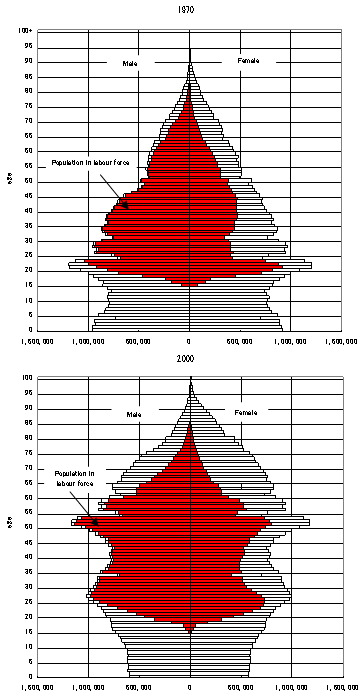
Japan’s birth rate has been slow for some time, but now the rate has slowed below what was predicted. The national birthrate in Japan is down to 1.29 (just a shade below), marking its lowest point ever. The rate has been low for some time, but the fact that it is still going down is a worrying point for the country.

PopchThe immediate concern is for retirement pensions: supported by the present workforce, it buckles when the number of retirees swells and workers shrinks–and that’s just what is happening. The post-war baby boom is close to retirement, and Japan has fewer young people working to support them.

Fixes have been in the works for years. As early as 1980, Japan required the minimum mandatory retirement age to be gradually raised from 55 to 60, the goal to be reached by 1998; in 2000 (and through to 2004), the youngest permissible mandatory retirement age was raised again to 65, to be reached by 2013. With the largest number of retirees reaching retirement age at present, it is unlikely that future boosts would do anything in time.

There is also an economic reason to avoid hikes in the mandatory retirement age. Japanese men often wish to work beyond that age, and companies take advantage of that, sometimes forcing them to retire, and then accepting them back afterwards at greatly reduced pay rates. Sometimes the retirees could not even achieve that; many switch over to what are effectively make-work jobs. Try parking a bike outside a train station before 10 am–you’ll likely be approached and chided by retirees working as bike parking police.

The decrease in the birth rate also affects my own profession, colleges. The decrease in population will continue for another few years and will then level out, but the overall number of students is also at a record low. In a few years, the number of students of college age will, for the first time, fall to or even below the number of available openings in colleges and universities. Fortunately for my school, Japanese institutes of higher education are slow to change; they are still stuck in the same mode they were when applicants far outstripped available seats, and when what you studied was less important than what school you got into. They still focus less on delivering an actual education at a time when businesses no longer wish to spend money to train workers themselves, as they did during the boom years. As a result, colleges which aim to deliver marketable skills are still not so common in Japan, making foreign institutions such as my own more attractive to students who look forward and see what will work best for them.

Categories: Focus on Japan 2005 Tags: