Archive

Archive for September 25th, 2006

Using Parallels on a New 24-inch iMac
September 25th, 2006 1 comment

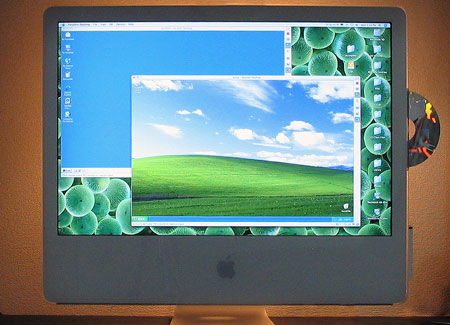
Parascreen
W2K and WXP alive on the Mac. Note the backlight, by the way; I find it helps a lot to make the screen brightness easier on the eyes.

The first thing you should know about running Parallels if you have one of the new Core 2 Duo iMacs is that the version of Parallels that download directly from their site won’t work–it will cause kernel panics, crashing your machine from the start. Instead, you have to get the latest build–which, at the time of this writing, is build 1908, which can be downloaded from this page.

Once you have that, it’ll all be cool. I installed Windows 2000 for starters, from an install disk my school gave me (we no longer use the OS, so they gave me a spare). With the new version of Parallels, it installed very nicely. When you make a new virtual machine, you’re supposed to check the CD-ROM settings to make sure that the optical drive will be recognized properly; since I was installing from a CD, the native settings were all I needed. Then you click the “Play” button on the right-hand toolbar (where the original version of Parallels would crash) and a virtual DOS setup starts, recognizes the CD-ROM, and you go from there.

After it installed, the Windows 2000 OS seemed to run fine–but was limited to a screen resolution of 640×480 pixels and a color depth of 4-bit (16 colors). It turns out that you have to install “Parallel Tools” in order for the W2K drivers to recognize your actual PC hardware. To do this, you go to the “VM” menu and select “Install Parallel Tools…” while your virtual OS is running. Then color and resolution work however you want them to. After you shut down the virtual OS, you can even go into “Edit” mode and create custom screen resolutions to fit your fancy.

After that test, I tried installing Windows XP, and had the same result–it installed just fine and started running without incident. In fact, XP instantly recognized my screen size, and allowed for better display settings from the get-go. However, there is still a big advantage to installing Parallel Tools: smooth transfer between operating systems.

In default mode, each virtual OS within Parallels will “capture” the attention of your cursor; the cursor will only stay within the bounds of the Windows virtual desktop, even if the virtual machine is not full screen. In order to get back to the Mac OS, you need to hit the Control and Option keys simultaneously. After installing Parallel Tools, however, this is no longer necessary; instead, the cursor will simply switch to whichever OS it happens to be hanging over at the time, making for much smoother transitions.

Switching to a full screen is similarly easy to do. Just hit Alt+Enter, and a nice Mac rotating 3-D cube effect switches you to full-screen mode in Windows. In fact, once you enter full-screen mode, Parallels automatically adjusts the Windows OS screen resolution to match your monitor, so the resolution remains clear and sharp. In addition to allowing full video control and smooth cursor transfer, Parallels Tools allow for audio to work well, cross-OS copy-and-pasting (text and small images only, at present), and shared folder privileges. At this time, Parallels does not allow for drag-and-drop transfers between OS’s–but give them time, and probably they’ll get that enabled as well.
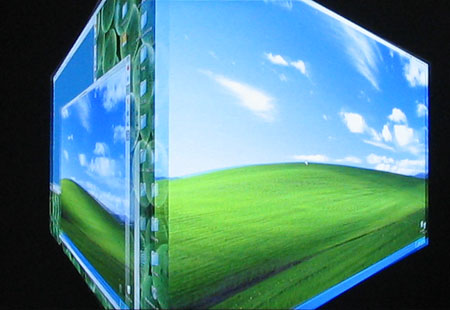
Paracube

If you have an Intel Mac, want to use Parallels, but are having trouble, check out the Parallel Forums. For some reason, Parallels doesn’t appear to have a link to here from any of their main pages–but it is a enormously useful resource.

Categories: Mac News Tags:

They Weren’t Wrong, They Just Lied

September 25th, 2006 Comments off

Me, August 27, 2002, six months before the Iraq War began:

Cheney argued that “extremists in the region would have to rethink their strategy of jihad.” Is he truly so utterly naive? An unsupported attack by America on an Arab nation would generate such fear and hostility in so many people that extremists would be swamped with volunteers willing to die for their cause. It would fire the call for a greater jihad, not frighten the extremists into impotency. Conflict is the friend of the terrorist.

The National Intelligence Estimate (“the most authoritative documents that the intelligence community produces on a specific national security issue”) today, three and a half years after the war began:

A stark assessment of terrorism trends by American intelligence agencies has found that the American invasion and occupation of Iraq has helped spawn a new generation of Islamic radicalism and that the overall terrorist threat has grown since the Sept. 11 attacks. … Titled “Trends in Global Terrorism: Implications for the United States,” it asserts that Islamic radicalism, rather than being in retreat, has metastasized and spread across the globe.

An opening section of the report, “Indicators of the Spread of the Global Jihadist Movement,” cites the Iraq war as a reason for the diffusion of jihad ideology. The report “says that the Iraq war has made the overall terrorism problem worse,” said one American intelligence official.

So, Negroponte could’ve saved a lot of time and money just by hiring me four years ago. Or, to be honest, just about any one of the thousands of voices crying out the same thing at the time. I’d like to say that I was ahead of the curve, that I was a keen predictor of future events, but frankly, this prediction was so goddamned freakin’ obvious that even a ten-year-old could’ve seen it. This is not a matter of Bush and Cheney being proved wrong, it’s a matter of the issue being so clear that they must have known it was wrong.

I think this demonstrates the fact that Bush and Cheney are simply not concerned about terrorism. This is also blindingly clear. Invading Afghanistan was nothing to them but a pretext for invading Iraq, their real goal. They gave up on hunting down bin Laden the first chance they got. They farmed out that goal to people they knew wouldn’t do as good a job as our people would. Once public attention turned to Iraq, they abandoned Afghanistan and allowed the Taliban to return. They have completely failed to secure our country against terrorism domestically, failing to guard ports, cities, and major facilities like chemical plants. They play with terror alerts as if they meant nothing, so they can get poll bounces at election time. They have spent literally hundreds of times more money on giving tax cuts to wealthy people and corporations than they have spent directly on terrorism. They have made only the most token efforts to do these things, only just enough so they can say they’re doing something, but not even a fraction as much as they would be if they truly were concerned about terrorist threats.

This administration has shown without any doubt that terror is nothing but a prop to allow them to focus on a neocon geopolitical agenda. Period.

Categories: Political Ranting Tags:

Subtle Snow Job?

September 25th, 2006 Comments off

A lot of people seem to be presuming that the pricing of movies on the Apple iTunes Store is based upon how new they are–that new movies cost $15 and older titles are $10. Just to clear up a point, that’s not how they’re doing it. That was the rumor mill talking. Actually, Apple just has two-tier (actually, three-tier) pricing. If you look at the online store, you’ll see that some titles as far back as the 1940s are priced at $15, and some titles from just last year are priced at $10.

However, the misunderstanding is not wholly due to the rumor mill. You’ll note that Apple never actually says that new movies are $15 and old ones are $10–but when he introduced the service, Steve Jobs certainly made it seem that way. He said that new titles could be pre-ordered for $13, and would be priced at $15 after they were released–which makes it sound like the $15 pricing is reserved for new titles, but it’s not. Sure, all new titles do get that price, but a lot of older titles get it as well. Additionally, the $10 price range is applied to what Apple calls the “Library,” which again is unclear but sounds like we’re talking about older movies.

In fact, the two-tiered pricing simply applies in whatever way the movie studio decides. Disney has priced all of its animated features at $15, including decades-old titles like Dumbo, Cinderella, and The Aristocats. Meanwhile, poorly performing titles from 2005 such as The Brothers Grimm, Herbie: Fully Loaded, and The Hitchhiker’s Guide to the Galaxy are priced at $10.

So don’t expect to be able to get your favorite movies for $15, unless you like movies that most other people don’t. Apple didn’t exactly lie on this one, but they did mislead–though there might be a reason beyond sales to explain it. Jobs has long tried to protect his coveted one-price-fits-all philosophy for online sales, while the movie industry has tried to get him to do tiered pricing, a more whatever-the-market-will-bear philosophy. Jobs lost on this one, and it may have been a bitter pill to swallow; the “new releases” angle may have been a bit of face-saving in that regard.

Categories: Mac News Tags: