Archive

Archive for September 30th, 2006

Hastert Knew

September 30th, 2006 1 comment

Oops. Just after posting the last entry, I saw this story:

The resignation rocked the Capitol, and especially Foley’s GOP colleagues, as lawmakers were rushing to adjourn for at least six weeks. House Majority Leader John Boehner (R-Ohio) told The Washington Post last night that he had learned this spring of some “contact” between Foley and a 16-year-old page. Boehner said he told House Speaker J. Dennis Hastert (R-Ill.), and that Hastert assured him “we’re taking care of it.”

That with Hastert’s denial on the record that he didn’t know about it. OK, so it was Hastert’s spokesman, not Hastert himself, who denied it (sock puppets can be a wonderful thing, can’t they?). Even if Hastert isn’t made responsible for the initial denial, there is still the small matter that Hastert was told that there was an active pedophile sexual predator in his ranks, that he said he’d “take care of it,” and he didn’t. The guy continued sending lewd text messages to underage pages.

This should be quite the pre-election story…

Categories: Political Ranting Tags:

Republican Family-Values America, 9/30/06

September 30th, 2006 1 comment

“Flat Daddy”? My god, this belongs in The Onion, not The New York Times. On one level, I suppose I can see that it keeps an image in childrens’ minds… but on another level, it seems incredibly cruel. And if nothing else, it points out how badly troops are being kept fighting in a war beyond the tours of duty they signed up for. “Backdoor draft,” “stop-loss,” declining recruitment, and now “flat daddies,” for a war we never even should have entered. It’s sick.


Meanwhile, Republican Jeanine Pirro, formerly the GOP’s best-and-brightest challenger to Hillary Clinton in the New York Senate race, is having… um, issues. After an inauspicious start, Pirro’s campaign floundered, and then she gave up against Hillary, and started to run for New York Attorney General. You know, the top “law enforcement” official in the state. Except now, she’s caught up in a little scandal: she believed her husband was cheating on her, so she attempted to abuse a little power, and get someone to illegally spy on him.

Unfortunately for Pirro, she chose Bernard Kerik, a Bush biggie who served as Interior Minister in Iraq and was nominated to head up U.S. Homeland Security, but was found to have been involved in various crimes, and eventually plead guilty to two misdemeanor charges. And his phone conversations were being recorded. Pirro is quoted as saying on the tapes, “What am I supposed to do, Bernie? Watch him f–k her every night? What am I supposed to do?… I can go on the boat, I’ll put the f—–g thing on myself.”

Now Pirro is playing the victim, claiming that the real criminal is the one who released the tapes, and is calling on Bush Attorney General Alberto Gonzales to look into the matter. You can’t make this stuff up.


But that’s not the big news. Straight out of Family-Values Republican-Land: A Republican congressman resigned after it was revealed that he’s a pedophile sexual predator–or at least sounds like one, having sent text messages to teenage male pages in the House. While he initially denied impropriety (the first revealed message could conceivably been simply a request for a page’s photo so the congressman could remember him better), claiming he was simply “overly friendly,” subsequent reports from other pages reveal messages including ones where he asks what they’re wearing, and then suggests disrobing them. There’s other sordid stuff, too.

Even worse, it seems that Republicans knew about this since about a year ago, when the initial page’s complaint was made. The congressman he worked for, Republican Rodney Alexander, says he told majority leader John Boehner, another Republican, as well as Thomas Reynolds, Republican chairman of the House Republican campaign organization. Then the House Page Board’s Republican member investigated Foley’s conduct with pages and the text message thing. A report was sent to Speaker Hastert’s office, but Hastert now claims he wasn’t informed. The Democratic member of the board was allegedly not informed of the matter.

So it’s looking more and more like a lot of Republican higher-ups knew about this, and covered it up. Hastert is promising an “investigation,” which will have to be closely monitored or it will simply be another cover-up. As it is, this quick “investigation” is likely the GOP’s best only way to set the issue aside before elections. Hopefully, the issue will be sufficiently juicy enough for the media to take it up.

Needless to say, it looks like the Democrats will pick up at least one seat over this….


I sometimes wonder how some bloggers get their blogs listed in Google News. Take this site, titled “Stop the ACLU,” a far-right-wing smear site. It’s not just that they’re so political, it’s that they apparently revise their web site without public notice. I found this listing on Google News:

Staclu-930

If you can’t read that, the headline is, “Mark Foley’s ‘Crime?’ Being a Gay Republican,” and the story snippet reads, “So right now, we know as fact that Mark Foley is not a pedophile, he has not broken any sexual consent laws nor has he violated any marriage vows….” The story was listed as new, and the URL tags it as 9/29/06. Interested in how they knew all this “as fact,” I went to their web site–and found that they had trashed the story, and replaced it with another one that didn’t directly address the bogus gay=pedophile issue, with no editor’s note about why the change was made. I’d love to see the entire original story, but can’t find a cached version of it anywhere.

If a site like that can get listed in Google News, then heck, maybe I should try to get listed. It would sure be a boon to visitor numbers…

Categories: Political Ranting Tags:

Dead Pixel, Stuck Pixel, Dim Pixel, Fine Pixel

September 30th, 2006 2 comments

As I mentioned before, when I got my new 24-inch iMac, my initial worry was dead or stuck pixels. I thought there was one dead one, but now I’m not so sure. Let me explain from the beginning.

A “pixel” is named after the words “picture element,” and refers to a single dot on a computer display. It’s an element because you can’t divide it further (in one sense). Each dot, or pixel, has its own unique color. Your display’s image is made up of perhaps over a million such dots. The computer generates the display image by telling each pixel exactly which color it should take for any given refresh of the screen, and there are perhaps 60 or so refreshes per second.

The old, heavy CRT monitors “painted” the pixels on the screen, line by line, and could change the number of lines (rows of pixels) flexibly; this allowed them to change resolution (number of pixels on the screen) and still maintain a sharp, clean image. Because they “painted” the pixels with color guns, you never had problems with individual pixels on CRTs; instead, if one of the guns failed, you’d have a discolored screen.

The new, thin LCD monitors work differently. In these monitors, each pixel is a physical entity on the screen; each pixel is its own mechanism. If you peer really, really closely at your LCD screen (preferably on a white area), you might just be able to squint and see the tiny lines, little rows and columns of teensy little squares. Those are the physical pixels of the LCD monitor. Here’s an image to save you some squinting:

Lcd1

Now, getting closer…

Lcd2

And closer yet…

Onepixel

Now you can see what a pixel on an LCD is really like. As you can see, each pixel actually has a red, green, and blue element. Those colors are the primary colors of light. By changing the brightness of each of the three colors from zero to full, you can create any color the human eye can see. For example, if you turn the red and green pixels on full and turn off the blue pixel, you get yellow. Turn on the red and the blue and turn off the green, it’ll be purple (magenta). Turn all three on full, it’ll be white; turn all off, and it’s black.

So actually, each LCD pixel has three parts to it, each one working independently. My LCD screen has 1920 x 1200 pixels, or 2,304,00 pixels. Count the color elements, and the LCD screen has 6,912,000 working parts.

We whine about dead and stuck pixels, but when you consider it, the ability to make a very expensive single piece of equipment with almost seven million working parts and not a single one of them failing–well, that’s one hell of an accomplishment, when you think about it. Frankly, it’s amazing they can make such screens without any malfunctioning pixels.

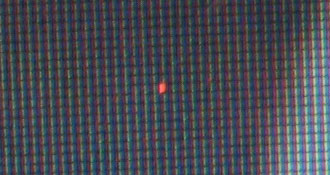
But parts do come out bad, and that’s what we have to deal with. The two most common ways for an LCD screen to have something wrong is with “stuck” pixels and “dead” pixels. In each case, it is commonly not the entire pixel, but usually one color element within the pixel that goes bad. In a “stuck” pixel, one of the color elements turns on and never turns off until the monitor is shut down. A “dead” pixel is the reverse–the color element, or sometimes the whole pixel, remains dark. Here are a few examples of “stuck” pixels:

Stpx1-1

Stpx2-1

Stuck pixels show up best against a dark screen, so you’ll notice them most when you’re watching a video with dark scenes.

A “dead” pixel will appear to be a tiny speck on your screen–you will often mistake it for a bit of dust, or conversely, you’ll mistake a piece of dust for a dead pixel. Here’s one that was on my Powerbook screen, before I had it swapped out last month:

Lcd4

Only the green element was dead, not the whole pixel.

So, getting back to the subject I started with, my new iMac. When I got it, I noted that there was one dead pixel up near the top left of the screen, apparently with the green element out. It seemed even smaller than I had seen a dead pixel look like before. At first I thought it was the larger screen and the pixels were smaller, but that’s not the case–Apple keeps the pixels about the same size.

So I decided to photograph it, that being the best way to see tiny details too small for the naked eye. Strangely, the photos showed no dead pixel elements. I looked at the monitor with my eyes, and sure enough, there was the dark dot. What the?

I started up Photoshop, and created a red, green, and blue image. By moving each color over the malfing pixel, I could see which elements might be mucked up. Sure enough, when I looked at the blue and the red, the dead pixel “disappeared”; when I put it on green, the dead pixel stood out. It was the green element, all right.

So why were my photos showing no dead pixels? After a bit of experimenting, I found out why: the pixel’s green element isn’t dead–it’s dim. I’d never heard of that before, but there it is. Here’s an image of the pixel with a green image; the red and blue elements will be dark, accentuating the green. You have to look carefully to see the one green element that’s dimmer than the others.

Dimpixel

Can you see it? It’s on the same pixel row as the horizontal bar of the “plus” cursor, with the arrow pointing at it.

Frankly, I’m amazed I even noticed it with my naked eyes–I must have pretty good vision. That explains why it’s not so dark as a dead pixel, and probably why I have to strain to even see it. I never even knew pixels could be permanently dim like this–now I do.