Debunking Fox

January 23rd, 2007 6 comments

Wow. Very rarely does the media go for actually defending a Democratic candidate rather than joining en masse to repeat the smear. Usually the media just gloms on to a lie like this and then goes silent when the truth is made clear.

This time it is a rumor that Barack Obama attended an Islamic Madrassa school, like those in Pakistan, which teach hardcore Islamic hatred of Christianity and the West. The rumor was released by a right-wing site (owned by the Washington Times), which in a double-whammy claimed that the rumor came directly from Hillary Clinton, despite naming no names and producing no documents to back that up. Fox News immediately jumped all over the story, gleefully broadcasting what amounted to a huge smear on both front-running Democratic candidates, and the deepest right-wing elements of the media and blogosphere began their swarm.

As for the Hillary part of the smear, Insight.com is standing by its story, saying that they had direct contact with “researchers connected to Senator Clinton” who said that:

“Ms. Clinton regards Mr. Obama as her most formidable opponent and the biggest obstacle to the Democratic Party’s 2008 presidential nomination. They said Ms. Clinton has been angered by Mr. Obama’s efforts to tap her supporters for donations.”

When you consider this, it comes across as the biggest load of crap ever heard. One of the things about Clinton is that she is a savvy political operator, and her campaign doesn’t make completely idiotic newbie mistakes. So for her own researchers to go to a right-wing organization, and to say, “hey, tell everyone that Hillary hates Obama and wants to trash him!” is so stupidly and transparently a lie as to be laughable.

This is where organizations like CNN usually chime in with the popular smear, ignoring little details like the one I just mentioned and foregoing things like investigating the truth first. In a turnabout from their usual routine, however, CNN is now savaging the rumor, calling it, accurately for once, a right-wing smear. Wolf Blitzer is even making a big deal about it, saying that “CNN did what any responsible news organization should do,” which is investigate the claim. Yeah, as if that’s what they have always done. Instead, this time, they actually went to Indonesia, discovered that the school was not a madrassa but instead a normal school where Christianity was taught side-by-side with Islam (but only once a week for both), and that there’s nothing subversive or dangerous about anything there–nor was there ever. But CNN didn’t stop there, they also went to lengths to show where the smear was coming from; Blitzer repeatedly mentioned Fox and “right-wing” news organizations and blogs as being responsible for spreading the story, and pointed out the connection between the conservative Washington Times and the web site that began the rumor.

Well, better late than never.

Categories: GOP & The Election, Media & Reviews Tags: by

Macs in Atlantis

January 22nd, 2007 4 comments

I was kind of surprised to hear this Apple reference in a Sci-Fi TV show, and more surprised that no one on the Mac sites seemed to catch it. It was in an episode of Stargate: Atlantis, in an episode where a civilization’s re-emergence was delayed by a computer malfunction:

Herick: Defeat was expected, but the computer was supposed to extract me automatically. In order to restore the others.

McKay: Unfortunately, the computer froze. It was completely locked up. Probably should have used a Mac.

Shouldausedamac

Indeed!

Categories: The Lighter Side Tags: by

Question

January 22nd, 2007 3 comments

How many Americans are there out there who still do not see Lieberman as a de facto Republican?

Categories: Political Ranting Tags: by

Biting Irony

January 22nd, 2007 Comments off

Wow. A post on Daily Kos which shows up the administration’s hypocrisy in pronouncing “National Sanctity of Human Life Day,” using quotes from the White House’s announcement set against photographs showing what happens to people under the Bush administration. Chilling.

Categories: Political Ranting Tags: by

Mega Mac

January 22nd, 2007 3 comments

McDonald’s Japan has a new product campaign going on now. I don’t know if it’s also being sold in America (their web site doesn’t show it), but it seems strangely un-Japanese. It’s called the Mega Mac, and it is essentially a double Big Mac, or at the very least, a double-Double-Burger. Here’s their graphic for it from their web page:

Megamac

According to their “nutrition” info, it’s got 750 calories and 46 grams of fat in it. In the regular “set” menu, it includes a medium fries (420 cal., 22g/fat) and a medium coke (140 cal.), for a whopping total of 1,310 calories and 68 grams of fat. For lunch. In Japan. This is not going to help Japan’s fight against recent trends to obesity in a country famous for slim, long-lived people. Which is also why it’s surprising that it’s being sold in Japan, and not in the U.S., where there seems to be more of a trend toward chicken and salad-based meals.

And the amount of fat is pretty disgusting. For a 2000-calorie-per-day diet, the Mega Mac set meal delivers just a tad more than the 65 grams of fat you’re supposed to get, and that’s just for one meal. You’re also getting more than lunch’s share of calories, leaving only about 700 for the other two meals of the day.

If I thought I could get a straight, accurate answer, I’d stop by one of their busier shops and ask how well the Mega Mac was selling. But then, if I could get a straight, accurate answer, I’d almost be afraid to ask.

Categories: Focus on Japan 2007 Tags: by

Which One Is Different… ?

January 22nd, 2007 Comments off

Here is a sampling of the headlines from major news services reporting on Hillary Clinton’s announcement to join the 2008 presidential race:

MSNBC: Clinton voices confidence in her 2008 prospects
CBS: Hillary Clinton Awaits “Great Contest”
ABC: Clinton Confident in Her 2008 Prospects
CNN: Hillary Clinton launches White House bid: ‘I’m in’
BBC: Hillary Clinton Joins 2008 Race
NYTimes: Clinton’s Success in Presidential Race Is No Sure Thing
LA Times: Clinton joins 2008 race for president
Boston Globe: Clinton gives her answer to voters: I’m in

And then, the lead Fox News story highlighted on Google News:

Fox News: Fear and Loathing on Sen. Clinton’s Trail

The story, actually, is written by someone at RealClear Politics, a right-wing site, and focuses on how Obama will sink a Clinton candidacy, and uses expressions like “discombobulated near-panic” and “liberal candidate” (as opposed to “Democratic candidate”).

Nice to see they are so vociferously fighting to maintain their fair and balanced perspective. While they don’t seem to be pitching that line too much any more, they still print the slogan, “We report; You decide.” Which, in line with its obvious falseness, brings to mind the fact that if they weren’t slanting their news so egregiously, they wouldn’t have to emphasize the idea that they weren’t trying to plant preconceived notions in readers’ minds. Kind of like a used car dealer calling himself “Honest Joe’s.”

Categories: Media & Reviews Tags: by

Subtle Bias

January 21st, 2007 2 comments

There is a sign on the front door of Mizuho Bank that has caught my attention every time I go to that branch. After seeing the exact same sign on another Mizuho Bank across town, I decided it was worthy of general note. Take a look at the sign and tell me if you can see what problem I have with it:

Policesign

Of course, it is not a problem with the grammar, spelling, or anything else about language; this is not a case of “Engrish.” The problem I have is when you compare this sign to almost all other bilingual signs in Japan. Check out these signs in the Flickr pages here and here (if they have disappeared, copies are here and here), for a quick, general comparison. Note that Japanese is on top and English is below. Also, although English is sometimes the same font size as the Japanese, it is usually smaller.

However, in the sign that graces the entrance to Mizuho, English is prominently on the top of the sign, and the lower half of the sign is in Chinese. Not Japanese.

The sign is aimed at foreigners, a subtle point made by the prominence of English on the sign. Japanese can read the sign easily enough, but the message is that the bank expects English- or Chinese-speakers to be the chief perpetrators of crimes at their establishment. The bank is clearly showing that they expect their foreign visitors to be much more liable to commit a crime.

Not a very welcoming message–though I would not be surprised if the people at the bank had no idea what message the sign was giving to non-Japanese. I have found that when this kind of bias appears in Japan, most Japanese are fairly blind to it.

I am thinking of going to the bank sometime soon and telling them what impression the sign gives, just to see what they would do about it.

Categories: Focus on Japan 2007 Tags: by

Do You Think That’s Really Necessary?

January 20th, 2007 Comments off

I saw something on the road last night that made me smack myself for not having my digital camera with me. There was some road construction going on, and so they had a setup to warn people at a distance, so they would merge right and not hit the construction area.

Now, you might not think that would be worthy of taking a photo and blogging on it. But this warning display was different. It consisted of a vertical array of electronic lights that easily reached 25 feet in height, and was at least 10 feet across. This was nighttime, so it all stood out like a sore thumb. There were orange lights arrayed across the bottom. Above that was one of those electronic message boards that scrolls messages across from one side to the other. Above that were giant yellow arrow chevrons, animated to point you to the right. Above that were flashing yellow “rollers,” the kind seen atop police cars in red and blue (and in Japan, often used outside gas stations). And to top it all off, at the zenith of the sign there were two big bright red circles, divided into pie slices, with the slices turning on and off in a rotating fashion–the one on the left going clockwise, the one on the right going counter-clockwise.

I mean, talk about overdoing it.

But that’s not even the funny part. Here we had this gigantic sign, visible from a mile away, flashing and moving and gyrating all to hell, almost blinding you with its brilliant warning. And at the bottom of the sign, invisible until you got fairly close, was the ubiquitous guy whose job it was to wave a little red baton back and forth.

I laughed so hard I almost had to pull over.

Categories: Focus on Japan 2007, The Lighter Side Tags: by

Par for the Corpus

January 19th, 2007 Comments off

Alberto Gonzales should be ashamed of himself, and run out of Washington, D.C. Just when you think the guy who legalized torture couldn’t go any lower, here we go again:

Arlen Specter: Now wait a minute, wait a minute. The Constitution says you can’t take it away except in the case of invasion or rebellion. Doesn’t that mean you have the right of habeas corpus?

Gonzales: I meant by that comment that the Constitution doesn’t say that every individual in the United States or every citizen has or is assured the right of habeas corpus. It doesn’t say that. It simply says that the right of habeas corpus shall not be suspended.

Uh huh. So, while the right of habeas corpus may not be denied, the people don’t actually have the right.

But then, you have to remember that this guy got his big break when he got George Bush Jr. out of jury duty when it became clear that Bush would have to perjure himself in court or reveal that he had been arrested for drunk driving.

The First 100 50 Hours

January 19th, 2007 2 comments

The Democrats have now officially finished their “First 100 Hours” legislation barrage, in less than half the promised time. The initiative was completed when the Democratic-controlled House passed an Energy bill with a 264-163 majority, not enough to override a presidential veto. The bill passed by the house would raise $14 billion in revenue over 10 years by forcing oil companies to pay the tiny, meager royalties they are supposed to for drilling for oil on public lands, and rolls back tax breaks that save the oil companies billions even as their profits soar to ludicrous highs. Unsurprisingly, the bill is supported by a majority of Americans, though at 61% it is one of the less-popular items on the Democrats’ agenda.

According to a new survey, the most popular item in the 100-Hours lineup was the minimum wage hike (81%), followed closely by the Medicare prescription drug bill (80%) and the student load rate cut (79%).

Other good news for Democratic lawmakers: Although the approval rating for Democrats in Congress hasn’t changed too much, at 42% they are more popular than Bush right now, and besides, Congress always polls very low. But Pelosi has reason to be happy: her positives have risen from 27% to 34% over the past two weeks, and only 21% regard her unfavorably (compared to Newt Gingrich, who at this time in his leadership had 26% positive and 39% negative). So much for the conservative claims that Pelosi is the most-hated politician in Washington. The only reason her positives are only a hair below Bush’s is because 41% still haven’t heard much about her. Another way to look at it is that Bush’s negatives are triple what Pelosi’s are.

The only damper on the celebration: the Senate. Even though Democrats control the Senate, they do so by a razor-thin margin, and even though there is surprising Republican support for several of the 100-Hours measures, Republicans in the Senate may yet be able to filibuster most if not all of them, saving Bush the embarrassment of whipping out his promised and virtually-unused veto pen for bills that have overwhelming public support. Of course, Senate Republicans will have to deal with the embarrassment of filibustering after having for so many years claimed that it was a vile, despicable act.

The Democrats, in the meantime, are not embarrassed at all about denying Republican lawmakers from saturating the 100-Hours legislation with poison pills by denying them the ability to amend the legislation before a vote. For all their whining about being “treated fairly,” after so many years of crushing the Democrats, having to put up with the same treatment for just a few weeks is chicken feed. If the Democrats go for the next decade or so in the same fashion, then the Republicans can start saying something, but frankly, the Democrats just don’t have as much ‘nasty’ in them as Republicans do, which is a good thing and a bad thing; Republicans will get far better treatment from the Dems than the Dems got from them. Not that this will stop the Republicans from continuing their whining, of course.

Categories: Democratic Controlled Congress Tags: by

McCain the Flip-flopper

January 19th, 2007 Comments off

If Republicans had a field day labeling John Kerry as a “flip-flopper,” then Democrats should have a bonanza with John McCain. After having been smeared by Bush with the assistance of the far right, McCain realized that he’d have to kowtow before the extremists if he wanted to be president, and has been busily prostrating himself before them, abandoning his prior “maverick” status. The Carpetbagger Report lists 15 significant McCain flip-flops over the past few years.

McCain used to support reproductive rights, gay marriage, campaign finance reform, and grassroots lobbying reform; now he’s against all those things. McCain used to be against torture, tax cuts for the rich, and ethanol subsides; now he’s for all of them. McCain used to disapprove of people like Jerry Falwell, Sam and Charles Wyly, Henry Kissenger, and Grover Norquist, but now he’s warming up to them for support. He has also flip-flopped on Martin Luther King Jr.’s birthday as a holiday, state support for the Confederate flag, and politicians visiting Bob Jones University. And he now claims that he always thought that the Iraq War would probably be “long and hard and tough,” even though he originally said that we would win the conflict easily.

Who knows, there might even be enough video material in there to make a good commercial. But one thing is for certain (and I’ve said this before), McCain is no longer someone who will appeal to Democrats or Independents like he did in 2000. He may now have the support of the far right and the religious extremists, but he has hobbled himself for the rest of us–and 2006 demonstrated that the extremist right is no longer what it used to be.

Categories: GOP & The Election Tags: by

Bits & Pieces, January 18, 2007

January 18th, 2007 Comments off

There is a complication in the Scooter Libby trial that might not have been anticipated: so many people hate the Bush administration now that it would be hard to find an impartial jury. But that could go the other way as well: of the remaining people who don’t hate the Bush administration, most of those people are the wingnuts, whose bias interferes equally as much, if not more.

Can one evade a trial by dividing the nation so much that finding unbiased jurors is impossible?


The Bush administration is now claiming that it is no longer wiretapping without a warrant. But since the agreement with the secret court is itself secret, and since I wouldn’t trust that the administration is not doing all kinds of crap off the radar, one can take that with whatever size grain of salt you prefer.


Apple posted a bigger profit than ever before, mainly based upon iPod sales. Profits rose 78% over last year. Computer sales were also up 28%, with Gartner showing a corresponding 30% increase in market share, which they now tag at 5.1% of the U.S. market. iPods sold like crazy, and Apple stores revamped stores to create express lanes so sales could go more smoothly. And yet, Apple’s stock slipped $2 or so because of Apple’s prediction of a slow second quarter (which is usual), and because of tech stocks declining in general.


Before you snicker too much at the “world’s smallest dongle,” have a look at it. Not a bad way to add BlueTooth to your computer. If you have a Windows PC, of course–Macs all come with BlueTooth built-in. Well, OK, it’s optional on the Mac Pros, but expect that to change to built-in soon.

Categories: Political Ranting Tags: by

Were We Right? Was I Right?

January 17th, 2007 3 comments

Kevin Drum brings up an interesting point: liberal hawks are saying that liberals who were against the Iraq War before it started don’t deserve credit because “the war has gone badly, but not for the reasons the doves warned of.” This strikes home a bit, because that’s exactly what someone close to me told me several months ago–with him being the liberal hawk on Iraq and me being the dove.

In one sense, it’s an unfair charge–to suggest that one could have predicted specific bad policy moves like allowing looting to go unchallenged, or having the Abu Ghraib scandal come up, this would be asking too much of the critic.

However, I think the central idea of the hawks’ criticism is that mismanagement by the Bush administration, more than anything else, caused the failure we see today, so if the doves did not predict that the war would be lost due to mismanagement, then we may have been on the right side but for the wrong reasons. I disagree with this partially because it is over-simplistic; mismanagement is undoubtedly one of the major reasons the war has failed, but certainly it is not the only reason.

Foreseeing mismanagement over all else is not a simple thing to ask. There were, after all, a great many reasons not to go to war. Drum had trouble reviewing the initial criticism because the archives did not seem to be immediately available. In my own case, I have no such trouble. My own writing on the subject is still available.

This was back in August 2002, before I started the blog officially. Back then, I had little idea of what a blog was. I had secured the blogd.com domain, and put up what I called a “blog,” but it was really just a handmade web page with a few essays on it. I didn’t go to Movable Type until the following spring, just as the war was starting. But my original writings still survive.

It is interesting to go back and look at them, to see what I was predicting six months before the war started and comparing it to what actually happened. As can be expected, my prognostications did not all come true–but I am still pretty surprised at how accurate I was. I made one whopping wrong prediction, put emphasis in some of the wrong places, and did not foresee a lot of the specifics–but for an amateur, I think I did pretty damned well.

I even believe that I can make the case that I predicted mismanagement would be a vital element. Right at the beginning of the essay, I wrote this:

The arguments for getting Saddam out of power are easy: he’s a dangerous madman, and we could overwhelm the Iraqi military. But the question is not should Saddam go, or could we win in a limited conflict: the question is, how can we do this without bringing about catastrophe? Imagine that rats have infested your home. There is no question that they must go; but do you exterminate them by taking a flamethrower to the building? Method is crucial.

True, I did not specifically say that Bush would make a series of colossal blunders that would lose the war, but how much can you ask? There is more that I said which touches on the theme near the end of the essay; I’ll get to that below.

After that introduction, I made many points about why the war should not be prosecuted. Let’s take a look at them. I began with the forming of a coalition:

First is international support. There is none. A coalition is vital to carrying out an armed conflict in the Middle East, and not only is there no coalition, but it appears that at this point, a coalition would be impossible to form. This is primarily due to Bush Jr.’s poisoning of the well; from the start, he has disrespected world opinion, breaking treaties left and right, and has pushed forth self-serving agendas without any concern that it was generating outrage around the globe. Add to this the fact that Bush started promising war on Iraq without any consultation with our allies, and you have an atmosphere in which no one would want to support us.

Although a Bush supporter would say that we got a coalition together with broad international support and that only weenies like France or enemies like China opposed us, the fact is, the “Coalition of the Willing” was a joke from the start. The United Kingdom was our only serious ally, followed by a small number of low-to-intermediate powers like Australia and Poland, with the list padded out by non-powers like Costa Rica, which doesn’t even have a military. I would say that I was pretty spot-on in this prediction.

Next was financial cost:

The immediately obvious repercussion of the go-it-alone strategy is cost: This war could easily cost $80 billion, probably much more than that. Bush Jr. has already snatched a huge deficit from the jaws of a surplus, and the country can ill-afford to pay for a costly war all by itself. We’re already in big budget trouble, helping to push us into deeper into recession, but a war paid for by the U.S. alone could aggravate the national debt substantially; Bush Jr., in just the course of a few years, could erase more than a decade of red-ink recovery and send us into deficits that would dwarf those of the 80’s.

If anything, I understated this point. But I did say “probably much more than” $80 billion, and I was dead right on that one. I was also right on the deficits, though to be fair, the war spending is only partly responsible for that.

Next was international reputation:

But the cost would not simply be financial: we would also pay in terms of lost reputation, international respect and influence in world affairs. This is hard and vital currency for the United States, and its value would be decimated if Bush Jr. started a conflict in the Middle East that everyone, even his own people, disagreed with. Future presidents would be saddled by the body blow to our prestige, likely needing decades to repair the damage and to rebuild worldwide confidence and trust. This kind of irresponsible action could remove us from our already precarious seat of world leadership.

Again, I think my statement here has been pretty accurately borne out. The Iraq War has cost us in prestige and influence, and there is no sign that this will change for future presidents.

Then there was the more philosophical point of policy and principles:

It would also shred our own values and long-held respected policies, most importantly the policy not to strike first without provocation. And sorry, but an alleged meeting between a terrorist and an Iraqi agent coupled with completely unsubstantiated reports that Saddam could develop nukes “any time now” does not qualify as “provocation. …

In addition, if we toss aside this policy, it will provide justification for others around the world to follow suit. Consider India and Pakistan, as only one of many examples. Each of these countries has far more justification for invading the other than Bush Jr. has for invading Iraq. Each can point out that the other is not just developing nuclear weapons, but that they actually have them; each could call the other’s actions “terrorist,” and identify them as a clear and present danger. The policy of the pre-emptive strike is one that would be the father of countless wars and the orphan of peace.

This is a harder point to judge, because the danger lies in a shift of perception and how the history of the Iraq War is used in future politics and warfare. So far, there has not been a rash of pre-emptive warfare; however, the precedent now exists, and could be used in the future. On the other hand, since the precedent is tied to the massive failure in Iraq, it might not be too persuasive–but it still could be used as a technical justification. I’d call this prediction not quite debunked, but possibly overblown.

Next, Middle East Peace:

In addition to the wars the policy itself would spawn, there is also the specter of Armageddon rising in the Middle East as a direct result of a U.S. invasion. Already relations are tense, not helped by the confusion and neglect that the Bush administration has used to turn a region grasping for peace into a region torn by escalating conflict and little hope for even a cease-fire. But if the U.S. should invade with opposition from the Arab states, the hope for any peace of any kind will die a swift death.

This was clearly over-emphasized. That is not to say it was wholly wrong. The Iraq War has disrupted the peace processes, but not overly so. But the body of this prediction still lies in the future, and could come true. I hope not, but one look at Iran and you can see what I’m talking about. One thing that can be stated with certainty is that Bush’s war in Iraq has brought much more instability to the region, and has brought untold instability to Iraq itself.

But I continued the previous paragraph with this:

Contrary to the rosy the-Arabs-will-love-us-for-saving-them pipe dream that Cheney has been hawking, the Arab people do not and never have reacted kindly to U.S. intervention, even when their governments allow it; should we go in with everyone opposing us, tempers will flare further still. Cheney argued that “extremists in the region would have to rethink their strategy of jihad.” Is he truly so utterly naive? An unsupported attack by America on an Arab nation would generate such fear and hostility in so many people that extremists would be swamped with volunteers willing to die for their cause. It would fire the call for a greater jihad, not frighten the extremists into impotency. Conflict is the friend of the terrorist.

I could not have been more spot-on with this one.

But the next one was the whopper I got wrong:

And let us not forget the Israeli part of the equation: an attack by the U.S. would, without question, be answered by Iraq with missile attacks on Israel, just as it was in the Gulf War. The difference will be that this time, Israel will not sit back and take it without acting\they will retaliate, and that retaliation will bring outrage and reprisals from the Arab world. If it was unwise for Israel to answer an Iraqi attack in the Gulf War, when the Arab states supported the action against Iraq, how will an Israeli attack on an Arab nation be received now? It will be an open invitation to a region-wide conflict, with nuclear strikes being a highly likely result.

I was dead wrong here, but for good reasons. Hussein had responded to the Gulf War by attacking Israel, and there was no reason to expect otherwise in the second conflict. But thankfully, there were no such attacks, and things did not spiral out of control. I am extremely glad to have been wrong on this one, of course.

Then there were the nuclear claims:

Cheney recently asserted that “many of us are convinced that Saddam Hussein will acquire nuclear weapons fairly soon. Just how soon, we cannot really gauge.” In other words, there is no evidence whatsoever that Iraq is even working on nuclear weapons. Maybe they are, but if they are, we have no data to substantiate that claim. And let us not forget that we were fooled before: during the Gulf War, the Bush Sr. administration frightened us with the claim of a nuclear Iraq\but a 1992 study by atomic experts looking at International Atomic Energy Agency data revealed that Iraq never came close to building a bomb. With the claims being weaker now than they were then, we would be naive to presume that Cheney or anyone else spouting that rhetoric is not lying through their teeth.

I returned to being spot-on correct with this one.

After that, I went into a bit of detail about whether or not Bush had authority to prosecute the war without congressional approval; as that is less relevant to the war itself, I’ll skip over it, except to say that I was right–and Bush did, eventually, ask for (and unfortunately got) congressional approval.

I then made the last, big spurt of reasons not to enter Iraq, and hit the bull’s eye on many of them:

And then we come to the end game: what is the exit strategy? How long will it take? How many of our troops will die? How many Iraqis (whom the Bush Jr. administration claims to be acting to benefit) will we end up killing? How long will our troops be there? How deeply will we become involved in rooting out everyone there who violently disagrees with our occupation? And how will the nation-building succeed? What guarantees do we have that the moment we extract ourselves, another Saddam Hussein won’t pop up again and bring us back to square one? As far as I can determine, not a single one of these questions has been answered.

In this paragraph, I can again make a claim to having predicted mismanagement. I predicted the lack of an exit strategy, I predicted the insurgency, and I predicted post-withdrawal problems. To my detriment, I completely missed the sectarian problems and did not predict a civil war; I was simply unaware of that factor. Still, for someone not schooled in the details, I did a damned good job of predicting the dangers–even if I did not place enough emphasis on these points, and put too much on regional disruptions.

I also correctly predicted a potential quagmire, as well as large numbers of American and Iraqi deaths–but that was easy. Of course, I should still get credit, as administration officials and other war backers were saying that this would all be a cake walk.

I ended the essay with an analysis of Bush’s motivations, which, admittedly, was over-simplistic. At the time, I felt that his primary reason was to seek another bump in the polls. While that was certainly an element, it was likely a small one. But again, it was only peripherally relevant to the war itself.

Overall, I think I can claim a good deal of credit for critiquing the proposed invasion. What’s your take on it?

Categories: Political Ranting Tags: by

Asakusa

January 16th, 2007 1 comment

0107-Asakusa1-450

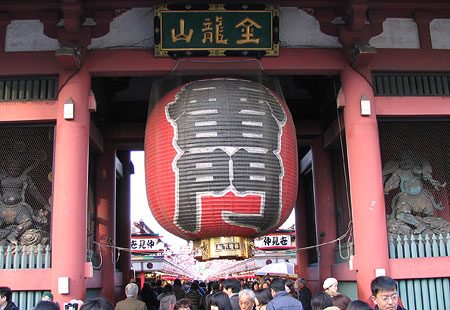
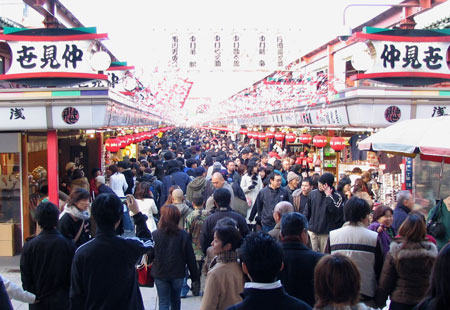
It having been maybe 24 years or so since I last visited, I got away to Asakusa last weekend with Sachi. The main draw of the area is the large temple, Senso-ji (a.k.a. “Asakusa-dera”). The street to get there begins with the landmark Kaminari-mon, or “Thunder Gate,” with the distinctive large red lantern, pictured above. Once inside, you get to brave the long gauntlet of pricey tourist-trap stalls and shops lining the avenue, separated by masses of tourists.

0107-Asakusa2-450

This is about as touristy as it gets in Japan, the kind of shops where kitsch dominates. Shops filled with “Ichi-ban” T-shirts, “Kamikaze” hachimaki headbands, Hi-no-maru folding fans, to bawdy novelty items–like the “Oppai Purin” (“Titty Pudding”) pictured below (miniature brassiere optional–I’m not kidding). The Osaka variety at left was sold out (god knows why that one went first). And no, I didn’t get any.

0107-Paipud-450

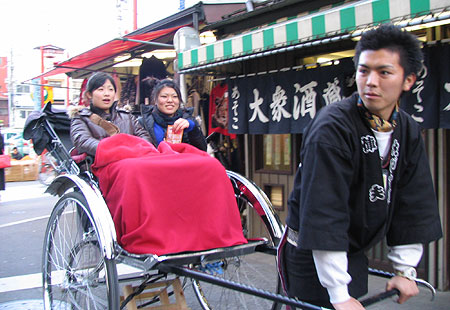
To round off the tourist kitsch, there were dango & manju (dumplings & buns) salesmen dressed up as old-style samurai, and nice rickshaw rides available. Though Japanese don’t call them “rickshaw,” they say “kurumaya” or “jinrikusha.” And to those of you who have never been to Japan, rickshaw are only located in the tourist areas, and not even very often then–though I will admit to having spotted several underpasses with “no rickshaw” signs at their entrances–probably very old signs indeed. Though they may have been simply more generic “no hand-drawn cart” signs instead.

0107-Dangoya-450

0107-Jinriku2-450

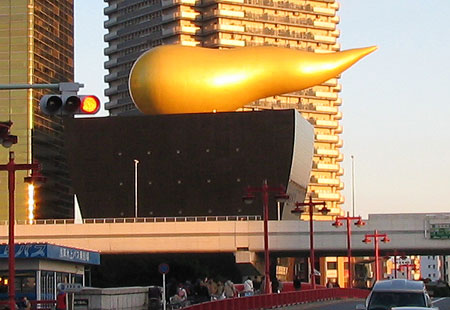
Nearby is the Asahi Beer Building, designed to have a giant flame atop the monolithic base. However, many Japanese see it differently, and call it the “Unko” building–literally, the “Turd Building,” after what they recognized to be a giant, stylized, golden piece of fecal matter (if you’re familiar with Japanese manga, they are kind of drawn like that).

0107-Unkobiru-450

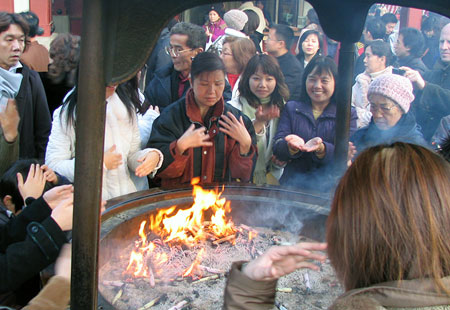
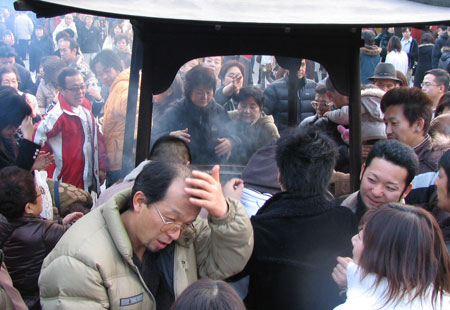
Once you get past all the tacky shops, you get to the Senso Temple proper. At the front there is a rather famous incense pot, where everyone stops and waves the smoke over their heads and at their bodies, as a kind of good-luck thing.

0107-Incense2-450

0107-Incense3-450

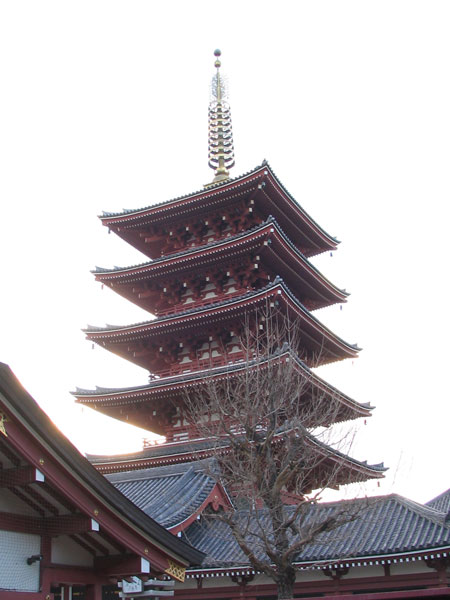
There is also a pagoda there, quite a nice one. This shot below is actually a composite. I took two shots at different exposures; one that was exposed well for the pagoda had the sky too washed out, and the other was good for the sky but the pagoda was too dark. Experimenting in Photoshop, I superimposed the good sky on the good pagoda and got quite a nice effect, I think. Click on the image for a larger version.

0107-Pagoda2-450

One more shot before I go: the pagoda with the washed-out sky. A very nice view regardless.

0107-Pagodatall-450

Categories: Focus on Japan Miscellaneous Tags: by

Crocodile Teeth and Tears

January 15th, 2007 1 comment

Not that the whole interview was “60 Minutes,” even with commercials; I was gagging after only a few minutes. If one were to arrive as an alien without any knowledge of what had come before, one might think that Bush was a brave, stoic, responsible leader, sensitive to the families of the fallen, able and willing to admit mistakes, and not wanting to send any brave young men out to die but rather doing so because he had no choice.

An image which, of course, is pure, unadulterated bullshit. Or at least, that’s the reaction of someone who was not born yesterday, and who does have a memory of what Bush has said and done in the past. Even though this looks like a “New and Improved” Bush, it is nothing more than the same old hollow manipulator up to the exact same tricks he’s always been up to.

First, from the interview:

Scott Pelley: You mention mistakes having been made in your speech.

Bush: What mistakes are you talking about?  Abu Ghraib was a mistake.  Using bad language like, ya know, “bring ’em on,” was a mistake.  I think history is going to look back and see a lot of, uh, ways we could’ve done things better. No question about it.

Bush is behaving in true Republican form here, admitting to mistakes long after exhausting every attempt to blame everyone else, long, long after having denied many times that he ever made any mistakes. Do you remember this one?

John F. Robertson: Thank you, Mr. President. In the last campaign, you were asked a question about the biggest mistake you’d made in your life, and you used to like to joke that it was trading Sammy Sosa.

You’ve looked back before 9-11 for what mistakes might have been made. After 9-11, what would your biggest mistake be, would you say, and what lessons have learned from it?

Bush: I wish you’d have given me this written question ahead of time so I could plan for it. (laughter)

John, I’m sure historians will look back and say, gosh, he could’ve done it better this way or that way. You know, I just — I’m sure something will pop into my head here in the midst of this press conference, with all the pressure of trying to come up with answer, but it hadn’t yet.

For years, Bush made what were universally regarded as disastrous blunders, and yet time after time, denied he had made any mistakes, or at least pretended there were none. In the debates for the 2004 election, for example, Bush again denied having made any mistakes more serious than a few ill-chosen appointment nominations. The debate denial, like many others, was made after the Abu Ghraib and “bring them on” mistakes he now ‘fesses up to. Why did he deny they were mistakes before?

And now we’re supposed to believe that suddenly he’s owning up to all of them without a selfish reason for doing so? Or that he chose to confess to only mistakes made far enough in the past to have safely faded in people’s minds? Bush is trying to play the humility card here; he has no choice but to admit to mistakes, and to claim that he is somehow responsible:

Bush: …the reason I brought up the mistakes, and I, is one, that’s the job of the commander-in-chief, and two, I don’t want people blaming our military.  We got a bunch of good military people out there who are doing what we’ve asked them to do.  And the temptation is gonna find scapegoats.  Well if people want a scapegoat, they’ve got one right here in me.  ’Cause it’s my decisions.

Yet another crock of BS. First of all, if it’s the “job of the commander-in-chief,” then why did he deny the mistakes before? Second, and more importantly, nobody else is blaming the troops. Bush is yet again trying to cast his opponents as troop-bashers, when the exact opposite has been true–Bush himself has blamed the troops for his own malfeasance. But by claiming that any criticism of him or the war is somehow aimed at the troops, he uses them as a human shield against criticism–whilst at the same time giving the audience a chance to consider that it was the troops’ fault, as they had never been blamed in the first place. It is a slick political move–it makes his critics look bad, makes him look good, and garners sympathy for his cause. That, of course, aside from the fact that it is a chickenshit cowardly maneuver that uses the troops, and demeans their honor and sacrifice by turning that into a political prop.

But the worst of it was this:

…Umm, (sigh) you know, you know a lot of them say, you know, Mr. President, don’t, don’t let my son die in vain.

One look at Bush’s past practices leaves no doubt that these family members were chosen with great care, allowing only those who would demand Bush continue to prosecute the war. As if that weren’t bad enough, for Bush to come out of it so dewy-eyed and use the sacrifice of the fallen troops as a slick propaganda line, to justify his past failures and his newly disastrous police to send 21,500 men and women back into the meat grinder, many for the third tour… it is enough to make one physically ill.

But there’s always time for one more lie:

Pelley: The president told us he reads a casualty report every morning, and personally signs every letter to the families of Americans killed in action.

This report, from the conservative Washington Times, shows how Bush, at the very least for the first year and a half of the war, did not bother to sign such letters; both he and Donald Rumsfeld used an signature-stamping device. All of this when Bush refused to allow fallen soldiers to be publicly mourned, lest the sight of flag-draped coffins be an embarrassment to the president.

But now, when Bush needs as much ammunition as he can get, now we hear how he agonizes over the personal tragedies, how he mourns each soldier, how he takes loving care to sign each letter. No one remembers, for example, how Bush callously excluded a fallen soldier’s widow from a ceremony using him as a PR prop “honoring” him. Bush didn’t even bother to lay the wreath himself.

One would be hard-pressed to imagine a situation where the expression “crocodile tears” would be more precisely accurate than this sickening performance in which we have seen the president partake.

Categories: Iraq News, Political Ranting Tags: by

Former State of the Union

January 15th, 2007 Comments off

Bush is scheduled to give his penultimate state of the union speech a little more than a week from now. As a preview, I thought you might like this speech of his from a previous year. The speech is abridged in hindsight to reveal his actual meaning as revealed by his actions since the speech.

Categories: The Lighter Side Tags: by

Bits & Pieces, January 14, 2007

January 14th, 2007 2 comments

An 8.2-magnitude earthquake hit the islands north of Japan yesterday. It was big enough to cause a great worry about tsunami, but eventually the warnings were called off when the highest waves seen were only 40 cm high and there were no reports of injuries or damage. Sachi and I went to an Indian restaurant after getting back from the dog walk, and they had NHK (with English) turned on, and they were focused on the story. It sounded scary at the time. And it does make you think: that earthquake could just as easily have hit Tokyo instead of hitting a sparsely-populated area up north.

An interesting look at Schwarzenegger over at C&L, talking about how he has shifted notably to the left. I still am strongly disapproving of the way he came into office–a “recall” election (solely created for the purpose of clearing out someone who did terrible things after an election) used to invalidate an election held only months before. And then Arnold moved in a host of Republican cronies, and tried to push a spate of “reform” initiatives that could have pushed California much farther toward being a red state. There were measures that were specifically aimed at decimating Democratic Party influence and power in the state–specifically, redistricting to favor Republicans, throwing up roadblocks to keep unions from participating in politics, and attacking teacher tenure (both unions and teachers being major Democratic backers).

But after his resounding defeat and then the loss of control by Republicans in Congress, Arnie now seems chastised to the point of becoming halfway reasonable. After losing the initiative fight, he hired a Democrat as his chief of staff, which brought howls of anger from Republicans, not to mention threats of stripping his party endorsement (Kennedy is still in that position today, but I don’t see Republicans throwing Arnold out of the party). And now Arnie is pushing a raise in emissions standards as well as universal health care–both pet Democratic issues.

So, are right-wingers still as vibrantly enthusiastic today about amending the Constitution to allow Schwarzenegger to become president as they were a few years ago? Something tells me that they’re not.


A lot of people have been wondering why Apple would stick to the “iPhone” brand name since the name is owned by Cisco Systems; it would seem a stupid move to invest so much publicity in the name before an agreement could be worked out with Cisco. After all, why invest so much in a name someone else still owns? You’d just be making their case for demands even stronger. You’d be begging for a lawsuit, and why bog down a new product with such legal problems when you have a team of imaginative marketing experts who can think up other cool names?

Well, it turns out that Apple may have done this because Cisco might not own the name, after all. A close read of this article explains how Cisco has probably lost the trademark because they did not use the name for a long time, and probably did not renew the trademark legitimately. If their trademark did indeed lapse, then it would go to Ocean Telecom Services LLC, a firm many people believe is a front company for Apple. Additionally, it appears that several other companies also use the “iPhone” name for their products.

So maybe Apple isn’t so dumb after all.


Four down, two to go. Congress passed a bill to help lower drug costs to seniors by using Medicare’s huge purchasing power to negotiate with drug companies. Enough Republicans opposed this to block a veto-proof majority (only 24 Republicans joined the entire Democratic block), which shows you how bought out they are–after all, Republicans are all about a free market system, right? Let the market decide, let people negotiate… except when they want to benefit their super-rich corporate backers.

Even if Bush vetoes this (as promised threatened) and Democrats force another veto-breaking vote which fails, it will be a huge public relations boon for the Democrats: we support the people, but Bush and the GOP favor far less the people than they do huge corporations which make massive, usurious profits from seniors and taxpayers.

Every one of these 100-Hours issues are supported by a strong majority of Americans. Makes me wonder what the Republicans think they’re doing. Maybe they figure that no one will remember two years from now. I’m guessing that the few dozen House Republicans that voted with Democrats on the last few close votes are ones who are ones who will face very close battles in the next election.


Bush has pretty successfully claimed the right to tap your phone calls without a warrant, and to read your mail. Now this administration is looking at your bank records as well. Not that this should be news to you, or surprise you in the least.

Aren’t Republicans supposed to be against this kind of thing? From debating gun control with right-wingers, I have heard the argument countless times about why we should avoid gun registration lists because the Nazis used them someplace in WWII to confiscate guns, and if the U.S. government ever became fascist, they would do the same thing here. Well, the U.S. government is slowly but clearly turning fascist, and for some reason the same people who made the argument about gun registration have no problem at all with this level of government spying on citizens. Nor do they seem too bothered by the government suspending habeas corpus, and holding citizens in jail without a charge (and without their guns!). Which kind of demonstrates how fake the whole argument was in the first place.

But you would still expect right-wingers, who profess to be so strident about getting government out of our lives, to vehemently oppose such intrusions. I can only guess that they are so frightened by the specter of terrorism that they feel it is perfectly OK for our own government to do this kind of stuff.

Or perhaps the whole get-the-government-off-our-backs philosophy is yet another fake argument used to cover for a more specific agenda like tax cuts. That does seem to be a common practice for right-wingers–to claim a greater philosophical belief to make a more specific, but less-defensible position seem more legitimate. This is done with the philosophy of strict constructionism as a cover for a pro-life and anti-civil-rights agenda, just as the “smaller-government” argument philosophy only serves to cover for a stance against Social Security as well as many other Democratic-favored social welfare programs. But when it comes to issues that Republicans favor, these overriding principles suddenly become irrelevant.

Categories: Main Tags: by

Cell Phone Charging

January 14th, 2007 7 comments

I am ready to smash my cell phone to pieces, and despair at the thought of having to wait a year or more for an iPhone. The reason: charging the damned cell phone. The phone I have now and the last one I had (the only two I have ever owned in fact) were very different models and designs, but they both shared the same flaw. You put the cell phone in its charging cradle, and nothing happens. You try again, this time pushing it down. Nothing. Wiggle it around, pick it up and breathe on the contacts to moisten them a bit, and then maybe, if you’re lucky, the charge light comes on.

But it gets worse. Half the time, the charge light starts flashing on and off, meaning that it’s got a contact, but for some reason, is not charging correctly. So you go through the process another 2-3 times until you finally get a solid light, and the phone’s LCD screen says that the phone is charging.

But even then, you’re not home free. All too often, the phone says it’s charging, the charge light stays on for a while then goes off, just like it does with a successful charge–but then, when you pick it up and open it, you see that it has not charged at all. And you usually find this out just as you are ready to walk out the door, and discover that you now have no cell phone for the day.

Is this just me? Am I incredibly unlucky and almost no one else gets this? Because it is driving me up the frakking wall.

Categories: Gadgets & Toys Tags: by

Dog Rental

January 13th, 2007 7 comments

Some time back, I remember hearing of a place (I thought it was in Odaiba, but am not certain) that rented dogs out. At the time, I thought two things: first, how silly and frivolous, and second, I’d like to rent a dog. Well, today, we did.

The place we used is called the “Wanko Rental” in Gotanda, which happened to be close-by. Upon arriving, we saw the staff giving the dogs some outside-time. (The dogs were attended to by two staff people, who moved out of the way for this shot.)

0109-Wanko1

Usually I am not too crazy about pet shops; I don’t like the idea that the poor animals are cooped up in tiny cages, and I get the distinct feeling that they don’t let the poor things out too much. This rental shop does indeed let the dogs get out for exercise, and the girls inside often let the dogs run around inside the fenced areas in the shop. But their great idea is the rental service: they not only get customers to walk their dogs for them, but they get you to pay for it at the same time. Not that I’m complaining.

Sachi is very fond of Shiba Dogs, so we decided to walk one of them. The shop had tons of Dachshunds, some Cavalier Spaniels, some Retrievers, and a wide variety of other dogs. They used to have three Shibas, but there were only two when we went–more on that a little later. Of the two in the shop, the staff advised us as to personality, and though Sachi likes the brown version of Shiba, we decided on a cream-colored one (a variation not approved of by the American Kennel Club for some reason), a female named Yuriya. When Yuriya was taken out and given a leash, there was a hell of a racket, as all the other dogs knew what was going on and wanted to be walked as well. (By the way, the rates are 1000 yen/$8 an hour for walking, or 5000 yen/$42 per day for longer stints, minimum 2 days for the discount rate.)

We were given instructions and a little kit that included poop-scooping materials, a water bowl, and other stuff we might need on the walk–as well as a map to a park that we could take her to (we had already planned on it anyway), and then we were on our way.

Here is Yuriya:

0109-Wanko2

0109-Wanko6

On the way out, she dragged us all over the place, doing usual dog stuff…

0109-Wanko3

0109-Wanko4

0109-Wanko5

Yuriya is an excellent dog. She was well-behaved, not too wild or excited; she never barked, heeled well on the walk, and seemed content (or at least patient) when we pet, scratched, and cuddled her. She just seemed to have a good time.

The rental thing just seems like a good idea to me. So long as you’re going to have a pet shop with mature dogs, why not get them acclimated to people, as well as have them taken out for exercise and care more often? It is also a good alternative for Japanese people who live in no-pet apartments, but love dogs.

But there is an extra point here: while mature dogs are often passed over in favor of puppies at pet shops, this shop deals only in mature dogs, or so it would seem. There were no puppies there when we visited. (Maybe these dogs are given up by pet shops after having aged without getting bought, I don’t know.) Rental customers walk the dogs and take them to the park for some sniffing about and frolicking, but all the dogs are ultimately up for sale. And what happens is that if a dog-walking customer becomes fond of a particular dog, they are more apt to buy them. The walking episodes become a kind of getting-familiar process, better than getting a dog cold and finding out your personalities don’t match. That’s what happened to Hanako, the third Shiba I mentioned before. She was purchased, apparently a short time before, by people who got to know and like her.

So maybe the idea of rental dogs isn’t as silly or frivolous as I had first thought.

0109-Wanko7

Categories: Focus on Japan 2007 Tags: by

Three Down

January 13th, 2007 Comments off

The House passed a bill for stem cell research today, making it the third of six major targets the Democrats have planned for the “First 100 Hours” of the 110th Congress. However, unlike the first two measures, this one does not have a veto-proof majority in the House–and Bush has already vetoed such a bill before, the only veto in his six years as president so far. For something that could save lives and bring people back to health. Old news, but still emblematic, nonetheless.

Categories: Democratic Controlled Congress Tags: by