Just because we have no choice in a matter does not mean that the right choices led to this impasse, nor that we should forget the errors made.
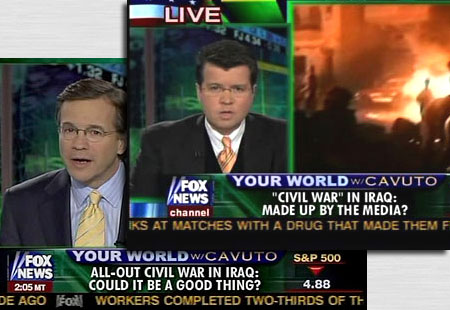
There is a strange phenomenon that I’ve observed with the war in Iraq: that having no good options left and being forced to choose a horrific course of action in order to avoid a catastrophic one is somehow being played as “we did the right thing.” Add to that a great deal of “the past is past, so ignore it and be optimistic about the future,” and you’ve got what many people are saying about the war.
On this site, I have been scolded several times by people who say that prognosticating a bad outcome, even though it is rather obvious to see, is a big no-no, and that complaining about the past will serve no purpose.
I beg to differ.
First off, I am a strong believer in learning from your mistakes, and am a stronger believer in not letting politicians get away with them, else they feel comfortable doing so. The Iraq War was a huge and terrible mistake. What’s more, it was not hard to see.
The Bush administration either lied about it or was so foolishly optimistic as to be a bunch of bright-eyed idiots. They said the war would cost no more than $2 billion. Opponents (like me) said it would “easily cost $80 billion, probably much more than that.” We were right: it cost more than $80 billion in just the first year, and now is over $240 billion, with the administration asking for money to put the cost over $300 billion. Think of the schools we could have built with that money.
The Bush administration lied about how easy it would be: they said we’d be greeted as liberators, the people of Iraq throwing flowers at the feet of our soldiers. The critics, again like myself, pointed out that people in the region “do not and never have reacted kindly to U.S. intervention.” Cheney said that “extremists in the region would have to rethink their strategy of jihad,” while people like me said that “an unsupported attack by America on an Arab nation would generate such fear and hostility in so many people that extremists would be swamped with volunteers willing to die for their cause.” Guess who was right? The war has inflamed the region, the country is on the brink of massive civil war, and the ranks of al Qaeda have swelled to more than 18,000, new recruits made passionate because of Bush’s war.
The Bush administration claimed that they could get a strong coalition and that the U.S. would not suffer in international respect or reputation. Critics again disagreed, saying, like I did, that “not only is there no coalition, but it appears that at this point, a coalition would be impossible to form,” and that we “would also pay in terms of lost reputation, international respect and influence in world affairs.” Again, we were right, they were wrong. The “coalition of the willing” was just as lame as the name it bore, and lacked support of most of the world. Basically, it was the U.S. and Great Britain, with a few other militarily smaller countries throwing in token forces.
The Bush administration painted Iraq as a grave threat, warning of “mushroom clouds” in the State of the Union speech, and claiming that they had solid evidence that Hussein was 6 months away from completing a nuclear weapon. Critics denied this, like the point I made that there was no evidence of a nuclear program and the fact that before the first Gulf War, the Bush 41 administration made the exact same fake claims in their own justification.
The Bush administration said that their planning was good and they did all they needed to; critics warned that the Bush administration had no exit strategy. I wrote, “what is the exit strategy? How long will it take? How many of our troops will die? How many Iraqis … will we end up killing? How long will our troops be there? How deeply will we become involved in rooting out everyone there who violently disagrees with our occupation? And how will the nation-building succeed?” Do I even need to point out that every one of those concerns has been proven to be a major concern, and that Bush’s lack of an exit strategy has now made each one of these points a painful area of loss? No thought was given to any of these points by Bush; it was purely a case of wanting something and not giving a damn about the cost.
My overall point here? That this was not a mistake that anyone could have made. This was not a mistake that no one could have foreseen. It is critical that we remember the fact that all the mistakes the Bush administration made in this war were foreseen well before the war started, and warnings were loudly given. We did know that this was a mistake, it’s just that the Bush administration was so blinded, so foolish, and so single-minded that they did not believe and/or care that they were making these errors.
Whatever the case, it is now the right of the critics who were correct to step forward and point out that the Bush administration was wrong, that they made terrible blunders though thoroughly warned, and they they are fully responsible for everything that happened. And it is the responsibility of the Bush administration to acknowledge these mistakes–though we all know that this is the last thing they will ever do.
Already, I can foresee the comments to this point: “but that’s in the past! We gain nothing by obsessing with things we can’t change, and that doesn’t help us now.” Hell yes, it helps us. It helps us avoid doing this again, and it helps us because it proves that the Bush administration is dangerously stupid and that we should not believe or trust them. That we should instead put into place a Congress that will serve as an opposition to them, and to pay attention to critics when they point out the wrongness of what the administration wants to do next.
But, as I have been scolded before and likely will be again, “you’re just being pessimistic. If we have a negative outlook on what will happen, it will just bleed into our actions and assure our loss. We have to be optimistic and support the administration.” Like hell. There is a difference between harmful pessimism and pragmatic realism. Being an optimist will not prevent Iraq from descending into civil war. Being an optimist will not make the insurgency crumble. Being an optimist instead of a realist will only repeat the same mistakes that Bush made when he pushed us into this war.
The realistic view of this war is that we’re screwed. I’m sorry, I wish it were otherwise, but when there writing is on the wall you don’t just ignore it. That’s the dangerous course of action. To close your eyes to reality and wish real hard for a good outcome, that’s what’ll lead to more disaster. To pretend that if we just hope and see things as ending well, that such will turn about our fortunes is, forgive me, foolishly naive.
Think I’m wrong? Well, I was right before the war. What makes you think that I’m wrong now?
The tragedy here is that if it were ever possible to have made things work out in Iraq, the time to make that happen is long past. One turning point would have been before the war, to work with our allies instead of bullying them and build a real coalition; at the start of the war, to have used enough troops to do the job right, stopping the looting and fighting the insurgency before it started; right after the initial military success, not to have disassembled the Iraqi military, and to have immediately brought in U.N. and Arab-nation overseers and managers, instead of greedily grabbing all the goodies and business contracts for ourselves. But time after time, despite warnings, despite advice to the contrary, Bush made mistake after mistake. And now, as much as we all would rather have it be otherwise, it is just too damned late.
The only thing we can do now is to realize the mistakes that were made, make sure that those who committed them are held responsible and are not allowed to repeat them. Then we clean our wounds, get out as gracefully as we can, and never do something this stupid ever again.
Unfortunately, that last paragraph was the expression of wide-eyed optimism. The pragmatic realist in me realizes that we probably won’t do any of that.

 Finally, my foot is feeling better. Ha! Bet I fooled you with the entry title, didn’t I?