Archive

Author Archive

This Thing Is Heavier Than I Expected

May 1st, 2010 6 comments

Ipad02

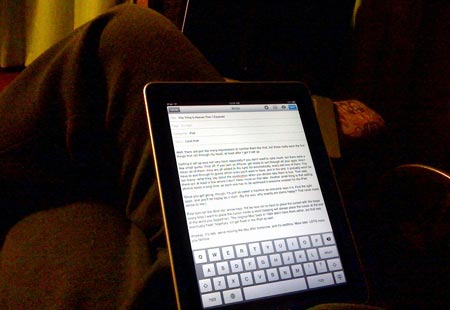
I got it! Finally! Thanks to the efforts of a generous coworker, who not only got me the gear on their vacation back in the U.S., but brought it even with a broken wrist (there’s a friend for you), I’ve got my iPad–a month earlier than the Japan release, a month after the U.S. release, and about two years after I started wanting one <snark>.

First impression: damn, this thing is heavy. Second impression: OK, maybe not so heavy. Third impression: damn, this screen can get bright.

Well, there are just too many impressions to number them like that, but those really were the first things that ran through my head, at least after I got it set up.

Getting it set up was not very hard, especially if you don’t need to sync much, but there were a few small quirks. First off, if you own an iPhone, get ready to sort through all your apps. And I mean all of them–they are all added to the sync list automatically, every last one of them. You have to sort through to guess which ones you’ll want to have, and in the end, it probably won’t be too many–what they say about the pixelization when you double-size them is true. That said, there are at least a few where I don’t mind–more on that later. Another small thing is that adding photos takes a long time, as each one has to be optimized (I presume resized) for the iPad.

Once you get going, though, it’s just as sweet a machine as everyone says it is. Find the right apps, and you’ll be happy as a clam. (By the way, why exactly are clams happy? That never made sense to me.)

First item on the Wish list: arrow keys. It’d be nice not to have to place the cursor with the loupe every time I want to place the cursor inside a word (tapping will always place the cursor at the end of the word you tapped on). The original Mac back in 1984 didn’t have them either, but that was eventually fixed; hopefully, it’ll get fixed in the iPad as well.

Anyway, it’s late, we’re moving the day after tomorrow, and it’s bedtime. More later. LOTS more, you betcha.

Categories: iPad Tags:

The Best Angle

April 30th, 2010 5 comments

Brian-HoganThe finder of the prototype iPhone has been identified as one Brian Hogan of Redwood City, and he’s taking about the best tack he can on the story: that he did not “sell” the iPhone to Gizmodo, but instead accepted money for giving Gizmodo “exclusive access to review the phone.” As to whether that’ll save his bacon is the question; he still pocketed five grand for something that wasn’t his instead of handing it over to the police as the law requires. And even though he claims that he did not sell the iPhone but instead sold the rights to an exclusive review, such a review was still not something that was his right to sell.

At the end of the day, he held on to something that wasn’t his, actively shopped it around to tech publishers, and then sold it for cash. It’s kind of hard to put a very good spin on that. His attorney is pushing the storyline that Gizmodo assured him that there was “nothing wrong in sharing the phone with the tech press,” but that shouldn’t really afford him too much cover. It falls under the “ignorance of the law” rule, which we have to follow or everyone could say that they were assured there was nothing wrong with committing a crime.

I mean, think of it–what if the president of the United States wanted to violate the Constitution, and all he had to do to clear himself was to get a lawyer to go on record as assuring him that it was OK?

Oh, wait.

Categories: iPhone, Law Tags:

Yikes

April 30th, 2010 Comments off

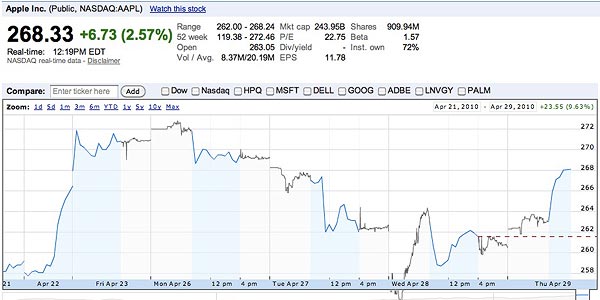
I believe that the technical economic term for what you see below is a “roller coaster ride.” You know, where you first get cranked up almost vertically, and then your stomach falls out as you drop, several times.

Aapl-This-Week

After Apple’s spectacular earnings report late last week, the stock shot up. Early Monday morning, Philip Elmer-DeWitt quoted a stock analyst predicting a “major sell-off,” and though he thought Apple stock would go up, he also called for it to plummet to $200 soon, taken down with the rest of the market. A few hours later, AAPL dropped by about $3 in a matter of minutes. The next day, there was an even steeper drop of about $5. The next day, in pre-market trading, it plummeted by about $8, erasing all of its gains after the earnings announcement. But then it came back up, then immediately plummeted $8 again in regular trading.

Believe me, after having lived with this stock through the Bush collapses in early and late 2008, when drops like the ones we saw this week led to $80 free-falls and worse, it is not in any way describable “easy” or “comfortable” to sit back and watch this happen, and not do something about it. Fortunately, since Wednesday afternoon, the stock has climbed back up and is just $4 off it’s peak. Hopefully it will start climbing again.

Now, I have been planning for some time to sell off about half my stock this year and hang on to the other half for at least another year or more. I will feel a lot more comfortable having done that, without the whole market tumbling first. And it was not DeWitt’s column or the analyst’s prediction that caused this (though many commenters in the column roundly blamed both for exactly that), but market activity in general, including the thing in Greece. Although, one does smell the malodorous presence of people playing the market for a quick buck–one almost hopes, as it would suggest a better overall stability. Still, it makes you think.

Categories: Economics Tags:

Vanguard Panorama

April 30th, 2010 1 comment

Been taking a few photos to remember the place by. Here’s a stitched panorama of the nighttime view from the balcony, taken tonight. The image runs from north at far left, through the eastern view, to the south and almost fully to the west–about 260 degrees, in all. The tallest building, on the right, is the 60-story Sunshine City building; the small blue building to its right is the Amlux Building (which blocks the view of Mt. Fuji from this perspective); to the left of Sunshine is the Prince Hotel. The bright light in the sky is the full moon. Tokyo Tower is a tiny thing in this image, barely a single pixel; it is halfway between the building below the moon and the tall, dark building to it’s right.

Pano-500

The 500-pixel image above doesn’t do the panorama justice, of course; so here are links to a 2300 x 1024 copy, or for a better view, one which is 4000 x 1667. And for those who want to see the bearings, here is a titled 4000 x 1750 version with the cardinal directions and major landmarks pointed out. Enjoy.

Categories: Ikebukuro Tags:

The Low Bar?

April 29th, 2010 Comments off

Democrats are currently crowing about a major victory in the Senate right now, as Republicans folded under pressure and gave up on their obstructionist attempt to weaken or kill the financial reform legislation before debate even started.

On the other hand, the Democratic “victory” was that with a 59-41 majority, Democrats, after several days, were finally able to open debate on a bill that must later go through several other steps before passing.

One way of looking at it says that Democrats have done the equivalent of tying their shoelaces correctly. Hardly impressive. Another way of looking at it, though, is that they have successfully tied their shoelaces while a bunch of people make a concerted effort to keep them from doing it. Imagine trying to lace your shoes with three or four people constantly yanking at your hands and feet, trying to stop you. I think you’d be impressed by anyone who get their shoes tied under such conditions.

But in a political sense, the achievement or lack of same is less important than the fact that both sides had resolved, and one side caved. If Obama was trying to pass a law for “National Shoelace Day” but Republicans thwarted him, the relative importance of the law would be of little importance, as the main focus would be who has got stronger political will.

So, for the time being, at least, Democrats are doing pretty well, keeping a fairly good image ever since the passage of the health care law. And it doesn’t help the Republicans that they are making their stand for the banking industry, which everyone now detests, trying to thwart reform which will help keep another bailout from happening. That’s not a very defensible stance, which is most likely why they folded–along with the fact that they were preventing even debating the legislation. If Dems can similarly succeed in blasting the Republicans as being pro-bank and anti-reform when cloture and passage come to pass, it would be an even bigger win. Republicans are also not helped by right-wingers pulling crap like the immigration law in Arizona and the Nevada Republican seriously advocating livestock payments for health care.

Of course, one can always count on Republicans to provide a steady stream of idiots to do stupid stuff like that. The real question is, how long can the Dems keep this up without reverting to weak-kneed giga-wimp form?

Petards

April 29th, 2010 Comments off

Remember how ACORN and other non-conservative voter registration organizations were guilty of “election fraud” because some rank-and-file employees decided to line their pockets by faking registrations? Remember how this made them criminal organizations which deserved to be shut down?

Two words: glass houses.

Categories: People Can Be Idiots Tags:

The Arizona Gaijin Card Law

April 29th, 2010 2 comments

Boy, that brings back memories. Back in the 1980’s, it was very common for the police here in Japan to stop you and ask for your papers just for being non-Japanese while walking down the street. Happened to me a lot. And if you were caught without your papers (in those days, it was a paper booklet too big to fit in your wallet; today, it’s a credit-card-sized ID), then they would haul your ass down to the station. They would make you wait there until your papers could be produced. And if you were unlucky enough not to have someone to do it for you, they would take your keys and do it themselves, presumably searching your apartment for whatever they wanted in the process. And however you acquired your papers in the end, you would then be required to write a long and sincere letter of apology to the police (commonly referred to as the “gomen nasai”, or “I’m sorry” letter), explaining your grievous error and promising never to do so again. Presumably so that it they did catch you again, they could wave it in front of your face.

There were stories from people who got stopped by police in aggravating circumstances. A famous example was for a foreign resident of Japan to be on the street and see the bosozoku hot-rodders zig-zag down the street, violating half a dozen laws, like not wearing helmets, having illegal passengers, violating noise ordinances, having illegal modifications to the bikes, speeding, and running stop signs and traffic lights–but the local cop would ignore them and ask the foreigner for his papers. And while the police never needed a reason to stop you, riding a bicycle was always golden–they would simply accuse you of stealing the bicycle. This happened to me at least a half dozen times, once with a group of cops and a squad car deployed to check me out (while Japanese passers-by got a strong-yet-bogus reason to believe the stereotypes of foreigners being criminals). I was stopped maybe as many times on foot as well. Only once I can think of right now did I not have my gaijin card in such a circumstance, but I was lucky enough that the cop allowed me to walk the 100 feet to my residence to produce the ID–maybe the leniency was because I was coming back from the local bath house and was dressed in a yukata (kimono-styled robe), and so he understood why I might not have my ID on me.

One reason this was more prevalent back in the 80’s was because international tensions were worse back then, and anti-foreigner sentiment was at a peak. Also, Japan is rather notorious for being less civil-rights friendly than most industrialized countries, with police being able to incarcerate you without charges for several weeks, even extending that by releasing you and then immediately taking you back into custody. People held such have been known to suffer interrogation techniques such as sleep deprivation and even physical assault which leaves little visible evidence, and false confessions are believed to be widespread.

The irony here is that Japan has eased up in recent years, and this kind of checking is rare nowadays in Japan–but looks like the U.S. might be picking up the mantle for most foreigner-unfriendly industrialized country. Of course, it’s very different in the U.S.–they will stop people who are potentially citizens, not just legal immigrants, who could also be jailed for not carrying their ID with them.

The best way to fight what we’re seeing in Arizona is what we’re seeing happen: economic boycotts. The public scorn is good too, but stop doing business with them, and they’ll reconsider right quick. Hopefully, in a year, this will be nothing more than an embarrassing footnote.

Postscript: I also should voice my agreement (again) with the sentiment: when is the Tea Party movement (not just a few individuals in it) going to lash out against the Arizona law which violates their stated core beliefs in the most outrageous manner yet seen? And if they aren’t, then why not? The answer is evident, of course, but one would like to hear them come up with some BS excuse.

Categories: Right-Wing Extremism Tags:

iPhone in Japan: Top Seller or Not?

April 29th, 2010 3 comments

You may have seen reports that the iPhone now commands 72% of the smartphone market in Japan, and if you read this blog as well, then you may be wondering why I haven’t commented on that yet. Here’s the reason why: the smartphone market in Japan isn’t all that big. I knew that the iPhone’s penetration in Japan wasn’t even close to 72% just from what I see on the street. Sure, I see an encouraging number of them–one can spot several during any subway ride nowadays–but absolutely not a majority. So far from one, in fact, that it was immediately apparent that the sub-market Apple got 72% of must not be all that big. And here’s a blog post showing that to be true: Apple’s actual share of the cell phone market is 4.9%. That sounds just about right–1 out of 20 seems to match what I see on the trains and on the streets these days.

Now, if you go from being incredibly impressed at 72% to being greatly unimpressed by 4.9%, remember that the iPhone was supposed to fail horribly in Japan, whose people were supposed to hate it, and that 4.9% in less than two years is a rather impressive showing, especially in such a tough and competitive market, and when your product is only sold by the least popular of the top three service providers.

It will be interesting to follow the iPhone over time, and see how the iPad–even more of a cypher for Japan before the fact–does here as well.

Categories: Focus on Japan 2010, iPhone Tags:

HP Buys Palm

April 29th, 2010 2 comments

They actually seem to get it: that if you want a successful touch-based tablet device, you can’t succeed with a mouse-based PC operating system. That’s one of the reasons tablets failed before the iPad: they were PCs trying to act like tablets. Apple was the first successful company to realize that tablets were waiting for multitouch, and multitouch was waiting for tablets, and they couldn’t succeed without each other, at least not at first. So HP woke up and said, “crap, we’ve gotta get an OS that doesn’t suck on a tablet!” And so they bought Palm, probably because it’s the next most-used touch-based OS after iPhone and Android, neither of which they could buy and control. Whether it’s a good enough OS and will work for HP, or if HP can make it work, is another question.

Categories: Computers and the Internet, iPad Tags:

Top iPad Misconceptions

April 28th, 2010 6 comments

The iPad is still new, so many people still haven’t wrapped their heads around it yet. David Letterman touched on this with his Top Ten presentation just before the release, lamenting that he couldn’t figure out what the iPad was. Here are a few common misconceptions I still see fairly often, in no particular order:

1. It’s a Computer. Well, technically, it is, but the iPad itself is not supposed to act as a stand-alone computer. If you’re buying one instead of a laptop, you may be in for an unpleasant surprise, just as many people who bought netbooks were unhappy. The iPad, at least for now, will not do all the things that a laptop or desktop will do. There are several reasons for this. One is the infancy of the OS and available software; the OS will gain features as time goes on, and developers will produce more powerful apps, but for the time being, things are still in the exploration phase. A second reason is the hardware; it’s not yet powerful enough to handle what some users might expect. But the third and most likely reason is design: Apple almost certainly does not want you to see the iPad as a laptop replacement. They want you to buy a laptop, phone, and and iPad. Some of the limitations are built-in, so as to keep the iPad from cannibalizing too much of the products on either side. Apple saw a gap and wants to fill it, but not at the cost of their biggest money-makers.

2. It’s an Oversized iPod Touch. No it’s not. The iPod Touch is an undersized iPad. The iPhone and iPod Touch were perfect for what they were, but the iPad is what a multitouch device should have been in the first place. The iPad is not an evolution, it’s the main event following a multi-year preview.

3. It’s Nothing New. This is an offshoot of the “oversized iPod Touch” misconception, and even the “it’s a computer” misconception: people are trying to shove the iPad into existing categories of what they are familiar with. Yes, it resembles an iPod Touch in some ways. Yes, tablet PCs and touch screens have been around for years. But the iPad is completely new because it’s the first correct expression of what a fully-fledged touch-screen tablet should be. Previous tablets were standard GUI PCs trying to act like tablets. The iPhone and iPod Touch were too small to really be fully-fledged tablet devices. The iPad is the first multitouch tablet which is actually what a tablet should be, and that’s its secret.

4. The iPad Is Its Own Killer App. This was one of the first misconceptions, based upon the initial introduction of the device. People who are disappointed in the iPad generally often are because they look at the iPad all by itself and assume that it’s the end-all be-all of itself. However, the iPad is just a platform, as close to a blank slate as Apple could make it. It’s simply a very cool blank slate, with incredible potential. But the real killer apps will be the literal killer apps, software made for the device. Apple gave an initial push with the iWork suite, which will attract many. But maybe the killer apps for some will be iBooks and Kindle; or maybe it’ll be Netflix and the ABC video apps, or perhaps NPR and the newsreader apps. I know a guy who will buy one mostly for the MLB app so he can watch baseball games. There will not be any single killer app; instead, all good apps for the device may be killer apps. The iPad is not about being impressive all by itself, it’s about delivering things in a new and impressive way. Just like the original Macintosh back in 1984 was great, it would have sucked had it been just MacWrite and MacPaint forever; it was great because it ushered in the age of the GUI, just like the iPad is ushering in the age of Multitouch.

5. The Closed Ecosystem Is a Bad Thing. This depends on who you are: if you’re a power user or tinkerer who likes to control everything on your computer, then yeah, the closed ecosystem is bad. These voices tend to get disproportionate play time on the Internet, as people like that tend to be the authors on the web, just as art critics who write most art reviews tend to be specialists with very specific tastes instead of everyday consumers. But most people don’t have the same high-end requirements, and for them, the closed ecosystem comes across very differently. Yes, there is the disadvantage of being locked in–but let’s face it, that happens to a certain degree with all computer devices. You buy a Windows PC, you’re locked in to the OS and the apps there as well, so in that sense, the iPad is little different. And yes, Apple can dictate terms and types of apps that get through–but again, this is something that affects the techie crowd more than the average consumers, who almost never notice how this affects them in an adverse way, and many benefit in other ways.

The advantages, however, outweigh the disadvantages. A protected system without the fear of viral infection. A dead-simple way to find any app in one central location. A huge variety of apps for very low prices. A common interface and style which makes the system easier to use. What it boils down to is that all systems have good points and bad points; the closed ecosystem of the iPhone OS simply has a different set than what most people are used to, but for the majority of people, it’s a better overall trade-off.


One thing which is not a misconception is that the device is a hit. In my office, for example, out of about a dozen people whose intentions I am aware, four have made a decision to buy the device at some point, more than a month before it gets released here. Nor is this due to my evangelizing; all came out of the blue. I expect more minds will be changed after the device is seen and handled. And that’s where the misconceptions, both good and bad, will clear up.

Categories: iPad Tags:

Unpublished Dilbert

April 27th, 2010 Comments off

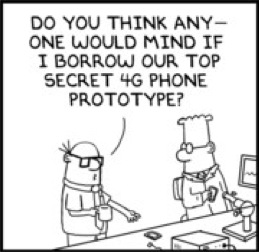
Scott Adams says that he wants his strip to not be too far out of sync with what he’s writing about, but could not resist writing two strips which he could not publish in time to meet that rule. So he published the drafts exclusively in his blog. Click on the first frame to see the two strips:

Screen Shot 2010-04-27 At 10.28.11 Am

You can see where it’s going, right?

Categories: Entertainment, iPhone Tags:

Fox News Recommends NPR over Fox News

April 27th, 2010 1 comment

And yet, the writer who did so seems to still have a job. This article on Fox’s web site recommends the “5 Best Apple iPad Apps,” which, interestingly, includes the NPR app but not the Fox News app. Although, if you read the review, it actually does still have a Fox spin to it: it lauds the NPR add for achieving the “impossible” task of “turning sometimes boring content into an addictive experience.” I guess that’s how the writer kept his job. As for the list itself, it’s pretty tame and limited for what it is; you get the feeling that the writer has downloaded maybe a few dozen apps and simply made a quick list of their own faves. I was going to say, “seriously, they could do better than this,” but then I remembered.

Categories: iPad Tags:

eBooks Article

April 25th, 2010 Comments off
Categories: Media & Reviews, Quick Notes Tags:

The View From Vanguard

April 25th, 2010 1 comment

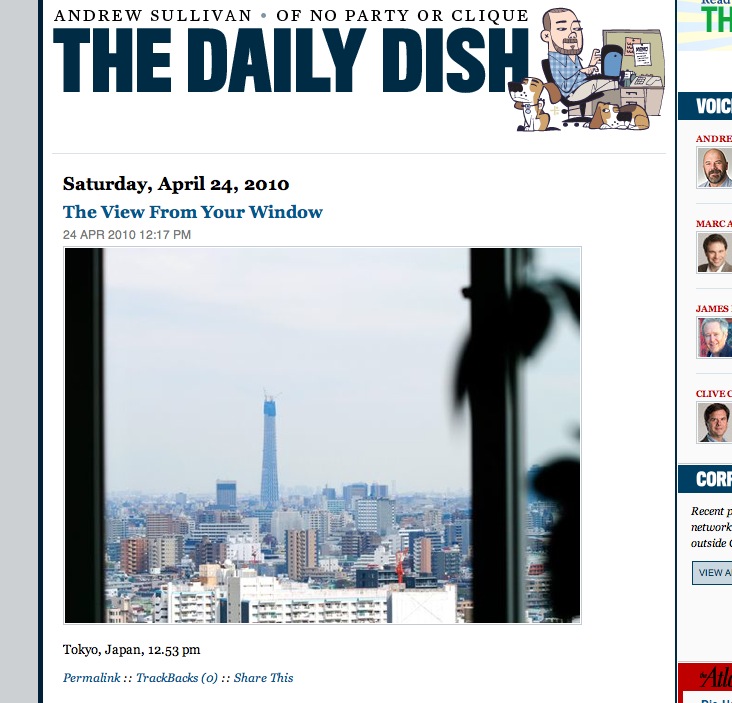
We’re leaving next week, and so it’s appropriate that The View From Our Window has now been memorialized in Andrew Sullivan’s The Daily Dish:

Screen Shot 2010-04-25 At 1.26.44 Am

The original here (click for enlargement, 2K pixels wide):

Tokyo-Japan-12.53Pm-S

And here’s the post from last week, a photo taken about the same time, super-zoomed up on Tokyo Sky Tree under construction.

Categories: Ikebukuro Tags:

Looking for Suggestions on Buying a Windows PC

April 22nd, 2010 6 comments

Yep, that’s right. In this case, a Mac doesn’t fit, and while I have some fair leads myself, I want to investigate every possible avenue to give the best advice to a friend.

That friend is looking for a new Windows laptop. Size should be 14~16“, less than a thousand dollars, not a powerhouse but reasonable. Form factor is not a heavy consideration–this will likely be used on a desktop at home most of the time (it needs to be a laptop as the user will move to a new country with it)–but a relatively slim and light machine would be nice, so long as it’s not so much as to jack up the price.

As for specs, the user will not be doing heavy lifting, so something like a basic Core 2 Duo with 4 gigs of RAM and the usual accoutrements (WiFi, webcam, etc.) should do nicely. While extra bells and whistles like Blu-ray or HDMI slots are not bad, neither will they be really necessary. More important is a good, solid build that will last over time, and a generally comfortable user experience. Win 7 is acceptable, but an XP setup would be best, as the person is most familiar with that and would probably not want to deal with post-XP disorientation.

Thanks in advance!

Categories: Computers and the Internet Tags:

Scoop and/or Steal

April 22nd, 2010 4 comments

Gizmodo has been slyly bending the truth concerning the legality of it’s acquisition of the “4G” iPhone, and could find itself in hot water over it. More information coming to light puts greater doubt on how legit the process was from start to finish.

First, there was the person who “found” the iPhone. He claims that he asked around and waited and waited for the owner to come back, but he never did. But he apparently did not say a thing to anyone who worked at the bar.

He claimed that the following day, after discovering that it was a prototype iPhone, he called “a lot of Apple numbers” but Apple displayed a lack of interest and he eventually was given a ticket number which was never followed up on.

I don’t buy it, and neither do a lot of people hearing this story. When you find a lost item and want to be honest about returning it, there are steps you take. Asking other patrons, hanging out for a while longer, and then making calls to a generic switchboard do not qualify, especially if your next step is to sell the item in question.

First thing, if you find a lost cell phone–any lost cell phone–you don’t just walk off with it. You give it to the people running the place where it was left. This is just a no-brainer–it’s the first place the person who lost it would look. If you suspect the staff would just steal it themselves, then give it to a manager. It’s actually less trouble than taking it home and trying to honestly return it after that. But if you feel it improper to give it to anyone at the bar, then you give the people at the bar your contact info so when the owner shows up, he can get in touch with you.

If you don’t mind invading the guy’s privacy, then you could check for his ID within the phone. The guy who found the iPhone said that he discovered the phone’s Facebook app and found the owner’s identity. From there, you would open contacts and get the owner’s contact info, and just call him up right there on the spot. The finder did none of that; he snooped, but did not use what he found to get in touch with the guy.

But the claim is that this guy was really drunk and was not sober enough to think straight until the next day, and by that time, the phone had been remote-wiped. Fine. The next step is clear. If you still think the bar is a nest of thieves and you don’t even feel like calling the manager and asking if the owner has been in touch–and the owner had been, frantically–then you either find the owner or turn it in to the police.

This guy claims he called Apple several times in different ways but got disinterest, just some support person giving him a ticket number. Bull. You call up Apple and say, “Hey, one of your employees, here’s his name, lost what looks like a next-generation iPhone prototype in a bar last night,” and I guarantee you’ll get interest. On the outside chance that you get a dumb support person who doesn’t, then you should realize that you need to talk to someone who is not a rank-and-file employee. Simple: ask for a supervisor, or even better, ask for a number of an executive. There’s no law against calling someone directly in administration. Again, I doubt that any of this was part of the “a lot of numbers” the guy called at Apple. They story simply doesn’t wash; I bet that were I to make an actual effort, I could have found an interested party within minutes.

But let’s assume the guy who “found” the iPhone was a complete idiot. Fine. Even idiots know that you return hopelessly lost items to the police. End of story. No excuses.

This all takes me back to a time when I was quasi-robbed myself. I was carrying a shodo (calligraphy) set with me at college, one I had picked up in Japan. The set itself was not too valuable, but inside I had a marble hanko which was given to me as a gift and had great sentimental value–worthless to anyone else. I had accidentally left it on the ground outside a classroom on the way to the parking lot. Just a few minutes later, I realized I had left it, ran back, and found it gone. After a week or two, with nothing turned in to lost & found or the campus police, I put an ad in the school newspaper offering a reward–and the “finder” immediately called to claim the money. He claimed that he found the case and wanted to “make sure no one would steal it,” but then didn’t get around to turning it in–but coincidentally just happened to be keeping a sharp eye out for anyone putting ads in the school newspaper offering a reward. Riiight.

Next, we have Gizmodo’s claims that when they bought it, they did not know that it was stolen. Also BS. They had to at least suspect it, else they would never fork over $5000 for it. No way they would pay five large for anything they figured was just a counterfeit iPhone. The fact that they paid as much for it as they did is direct evidence that they believed it was Apple’s property. They claim that it took them at least a week to convince themselves that this was the real thing. So, if I am good with tools and can make a semi-convincing mock-up of an iPhone, Gizmodo will pay me five grand for it before having strong confidence that it’s real? Yeah, right. Gizmodo’s claim of innocence in purchasing the phone doesn’t even come close to passing the smell test.

Then there’s the Rolex principle: if you are offered what you believe might be an authentic Rolex watch in a back alley for fifty bucks, you can’t claim you didn’t know it was stolen. Gizmodo at the very least suspected that this was an Apple prototype, which means that even if they had reason to believe that an Apple employee was selling it to them, it would still not be a legal sale. Furthermore, they did know the story behind how it came to them–hell, they published the story, in detail–and the story clearly shows that the property was not sold by its rightful owner. Case closed.

Even ignoring the illegality of the actual purchase, Gizmodo’s first honest step would have been to either simply hand it over to the police, knowing it was not legally acquired, or to actually contact Apple–they can clearly get someone high up in the organization on the phone–and explain what happened and arrange a meeting where things could be ironed out. They did not. They claimed that they always intended to return the phone if it turned out to be authentic; while this can be believed, the implications are not good for Gizmodo, as it only demonstrates that they indeed suspected the item was stolen when they bought it. Nor does it excuse the fact that they did not return it immediately when they did make that determination.

Instead, they photographed and videotaped the hell out of it, ran huge stories for their considerable profit, and then coyly teased Apple, forcing the company to issue a printed public statement of ownership before handing it over.

While I can’t fault their sense for a scoop, one may indeed fault their legal standing–as well as the guy who picked up the phone and later sold it. Turns out there are laws against selling things that don’t belong to you, as well as laws against buying them. The seller and people at Gizmodo face potential civil and criminal penalties for what they did. Not under the trade secrets law, which requires the owners of the secret to reasonably guard the secret–and losing it in a bar does not reach that standard.

This all could mean as much as a year in the slammer for some folks at Gizmodo, and Apple could claim they have lost millions and sue Gizmodo out of business–and they could win.

Next move, Apple.

Update: The Santa Clara police department is reportedly looking into the incident, trying to determine if a crime was committed. Starting to look not so good for Gizmodo and the guy who thought five thousand bucks would be worth it.

Categories: iPhone Tags:

Dazzled and Blinded

April 22nd, 2010 Comments off

The Bush administration thoroughly attacked the Constitutional rights of all Americans. They virtually killed off the 4th amendment:

The right of the people to be secure in their persons, houses, papers, and effects, against unreasonable searches and seizures, shall not be violated, and no Warrants shall issue, but upon probable cause, supported by Oath or affirmation, and particularly describing the place to be searched, and the persons or things to be seized.

That administration essentially made it legal for the U.S. government to invade your privacy–your person, house, papers, and effects–without a warrant, without probable cause, without even a specific location and without anything more than a general category of what is to be searched for. After stacking the Supreme Court with justices just waiting for an excuse to place their stamp of approval on such practices.

And the Fourth Amendment wasn’t the only one shredded. You can be arrested without being informed of the charges and swept away to a foreign land without counsel–there went the Sixth Amendment–to be held without due process, and you can be tortured so as to testify against yourself–there went the Fifth and Eighth Amendments–and can be locked up for years without a trial, and never get a jury trial–there went the Seventh. That these rights are not violated daily against all citizens is moot; the foot is in the door, the camel’s nose is under the tent flap, and the precedent is set.

So it flabbergasts me when I see right-wingers going berserk about how the Obama administration is somehow responsible for depriving them of their rights, seemingly oblivious as to what went on under Bush, as if his bolstering of the Second Amendment made up for stripping most of the rest. Sure, the Obama administration gets the blame for perpetuating many of these practices, but the Republicans are the ones who did the damage, and the point is that once the damage is done, it almost never gets undone. Even more to the point, the right-wing protesters don’t even seem to be protesting the actual deprivation of Constitutional rights that Bush committed and Obama is being soft about, but instead they are outraged by some imagined theft of rights that Obama hasn’t even come close to perpetrating.

Consider Arizona: Republicans in control of the state senate just passed a bill which would allow police in the state to stop people just for looking like they’re not legal citizens, demand to see one’s “papers” like they were Gestapo or Soviet state police, and if you don’t have them, haul your ass off to jail. This is exactly the kind of crap that the Tea Party crowd imagines Obama is pulling and get outraged about it–but it’s the Republicans in Arizona doing it, along party lines (all Democrats opposed it and only one Republican joined them). The paradox is that the Teabaggers will probably love this because they imagine it will never apply to them–so it’s OK to violate the rights of Americans of color, even as it whittles away at the rights of everyone. It’s “no government-run health care and don’t touch my Medicare” all over again.

The stupidity dazzles, the irony blinds. Welcome to the Tea Party™.

Litmus Tests

April 22nd, 2010 Comments off

Come on, Obama… “Women’s rights” is a litmus test. Every president has litmus tests. It was even more stupid when Bush tried to claim he didn’t have litmus tests but required his justices to be strict constructionists (the ultimate mega-bundle mother of all litmus tests), but it’s not much less stupid when you try to claim you don’t have any yourself. Politically expedient, maybe–but you’re not fooling anyone.

My iPad Is Purchased

April 21st, 2010 7 comments

After hearing that the iPad would be sold a month later in Japan than the U.S., I figured that it would not be worth it to ask anyone to buy one for me and ship it to me. Not only would it be a pain in the neck for them, but it would also cost a lot extra–about $45 to ship it with insurance, and who knows what customs would add to that. An extra three weeks wasn’t too long to wait.

But then Apple pushed back the international release by at least a month. I was then seriously tempted to ask family to buy and send one–they were willing–but fortunately other avenues became available. An official from my college’s home campus in Sheboygan, WI came to visit, and I thought that maybe I could have one ordered and delivered to him before he left.

That’s when I discovered how short supply really is. The online Apple Store listed a shipping delay of “5 to 7 business days,” and that did not include the actual time for shipping, meaning it could take up to two weeks; too late for this arrangement. There are two Apple stores in Milwaukee; neither had iPads in stock. You could have an iPad set aside, but only by coming in to the store. You could pay for one by credit card, but you would have to fax copies of your credit card. A family member of the college official, a former student of mine, volunteered to go to the store to get one. None of that worked out.

Two professors working at my school are going overseas and very kindly volunteered to buy one for me. One is going to Hawaii, and will be back by the end of April; her son also volunteered to pick one up while he was there. I called the Apple stores in Honolulu, and found that they too were out of stock–in fact, the person on the phone claimed that nationwide, units were not being offered for sale as “in stock,” but were instead all sold out via reservation. But Hawaii has a special case: tourists make reservations but then leave before they can pick them up, putting them up for grabs. So my colleague’s son was able to pick one up, along with an Apple case and a VGA adapter, just today.

So, in a little more than a week (a day before we move, in fact) I’ll have my mitts on one–as much as a month before they go on sale here.

I decided to go with the 16 GB unit, primarily because I have found various apps which allow for either audio/video streaming, or else wireless network access of files which, I understand, can sometimes be shared between apps. Apps which I am ready to install–I have already stocked up 42 iPad-only apps, several of them paid apps, and about 20 universal apps. I’ve built up a wish list of about 10 more paid apps which I’ll consider buying when I have the machine in hand. The App Shopper site does an excellent job of keeping track of all iPhone OS apps; you can view apps by platform, popularity, paid/free, or Updates/New/Price Change, or any combination of these. Want to know what iPad apps have recently been priced down or made free? The site is kept up-to-date and is very nicely laid out, which links to the iTunes Store for each app.

And yes, I know, I am too much in to this. Hey, it’s a hobby! (And with yesterday’s earnings report, a profitable one–Apple stock is up $15, or 6%, on Apple’s stellar performance–even before the iPad came out.)

Categories: iPad Tags:

Obama Rage

April 20th, 2010 2 comments

A lot of people have spent a good chunk of time trying to analyze why the right wing is so hysterically, incoherently apoplectic about Obama. The conservatives screech that they’re being taxed to death, when all Obama has done is lowered taxes for the vast majority of Americans. They go into fits of rage over how Obama is so liberal that he is in fact a communist or a socialist when his record shows him to be at worst a left-leaning centrist. And they seem completely immune to consistency or fact, going ballistic over how Obama’s nuclear treaty when in fact it is absolutely in line with the dream and legacy of Ronald Reagan, a man these people worship as a near-god.

A big part of it is simply stubborn ideological opposition. “Stubborn” is too weak a word, of course: monolithic, primal, absolute, unyielding, spiteful, rage-filled opposition is a bit closer to the actual flavor. Like the Republicans in Congress, they would oppose a bill to prevent the drowning of puppies if it was something Obama was pushing for. It could be a bill completely identical to legislation presented by the GOP just two years ago and they would call it every name in the book and oppose it with every fiber of their being. As Limbaugh and others said from the start, they want Obama to fail. They backtrack a bit in saying that they want him to fail because they think his policies are poison and thus opposing them is saving the country, but the facts over time betray their real agenda. Several times they have steadfastly opposed legislation and policies they previously endorsed and even forwarded themselves. No, they want Obama to fail even (or especially) if it means America also fails. Because this is not about doing what is right, it is about power. It is about besmirching any effort by anyone to the left of the right wing as being so toxic and so abject a failure that the public will not even consider electing anyone but stolid right-wingers. And if America has to take some damage in the process, well, in the long run we’ll be better off, so the reasoning probably goes.

There are other elements as well. Selfishness–or perhaps, more fairly, a skewed sense of entitlement–is certainly one of them. “I’ve got mine, you go to freakin’ hell” could be the motto for many of these people. Their states are at the rich end of the government trough, their leaders boast of their ability to shovel pork to their constituents, and the people themselves viciously defend their absolute right to collect as much social security, medicare, and other entitlements and handouts as they can grab. At the same time, however, they explode with indignant anger at the thought of anyone else getting the same benefits out of their tax dollars. Thus we get the otherwise incoherent shouts of “government-run medical insurance is an evil communist plot and don’t you dare touch my Medicare!” They want–no, demand–the benefits wrung from the tax dollars of others, but flare up in wild rage if anyone else tries to do it. They envision “anyone else” as being liberal elites who want to spend other people’s money, poor people who slack off and then live off of government handouts, and illegal immigrants who come to America solely for free education, health care, and social security payments. The image of the leftist, lower-class, con artist “welfare queen” Reagan conjured up a quarter of a century ago has acquired alien and ideological grafts and has mutated into a grotesque, many-tentacled monster ransacking the public treasury. The right-wingers see themselves as the “real Americans,” the only ones who are hard-working, honest, and actually contributing to society, and everyone else is stealing from them.

And then let’s face it, one more element is that awful, dirty word that right-wingers instantly become indignant upon hearing: racism. I will fully concede that it is not the most powerful element; the aforementioned ideological opposition and self-centered attitudes are the dominant forces at work. But it is undeniable that racism is a thread in this tapestry, often running beneath the fabric but nonetheless an integral part of it. Most of it is muted, understated, veiled, or the subject of displacement. But it is there, and it is deeply woven. The larger right-wing crowd tries to ignore the white supremacists standing in the back, and they are in denial over their own subtle racism which is, they would say, not racism but simply a “reasoned” and “rational” case of “recognizing the facts.” They make a big deal over how they are always unjustly branded as “bigots” and “racists” and yet see nothing inconsistent with holding up signs of Obama dressed as a witch doctor, or forwarding emails with photos of the president photoshopped to resemble a 1980’s pimp and Michelle as a hooker out of Super Fly. From Curious George imagery to Rush Limbaugh’s “Magic Negro,” from the disputably objectionable cartoon of police shooting Obama-as-chimpanzee dead to the overtly racist “Obama family portrait,” there has been no shortage of either racism nor its tacit approval and enjoyment among the right.

The racism element also ties in with the sense of entitlement. A theme which has long run in American society is the persecuted majority, or the oppressed ruling class. The white majority, the male dominance, the Christian throngs, the right-wing power base, what have you–it is the picture of a social group which holds a drastically disproportionate majority of the power, wealth, and privileges in society, and yet sees itself as being unjustly robbed and persecuted by the very people who lack the very same power, wealth, and privileges. White males dominate the higher-paying, higher-ranking positions throughout society, with racial discrimination undeniably playing a substantial part, and yet somehow these same people are put upon by minorities and women trying to get “special privileges” like equal pay, fair employment practices, or simply laws which would protect them from being beaten to death. Christianity permeates society, pushing all other faiths and beliefs to the sidelines, vilifying Islam and atheism (“supporting” Israel only because they must control Jerusalem before they are killed or converted to Christianity upon the Second Coming), is unconstitutionally injected into all levels of government and slowly creeping into the marriage bed with the state–but when a few stores advertise “holiday sales” instead of “Christmas sales,” there is suddenly a “war on Christians” which is grinding them into the dirt and depriving them of their sacred rights. This “persecuted” part of society feels that conservative white Christian males being in control is simply the natural state of things, and when they see any part of this disturbed, they feel as if they have been robbed, and therefore we get the otherwise confounding cries of “taking back our country.”

Jon Stewart called this out appropriately as “confusing tyranny with losing,” but it’s more than just that. It’s a privileged clique stalwart in their belief that they are supreme and all-deserving, hell-bent on maintaining control, becoming hysterical because they see the signs of that control beginning to slip away.

Overall, it is a pretty ugly picture. But it is an accurate one.

Categories: Right-Wing Extremism Tags: