.Mac Changes Coming?

June 7th, 2005 Comments off

By the time most people read this, it will probably have been officially announced in the WWDC keynote, but…

An alert reader at Spymac noted that Apple’s .Mac service is going off the air at the exact time as and for the exact duration of Steve Jobs’ keynote at the WWDC. From reports, the service has almost never gone down before, and the timing is almost certainly not coincidental; there may be some significant .Mac service changes coming, and soon.

Maybe.

In any event, it’s half an hour before the keynote right now, with probably any big announcements coming some time after the start.

Categories: Mac News Tags: by

Hopeful, but Wary

June 7th, 2005 2 comments

Last month marked the most excessive period of referral spam I’ve experienced so far for this site. (See here for an explanation of referrer spam.) The problem itself started a year and a half ago, in November 2003, with a grand total of 7 “hits” from a Paris Hilton site. It was #36 on my referrer list, with the referrers before it all legitimate, adding up to an aggregate 1167 hits from 35 referrers before the one spam showed up.

I didn’t even notice it.

December’s experience was almost identical: the Hilton spammer was #35, with another 7 hits, 1153 other hits coming from the prior, all-legit referrers.

But then Hilton advanced: in January 2004, one Hilton referral was at #18 with 13 hits, while another Hilton spammer was at #18 with 8 hits (interestingly, the RIAA seemed to spam my site just in front of the first Hilton site, coming in at #17 with 14 hits–certainly faked, I doubt the RIAA linked to me from their main page).

This went on for a few months, but the spammers stayed out of the top 10–until April 2004. Suddenly, the top three referrers were spammers with a total of 333 hits, with others beginning to litter the spots below. For a few months they died down, scattering several dozen hits in the lower rankings, until in July, someone mysteriously spammed me 1556 times. It was mysterious because the spammer made it look like the links were coming from the IAEA, and I know the International Atomic Energy Agency was not linking to me from their home page. The only thing I can figure is that it was a spammer testing out a new script before using it to get referrers to point to his site. I am assuming it was Burnham, but I may be wrong–there is a lot of scum out there.

Spam referrals continued to persist in the lower rankings, sometimes hitting as high as the #4 spot, but outrageous spam held off–until October, when the infamous Burnham Internet Sales Cockroaches hit full-force, dominating not only the top 5 spots, but also 25 of the top 27 (and probably more that I couldn’t pin down as Burnham), their top 25 spam referrals totaling a record 3758 hits. This prompted me to blog about them, reporting on their scumminess, and I am happy to report that Google still ranks that post of mine as #1 in a search for “Burnham Internet Sales,” with their own site ranking #2. Score one for the little guy! Try to spam me to get high Google rankings at my expense, you do so at your own risk!

Although Burnham stopped harassing me, other spammers started glomming on, and since late last year my stats have been clogged with the lowlifes. I tried everything I could to get around them. I tried IP Deny in my site’s control panel, but it didn’t work. I tried to create an .htaccess filter myself, and it worked, but only for about 24 hours, after which the spammers blew through it like tissue paper. I wasn’t publishing a “top referrer” list which the spammers hope they will appear on, nor was my stats page open to public view (it’s in a password-protected directory), so I wasn’t encouraging them in any way. But this is a blog, and blogs are spam magnets. Spammers care little if one site which they’re decimating isn’t getting them any profit, it costs them next to nothing to do, and they probably enjoy defecating over sites that deny them a return. So I got more and more spam, and there was no way to block it.

Here’s where I get to the “Hopeful, but Wary” part. Last month, as I mentioned at the top, was the most excessive month of referrer spam. 24 of the top 25 referrers were spammers, accounting for more than 10,000 fake hits. So I looked into it again, and found a possible solution. There is an AwStats (the program used to get statistics) patch on SourceForge which claims to “check comment spam blacklist for referer spam.” The information on the patch is incredibly sketchy; I thank the author for making it, but I would think they could spend more than 50 seconds to type the instructions. There is no explanation beyond the title as to what it even does. But someone on a forum claimed it “scrubbed” the referrer logs of all spam, which sounded great to me.

What was clear was that the patch used the same blacklist that MT-Blacklist used to delete comment and trackback spam. All I would have to do was add the referral spammers to the blacklist (easy enough to do with MT-Blacklist’s interface–and many of the spammers were already there).

It turns out that I had even seen this before and blogged on it, but had not used it because it required admin skills I frankly do not have. As I said, the instructions were sketchy at best, and I could not come close to deciphering them. But after May’s spam numbers drove me to search some more, I found someone who suggested the web host’s tech people install it instead of the site owner. Worth a shot, I thought, so I asked–and they did it.

At first, I was disappointed; I expected the existing spam to melt away, leaving nice, clean stats behind, but alas that was not to be. Before the patch was installed, the top 26 spots were filled by spammers who had hit me a total of 867 times, and that was just after 5 days. After the patch was installed, the spam was still there. Failure again, I thought. But half a day later I noticed something: the spammers I had added to the blacklist had not hit me in that time. Other spammers, not on my blacklist, had hit me again. So I added more spammers from the referral logs to the blacklist, and they stopped adding hits to the list as well.

If my understanding now is correct, the patch does not clean up old spam, but it stops new spam that you’ve blacklisted from getting in. And that will do quite nicely in the interim. I’ll just have to keep an eye on the stats (which I usually do anyway) and blacklist spammers as soon as they hit me. With luck, the flood will return to the relative trickle that I was experiencing a year ago.

I’m also checking out ways that AwStats might be tinkered with to get rid of older spam, too. Perhaps by removing the AwStats log file for the month, a new one will be generated automatically, this time fully applying the blacklist filter. I’m almost afraid to try it, though, for fear of screwing things up.

Still, hopeful news. But I’m not counting my chickens yet–spammers have blown through defenses before. Time will tell. I’ll keep you posted.

Categories: BlogTech Tags: by

Now Your Dog Takes You for a Walk

June 6th, 2005 Comments off

An interesting invention here. Do you have a dog, but don’t like having to exert so much energy walking the pooch every day, struggling to hold him back? This device takes care of that: strap Fido into the harness, and let him pull you along while you steer.

Kalana8

A movie showing the device in action is also available on the product’s site.

This may not be in line with what most canine lovers may accept as doggie-friendly, but it’s better than some ideas I’ve seen before, like one guy I saw “walking” his dog from his car, holding the leash out the window. The makers of this “urban mushing” device claim that it actually gives “identity and pride for your dog,” though somehow I’m not fully sure that this is what the dogs are thinking.

If you want to spread the workload of dragging your fat ass around, there’s a model of the Dog-Powered Scooter which allows for two dogs. Though frankly, I might not want to be on that scooter when Spot and Rover lay their eyes on Fluffy the Cat and decide to go for it.

Categories: Gadgets & Toys, The Lighter Side Tags: by

Well, That’s a Little Disturbing

June 6th, 2005 5 comments

If you’ve read this blog for a while, then you know that I got a Toshiba TiVo-like box late last year, one that not only records shows digitally, but then archives them on DVDs.

But in April, the DVD burner started producing multiple disk errors, just as the hard drive filled up. I got it repaired–but now, only a month and a half later, the drive sputtered out once more, again producing disk errors. So I called up, and again, they sent a techie out to replace the DVD drive.

Now, just the fact that the DVD burner craps out twice, once after four months and again after one and a half months, is bad enough. But then the tech guy doing the replacement was kind enough to be honest with me: the drives, he said, are built to last only for about 600 burns. Prior models, he said, could last for 1000, but this one does about 600. And he was giving me a refurbished unit–no way of telling how far along the odometer was. And I burn a lot of DVDs. I could easily run through 600 in less than two years. So that’s the lifetime on the unit I bought?

Of course, I could always have the DVD unit swapped out, like I’m having now under warranty. But that costs about $300, adding 50% to the cost of each DVD I burn, from $1 a pop to a buck fifty. In addition to the original cost of the machine, which was over $1000.

Not exactly what I thought I was getting, and I’m none too happy about it. Is this considered the norm for DVD burners?

Categories: Gadgets & Toys Tags: by

Wired on Macs on Intel

June 5th, 2005 2 comments

Wired has a story out which may explain Apple’s willingness to make the platform jump: Transitive.

Transitive is a new product, introduced last year, which purportedly allows any software to run in emulation mode on any hardware without any perceptible speed cost:

In demonstrations to press and analysts, the company has shown a graphically demanding game — a Linux version of Quake III — running on an Apple PowerBook.

“One of the key breakthroughs is performance,” [CEO] Wiederhold said. “You can’t tell the difference between a translated application and a native application.”

Presumably, Apple will use Transitive’s technology to make the Intel switch painless for both themselves and for developers; this has actually been rumored for months now. If possible, it would explain why Apple would be willing to make a switch that normally would cost it more than it could afford.

Not only might it allow Apple to run OS X on an Intel chip more easily, but it might also allow Apple to run practically any Windows application under OS X as well–meaning that switching to the Mac OS could be completely painless–no need to buy new versions of software.

Wired is presently musing that Apple is not just looking at Intel’s fast chips, but more so their DRM technology, as a platform to allow Apple to become a movie peddler in the same way they’ve started selling music so successfully.

Categories: Computers and the Internet, Mac News Tags: by

Apple with Pentium Inside?

June 4th, 2005 13 comments

Everyone was wondering what big announcement Steve Jobs will be making at the WWDC scheduled to start on Monday. Will it be hardware, software, a new gadget, or nothing except a status report on existing product? Will the PowerBook line finally get a G5 or at least a multi-core G4? Will there be a new video iPod? A new home media center?

Well, C-Net now claims to know the big news, and everyone is reasonably shocked by it: Apple, they say, is abandoning IBM and is switching to Intel’s chips for future Macs. While rumors of this nature were reported recently, no one gave them any credence. After all, we’ve been hearing Apple-Intel rumors for quite some time now, a few years at least, and no one took it seriously. But C-Net isn’t your common rumor site; they have a reputation for good reporting. Even so, most people are still holding back belief until Stevo makes an official announcement at the World Wide Developer’s Conference.

According to the report, Apple will switch its Mac Mini to Intel by mid-2006, and will have the PowerMac line on Intel chips by mid-2007. Concerns include the possible loss of software developer support and customer attrition that could come with a switch to a different chip architecture. However, Mac OS X runs on Unix BSD, which is not altogether incompatible with Intel’s architecture. And Intel seems to have interest; note this interview by the IDG News Service with Intel VP Anand Chandrasekher:

IDGNS: The Wall Street Journal recently reported that Intel has been trying to get Apple to use its processors. Has Intel been talking with Apple?

Chandrasekher: We always talk to Apple. Apple is a design win that we’ve coveted for 20 years and we continue to covet them as a design win. We will never give up on Apple.

IDGNS: What would you be willing to do in order to win Apple’s business?

Chandrasekher: Well, nothing unnatural that we wouldn’t do for other design wins. It’s got to make sense from a business standpoint. We would do what makes economic sense. If we can do that and still get the design win, we’d do it.

What people don’t seem to be assuming much is how much Intel would customize chips to be used in Macs. Some people are talking as if the Mac will somehow use off-the-shelf Wintel chips, allowing for easy cloning by other hardware manufacturers. While this is an option, I hardly believe that Jobs will go that route; he has seen the hardware as proprietary for far too long, basing too much of Apple’s business on that paradigm to simply open wide the doors to mass cloning of Macs. I am almost certain that if the Intel rumor is true, then the chipmaker will be producing a specific line of chips, probably including necessary changes to accommodate PPC and pre-PPC architectures, perhaps allowing for some emulation as when Apple switched over from Motorola’s 680×0 line to the PPC.

An interesting effect of such a switch would be the relative equalization of CPU speed when comparing Macs and Windows PCs–we might even hear the term “Mactel” in comparison with “Wintel.” It would certainly make for a more notable contrast between the two operating systems, even if Intel makes some modifications to suit Apple’s needs. And it would bring Apple one step closer to the eventual possibility of making the hardware non-proprietery, opening the doors to direct competition with Microsoft, should it be possible that the Mac OS would run on any PC box, or even if AMD were left out in the cold. It will be interesting to see how much Intel will do for Apple.

Certainly, Apple has not had the greatest luck with chip manufacturers; both Motorola and now IBM have left Apple hanging in the wind when it comes to updating the product lines and delivering on promised goods. The PowerBook line, for example, has been languishing in the G4 backwaters for far too long–the main reason I have not bought a new ‘Book despite the relatively slow performance of my 800 MHz machine. New PowerBooks at present only have double the processor speed, despite my current machine being 3 years old. I am holding out for a significant upgrade to the line before buying a new one, hoping for either a multi-core G4 or some form of G5, possibly liquid-cooled (even if it is thicker and heavier than the present line–I can live with that). This news about Intel, if true, might even be an indication that IBM has completely let Apple down and will not be able to supply them with and big new products at all–which could set back a big PowerBook upgrade for a few years, possibly.

But, as I said, it’s not set in stone, not confirmed yet. We’ll see what The Steve has to say. Maybe it’s true, or maybe C-Net got snookered. Maybe even if it is true, there will still be a multi-core/G5 PowerBook anyway. Or maybe nothing at all will happen.

Stay tuned.

Categories: Computers and the Internet, Mac News Tags: by

Lose Watergate, Win Vietnam?

June 3rd, 2005 3 comments

Sometimes right-wingers can go ludicrously far in their claims. Wait, what am I talking about? “Sometimes”?

The latest example is a string of wingnuts reacting to the news that W. Mark Felt was “Deep Throat.” Pat Buchanan, Rush Limbaugh, Ben Stein and Peggy Noonan (and probably more I haven’t found) are all claiming that Felt’s betrayal of the White House felons resulted in the loss of the Vietnam War and the genocide in Cambodia. Felt, Woodward and Bernstein, apparently, are guilty of causing the murders of millions of people.

Let’s set aside the fact that Nixon and his people were the criminals, that what they did was their own fault and responsibility; that Felt was telling the truth, that Woodward and Bernstein were doing their jobs, jobs that most Americans feel is vital (including most Republicans, so long as the president being exposed is a Democrat).

For now, let’s just focus on the one claim: Watergate caused us to lose in Vietnam. Noonan wrote, in support of Stein:

What Mr. Felt helped produce was a weakened president who was a serious president at a serious time. Nixon’s ruin led to a cascade of catastrophic events–the crude and humiliating abandonment of Vietnam and the Vietnamese, the rise of a monster named Pol Pot, and millions–millions–killed in his genocide.

Are they serious? We could have won in Vietnam, if only Nixon weren’t distracted and disgraced for crimes he committed? The U.S. had already pulled out of Vietnam by the time that Watergate as a scandal was just getting started. The only argument that could be made is that by weakening Nixon, Watergate prevented him from re-entering Vietnam in full force. As if that was going to happen, Watergate or no Watergate. Vietnam continued to get economic aid from the U.S., but most of that disappeared because of corruption within South Vietnam.

The fact is, American troops left Vietnam by March 1973, two months after the Paris Peace Accords. The famous films we’ve all seen of Saigon in 1975, with the people streaming up to the helicopter on the roof of the U.S. embassy, was the evacuation of U.S. civilians and embassy staff and marine guards–it was not the military pullout. That had happened in early 1973.

Contrast that to the Watergate chronology: in November 1972, Nixon was re-elected in a landslide; it wasn’t until January 30 that Liddy & McCord were convicted, only days after the Paris Peace Accords were signed. Haldeman and Ehrlichman didn’t resign until a month after the last troops left Vietnam. And the televised Senate hearings didn’t start until May.

So by the time Watergate really got going, we were already out of Vietnam. Our people had left. Are we really to believe that if Watergate had not happened, then Nixon, in late 1973 to early 1974 would have brought us back into Vietnam, sending tens or perhaps hundreds of thousands of U.S. troops into yet another act of a massively unpopular war? Or that we would have poured troops into Cambodia to fight Pol Pot?

Riiiiiight.

Naturally, none of these wingnuts actually goes so far as to spell out specifically how Watergate remaining secret would have led to our victory in Vietnam and a strong U.S.-led peace in Cambodia. They remain remarkably nebulous in what is the very thesis of their claims.

Look, you can question Felt’s motives, but you can in no way claim that he caused Vietnam and Cambodia to fall. Even for the wingnut crowd, these claims are way, way around the bend.

And that’s saying something.

Categories: Political Ranting Tags: by

Worth the Trouble?

June 2nd, 2005 14 comments

Yet another article from a disgruntled Wintel user. This one, in Fortune Magazine, about a maddening invasion of pop-up-generating spyware and the inability of the hardware and software sellers to eradicate it:

It started about a month ago. A blue window appeared on my screen. It was flashing, which is always a bad sign in Cyberville. The alert stated that my system was possibly invaded by spyware and that I should click on the ok button to scan for problems. I’m not a fool. I did not click. I am aware that viruses, like vampires, must be invited across the threshold to gain entry.

Over the next few days the blue window kept reappearing. I ignored it. But you can’t wish this kind of thing away, any more than you can keep an upper-respiratory infection from striking you on a flight full of coughing travelers. …

I went to Best Buy and purchased Norton Internet Security and something called Spy Sweeper, which promised to help eradicate cookies, sprites, wafers, and tidbits that gum up your system. The Norton was clunky and slow and inscrutable to me—it kept presenting windows that offered choices I did not understand. The Sweeper, on the other hand, was lean and nimble. It scanned my friend and pronounced that he was suffering from more than 250 viruses and some 2,000 traces of spyware seeping through my innards. I expunged them all, and felt much better.

Then up popped Mr. Window again. And then another. Hmm, I thought, and ran the fix-it program again. Whoops. It found 25 viruses and 350 or so footprints of associated dreck. Blew those off. Back they came. I had now spent the best part of a day cursing, yelling, damning the morons—wherever they were, whoever they were—who had caused this disaster. …

There are lots of people I guess I could blame—Microsoft, for leaving a back door into Explorer that made this all possible; Best Buy, for giving me back a box that still had issues—but I don’t. They, too, must be counted among the victims of the walnut brains who are out there wreaking havoc. If I could air out their skulls with a ball-peen hammer, I would. But I can’t. All I can do is my little part to make this kind of thing less likely.

I’m getting a Mac.

Perhaps you see this writer as being uneducated about how to use a computer–but then, so are most users. And certainly, a regimen of prevention (which would include spyware and virus blockers from the beginning) in addition to wise usage to avoid viral email and spyware-ridden ‘freeware’ would make using a Wintel box much less hazardous. But the problem is, most users are not savvy enough to know how to do these things, so a Mac would certainly be a better choice for them in that respect.

And for those who do know how to do ‘safe computing,’ is it really worth all the trouble just to avoid using a Mac? Seriously, I’d like to know what makes a Mac so less attractive than a Wintel?

Oft-stated reasons include: the Mac costs too much. My answer to that would be, they used to, but not any more. Yes, the prices are maybe 10% higher for comparable systems, but then on the Mac you don’t have to buy anti-virus software, and the machines tend to last longer than cheaper PCs. Another comment: Macs don’t have software. Granted, if you like computer gaming, the Mac is definitely not for you. But for most everything else, while there may not be as many titles available as there are for Windows, there are enough for every category to satisfy most people.

Another gripe about Macs is that they are not compatible. That strikes me as strange, as I find Macs to be very compatible. Any removable storage device I can read on a PC, I can read on a Mac. Any major software format from the PC, I can open on the Mac. Any MS Office document is cross-platform, and many say that MS Office for the Mac is even better than MS Office for Windows. And connecting to PCs on a network is a snap–in fact, it’s easier for me to connect to a Windows network on my Mac than it is to do the same on a PC! And for anything else, I can run Virtual PC on my Mac if I want to. Yep, it’s slow, but it’s much closer to having the best of both worlds.

However, most of the PCs-are-better-than-Macs arguments are not about why PCs are better; they tend to be pot-shots at the Mac, at either misconceptions about the Mac (“you can’t use a 2-button mouse”), exceptions (“the design sucks–look at the flower-power iMac”), peripheral claims they disagree with (“Apple claims to be ‘Your own digital entertainment center,’ but Windows can do the same thing”), or PC-centric subjectivity (“after using a PC, the Mac is too hard for me to use”–generally, it’s bad because it’s not exactly like Windows).

So I’d like to ask, while you may prefer Windows, is the Mac really that bad as to make it a lesser choice?

Categories: Computers and the Internet, Mac News Tags: by

Birth Slump

June 1st, 2005 1 comment

Japan’s birth rate has been slow for some time, but now the rate has slowed below what was predicted. The national birthrate in Japan is down to 1.29 (just a shade below), marking its lowest point ever. The rate has been low for some time, but the fact that it is still going down is a worrying point for the country.

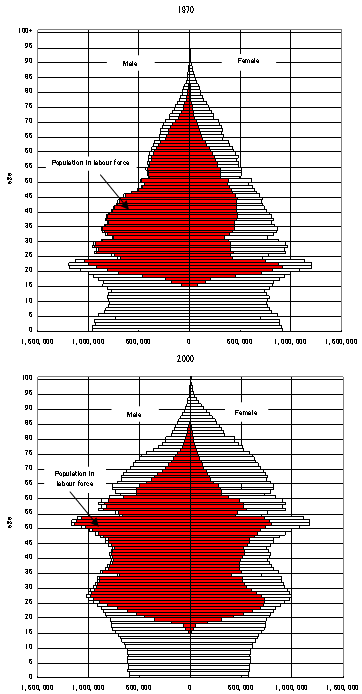
PopchThe immediate concern is for retirement pensions: supported by the present workforce, it buckles when the number of retirees swells and workers shrinks–and that’s just what is happening. The post-war baby boom is close to retirement, and Japan has fewer young people working to support them.

Fixes have been in the works for years. As early as 1980, Japan required the minimum mandatory retirement age to be gradually raised from 55 to 60, the goal to be reached by 1998; in 2000 (and through to 2004), the youngest permissible mandatory retirement age was raised again to 65, to be reached by 2013. With the largest number of retirees reaching retirement age at present, it is unlikely that future boosts would do anything in time.

There is also an economic reason to avoid hikes in the mandatory retirement age. Japanese men often wish to work beyond that age, and companies take advantage of that, sometimes forcing them to retire, and then accepting them back afterwards at greatly reduced pay rates. Sometimes the retirees could not even achieve that; many switch over to what are effectively make-work jobs. Try parking a bike outside a train station before 10 am–you’ll likely be approached and chided by retirees working as bike parking police.

The decrease in the birth rate also affects my own profession, colleges. The decrease in population will continue for another few years and will then level out, but the overall number of students is also at a record low. In a few years, the number of students of college age will, for the first time, fall to or even below the number of available openings in colleges and universities. Fortunately for my school, Japanese institutes of higher education are slow to change; they are still stuck in the same mode they were when applicants far outstripped available seats, and when what you studied was less important than what school you got into. They still focus less on delivering an actual education at a time when businesses no longer wish to spend money to train workers themselves, as they did during the boom years. As a result, colleges which aim to deliver marketable skills are still not so common in Japan, making foreign institutions such as my own more attractive to students who look forward and see what will work best for them.

Categories: Focus on Japan 2005 Tags: by

Mac Mini vs. the PC Mini

May 31st, 2005 1 comment

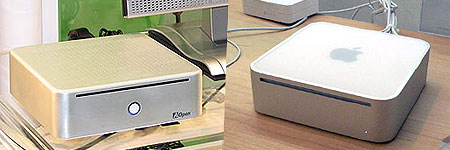
Well, sooner or later it had to happen. The Wintel world has ripped off just about everything else that Apple comes up with, so why not this? A company named AOpen has displayed what is clearly a complete rip-off of the Mac Mini. See for yourself:

Mini1

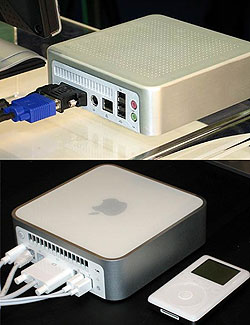
Mini2SPC defenders claim that small form factors have been around for years, so this can’t be a rip-off (here’s an example of what they’re talking about). But the AOpen is so clearly a copy of the Mac Mini it’s not even funny. The same size, same rounded edges, same brushed-metal sides, same location and appearance of the optical slot drive.

And look at the back: even the fan slots across the top of the back panel are a near match. More noticeably, the white plastic area containing the back panel: an exact match to the Mac Mini. The primary difference is the relocation of the power button and the lack of an Apple logo in the middle of the top of the unit.

They could at least bevel or round the edges differently and make the unit’s color scheme something other than brushed metal. Stand it on its side or something. There’s no getting away from the size constraints forced by the optical drive, but hey, at least try to make it look a bit different!

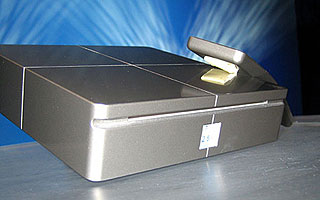
This comes on the heels of an announcement and display of an Intel “proof of concept” mini-PC. Intel order the prototype to show that they could put Intel chips in a similarly-sized PC box (though it is expected to cost more than the Mac Mini–so much for “cheaper” Wintel boxes). But the Intel model looks suspiciously like… you guessed it, the Mac Mini. Except it’s a lot uglier. See the photo below: basically the Mac Mini box, with a ghastly grid on top and bizarre beveling of the identically-placed optical slot drive.

Intelmini

Update: just more info that I dug up, actually. For all the protestations in the PC world that there are Wintel boxes that sell for less than the Mac Mini (only if you spend hours jumping through mail-in rebate hoops and then wait months for checks), the Wintels referred to are all big tower PCs. Wired News, meanwhile, reports that Wintel minis that do exist sell for $600 at least, and about $900 to get features comparable with the Mac. And the PC minis don’t sell well, while the Mac Minis have been flying off the shelves at the rate of 40,000 per month. So much for Wintel doing it cheaper and better.

Categories: Computers and the Internet, Mac News Tags: by

Thoughts on Macs and Wintel for the Day

May 30th, 2005 Comments off

I was at Costco in Tama-Sakai the other day and noticed that they’ve started selling eMachines for a fair price; they have a 2.8GHz Celeron with 256 MB RAM, 80 GB HDD and XP Home for ¥41,766 ($390), and a 3.06 GHz Celeron with 512 MB RAM, 160 GB HDD and XP Home for ¥57,516 ($535). Those are very low prices for Japan.

One problem: the copy of Windows XP Home is in Japanese for both machines. So if you prefer to compute in Japanese, this is for you; if you want English, however, you’re screwed: Windows Doesn’t Do Languages. I’ve looked into this, and from what I can find, there’s no way to switch from Japanese to English within the operating system you’re provided with; to get an English-language OS, you’d have to buy Windows XP English version straight out, which is going to set you back an additional $250.

Time to do some boasting about Macs: they do languages, and well. Macs come with 14 languages pre-installed (English, Japanese, French, German, Spanish, Italian, Dutch, Swedish, Norwegian, Danish, Finnish, Portuguese, Chinese and Korean), 15 if you count both traditional and simplified Chinese. It’s free and easy. Switching the languages simply involves going to the International preference pane, moving the desired language to the top of the list, and logging off and back on. All menus, dialog boxes and other native system features are in the new language. Additionally, there are 61 languages (not counting variations and varied keyboard layouts within languages) for text input, also included in the original OS, no downloading of language packs. And they’re nicely integrated–the Japanese input I downloaded for Windows is clunky at best.

One reader pointed out to me several months ago that you can get the Multilingual User Interface (MUI) to change languages in Windows–but he was just slightly wrong on that one. Yes, there is a MUI pack, and yes, it can change languages–but it (a) is not free, (b) is not available retail, only specially through volume or OEM purchases, and (3) only works on top of English-language versions of Windows. And even then, it only mimics a localized version of the OS, and not completely. Pretty pathetic, if you ask me.

Since I’m on the topic of Macs and Wintel, there’s a story recently about how a nationally known technology security expert got fed up with Wintels and decided to switch his business over to Macs. His name is Winn Schwartau, and he and others maintain a blog on the subject. Schwartau has written:

This is my first column written on a Mac – ever. Maybe I should have done it a long time ago, but I never said I was smart, just obstinate. I was a PC bigot.

But now, I’ve had it. I’m mad as hell and I’m not going to take it anymore. … the WinTel platform represents the greatest violation of the basic tenets of information security and has become a national economic security risk. I do not say this lightly, and I have never been a Microsoft basher, either. I never criticize a company without a fair bit of explanation, justification and supportive evidence.

He’s not alone in his frustration–Paul Otellini, CEO of Intel, also believes that if you want better security, get a Mac.

A coworker of Schwartau’s commented:

I’ve known Winn for a few years now, and when he called me up and said “We’re switching to Mac’s”, I have to say, I didn’t believe him. While initially I argued that if he truly intended to go in this direction he should send me a Mac mini for testing before we commit to it. … Well, it’s been a few weeks now and all and all, I’d have to say I’m smitten. I look forward to using my Mac every day, and I can honestly say I’ve never felt that way about a Windows machine. Lets face it, it’s a sexy beast and it’s just been one pleasent surprise after another. I crashed the dock once and was able to shell out and use ps aux and kill to end the process.

Neat.

Not everyone is going to have the same experience. I’m experiencing a bit of instability in Tiger myself, though I can tell that a lot of it is due to my aging PowerBook and heat issues (reducing the processor speed in the Energy Saver prefs helped a lot) and new versions of the OS are usually shaky at first, Windows included. But overall, the Mac has a lot more to offer than Windows, and not just in security (though zero malware vs. 60,000 is impressive in itself).

I just did a presentation in my computer class to highlight what OS X can do (for students who have only known Windows), and there was a lot to talk about–the Dock, spring-loaded folders, interface control, graphics, languages, customizable keyboard shortcuts, plug-and-play with peripherals, access to non-standard characters, Exposé, Dashboard, Spotlight, Windows compatibility, and more (that’s just from the basic outline).

A few recent experiences as examples. On my Windows box, using XP, I was opening a variety of documents alternately in two diverse locations. I had one folder deep within my C: drive, another deep within my external F: drive, and had to open them from within a single application. When you get the “Open File” dialog box, it always opens to the last place you accessed. So to switch to the other folder, I’d have to go up to the drive level and work my way down through long lists of folders to get to where I’d want. Every time I needed to go to the alternate folder, I’d have to do that all over again. Huge pain in the neck. I tried to find some way to set “favorites” or “recent places” in the dialog box, but with no luck–only “My Recent Documents” was available, and though you could see folders in there, they were shortcuts, and did not allow the dialog box to open the folders and look inside. If there’s a way to do what I was looking for, Microsoft hid it well–I certainly couldn’t find it, despite multiple searches in the Help window.

On the Mac, the left side of any window or dialog box has a list of all drives and a customizable list of documents and/or folders. Just drag and drop a folder on the list, and there it is, one click away.

Another example: dealing with nested folders in regular file windows. Sometimes I want to clean out big files that are eating up space, and being able to see the size of each folder in list view, sorted by size, is invaluable to that end. On my Mac, that is, not in Windows–Windows will not display folder sizes in the list–instead you have to hold the cursor over each folder and wait a few seconds for a small info window to come up and show you the size (which, frustratingly, is difficult to get every time). On the Mac, you can set the Finder to calculate folder sizes (in all windows, or just select ones), then sort by size. Way easier. And then there’s threaded view in folder windows, where you can toggle folders to see see their contents in an indented list without opening the folder itself. This feature is only accessible in Windows when using Windows Explorer; you can’t do it in regular windows like you can in the Mac.

One more example. At my college, the main office just got a new Fuji-Xerox color copier, with network access from computers, so you can use it as a printer. Someone in the office with a Mac wanted to use it to print, but was told by office staff that it would be a week before the tech support people could come by with software to install the necessary drivers. But this person (not an expert user, by the way) knew he was using a Mac, so he just went to the Print Center and told his Mac to find printers on the network. The Mac found the copier and made its own driver, all in a few minute’s time. And it worked perfectly. I’d like to see a layman try that on Windows.

Categories: Computers and the Internet Tags: by

And He’s a Wimp, Too

May 29th, 2005 Comments off

Tom DeLay is whining about how a recent episode of Law & Order used his name in an episode. In the episode, two judges had been killed by right-wing extremists, and the detectives had no lead; one officer joked, “Maybe we should put out an APB for somebody in a Tom DeLay T-shirt.”

This, of course, is in reference to a comment Tom DeLay made during the Terri Schiavo case. On March 21 of this year, he said, “This loss happened because our legal system did not protect the people who need protection most, and that will change. The time will come for the men responsible for this to answer for their behavior, but not today.” This was in a written statement which he read–and because it was written, it is clear that he had reviewed it and considered it carefully before speaking. Further, the statement was made at a time when several others associated with DeLay were making similar veiled threats, including another Texas Republican, Senator Cornyn, who suggested that judges were being murdered because their killers were objecting to the judges’ politics.

The Law & Order line was completely valid; DeLay had spoken words that conveyed the idea that these judges deserved to be punished because their decisions did not fall in line with right-wing politics. The killers on the show, presumably, had killed judges for the exact same reason. What’s so unreasonable about suggesting that people like that wouldn’t approve of what DeLay said? If anything, it makes perfect sense. If Tom DeLay doesn’t want to be identified with such things, he should not say such things; and if he did not want to open the door for the interpretation of violence, he should have made his statement more specific.

But in the end, it comes down to the fact that he’s a public figure, he said something offensive in public, and now he’s identified with it. Not to mention the whole thing about free speech, especially the freedom to be critical of our leaders. If he doesn’t like it, that’s just tough.

Suck it up, Tom. You were an asshole. And it’s a teevee show. Deal with it, and stop being a little crybaby.

Categories: Political Ranting Tags: by

Conflict

May 28th, 2005 1 comment

So, it appears that installing Netscape 8.0, cousin of Mozilla Firefox, can disrupt the functionality of Microsoft’s Internet Explorer on some web pages. Microsoft has issued a press release and general widespread call with a solution: uninstall Netscape.

Here’s a better solution: throw Internet Explorer into the Recycle bin, where it belongs.

The sorry excuse for a browser is chock full of security holes, has not been substantially improved in six years (an eternity in software time), and is just plain crappy in general. You shouldn’t be using it. When experts bail and businesses urge their employees to chuck a major Microsoft component, you know there’s an excellent reason for it.

Not to mention that, back a decade ago when Netscape was the king of the hill, part of Microsoft’s strategy to crush Netscape included revisions to Windows and Explorer that partially disabled Netscape. Microsoft also avoided popular web standards in favor of their own version of web page coding so as to force web page designers to create their sites for Explorer specifically, shutting out other browsers–in effect, disabling Netscape by changing the world wide web itself. Microsoft has, several times, and intentionally, used its muscle to make Netscape not work as well as it should, discouraging people from using the competing browser.

So, talk about the stove calling the kettle black.

I’ve said it before, and I’ll say it again: chuck Explorer, start using Firefox, Mozilla or Netscape. THey are more secure and have far superior features. If you use Explorer, then you should be aware of the fact that the reason you use it is not because it is good–the reason you use it is because it was there when you bought the computer.

What if, when you first got your driver license, you could have taken your father’s decrepit Dodge Dart, or had your parents buy you a new BMW? Would you have taken the Dart simply because it was there in your driveway? That’s how unintelligent it is to use Explorer when far superior browsers are just a few clicks away.

Categories: Computers and the Internet Tags: by

I Don’t Buy Used Stuff Anymore

May 27th, 2005 5 comments

I remember when I first came to Japan in the mid-80’s, Japan was in a boom period and consumption was rampant–and garbage was of fairly high quality. At the time, Japanese people were throwing out some pretty nice stuff. The foreigners who came to Japan in that period often didn’t have much to spend, especially at first (you usually don’t arrive in a new country flush with cash, your first pay doesn’t arrive for one and a half months, and paying 6 month’s worth of rent before getting the key to your apartment has the effect of draining whatever resources you have), so many depended on the junk to be found in the streets. No dumpster-diving–you’d just see a nice gas cooker laying on the side of the street and take it home to find that it worked. Now, this is not as pathetic as it might sound; it was pretty good junk, and there was no reason to let it go to waste. From furniture to electronic items, if you found it before it rained, there were some more-than-acceptable items. I knew a few people whose apartments were almost fully furnished with stuff off the streets.

When the economy crashed, things changed. People stopped throwing out perfectly good stuff so much. Secondhand shops started sucking up what remained–bad news for people trying to get by on the cheap. A lot of the stuff the shops get is discards that would have ended up in the gomi piles; they have small trucks roaming the streets now, crying out for you to give them your stuff. This not only takes away any usable items for people walking past to find and pick up, but it annoys the hell out of me by adding yet another damn loudspeaker truck to the horde that continuously drive through every last parking lot in the area at 5 kilometers per hour.

But that’s not the only reason I don’t buy from such places. They also charge way too much. They pay nothing or close to nothing if you’re trying to get rid of something, and way too close to the list price for new items to justify a used purchase. And often you get something (no refunds, thank you) you didn’t expect. One experience I had was the purchase of a dining room table. A solid wood table, looked fine, the price high but not prohibitive. But after I got it home, something changed–the smell of my apartment, specifically. But it was subtle enough at first that I didn’t recognize the table as being the source of it. You see, I started smelling cigarette smoke on a regular basis.

At first, I attributed it to my chain-smoking next-door neighbor, who always left his front window open with smoke pouring through so if I left my own front window open, it was like having a smoker in my place. I had already had trouble with the smoke; I discovered that whenever I turned on the air vent in my bathroom or over my stove, the cigarette smell from my neighbor would get sucked in via a small air vent most Japanese places have by the front door. But this new smell wasn’t getting in like that, I eventually determined. I finally identified the source as my new used table. Apparently, the former owner had been even more intense a smoker than my neighbor, and the stink permeated the wood. I tried various solutions such as hosing down every crevice of the table and applying spays and solvents, but eventually it was just a matter of letting the stink escape from the wood until there was no more.

Buying used stuff from other people was even less satisfying. In a previous stay in Japan, I moved into a place in Koganei and had to buy a refrigerator. I looked at both secondhand shops and personal ads, and found some guy out in Kasai who had a fridge priced at 11,900 yen. A rather odd figure–most people choose nice, round numbers for personal used items, and when I asked the guy about it, he even admitted that he felt such numbers sold better. What sold me, however, was a reasonable price for a reasonably-sized fridge. I went to the guy’s place, and he proved it was working by showing me the ice in the freezer and inviting me to stick my hand in the main section and feeling the coolness. Figuring it worked from this evidence, I paid him and arranged for the delivery.

When the fridge came, I turned it on, and lo, it froze ice and it made my hand feel cool when I felt inside. But the damned thing didn’t get cool enough. The freezer would just barely make ice when turned on high (anything less wouldn’t freeze anything), and the fridge probably didn’t get down below the high 50’s fahrenheit, tops. (It was summer, which made it feel colder when you put your hand in.) The refrigerator was useless–and the guy I bought it from refused to take it back or give any refund at all. I despise people who sell stuff they know is broken–but when you buy used stuff, that’s just a common risk you face.

But the fridge story had a happy ending which dovetails nicely with the trash angle of this post. Just a few days after I bought the good-for-nothing fridge, one of the most unlikely things I’ve experienced happened: one of my building’s occupants threw out a broken refrigerator. And that refrigerator just happened to be the exact same model and color as the broken fridge I’d just bought from that creep. The discarded fridge, which sat just a few meters from my front door with a sign on it designating it as large-trash-item-for-pickup, had a broken door–somehow it had become warped and did not close properly. The fridge I had was broken because of its internals, but the door was fine. So I got an idea. I got out a screwdriver, took the door from my fridge and put it on the broken refrigerator outside, ran an extension cord to it, and plugged it in. Sure enough, it worked perfectly. I could hardly believe how that had happened to work out (what are the odds on that?), but was not about to question such good fortune. So I put the piece of junk I’d bought with the swapped broken door outside and took the newly amalgamated fridge into my kitchen, where it worked just fine until I left Japan two and a half years later.

But that experience turned me off to buying used stuff from individuals, as the smoking table and high prices turned me off to used junk stores. And having lived in Japan for 7 years straight, I have enough money that I don’t have to buy used junk, thankfully. In the end, it’s just not worth the hassle, and it is just a nice luxury to have new stuff.

Categories: Focus on Japan 2005 Tags: by

Downloading Dent?

May 26th, 2005 8 comments

Just a week after its release, Star Wars: Revenge of the Sith is expected to break $200 million–and that’s just the domestic box office. Overseas, it’s earned over $160 million by now. And none of that includes the merchandising, or the DVD sales that often match or exceed box office sales. It is probably safe to say that by the end of the year, the film will gross well over a billion dollars.

A bootleg copy of the film–a workprint straight from LucasFilm, in fact–has been available on BitTorrent since just before the film was released, and probably tens of thousands of people have downloaded it. Federal agents stormed sites in ten cities across eight states as the MPAA got help from the FBI and–why, I have no idea: the Department of Homeland Security–in shutting down “Elite Torrents,” a BitTorrent tracking web site which guides people to make the connections to download movies such as Sith.

But it doesn’t stop there. A 60-year-old man was arrested in California for taking digital still photos of the screen while Sith was playing. Still photos. Of lesser quality than hundreds of photos which have been out there legally for months now. He faces a $2500 fine. The theater owner explained it like this:

But Del Oro Theatre co-owner Mike Getz said Keachie’s actions Thursday amount to movie piracy. Signs near the entrance to the theater clearly state that video recording devices are prohibited, he said.

“People who are (pirating films) are costing us billions of dollars a year,” Getz said of the cinema industry.

Now, the Torrents site I can understand, but the guy with the still camera? Please. Throw him out of the theater and be done with it. But arrest him and claim he’s responsible for “billions” of dollars lost?

The MPAA and related industries, in a way similar to the RIAA, are acting like Republicans nowadays–highly successful and hurt none at all by the opposition, but playing the grievously wounded victim for the cameras, as if they were getting killed by this nickel-and-dime stuff.

Say 100,000 people download the Star Wars movie. You think that even a sizable minority won’t go see the film in theaters? Unlikely. Most of these are people who’ll still go see the film three times, then buy the DVD along with bags of merchandise from the film. I don’t care how much it’s downloaded, Star Wars isn’t going to lose a dime from Torrents, and certainly not a penny from senior citizens with digital cameras. There will not be a single dent in George Lucas’ wallet.

The truth is, illegal downloading, despite being illegal, isn’t doing the music or movie industry any actual harm–but it might if they keep acting like fascists. I mean, Homeland Security? Shouldn’t they be hunting down terrorists instead of arresting people for stealing a few bucks apiece from billionaires? Do they not have their priorities straight? Lighten up, people.

One way to lighten up: watch this. I love ChewBroccoli.

Widgets I Like

May 25th, 2005 1 comment

With Apple’s Tiger, comes Dashboard, and with Dashboard, a horde of Widgets to choose from. Apple’s initial set has a few good ones–the Weather widget is good, the translation widget is fun, the Dictionary widget is excellent, and the calendar isn’t bad. But there’s a wealth of new widgets coming out on a daily basis, and from that you can pick and choose the dozen or two that you can use on a daily basis. Here’s what my own dashboard looks like now:

Wg-Dash

Two sites which have most of them are Apple’s own widget download page, but even better is the Dashboard Widget Showcase. New widgets are added all the time, and they have a pretty good collection so far.

Wg-ReversiAmong my favorites:

Reversi: a simple game, but it works well. Which is more than I can say for the solitaire game that came out early as a widget–that one was hard to operate, and just kinda sucked. But Reversi works as advertised, and can be quite distracting. At the medium setting, I can usually beat the computer–but the widget allows for two humans to play as well. A very well-execusted widget here.Wg-Icalev
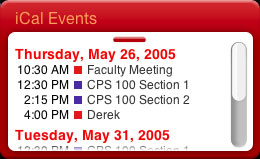
iCal Events: recently updated so that it displays the events in all your calendars at once, this widget will alert you to all of your coming appointments in the next day without having to open the actual iCal app in which you set the appointments. Not a huge convenience, but it is a convenience–especially for someone like me, who often forgets to check his calendar….

Then there are a few Timer widgets:

Wg-Timers

the one on the left is iChrono, and provides a service I’ve lacked on my Mac for some time: a simple stopwatch function. This comes in handy when my students do their PowerPoint presentation projects, and one of the grading elements is timing.

The other widget, on the right, is the Countdown Calendar, which does what it says, though it also counts up, as I use it to count how many days of consecutive blogging I’ve done.

Others I have include widgets that search sites like Amazon, the Internet Movie Database, Wikipedia and song lyric databases; “This Day in History,” a metric/currency conversion tool, a word/quote/joke-of-the-day widget, and a simple digital clock are also nice. But you’ll find the ones that you like, and will build your own custom dashboard.

There are a lot more, and I suggest that you regularly visit the download pages I’ve linked to above–new, interesting widgets are coming out all the time.

Categories: Mac News, Main Tags: by

Deal

May 24th, 2005 2 comments

So there has been a deal between moderate Republicans and Democrats, and like most deals, both sides can feel victory, both sides can feel betrayed. Me, I feel that the Democrats gave up a bit too much–especially Priscilla Owens for the fifth circuit–but it seems pretty clear that the Republicans, however moderate, could not get away with betraying their party unless they brought something substantial from the deal. So they got three of the more controversial nominees cleared for a vote, and got the Democrats to agree not to filibuster again unless “extreme” circumstances warrant. It is a foregone conclusion, therefore, that Bush nominees either coming immediately or very soon will be so outrageously questionable, intentionally so, that Democrats will have no choice but to filibuster, at which time Republicans will scream deal-breaking and try to make the Democrats out as villains in the public eye.

Of course, for Republicans, they are getting more than any party in power has ever gotten, but because it is short of 100% overwhelming domination, they will scream persecution and bemoan their failure to get every last single thing they wanted. What infantile children these people are.

My pessimism here tells me that the Democrats will not get credit for leaning over backwards and giving away ten times more then Republicans would have under similar conditions, and that my predicted Republican move of pushing the barrier to prompt a Democratic filibuster they can decry will serve the Republicans come election day. If it had been up to me, I would have pushed the Republicans to the edge, and had they decided to jump over, so be it–it would expose them and make martyrs of the Democrats. The risk would have been the loss of the filibuster and possibly an extremist put on the Supreme Court, but frankly I don’t think that would have been so great a possibility.

I hope, but do not expect, the Democrats to pull one out of their hats on this one. Sure, the extremist right will be pissed that they didn’t get every lollipop in the land, but the GOP will be able to make enough hay to compensate, and the religious right ain’t going shopping anywhere else. So, come on, Senator Reid and Mr Dean, show us what you’re made of. Bring this one back into our court.

Categories: Political Ranting Tags: by

Lies Bush Tells Us, Lies the Media Loves

May 23rd, 2005 Comments off

In order to stoke the flames of patriotism back home and make an ugly and unnecessary war sound heroic and popular back home, the administration has regularly lied about goings-on overseas. One example I reported on almost two years ago in early June 2003: Jessica Lynch. She was injured when her vehicle overturned and was captured by the Iraqis. She was taken to a hospital where she received better care than most patients there, with doctors donating their own blood to keep her alive and healthy. Hospital workers even tried to return her but were fired upon when they tried to do so, and when American soldiers finally came to “rescue” her, hospital staff cooperated, only to have their cooperation refused as the soldiers tore through the complex unchallenged.

But that’s not the story the Bush administration told. According to the lies disseminated through the media, Lynch was not injured in a rollover, but instead valiantly fought back before being shot and/or stabbed; she was then taken to an Iraqi hospital where we were told she was slapped around and tortured before a daring American raid rescued her in a firefight against Iraqi soldiers imprisoning her in the hospital. Complete fiction. Yet it was bought into so thoroughly that most Americans still believe the lie, and the media does little to disillusion them. In fact, the media lapped it up, almost orgasmically excited by the footage that went with the story. And when the story was shown up as a lie, most of the media casually ignored that aspect of the story. In the case of Lynch, she herself conveniently suffered from “amnesia” about her entire ordeal, though her family seemed to know but were “not supposed to talk about it.”

Well, not every family is quite so cooperative when their child’s misfortune overseas is lied about. Pat Tillman, a patriotic young man who left his successful football career to fight for a fight he believed was right, was accidentally killed by his own men as he got into a position to defend them while in Afghanistan. The Bush administration, in pre-election mode and smarting from the Abu Ghraib prison scandal, decided they needed a red, white and blue poster boy, so they lied. They told the people and the Tillman family that Pat died heroically, charging an enemy hill, barking orders to his fellow troopers before being cut down by the enemy. The administration awarded him the Silver Star, and Bush took full political advantage by giving a falsely heartfelt memorial message at his team’s football stadium shortly before the election.

When the family found out the truth, they were understandably furious:

Patrick Tillman Sr., a San Jose lawyer, said he is furious about what he found in the volumes of witness statements and investigative documents the Army has given to the family. He decried what he calls a “botched homicide investigation” and blames high-ranking Army officers for presenting “outright lies” to the family and to the public.

“After it happened, all the people in positions of authority went out of their way to script this,” Patrick said. “They purposely interfered with the investigation, they covered it up. I think they thought they could control it, and they realized that their recruiting efforts were going to go to hell in a handbasket if the truth about his death got out. They blew up their poster boy.” …

“Maybe lying’s not a big deal anymore,” he said. “Pat’s dead, and this isn’t going to bring him back. But these guys should have been held up to scrutiny, right up the chain of command, and no one has.”

Mary says the government used her son for weeks after his death, perpetuating an untrue story to capitalize on his altruism, just as the Abu Ghraib prison scandal was erupting publicly. She said she was particularly offended when President Bush offered a taped memorial message to Tillman at a Cardinals football game shortly before the presidential election last fall.

Not that this is anything new. We know about Jessica Lynch, and we also know about the toppling of the statue of Saddam Hussein. Or did you not know of that?

Like the fake Jessica Lynch story, the press continues to perpetuate yet another exposed lie, the toppling of that statue. You can still see it in video montages, almost every time they do one for a story about Iraq. What they rarely mention is that is was a faked event, a staged media story, which the media knew all along and cooperated with.

I reported on this a little more than two years ago, soon after I started this blog; go and see the post, complete with photos. You’ll see in one shot what the media showed us: apparent throngs of jubilant Iraqis tearing down the statue. But the other photo shows a truer story: the square where the statue was torn down was almost deserted, with only a few people crowded at the center of events–and the low-angle media shots suddenly crystallize: they were shooting from angles that hid the vacant plaza and made the crowd seem much bigger than it was. Your “objective” news media at work.

Not only that, but we also later learned that it was US soldiers, not Iraqis, who tore down the statue. And of the few Iraqi who were there, several were identified as aides to Ahmed Chalabi, Bush administration bag man–in other words, the “crowd” was faked in more than one way. And as icing on the cake, the American flag that was draped over the head of the statue as it was torn down just happened to be the same flag that had flown over the Pentagon on 9/11. As if that particular flag could just “happen” to show up at such a time and such a place. The event was completely staged and fake, attempting to make Bush and Cheney’s pipe dream of “Iraqis welcoming us as liberators” seem true.

But the real shocker is that the press knew about the lie from the start and was actively complicit in telling that lie, and continues to perpetuate it to this day. Or maybe it’s not a shocker, seeing as how the media has become such a willing whore to the Bush administration.

Categories: Iraq News, Political Ranting Tags: by

Memogate

May 22nd, 2005 3 comments

Okay, the next time somebody suggests that there is even a hint of a “liberal media” in the United States, I’m going to laugh right in their face. Not a funny laugh, mind you, but a harsh, cynical laugh that may be forced through frustration and disgust but nonetheless is heartfelt and righteous. Anyone who truly believes that the American media is liberal is an out-and-out complete moron.

For years now, Bush and the right wing have been insisting that the administration’s reasons for going to war were just, honest and well-supported, and that the final decision was not made until soon before the war started. Though critics insisted from the beginning that Bush decided to go to war from the start and that the data to make Iraq look like a threat was cherry-picked and inflated, the administration denied it. When it was shown that some claims, like the one about Saddam buying uranium from Niger, were not only false but the administration knew it (they rejected our own intelligence and went with a British report instead), they denied knowing anything but what they told the people. When it was proven that there were indeed no WMDs and Iraq had not been a threat, they blamed the intelligence community.

Of course, it was all bullshit. But they at least had some cover because while it was obvious they had lied, there was no “smoking gun” that showed that they had lied. But now there is. In fact, there has been a smoking gun out in the open for two weeks now. But the “liberal” media never touched it.

In a revelation that would have exploded in a media orgy of scandal reporting under a Democratic administration–and probably most Republican ones as well–a British government report has demonstrated how Bush knew Iraq was no threat and was slanting the evidence to go to war anyway.

The July 23, 2002 secret memo was written by a British national security aide named Matthew Rycroft, and summarized minutes from a July 2002 meeting of Prime Minister Blair and his advisers, including the head of MI-6, who had recently met with Bush administration officials. The minutes included these passages (emphasis mine):

C reported on his recent talks in Washington. There was a perceptible shift in attitude. Military action was now seen as inevitable. Bush wanted to remove Saddam, through military action, justified by the conjunction of terrorism and WMD. But the intelligence and facts were being fixed around the policy. The NSC had no patience with the UN route, and no enthusiasm for publishing material on the Iraqi regime’s record. There was little discussion in Washington of the aftermath after military action. …

The Foreign Secretary said he would discuss this with Colin Powell this week. It seemed clear that Bush had made up his mind to take military action, even if the timing was not yet decided. But the case was thin. Saddam was not threatening his neighbours, and his WMD capability was less than that of Libya, North Korea or Iran. We should work up a plan for an ultimatum to Saddam to allow back in the UN weapons inspectors. This would also help with the legal justification for the use of force.

These minutes provide high-level and highly reliable proof that Bush knew Iraq was not a threat, but had decided from July 2002 or even earlier that there would be a war no matter what, and that in order to sell the war, the “intelligence” was being intentionally manipulated to essentially lie to the American people.

This is not some anonymous source, this is the British government, and it’s not about whether or not Bush dodged the draft 30 years ago, it’s about whether or not he lied–and is continuing to lie–repeatedly to the American people to drive them into a war they would never have agreed to had they known the truth. This is malfeasance at the highest level, with the proof being of the highest quality and reliability.

If there were even the barest shadow of a liberal media, this would have been huge news for the past several weeks and would continue to stay in the headlines with massive reporting for weeks and months to come. This is about the president lying and taking us into a war the people would not have wanted, not some extramarital affair.

If the media were fair and balanced, to coin a phrase, it would be covering this at least as much as Whitewater, Monica Lewinski, or Paula Jones–just the coverage of one of those, let alone all three.

So what kind of media do we have if half-baked political scandals around decades-old land deals or extramarital affairs gain huge years-long media attacks, but proof that the president massively lied over years to force America into an unwanted war where so far 1631 American have been killed, thousands more maimed for life, and tens if not hundreds of thousands of Iraqi civilians have been slaughtered–is met with almost complete silence and disinterest from news organizations?

So once again, the next time anyone mentions the “liberal media” as if it were real, laugh in their faces and call them idiots, because they deserve it. The media is undeniably and unabashedly right wing.

Categories: Political Ranting Tags: by

Harry Potter and the Ring of Reduction: Whole Book Files

May 21st, 2005 5 comments

Okay, for those of you who have been patiently waiting for Ring of Reduction fanfiction novel to be released in whole-book form, here it is, in two different versions–one PDF and one text-only. The downloadable PDF file has 12-point Garamond text at 1.5x line spacing. I intended to have two different PDF versions, one B5 and one US Letter, but repeated attempts at the US Letter sized files failed for some reason. I’ll have to come back to that in a day or two and try from scratch again.

So instead, I just have the B5-sized PDF version. B5 is an international paper size a bit smaller than US Letter. If you prefer larger lettering, you can use this to print out an enlarged version on US Letter size, probably scaled at 115% of normal size. In this format, the book is 1255 pages long, not including the Table of Contents, and weighs in at 4.6 MB. This format is better for viewing on a computer screen, should you prefer to read it that way.

Wholebookror

Also, there is the plain text version, which weighs in at 2.4 MB.

The main Harry Potter page will be updated in the next day or so.

Categories: Main, Media & Reviews Tags: by