Archive

Author Archive

Basing One’s Morals Upon the Worst of Others’

September 12th, 2010 Comments off

Despite the Florida group’s decision to cancel their Koran-burning event, one protester near the NYC Islamic center site did burn some pages from the holy book. Now, had he said, “if they can build a mosque near Ground Zero, I can burn the Koran,” both would have been true in terms of what rights each group has, but the statement would have been a false equivalency; building a house of worship and interfaith community center is not comparable to defiling a book of scripture.

But that’s not what the guy said; he said something that sounded much more reasonable. He said, “If they can burn American flags, I can burn the Koran.” Now, that’s easier to identify with. The double standard does get pretty galling sometimes; angry groups in the Middle East do seem to regularly get out and burn our sacred symbols a lot, as well as our leaders in effigy–but if we do something like a Koran burning (or even a Mohammed cartoon) back, they get furious. One could, I suppose, draw differences between national flags and holy books (maybe they would not mind it so much if we burned their flags), but with the “you can’t draw Mohammed” issue, the standard does not seem to be a tit-for-tat but rather a requirement to observe what is most sacred to each group. And the American flag is pretty damn sacred to a lot of Americans. The people who burn them don’t seem to care, or perhaps that’s why they burn them.

First, there is the point of who is being hurt. Lots of people in the Middle East have burned American flags. But hardly all of them, not even a large percent. Burning pages of a Koran, however, hurts millions of people worldwide who did nothing to offend, who were probably even in opposition to that offense. Many have wondered recently how all of America could be held responsible for the acts of a tiny church in Florida with only a few dozen members. Well, that’s how–we tend to do the exact same thing.

It is easy to forget, however, that the real issue here is one level higher: doing the right thing. Being a good person. One of our biggest flaws as human beings is our ability to rationalize an immoral act based on someone else doing something we don’t like. Punching someone in the face is wrong; but if another person says enough provocative things, we feel justified, as if that person’s wrong actions somehow justifies our own. The guy who burned the Koran in New York may have felt justified, but what he did was still wrong. In one sense, he just burned paper like it’s burned all the time. But that’s not the real meaning of what he did, which was instead to carry out an act he knew would cause disrespect and anguish to others. And while that’s legal, and while he has that right, it doesn’t mean it is a moral or correct action to take.

In recent weeks, the example has been, “if we can’t build a church in Mecca, they shouldn’t be allowed to build a mosque near Ground Zero.” This, however, is based upon the same fallacy. Yes, they are wrong to deny people religious freedoms. But no, that does not mean we should follow their example. It’s the same with what many feel justifies the death penalty–why should the murderer get “life” when the victim got death–but my own primary objection is that whatever the criminals did, we should not feel justified in doing the same wrong action. Most would see this the same way in light of the analogy that we do not rape rapists–although far too many people would at the very least be satisfied with such a thing happening, and at the most would go so far as to promote it.

This follows a scriptural moral code that many embrace: an eye for an eye, a tooth for a tooth. Tit for tat. However, this was superseded by the New Testament morality of “turn the other cheek,” something that every mother echoes with the age-old clichéd lesson, “two wrongs don’t make a right.” We all know this. And yet we seem ready to abandon this simple, common wisdom at the burning of a flag.

Categories: Religion, Social Issues Tags:

Heartsong: Here’s How to Commemorate 9/11

September 11th, 2010 5 comments

For all of our talk about and taking pride in our tolerance, diversity, and freedom, we are quite often intolerant, not welcoming of those different from us, and less enthusiastic about freedom when we don’t like those whose freedom is being exercised.

Islam has never been especially welcome in the United States. After 9/11, many got the message and, at least publicly, made gestures of acceptance toward American Muslims. Most recently, however, the climate against Islam in America has reached a level of hatred and fear as can only be generated by politicians trying to win a political campaign.

In the Bible Belt state of Tennessee, we see several examples of this. In Murfreesboro, about 40 miles southeast of Nashville, an Islamic Center under construction has been the site of unusually strong opposition by its community. The site was set afire and vandalized amid sounds of gunshots in the vicinity. A sign announcing the center was defaced while a large billboard not far away advocated stopping the mosque from being built. Pat Robertson made things worse by insinuating that money from Saudi Arabia would be used to essentially take over the city.

Closer to Nashville, a proposal to build a mosque in Brentwood was shut down after a campaign by locals to smear the builders as having terrorist ties, fueling a letter-writing campaign that ultimately derailed the project.

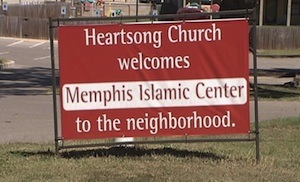
However, among all of the lies, distortions, defiling, protests, and even violent attacks, there is at least one example of what people of faith should be acting like. A few hundred miles to the west, in Cordova, on the outskirts of Memphis, a Muslim group bought 31 acres of land to build the Memphis Islamic Center, a sprawling center built around a mosque. What’s more, it was right across the street from the Heartsong Church.

When the church’s pastor, Steve Stone, first heard of this, he was nervous, admitting to a “tightness in my stomach” at the news. “But then,” he said, “I realized that was fear and I realized that was ignorance.” He and his congregation decided to do something all too uncommon among American Christians: they heeded the words of Jesus. “They’re our neighbors across the street and we follow Jesus, who teaches us to love our neighbors,” Stone explained.

HeartsongsignSo the small congregation laid out the welcome mat, in more than one way. They erected a large sign in front of their church, reading “Heartsong Church welcomes Memphis Islamic Center to the neighborhood.”

The Muslims planning the center were “overwhelmed with emotion” when they saw the sign, and thus began a warm and close relationship between the two religious groups.

When Ramadan came and the Islamic center was not yet finished, its leaders asked the Heartsong church if they could hold their Ramadan prayers at the church. Instead of being offended, Pastor Stone accepted the proposal as “a high compliment,” and welcomed the Muslims in. People in both congregations may have been a bit nervous that something might go wrong, but nothing did–and the groups moved that much closer.

This is the America we claim exists. This is the tolerance, acceptance, and diversity we celebrate. This is, furthermore, what Christianity is supposed to be all about. So the question becomes, why can’t more American Christians act like these people? We’d all be better for it.

And after all, what better way to commemorate 9/11 than to show what is best about America?

Categories: 9/11 News, Religion Tags:

What Could Possibly Go Wrong?

September 10th, 2010 2 comments

Terry Jones, the guy in Florida who plans to burn Korans, said that he’s calling off the burning event because he has been assured by a Florida Imam, Muhammad Musri, that in exchange for the Koran burning being called off, Imam Feisal Abdul Rauf will move the planned Community Center near Ground Zero to a different location, something which Jones called “a sign from God.”

When I read this, I thought, “that sounds crazy, maybe even stupid.” I mean, really–if Rauf were to agree to move because some nutjob in Florida announces he’s burning Korans, that’s kind of like giving in to terrorist demands–you give him a cookie, he’s gonna want a glass of milk. before you know it, fundie pastors from across the nation will hold Koran burnings unless Muslims do this or that. I thought, maybe Rauf is taking one for the team–but it still sounded wrong.

And indeed it was: Musri stated that there was no deal in place, but instead that the deal was to have a three-way meeting between Rauf, Musri, and Jones in New York to discuss the issue.

Okay, so maybe Jones was just playing things up, and got ahead of himself, or else was desperately looking for a face-saving way out and exaggerated a bit.

Rauf, however, claims that he wasn’t contacted by either Jones or Musri, and has no plans to move the planned project, and would not barter over the site.

Looking back, Musri had not said he talked to Rauf, but to Rauf’s “office.” That makes some sense–it could have been a miscommunication or something. Musri calls Rauf’s office to set up a deal; maybe Rauf’s people say the Imam is willing to talk to anyone as a statement of general policy. Musri perhaps tells Jones they can have talks, and maybe in that discussion tries to beef up the possibility of a deal to sway Jones, and Jones takes that as an assurance there will be a deal, and so announces he’s the NYC Mosque hero. Something along those lines. Then Rauf comes back to his office, and asks, “so what happened while I was away?” And then has to deny everything.

It wasn’t hard to predict how Jones would react to that. Claiming that Musri had “clearly” lied to him, Jones said that the Koran burning was not being canceled. However, some reports have him going forward with the burning, while others say that Jones has cryptically characterized the burning as being “suspended,” whatever that means.

All this happened, as far as I can tell, within the span of a few hours.

So, what’s next?

Categories: 9/11 News, Religion Tags:

Support the Troops and Honor the Victims? Not Really. But It Sounds Good.

September 8th, 2010 17 comments

In Gainesville, Florida, there is a group called the “Dove World Outreach Center.” From the name of it, you would think that it is an organization seeking peace by reaching out to the world.

So naturally, they want to hold a high-publicized event where they burn copies of the Koran.

Actually, the “Dove” part of the title is probably more a reference to the Holy Spirit rather than to peace in general, and the “World Outreach” part is more about proselytization, about domination Dominion theology, not reaching out in respect and tolerance. They’re really a fundamentalist group with strong anti-Islamic tendencies who apparently think that burning the Koran is a peachy idea to show their dedication to “love, healing and prosperity” by going “outside the walls” of their church and “marching for righteousness.” Among their reasons for burning the Koran: Muslims don’t believe Christ is the Son of God, the Koran is of human origin (unlike the Bible), it includes Arabian idolatry, paganism, rites and rituals, it was written after Mohammad’s death and is confused, contradictory and inconsistent, it’s totalitarian, etc. etc. (Funny, I have heard most of these used by atheists to criticize Christianity….)

Anyway, these peace-loving righteous folk have now been officially warned by our military leaders in the Middle East: what you’re doing could get our troops killed and can endanger our whole mission. Burning the Koran “could endanger troops and it could endanger the overall effort,” said General Petraeus; “It is precisely the kind of action the Taliban uses and could cause significant problems. Not just here, but everywhere in the world, we are engaged with the Islamic community.” His deputy added that “their very actions will in fact jeopardize the safety of the young men and women who are serving in uniform over here and also undermine the very mission that we’re trying to accomplish.”

So, will the Dove World Outreach Center reconsider its plans? They say “no,” although they’re “praying” about it real hard. But their plans remain in place.

Now, they certainly have the right to burn the Koran, no question there. But these people are just the kind of folk who often claim to honor the troops and drape themselves in patriotism, and yet they knowingly, even brashly put the soldiers in danger. For what reason?

He says the goal of burning Korans is to send a message to al-Qaida, the violent Islamic group that carried out the terrorist attacks in New York and Washington nine years ago.

“That led us to International Burn a Koran Day, to honor those who were murdered at that time [September 11th]. And to put a real clear message out to Islam that we will not tolerate, we do not want them trying to push their agenda on us, in other words Sharia law,” he said.

Shows what a fool this guy is–al Qaeda, while probably not enjoying the Koran being defiled in any way, is almost certainly gleeful that this is happening; this is exactly the kind of animosity they have been trying to build, exactly the image of the West they hope to propagate amongst Muslims. As for “honoring” those murdered on 9/11,“ I will wager good money that this guy has not spoken to a single family member who lost someone on that day, and probably has no actual clue how most of them would in fact feel about something like this.

In New York, Pamela Geller, the woman who has been leading the wingnut charge to demonize Islam and take down the Park51 project, plans a protest rally in front of the proposed site on September 11. However, a coalition of 9/11 families’ groups as well as many of the family members individually have respectfully asked they hold the rally on a different day:

The proposed mosque has caused tremendous pain and great concern to many within the 9/11 community. Our desire, which we hope you share, is simply to preserve 9/11 for appropriate remembrance and reflection – we do not believe that protest rallies of this nature should take place on such a sacred day and in such close proximity to Ground Zero.

Geller claims that because there are some families who support her, and because she has not received a direct request (registered mail required, I’m guessing) from a majority of the families of the victims, she feels fully justified and will ignore those she is offending.

Which goes to show that she doesn’t give a shit about the families of the victims. After all, the mosque doesn’t offend all the families of the victims, and yet Geller feels passionate supposedly about the possibility of offending even some of the families. However, she could care less about doing the exact same thing herself.

In both cases, we have people whose actions betray their claims: they are not doing this for the victims of 9/11, or for peace, or for battered women, or for America, or for whatever excuse sounds best–but the fact is, they are doing it for themselves, for their own base and selfish reasons. Fact is, they don’t like the victims’ families (right wingers like Geller, for example, hated them when they protested Bush), they just like the victims’ families who will stand behind them and give credence to their twisted little campaigns. What they do and especially the manner in which they do it, in the face of potentially hurting many of those they would claim to support, exemplifies that they don’t give a rat’s ass about them, but use them as a convenient excuse to pretty up their motives.

You Know You’re In Japan

September 6th, 2010 1 comment

Ricemac01

And not just in Japan, but out in farm territory, when you see vending machines selling 10kg bags of rice.

Categories: Focus on Japan 2010 Tags:

No Contradictions There

September 4th, 2010 25 comments

Right-wingers are all about government getting out of your business. They are all about personal liberties, one of the two biggies being freedom of religion, and government should not even think of interfering with that. They say that government can’t do anything right, and if it appropriates private property, especially on political or ideological grounds, it’s communism.

Therefore, naturally, Newt Gingrich thinks we should declare the zone around Ground Zero as a battlefield memorial so the government can take control and prevent a place of worship from being established.

Uh huh.

Categories: Right-Wing Hypocrisy Tags:

A Little Late to the Game, Dude

September 2nd, 2010 2 comments

From an article titled “White Fright” from Slate:

In a rather curious and confused way, some white people are starting almost to think like a minority, even like a persecuted one.

“Starting”? What, this guy’s catching on to the phenomenon only now? Sheesh. I’ve been blogging about it for years. Back in 2003, the year I started blogging, I noted the cause as being:

When we gain something, we tend to believe it is earned, not stolen; when we lose something, we do feel that a deserved reward has been taken from us. Similarly, white men are used to a superior position, and believe it is their due; when the scales are made more balanced, it feels to them as if something they have earned is being unfairly stolen and given to someone who does not deserve it.

Whites in general, up until the 60’s at least, were far disproportionately advantaged; they had more wealth, more power, more influence, more everything relative to a balanced norm. And while no one acknowledged it, it was clear that the advantage was taken, not earned.

Minorities were not underachievers; they were, like the term or not, oppressed. Most family lines started from literally nothing in this country, and were denied most opportunities open to whites; they received substandard education, and were constantly discriminated against and shut out, a situation that lasted openly for a century after slavery was ended, and has continued more quietly since.

But to a white person, who had indeed worked hard all of his life, the idea that any of his position or status was due to others being actively kept down was considered insulting. Racism was rationalized and/or committed out of sight, distanced from the positive achievements of white individuals. Few whites would ever know they got a position because a minority was turned down out of their field of view, by an individual who did so because of race but would never admit to it.

No, whites felt they had what they had because it was rightfully theirs. Their race, their religion, their views, all naturally dominant. So when it started being less than dominant, there was no other explanation than that it was being stolen from them. Because if it weren’t, that meant their position in life wasn’t 100% honestly earned, and that was not something they would consider.

It helped that while the unfair elements that helped them were so easily dismissed, and yet even the weak and partial systems of redress, such affirmative action regulations and legislative & court-ordered quotas, were not only visible but so easily vilified. Over the past 40 years, little if any racism in matters of record is overtly committed, and so is deniable as a cause (we are, after all, a “color blind” society now, and any accusation of racism is vehemently and automatically denied as an unfair charge no matter how outrageous the offense), and so whites can act as it there was nothing helping them at all.

Minorities are told that any achievement they make must be viewed as tainted if there is a chance that any equalling program played even a small role in their achievements, but few if any whites ever insist that they must feel the same way themselves about racial discrimination or past advantages ever being a factor in their achievements. So we have the mindset that there is little or no racism by whites, but that there is a good deal of “reverse racism” that subjugates them.

Whites have started to see their supremacy slip, and can only conclude that it is being stolen, and so they are oppressed. Christianity is naturally dominant (didn’t you know that everything we are as a country owes its origins to Christianity?) and so Christianity not being allowed into every last crevice is persecution.

It’s hard being a white Christian male. We suffer so.

Categories: Social Issues Tags:

…And the Kitchen Sink in Five Weeks

September 2nd, 2010 7 comments

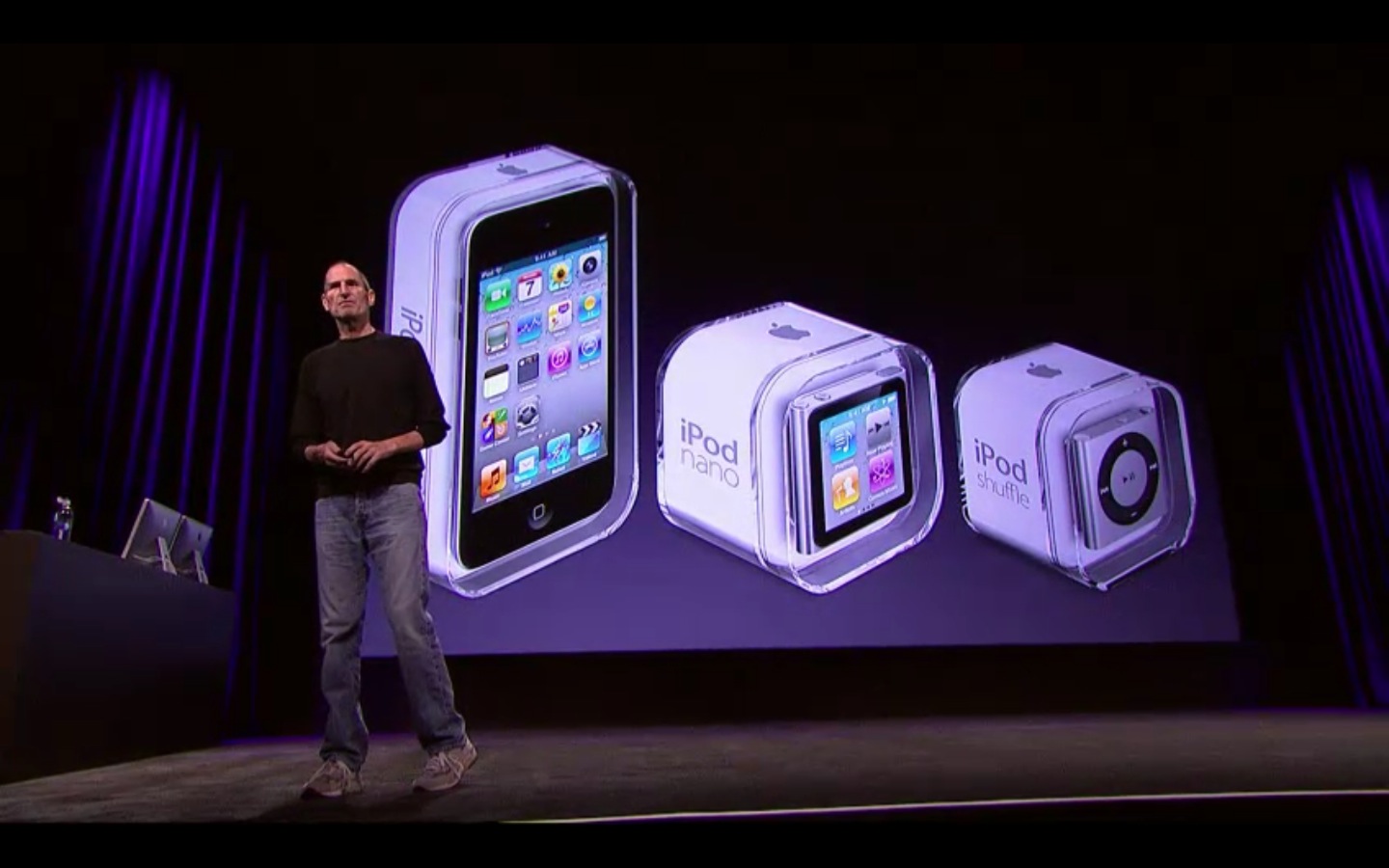
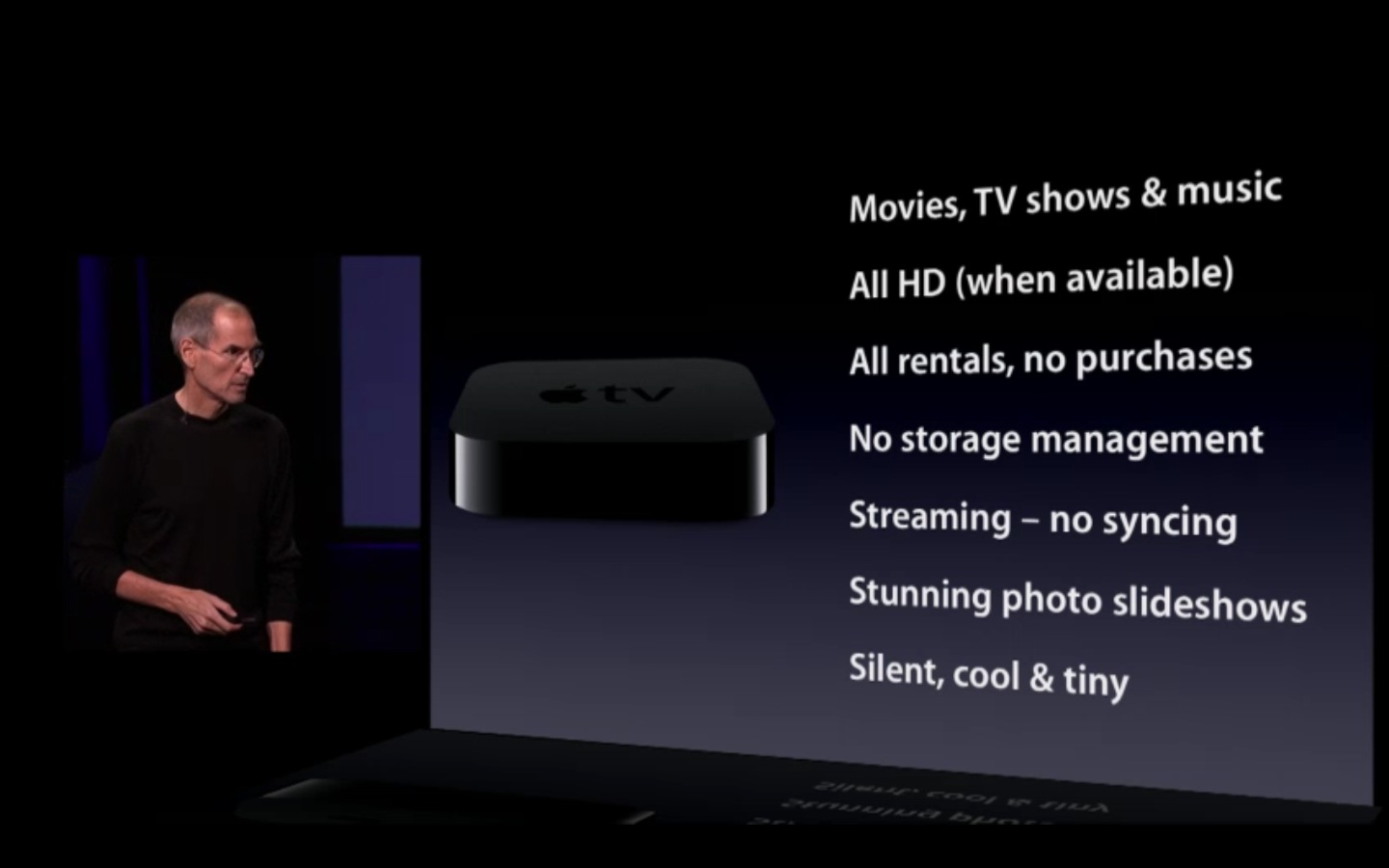
At least, that’s what it seemed like. Apple released just about everything else left, after all the product releases so far this year. The iPod Shuffle, Nano, and Touch; iOS 4.1, and a look at 4.2 for the iPad; iTunes 10 with Ping; Apple TV completely reworked, and AirPlay.

The iPods, perhaps, had to be reworked to keep ahead of the iPhone’s shadow, and there’s some pretty cool stuff–a lot of it for people who don’t want the phone.

iTunes 10 looks OK, but really it’s all about Ping. It’s a question as to whether it will actually take off, but frankly, it looks like a no-brainer. Me, I’m not so centered on my music, and I tend to stay with what I’ve had for some time. But I can see a lot of people doing this, and more significantly, use it as an engine to sell music. Bands can use it to popularize their music, and for people who are really into music, it’ll be with them quite a lot. Will it come close to Facebook or Twitter? If anything can, it probably will.

Between these products, it’s not a far stretch to say that Apple is keeping a pretty solid lock on the hold they have on the market by now.

But the potentially big thing is Apple TV. I didn’t used to want it. Now I kinda do. It’s affordable enough, and looks so versatile about content that I’d love to be able to have it there. My only problem is that I live in Japan, which is a crummy place for video content, alas. But even with that–and so much of what the product does closed off to me–I’m still thinking about this.

This could be Apple’s chance to finally have their TV box take off.

FInally, just a quick word about Apple’s streaming webcast: I like it. Not perfect–at some points, it sputtered and blacked out for a minute at a time, but it gave a great picture, high quality, despite streaming live–Apple is doing some pretty nice things with video. It looked perfect in its 850 x 480 window, and almost as good full-screen. Below are some screen shots, displayed here at 500 pixels, but they’re full-screen (1440 x 900) screenshots; click to see the full images. And it’s late, so good night!


Nanos

Steve

Lineup

Appletv

Categories: Gadgets & Toys, Mac News Tags:

The Story Needs a Villain

September 1st, 2010 6 comments

I’d like to hear reactions to this.

The mosque controversy is a struggle between the reckless and the prudent, between the dim-witted and the progressive. But we’re not the reckless radicals they wish for. No, liberals span the broadest range of American demography imaginable. We defy stereotyping, except for love of country. Look in your mirror, your shopping mall, your church, your grocery store–that’s us. Millions of ordinary people and extraordinary people. War heroes, sports idols, U.S. Presidents, and movie stars.

But the screeching hyperbole leveled at liberals has made these two camps so wary of each other, so hostile and confrontational and disrespectful on both sides they have forgotten that we are first Americans. I am asking all of us, on both sides, to take one step back from the edge, than another step and another… however many it takes to get back to the place where we are all Americans. Different…different, imperfect, diverse, but one nation, indivisible.

This cycle of tragedy-driven hatred must stop, because so much more connects us than that which divides us because tragedy has been, and will always be with us. Somewhere right now, evil people are planning evil things. All of us will do everything meaningful, everything we can do to prevent it, but each horrible act can’t become an ax for opportunists to cleave the very Bill of Rights that binds us. America must stop this predictable pattern of reaction. When an isolated, terrible event like 9/11 occurs, a group is chosen for blame. Right now, it’s American Muslims. Why? Because their story needs a villain. They want someone to play the heavy in their drama of packaged grief. To provide riveting programming to run between commercials for cars and cat food.

The dirty secret of this day and age is that political gain and media ratings all to often bloom on fresh graves. I remember a better day, where no one dared politicize or profiteer on trauma. Simply being silent is so often the right thing to do. But today, carnage comes with a catchy title, splashy graphics, regular promos and a reactionary passage of legislation. Reporters perch like vultures on the balconies of hotels for a hundred miles around. Cameras jockey for shocking angles as news anchors race to drench their microphones with the tears of victims.

Injury, shock, grief and despair shouldn’t be brought to you by sponsors. That’s pornography. It trivializes the tragedy it abuses. It abuses vulnerable people, and maybe worst of all, it makes the unspeakable seem commonplace. And Muslims are being cast as the villain. That is not their role in American society, and they should not be forced to play it.

Our mission should be to remain a steady beacon of strength and support for the First Amendment. We cannot, we must not let tragedy lay waste to the most rare, and hard-won human right in history. A nation cannot gain safety by giving up freedom. This truth is older than our country. Those who would give up essential liberty to purchase a little temporary safety deserve neither liberty nor safety.

Reactions? –Though if you have a pat answer, hold back and give others a chance to express themselves thoughtfully.

Categories: Political Ranting Tags:

An Example

September 1st, 2010 16 comments

Re: my point last week that in some ways, anti-Muslim sentiments are worse now than they were after 9/11, in particular the open expression by the public as opposed to only private, back-alley-at-night outbursts. Take this excerpt from an article on the Tennessee mosque which has found sudden, forceful rejection from their community:

The mosque — which is still two years away from being completed — has sparked protests in the city of Murfreesboro. There have also been other acts of vandalism: A sign marking the site of the future building was spray-painted with “Not welcome,” and then later broken in half.

Sbenaty expressed shock over the atmosphere in a town he’s lived in for 30 years. For most of that time, he said, the community has been extremely supportive and welcoming. Even after Sept. 11, 2001, he said, neighbors came up to him and said, “Please do not feel scared. We know your religion has nothing to do with this.”

“It’s a wide shift, and a shock,” he told TPM. “It’s just mind-boggling.”

Sbenaty, who is also a member of the Middle East Center at Middle Tennessee State, pinpointed the shift to the 2008 elections and allegations that President Obama is a Muslim.

Interesting that the major shift was not the NYC mosque but the whole movement that preceded it; not too much difference, as the Obama Muslim thing and the NYC mosque Muslim thing are artifacts of the same political campaign and mindset. Of course, despite the shift happening with 2008, the anti-Muslim sentiments have exploded with the NYC mosque outrage, thus we got the arson and vandalism spree at the mosque site and against the company doing construction for it in Tennessee. And the NYC cab driver stabbing, and the turban-wearing man being punched out, and so on.

But hey, right wing, if it helps get votes this November, by all means, keep spewing rabid hate. Maybe you’ll get lucky and lynchings will start up again. Can’t make an omelette and all that, right?

Categories: 9/11 News, Right-Wing Extremism Tags:

Bikes!

August 31st, 2010 3 comments

Bikes01

Bikes02

Not too long ago, there was a bicycle sweep at our apartment complex. This happens in Japan from time to time. In many places in Japan, bicycles are, if not a disposable item, certainly one that depreciates quickly and is forgotten about. Parked bicycle congestion is rampant, with people having bikes but either choosing semi-permanent parking places, or abandoning them outright, in the damnedest locations. If you see any group of parked bicycles in Japan (except for carefully regulated and attended lots, especially near train stations), odds are that half of them are covered with dust and have flat tires.

It seems that everybody has bikes, but most people don’t use them most of the time, and eventually just forget about them. Sachi and I are of the maintaining group–we have ’em and use ’em. Not so with others. It’s sometimes frustrating, in fact, trying to find a parking space, but most are taken up by grungy old wrecks that obviously haven’t been touched for a year or two, and would require serious maintenance before being ridden again.

That is undoubtedly why the complex had this roundup, likely a regular thing every few years. First, they tagged the bikes where they were parked, noting that if the owner did not remove the tag, the bike itself would be removed. This was already in progress when we moved in. They gave everyone notice and left this going for some time, so that everyone could see what was up and make their move if they so wished.

After a certain time, they took all the bikes which were still tagged and moved them to the place pictured above. Yep–every single one of those bikes is a throwaway. They left that pile, impossible to miss, out there in the middle of the complex for a few weeks, giving owners one last chance to wade in and reclaim their bike. (I never asked if it was kosher to just take one for yourself or not; probably not, I’d guess.)

Now, the bicycle parking areas are much more open. But they’re already filling up again, and all too many bikes that remain are still covered with a layer of undisturbed dust and resting on flattened, airless tires.

Ah, Japan.

Categories: Focus on Japan 2010 Tags:

Notes on “What They’re Fighting For”

August 30th, 2010 30 comments

A few thoughts, in part reflecting on comments to the previous post, in part expanding on some of the ideas.

“Freedom” and “Liberty” are interesting subjects to examine, as their definitions seem to be highly subjective. Looking up dictionary definitions of the two, one might see them as synonymous–the ability to act as one pleases without external restraints. The lines are blurred, the definitions shift.

Freedom” describes the power to do what you want without others acting to restrain you; this is limited only by the potential of your actions to harm others, the classic “your right to swing your arm ends where my nose begins.” In Benen’s example, gay marriage serves well to define this: two people of the same gender making a social contract to love, honor, respect, and support each other harms no one–in fact, only helps people, and serves if anything to strengthen society by strengthening the individuals. Others acting to thwart this act of love and support could serve as a classic example of the opposite of freedom. This exists in contrast to, and really completely externally to, what is allowed within past definitions of the institution–definitions which have changed so radically over time that any attempt to restrict marriage upon the basis of the past becomes a practice in hypocritical self-indulgence, of cherry-picking morality to suit one’s bigotry.

Liberty” is often considered a natural right, the state of being free, but also is commonly associated with having rights to act freely in relation to the society in which you live. Certainly if there is a liberty we have claim to in our country, it is the liberty to believe as we will, to worship or not as we wish, and not be restricted or hindered by society or the state in the free expression of that belief. Again, Benen’s example is well-chosen; the people who wish to build that community center, mosque and all, should be allowed to do so even if it were directly across the street from Ground Zero instead of a couple of blocks away. They are at liberty to do so; trying to stop them is a restriction of that liberty. Allowing them to do so honors the victims of 9/11 at the highest order, as it perfectly exemplifies the principles upon which the nation is founded; but even that is a side point to the fact that liberty means they can believe what they wish and worship where they please. Again, the only restraint is where the expression of that liberty deprives others of theirs, by causing harm or restraining others, and the mosque does not do that. Any crass or slanderous analogies of harmful acts to this one would simply express ignorance and bias.

Where Benen seems to have reached not far enough is in exemplifying “opportunity”; certainly, having the opportunity to access affordable health care is one. Frankly, anyone who argues that private health care, health care for profit, which skims at minimum 30% off the top and works its hardest to deny and cheat and steal, is better, cheaper, or more ‘efficient’ (efficient in terms of serving the patient) is, to put it bluntly, a moron. Just ask any senior-citizen Tea Party member if they’d prefer private health insurance over Medicare; they’ll tell you which is better. They’re not morons, just hypocrites. But “opportunity” is much more than just health care. It’s a chance at the American Dream. Of owning a home–but that’s become a money game, filled with predators who, free of regulation and policing, have stolen that opportunity from too many of our number. Opportunity is the chance to get a meaningful, productive job for decent compensation–but the current conservative mindset is intent on maximizing profit for shareholders and depriving the worker of every opportunity possible. Opportunity means getting a fair and equal education–but the localization of education, not to mention its defunding at all levels and the skyrocketing costs of higher education, robs most Americans of what is considered one of our most fundamental opportunities.

The real and unavoidable conclusion here is that opportunities are best served when provided or regulated by the state, as ‘free market’ methods to key services simply throw the doors open to inequality, unrestricted greed, and savage predation. In this way, public health care is, in fact, one good example of a true American opportunity–being fought and quashed by the fearful throngs of the small-minded.

Benen’s example of “values” comes from a similarly rich field, but this one is an excellent choice. Separation of Church and State is one of our most fundamental values, essential to religious liberty and freedom. Only the most unobservant or intentionally ignorant could fail to recognize the fact that where a system of belief merges with state, religion suffers horrifically. For in the end, only one belief system will prevail, and it will then act to mercilessly quash all others. So many Americans are willing to see this marriage because it is their religion they see as married to the state, and they feel fine with quashing the rights of others in this regard. But ask any Christian if they believe that official state atheism under Stalin was a fine idea; I doubt they’d agree. My grandfather, a Spanish Republican, believed in the freedom of religious liberty, but had to flee Spain after the fascists elevated the Church of Spain to power, oppressing all other beliefs, including all other Christian beliefs. What the church-and-staters fail to recognize is that Christianity is hardly monolithic; which sect prevails? The answer: probably not yours. Prepare to suffer, like those who came to America roughly four hundred years ago to escape the persecution at the hands of their Christian brethren.

The claim is that separation of church and state has “gone too far,” but this is false victimhood; religion is everywhere and prospers just fine, it is only limited in very narrow confines seen as great only because they are wildly exaggerated and emphasized by those in evangelistic fervor, craving to fill every last crevice with a dominant faith, and refusing to recognize that entanglement of church and state is not a freedom, but a vital threat to that freedom.

James Madison, primary author of the Constitution and the Bill of Rights, made it very clear: “Every new and successful example, therefore, of a perfect separation between the ecclesiastical and civil matters, is of importance; and I have no doubt that every new example will succeed, as every past one has done, in showing that religion and Government will both exist in greater purity the less they are mixed together.” Nor was this Madison’s only reference to the value; find here a long list of references to exactly this principle. However, the fundamentalist and right-wing crowds see history through a fog of their own bias. They quote statements of faith by various historical figures and equate them to professions arguing for the merging of church and state, as if Madison’s values were somehow false or non-existent. They belittle those who would fight even the smallest entanglements between church and state as spiteful pettiness, and then turn around and claim that these exact same incursions justify full marriage of church and state.

The fact is, as Madison wisely saw, perfect separation of church and state–secularism, not atheism–is the only true path to religious freedom. That is perhaps our most proud, honorable, principled, fair and priceless values. And it is being trashed by selfish hypocrites who aggrandize themselves in cloaks of fraudulent persecution, who ironically work to defeat themselves but are just too shallow-minded to realize it.

Benen’s example of sacrifice is also spot-on. Back in WWII, people sacrificed nobly and severely. They passionately collected materials to be used in the war effort, selflessly and patriotically went without meat or sugar so that these could be diverted to the troops, and did so much else to give to their country so they could secure the future of their children. But now we have despicable faux-patriots, people who clamor for war but will not serve; people who claim to support the troops but then mindlessly put them in harm’s way with inadequate provisions while cutting benefits to them and their families back home; people who drape themselves in the flag but do not even understand the sacrifices it represents. People who use debt and deficit as political weapons of the moment, who now scream about their danger, and yet cannot bring themselves to list what must be cut, and whine endlessly about how the super-rich deserve to inherit every penny of what they did not earn and remain free even from tax levels lower than at just about any time in recent history. Sacrifice means giving up a great deal so that all may prosper. But the current clarion call from the dexter is “I’ve got mine, so go fuck yourself.” The right wing today, the child of Reagan’s “greed is good” Me Generation, is the absolute antithesis of sacrifice.

And about truth? Let’s face it, the last thing the Tea Partiers and the right wing in general today are about is “truth.” They scream that the president is a communist, socialist, and fascist, without even the wit to understand that these descriptions are contradictory. They mock global climate change because it’s cold outside where they are, then go mute when heat waves cover the globe. They smear opponent after opponent with bald-faced lies and doctored videos, only shifting focus to new smears when the original lies are brought to light. They never, ever acknowledge when their lies are disproved, they simply move on to the next lie, often returning to ones repeatedly exposed as such. They sketch lurid and self-contradictory conspiracies on chalkboards, or else believe the most pathetically absurd of claims, so long as it suits their ideology. They condemn the president for doing things they themselves promoted only shortly before. The list goes on and on and on and on.

For the right, it’s about one thing and one thing only: power. That’s all that matters. The ability to control; and since they cannot win power honestly, they do it any way they can–and often state it exactly that way, we’ll do whatever works for us. Sadly, they have now latched on to the worst of realizations: the power to destroy a thing is the power to control it. And they are destroying with abandon. Truth is simply the first casualty.

Two Things

August 29th, 2010 4 comments

Didn’t take long for me to switch Beck off. I tried, I really did. But it’s simply more of the same, only more extreme and even more draped in God and patriotism. I always come back to that speech penned by Aaron Sorkin, because it so deftly describes conservative tactics, today and yesterday, and likely for all tomorrows in the near future:

We have serious problems to solve, and we need serious men to solve them. And whatever your particular problem is, friend, I promise you, Bob Rumson is not the least bit interested in solving it. He is interested in two things and two things only: Making you afraid of it and telling you who’s to blame for it. That, ladies and gentlemen, is how you win elections.

Fear and hate. Phobos and Deimos. Tools of the conservative trade. Hallelujah, and pass the rifles. The black Muslim communist is destroying our country, time for a Second Amendment solution.

Categories: Right-Wing Extremism Tags:

What They’re Fighting For

August 29th, 2010 14 comments

What do the Tea Partiers, the Beck fans, the Palin adorers, the new right-wingers, want? What are they about? What are their principles? Steve Benen, as usual, gets it spot on:

This is about “freedom.”

Well, I’m certainly pro-freedom, and as far as I can tell, the anti-freedom crowd struggles to win votes on Election Day. But can they be a little more specific? How about the freedom for same-sex couples to get married? No, we’re told, not that kind of freedom.

This is about a fight for American “liberties.”

That sounds great, too. Who’s against American “liberties”? But I’m still looking for some details. Might this include law-abiding American Muslims exercising their liberties and converting a closed-down clothing store into a community center? No, we’re told, not those kinds of liberties.

This is about giving Americans who work hard and play by the rules more opportunities.

I’m all for that, too. But would these opportunities include the chance for hard-working Americans to bring their kids to the doctor if they get sick, even if the family can’t afford insurance? No, we’re told, not those kinds of opportunities.

This is about the values of the Founding Fathers.

I’m a big fan of the framers’ generation, who created an extraordinary nation. But if we’re honoring their values, would this include their steadfast commitment to the separation of church and state? No, we’re told, not those values.

This is about patriotic Americans willing to make sacrifices for the good of their country.

That sounds reasonable; sacrifices can be honorable. But if we’re talking about patriots willing to sacrifice, does that mean millionaires and billionaires can go back to paying ’90s-era tax rates (you know, when the economy was strong)? No, we’re told, not those kinds of sacrifices.

This is about a public that, at long last, wants to hear the truth from those who speak in their name.

What a great idea. Maybe that means we can hear the truth about global warming? About the fact that health care reform wasn’t a socialized government takeover? About Social Security not going bankrupt? About how every court ruling conservatives don’t like doesn’t necessarily constitute “liberal judicial activism”? No, we’re told, not those truths.

The point is aptly made: this new political movement is not about values or principles, it is about narrowly defined values and principles. Narrowly defined so as to only apply to specific cases they wish to defend, otherwise screw it.

Take the Constitution, for example. They say that they love it, cherish it, defend it, want it to be valued and followed. But, when you get down to the details, only certain parts of it. Only the parts they like. And only in the way that they interpret it to be.

The First Amendment, for example, is vital, the way they read it: freedom of religion, but that part about “establishment,” and what Madison and Jefferson, two of the most significant figures related to the document, called a perfect separation, a wall of separation–screw that, that’s some fascist-liberal myth to attack religion. We’re sure they meant something else. And free speech, that’s what is infringed when people don’t like what we say, that’s what we’re being robbed of when our words have consequences. But only ours–when others say things we don’t like, we feel free to clobber them, because we have the right to speak back. But not them. That’s how it works–I read it right there, on the label.

The Second Amendment, holiest of all holies–this, to many of the Beck-Palin-Tea crowd, is the raison d’etre for the whole bill of rights, and aside from the religion part of the First Amendment, really the only thing worth paying attention to.

The Third Amendment they tend to ignore, not because it’s out of date, but because it shows that an amendment can be out of date, far too proximate to the Second Amendment for comfort.

The Fourth through Eighth Amendments? The bad aftertaste of the first two amendments. Criminal rights? (Never “rights of the accused”–we don’t arrest innocent people!) Best those be swept into the dustbin. Except, of course, until someone we like is found to have committed a crime, then they’re handy for getting them out of jail.

The Ninth Amendment? Dare not speak its name! That harlot of amendments, giver of substance to all kinds of civil rights we do not approve of! Privacy? What an abomination! How would we ever meddle with the rights of others if they have privacy?

And the Tenth Amendment? A handy tool to get issues we approve of handled at the state level when they don’t go our way at the federal level. Except, of course, when the states get uppity, and then the federal government rules all.

Yes, the Constitution and all of its amendments, we love it and believe in it, and damn that communist Obama for saying it’s not a perfect document! It is perfect!

Well, except for those parts we want to amend. Like the 14th Amendment. Oh yeah, and the 16th Amendment, Jesus, let’s not forget to repeal that one. And the 17th–what were they thinking, people voting for senators? And the 22nd, that’s no good when we have presidents like Reagan! For Democrats, we should keep it around, I suppose. And–hey, you know what? Just give us that thing, let us rewrite it to suit our current ideology, OK? Lessee, cross out those ones… add amendments to make sure those courts can’t stop religion from being in schools and courts and government, and to ban flag burning and gay marriage and abortion and income tax, and to ensure God stay in the Pledge and the classroom, an’ oh yeah, let’s not forget to add a whole slew of “Victim’s rights,” ‘coz they don’t have none, and that would really gut the 4th-8th in a way we like. What else is it we don’t like recently? Oh yeah, TARP! No government ownership of private companies. And let’s not forget Bread and Circuses, so how about making it harder to raise taxes, and letting people vote to override Congress because that worked so well with Prop 13, and presidents can’t sign international treaties because, Obama, damn!

Of course, by doing all of this, we’re actually protecting the Constitution, keeping it the way it’s supposed to be, not the way those crypto-fascist commie librulz want us to think it is.


I was going to label the above as “snark,” but then I remembered, it’s not. This is pretty much what they’re saying.

I think there may be some link to the fundamentalist Christian lines of thought in here–the ones that allow a person to say that the Bible is a perfect document, every word from the lips of God himself, and then to proceed to selectively interpret and ignore various parts of that document so it just happens to come out saying what they, in the end, would like it to say. Forget its history, forget the mistranslations, forget the political, historical, and cultural background that got worked into the document.

This is pretty much how conservatives today approach the Constitution: romanticize, edit, ignore, and otherwise re-interpret the original intent; pay attention only to the parts that back up what we agree with, and otherwise ignore, deem moot, or amend the parts which say things we don’t like.

And then stand up and say that we are the champions of the “original” document as we say it is, using the coin of historical reverence to proclaim our mangled version of this document as holy writ that must be honored and obeyed.

As Benen pointed out, it’s not about values. It’s about picking and choosing.

Categories: Right-Wing Extremism Tags:

August in Japan

August 29th, 2010 2 comments

Semi01

If you’ve lived in Japan, you could not have failed to see this. In August, when the heat and humidity are turned up beyond high, the two- to three-inch cicadas (“semi” in Japanese) are everywhere, and are quite loud. In traditional insect fashion, they buzz then mate and die. So you see first this, above, and then just parts after the ants get to them.

Of course, they run low on gas the last few days and so many of these bugs are still alive while prone like this. I gave this fellow the obligatory “you dead?” nudge with my foot, and he took the momentum I offered and righted himself, with a few insectoid thank-you clicks.

Find a nasty close-up of the fellow here (full-res, but cropped), if you swing that way. Me, I can put up with a lot of stuff, but insects tend to get to me. The bigger they are, the worse they are. And these cicadas are sizable bugs. Snakes and frogs and other amphibians and reptiles I think are cool; Sachi weirds out when I catch the local salamanders, which I think are cute as hell. But the cicadas are too much for me.

Recently, at their peak buzzing fervor, they started coming to my home-office window at night. Makes sense–I stay up after midnight, it’s a big frosted-glass window all lit up like an insect welcome mat. So it begins when you hear them flutter up and then bump against the glass. And these bugs have mass, it’s like a small stone hitting your window, kind of loud. Flutter clickclick flutter BONK flutter BONK BONK clickclick flutter. Then they start their trademark high-pitched, very very loud mating-call buzz.

The other night I was trying to get some work done and they started up. So I went out with an umbrella to poke at them until they went away. Problem is, these things, in classic bug form, are attracted to light as if it held them by a bungee tether. And this night, it turned out there were three of them. Just by approaching, all three started flying about–golf-ball-sized buzzing insect horrors, all blurry wings and sharp edges and too many chitinous spindly legs and bulging thoraxes, three of them flying fast and randomly about. Please, kill me now. I run for cover till they settle, then come back and poke at them with the umbrella, before they spook and start the process again, whereupon I bravely and boldly squeak like a little girl and run for safety. Repeat this about a dozen times until two of three have settled elsewhere.

But that one last one is stubborn. Another dozen attempts and he sticks to my window area like glue. When I finally get him out, where does he go? Our recessed front door alcove. Where he again refuses to leave–and now I’m trapped outside my own apartment by a bug. If I try to sneak past him, he could easily just fly in the door, and then God help me.

After a full 20 minutes or so outside, I finally get past him (he slowly crawled away when I left him alone), and went back to work.

Egads, I hate bugs.

Categories: Focus on Japan 2010 Tags:

Restoring Honor (But Not, Apparently, Dignity)

August 28th, 2010 2 comments

Because if anyone can restore honor, it’s Glenn Beck.

Wait, didn’t somebody promise to restore “honor and dignity” some eight years ago? Oh yeah, him. Well, I suppose that if Beck is now trying to restore honor, then Bush must have only been able to restore dignity.

Don’t you just love it that in explaining his “Restoring Honor” rally, Beck lies rather transparently? His rally is not only being held at the Lincoln Memorial, where Dr. Martin Luther King Jr. gave his historic “I have a Dream” speech, but it is being held on the 47th anniversary of that event. But Beck claims that it’s “only a coincidence,” and that the date was chosen to fit people’s schedules only. Yeah. And he claims that the rally, featuring him and Sarah Palin, with the Tea Party in large presence, is “nonpolitical.” Again: yeah. Very honorable there, Beck.

Don’t Do It!

August 28th, 2010 1 comment

Restdoom01

Restdoom02

This is something like the 4th restaurant I’ve seen open at this location in the last two years. It’s always the same: a remodel, redecoration, a beautiful new opening that looks expensive to set up… and then only a trickle of customers over the ensuing months, no more than one or two people in the place at any given time if anyone is in there at all. Usually you just see the cook behind the counter and the waitress sitting on a bar stool talking to him. Then it’s closed more often than it’s open, and finally no activity–until the next remodeling begins and a new name goes up.

The thing is, it looks like a good location, but it’s not. It’s situated between my school and our partner school a block down the street, so there are hundreds of students around all the time. The problem is, they don’t eat at restaurants. They bring bento lunches or nosh at snacks, or just eat at home. If they do eat out, they have long gotten advice on and settled their list of go-to places (and the area is saturated with eateries, another reason why this place is doomed) which include all-you-can-eat lunches for a thousand yen, or that great noodle place which has a 500 yen bowl which is more than enough. But they’re not going to plop down 1800 yen for a nice dish of pasta.

So every time a new tenant starts setting up shop, I want to go in and warn them, “Don’t do it!” But of course, by then, it’s probably too late anyway. Poor sods.

Categories: Focus on Japan 2010 Tags:

It’s OK to Publish Ads Attacking Religion After All, Apparently

August 27th, 2010 4 comments

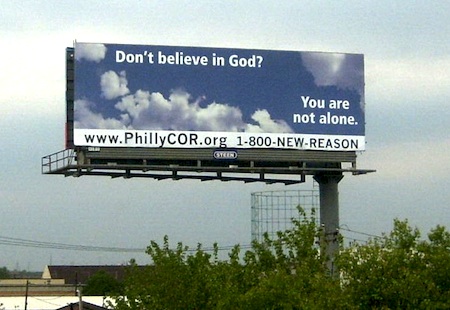
In the past, when atheist organizations put up ads, even ones which are positive in nature and do nothing to put down religion, the ads are seen as threatening, hostile, and unacceptable; numerous Christians pressure the organization hosting the ads, usually successfully, to take down the ads. Usually that is done under the pretense of open proselytization–although many of the ads don’t actually proselytize, and Christian groups often openly proselytize on billboards themselves.

Dontbelievead

One ad was so subtle that it required a bit of thought to see the message, and made a statement that was at the same time patriotic and nothing more than plainly secular–quoting the original text of the pledge of allegiance. Not to mention text that is more inclusive, not less. And yet this rather unserstated, simple display was considered so radical as to merit national attention.

These ads usually are relatively tame; for example, a common one asks, “Don’t Believe in God? You’re Not Alone,” and prompts people to visit the “Coalition of Reason” web site. They usually do not urge people to leave the church, but instead try to attract atheists who do not know of others who feel the same way they do. And yet, such messages often prompt Christians to angrily protest, demanding the ads be removed–this one was taken down after the billboard owner got death threats. (Islamic extremists do not, it seems, have a monopoly on that particular tactic.)

One can safely assume that these are often the same people who are offended by liberals who ask people to be sensitive about what names they call other people, attacking such “PC” sensibilities as “censorship” and “violating First Amendment rights.”

The FFRF (Freedom From Religion Foundation) is somewhat more aggressive, posting billboards and bus ads which directly criticize religion. Quotes from famous figures like Mark Twain, Butterfly McQueen, Clarence Darrow, Emily Dickinson, and Katherine Hepburn involve messages that are clearly critical: from Twain’s snarky “Faith is believing what you know ain’t so” to McQueen’s more pointed “As my ancestors are free from slavery, I am free from the slavery of religion.” These ads, although done tastefully, do push the boundaries somewhat; and churches hit right back, with ads quoting, “The fool hath said in his heart, There is no God.”

However, imagine if the atheists put up signs going much further–say, an ad atop taxi cabs which screamed, “CHILD ABUSE VICTIMS,” and asked, “Is your church a threat to your children?” followed by the URL, “www.LeaveChristianityNow.org”. Not just commentary, but a smear–taking a restricted, unrepresentative scandal and using it as a front to break people from their faiths.

How do you think Christians would feel about that ad?

Actually, the question is academic: I fully doubt that any business or ad agency would allow such an ad to get past the preliminary stages. And rightly so; support ads and even proselytization are one thing; ads quietly critical of religion would be considered less kosher but within limits. But ads actively, underhandedly smearing a religion so stridently are another thing entirely. Even liberals would balk at that, and one might assume that conservatives would be livid at even the idea.

Unless, of course, it’s an anti-Muslim ad.

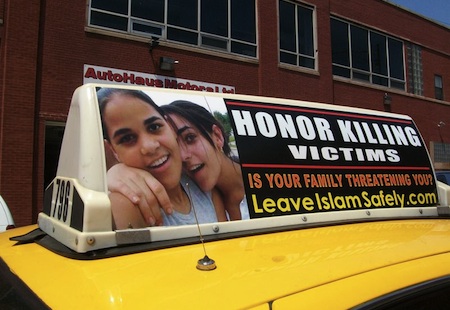
A few days ago people started hearing about ads placed atop taxicabs in Chicago which read, “HONOR KILLING VICTIMS: Is your family threatening you?” and displays the URL “LeaveIslamSafely.com”. Were this a women’s advocacy group trying to protect people, that would be different–but the URL makes it clear that the intent is to drive people completely from their faith.

The thing is–and I may be wrong on this as I am hardly an expert on the subject–I don’t even think this is related to Islam except indirectly. My understanding is that honor killings are a cultural, not a religious practice.

The ads are cleverly cloaked in an anti-violence support guise, but the real intent behind them is made clear when you understand that the ads were placed by one Pamela Geller, a strident, extremist anti-Islam whack job who revels in seeing lurid conspiracies of anti-American jihad under every prayer mat. Honor killings are not what she’s about, she’s completely anti-Islam. This suggests that the ads are less about saving lives and are more about demonizing Islam. Not that honor killings are not a problem, but they are hardly synonymous with Islam, just as child molestation is not synonymous with Christianity.

For better or worse, the ads are being taken down. One point, however, is that had they been equivalent ads targeting Christianity, they would never have gone up in the first place.

Antiislamad

The Future of Television That Probably Won’t Be

August 26th, 2010 Comments off

Seven years ago, I wrote a three-part blog post (parts one, two and three) on what I saw as being the future of television. And despite the fact that TV content producers seem intent on taking a very different course, I stand by my assertion that the system I described back then would be the best available, given the bandwidth.

My idea was based upon the difference between broadcasting and narrowcasting, and how ad revenue is generated. Currently, television initially generates revenue by being broadcast over the airwaves, carrying advertising (more and more each year, it seems) during the commercial breaks. The problem: it is difficult to create an ad that will appeal to more than just a small portion of the audience. You are sending the exact same ad to millions of people who are so varied that most will not respond to the ad, and some may even have a negative reaction to it. As a result, the effectiveness of ads is only a tiny percent of what is possible, wasting the vast majority of ad revenue potential.

In recent years, another two revenue streams have appeared for these shows: sales of DVD sets, and, similar in certain ways but different in others, online sales of the episodes. While ads may still play into them, these versions mostly make their money by the customer paying up-front. A season of a TV show on DVD might range from less than $20 to up to $100. TV shows for download often cost $2 an episode.

There are significant problems with these models. As mentioned above, TV broadcasting is massively inefficient. Add to that the fact that shows are dribbled out by day or week, disappear and are inaccessible for months or years at a time, and appear only on a pre-determined schedule which is easy to miss. Not very user-friendly.

Sales of DVDs had an initial burst, but now the medium is struggling a bit more. People are catching on to the fact that paying $150 for a full series of TV shows seemed like a good idea at first, but later realize that they might never watch it again. Furthermore, since these must be bought physically, they are not available on demand, immediately on a whim. (Services like Netflix successfully play to these weaknesses.)

And not many people are going to cough up $2 to watch something they can get on TV for free, or can be bought cheaper by season on Blu-ray with HDTV quality and extra features like deleted scenes, outtakes, commentary and featurettes. Frankly, I never understood that model at all. In fact, the whole idea of paying for TV is still relatively alien to many people: TV has been free for most of our lives, and many almost see it as an expected right. I’d be willing to wager that if you polled people and asked if it was wrong to pirate software, movies, books, and TV shows, most would say it was wrong to pirate the first three, but few would have as much problem with pirating TV shows. They’re on TV, after all!

All of this is tainted more by the senseless paranoia of the content producers and their fear of piracy and loss of control, which pushes them to add DRM and other restrictive features that only hurt paying customers, and result in more people resorting to piracy.


In 2003, I suggested a different take: targeted advertising and narrowcasting. Put all TV and a great deal of movie content on the web, for unlimited free streaming and viewing at any time the viewer desires. The cost: the viewer must make their commercial preferences known, filling in a bit of information once a month. When the viewer then asks for a presentation of media, the content, originally with blank spaces for advertising, is filled with ads that are targeted at that one viewer.

The benefits for all sides is great. First, the viewers: they not only get everything they want, a virtually unlimited, all-you-can-eat buffet of on-demand content, but it’s free of charge. And while there are as many commercials as before, there is a huge benefit: the commercials are all ones that you want to see.

That’s the secret: by filling out some personal info, specifically (a) what are your interests, (b) what do you plan to purchase in the near future, and (c) what kind of commercials do you like, in addition to a few other bits of indicative data, TV ads could be transformed into something the viewer will want to watch. Currently, commercials are things to avoid–mute the sound and take a kitchen or bathroom break. But the truth is, there are commercial we all want to see. But because commercials today are broadcast, perhaps 97% of them don’t interest us, so we tend to skip them all.

But what if the commercials were directed at your interests? For example, if the ads were all for movies, new books, computer stuff, and some other things I am interested in, I would probably be interested in staying with the commercials, watching them all and letting them have their hypnotic, subliminal way with my subconscious.

There could even be feedback, a “next” switch for commercials–if an ad comes up that you don’t like, just zap it with the remote. This could be used to build up data on what you do and do not like, and so be utilized to weed out the remaining commercials that you don’t want to see–kind of like Apple’s “Genius” feature in iTunes. This could also be used to sharpen their targeting; random ads could be tossed into your mix, and by analyzing what you zap, they can build up a scenario of what new stuff they can throw at you which you might like.

The benefit for advertisers should be abundantly clear: the efficiency of ads rockets from single-digits to near-perfection. Instead of people turning off ads, people will stay and watch them, and might even look forward to them. Even good commercials suffer from the taint of being commercials, with all the negativity currently associated with that medium. But if people begin to like commercials, their effectiveness will increase beyond just the growth in targeted exposure.

This will, in the end, benefit the content producers the most: because each ad sold will be up to 20 times more effective, they can up the revenue that much more. And since viewers will not mind the commercials so much, they won’t get as much blowback for adding more ads, up to a certain point of course.

But the best part is that by making the content freely available over the Internet, you completely defeat the problem of piracy. Downloading pirated stuff is not too difficult, but most people would much prefer a free alternative, and would certainly find it easier to use. If the model I describe were used, then there would be no need to resort to piracy, unless you are religiously opposed to advertising of any kind, or are the kind of person who refuses to divulge any info about yourself.


And that would be the point probably most focused-on with this system: giving up personal data. For a long time, many people have been concerned about what data is collected about them, and how it is used and potentially abused. Privacy looms large, and admittedly, the model I describe above seems to ask the viewer to surrender a great deal of that privacy.

Well, yes and no. First of all, we surrender privacy every day. When you join new web services, buy something online, or download free software, chances are you are giving away a good deal of private information, including your name, age, email addresses, physical addresses, profession, and a lot of other stuff. We commonly post personal information online, from our profile on social networking sites, to our hobbies and preferences in telling people what we like, to our political and religious feelings on blogs and forums.

Advertisers already suck in volumes of data about us. Take that supermarket member card that’s in your wallet, which you have no problem swiping at Safeway to get the “discounts” connected to it. That card is connected to your name, address, and other info they get from you and about you via other means (including public land ownership records, career info, etc.). Every time you buy stuff with it, they record what you bought, how much you bought, when you bought it and at what price, and use that data for advertising and for presentation & pricing of goods they sell you. Similar goes for your credit card trail, and other things you use without thinking about them.

The fact is, you already hand out, usually for no actual benefit to you, far more information than I propose is involved in the system I laid out. In fact, if privacy is truly a concern, then the system could be set up so that the data collected for this TV system would be completely unconnected to your name and public identity. The reason they collect your name, address, and other data is so they can use it to predict what you’ll want to buy. In the system I propose, they don’t need to do that. Frankly, I don’t think they really care what your name and address are; they only want to make money off of you. And if you are telling them exactly what you are interested in buying, what you’re looking for, then they don’t need that info, and could easily do without it.

So when you join this system, you could do so anonymously; your name and address are never asked for and never given. Nothing needs ever be tracked back to you personally. By giving more personal information, the system becomes more private.


I truly see this as being the optimal system for everyone. There’s a problem, though: fear, stupidity and greed. (Aren’t they always the problem?)

What set me off on this topic? This story about Apple’s rumored plan to rent TV shows for 99 cents. Frankly, I see this as still too expensive. Sure, better than regular TV because the ads aren’t there and it’s on my schedule, but worse than buying the DVD later on because the resolution is poorer, there are no extra features, and you don’t get to keep them.

But the content producers are calling this new model dangerous. Why? Because they saw the music industry lose their evil, usurious model, and fear that somehow something similarly bad will happen to them. So they shy away from even a model which would still be far from perfect and skitter back to even less perfect models.

Argh. It frustrates me to see them wear their fear and greed so transparently, to be so idiotic in their pursuit of fleecing the public, when it seems that a far superior system is available–but they are just backing away from it, step by fear-filled, idiotic, greedy step.

Quick Note: Reactions

August 26th, 2010 8 comments

Interesting that after the horrific 9/11 attacks, our attitudes toward Muslims was much more conciliatory and restrained than it was after a peaceful sect tried to set up a mosque two blocks away from the attack site nearly a decade later.

What does that say?

Categories: Quick Notes Tags: