Willie Nelson Arrested for Drug Use
September 19th, 2006
1 comment
The news headline tonight, Willie Nelson Cited for Drug Possession.
The police figured this out just now?
Categories: The Lighter Side

The news headline tonight, Willie Nelson Cited for Drug Possession.
The police figured this out just now?
You may have heard that the Pope gave a lecture at a university recently, and that there was a widespread reaction of anger in the Muslim world over what was said. For those of you who are curious, here is the Pope’s quote; if you’re not interested, skip just past this quote and I’ll paraphrase.
In the seventh conversation [text unclear] edited by Professor Khoury, the emperor touches on the theme of the holy war. The emperor must have known that surah 2, 256 reads: “There is no compulsion in religion”.According to the experts, this is one of the suras of the early period, when Mohammed was still powerless and under threat. But naturally the emperor also knew the instructions, developed later and recorded in the Qur’an, concerning holy war.
Without descending to details, such as the difference in treatment accorded to those who have the “Book” and the “infidels”, he addresses his interlocutor with a startling brusqueness on the central question about the relationship between religion and violence in general, saying: “Show me just what Mohammed brought that was new, and there you will find things only evil and inhuman, such as his command to spread by the sword the faith he preached”.
The emperor, after having expressed himself so forcefully, goes on to explain in detail the reasons why spreading the faith through violence is something unreasonable. Violence is incompatible with the nature of God and the nature of the soul. “God”, he says, “is not pleased by blood – and not acting reasonably … is contrary to God’s nature….”
In essence, the Pope brought up the concept of proselytizing through force, and quoted a 14th century dialogue in which a Byzantine emperor said that anything new that Mohammed brought was evil and inhuman, and proselytizing by force was one example. This is the quote that the media focuses on, especially the part with the words “evil” and “inhuman.” Interestingly, this is perhaps less offensive than other parts of the speech, at least in terms of what is the Pope’s voice and what is a quote that he may not personally agree with. The imperial quote was phrased so that the Pope’s own view of the matter was occluded, except that he found it “forceful”–which could leave the door open to him agreeing, but not willing to put it so strongly.
What seems somewhat more objectionable to me would be a subsequent paragraph:
But for Muslim teaching, God is absolutely transcendent. His will is not bound up with any of our categories, even that of rationality. Here Khoury quotes a work of the noted French Islamist R Arnaldez, who points out that Ibn Hazn went so far as to state that God is not bound even by his own word, and that nothing would oblige him to reveal the truth to us. Were it God’s will, we would even have to practise idolatry.
This information is presented differently, as fact. The Pope is essentially saying that the Muslim faith has no reason or consistency, that God can be dishonest. Seems to me that this is the worse thing to say. Well, unless it’s true and Muslims have no problem with that.
Keep in mind, however, the points made: that Islam can be violent, irrational and contradictory.
So what was the reaction in the Muslim world? There were angry protests worldwide, Iraqis burned the Pope in effigy, and in Somalia, one of their number killed a nun and her bodyguard, shooting the nun in the back four times.
So, apparently, these individuals wanted to make the Pope’s argument for him.
It should be pointed out, however, that the objectionable acts were carried out by extremists. On the other hand, we don’t seem to see Muslim leaders pouring out to condemn these acts.
My question is, how deeply does religious extremism really run? What percentage of Muslims really do feel sympathetic to the people who committed these acts? I suspect it’s a lot less than the media makes it seem, but sometimes I wonder; there seems to be so much righteous anger in the world today, more than can be accounted for by a few extremists. Is it that the extremists are not actually so extreme at heart, but rather just in the actions they take?
And before you object to my singling out Muslims, I would point out that I feel exactly the same way about Christians. Watch this Jesus Camp trailer if you want an example. Sure, Christians might not react violently to political cartoons and speeches by Muslim leaders which attack Christianity (as many, especially Christians, take pains to point out), but that is far from saying that some Christians don’t react violently, or in threatening manners, about things that are just as important to them as the Prophet is to Muslims. Killing doctors who carry out abortions, bombing clinics, harassing and threatening women who go into these clinics–just a few examples in one specific area. Christians can react just as violently when it comes to something that offends them as much, and Christian leaders also often do not come out and condemn their actions.
Sometimes, religion scares the hell out of me. It allows for people to act immorally and believe that it is moral because it is in the name of God. It drives people to believe things that don’t make sense, to become apologists for absolute contradictions because to admit to anything else would threaten their world view.
And since their world view is often tied directly to their belief that they will live after death, any criticism against their belief in general can threaten that anchor they have chosen and cause them to react in irrational ways. (If you’re religious, not like this, and starting to object, then note my modifiers.)
The supreme irony appears in this other quote from the Pope’s speech:
The decisive statement in this argument against violent conversion is this: not to act in accordance with reason is contrary to God’s nature.
Now, that’s quite something to say. Religion is about faith, sometimes to the exclusion of reason–all too often, from what I can observe.
This entire episode, it seems to me, proves exactly that point.
If you’ve had trouble getting through to my site, you aren’t alone. I’ve been having small to large outages for the past few weeks. I’m on my web host about this, but sometimes web hosts do this, and you have to bear through it… One of the frustrating things is that you don’t always know what causes it. Web hosts never admit to screwing up. They either dismiss it as a minor technical glitch beyond their control, or they blame it on a disruptive user on the server. With continued outages like this one, neither makes any sense; either they should have repaired the glitch or given the boot to the disruptive user long before now… which probably means it’s the web host screwing up somehow.
My apologies for the inconveniences. I’ll post a quick note when service seems to be stabilized.
Update: Great. I get a message back saying that the problem “was due vulnerable perl scripts running under a user,” and that they have “disabled that user.” Except when I check, my own site’s comment script has been disabled. Charming.
…And as I tried to post this, I got an error message. Can’t post, either. Swell. My site is up, but it’s also dead. [Obviously I posted this after the problem was fixed.]
About nine months ago, I commented on the story that the IRS is being used as a political tool. There are churches under investigation by the IRS, in danger of losing their tax-exempt status because of their dalliances in the realm of politics. Now, don’t get me wrong–I think that churches should remain utterly neutral in politics; left-leaning or right-leaning, it doesn’t matter. A church can espouse morality, but it should stay away from endorsements or engagement in politics. So it’s not the fact that churches are being investigated that I object to. It’s the political bias implicit in the investigations.
Politicization at the pulpit does goon, and rather heavily on the conservative side. The Republican Party asks for and gets church directories, essentially mailing lists of churchgoing members to beef up their contributions and get-out-the-vote drives. Many churches, especially Baptist churches in the South, commonly endorse politicians (overwhelmingly right-wing, of course), and leading religious figures such as Jerry Falwell commonly work for the Republican Party both directly and indirectly, using their tax-exempt organizations to do so. The Catholic Church even went so far in 2004 as to deny Kerry communion because of his abortion beliefs–despite the fact that the church did not condemn all politicians who hold the same opinions, including some right-wing politicians.
I cannot find any mention that any of these organizations are being investigated by the IRS for encroaching upon political ground.
There are, however, churches being investigated and in danger of losing their tax-exempt status: liberal churches. As I mentioned in January, the All Saints Episcopal Church in Pasadena, CA, is being investigated because a retired pastor made a guest appearance in which he commented on the 2004 election. And though it has since been cleared, a heavy IRS investigation of the NAACP for similar reasons begs the question: why are liberal organizations being targeted by the IRS when conservative churches and other tax-exempt organizations–which are far more commonly and vehemently political–are left alone?
Well, now, just as the 2006 elections are ramping up, the IRS is kick-starting their investigation of the All Saints Episcopal Church again, this time demanding that the church “turn over all the documents and e-mails it produced during the 2004 election year with references to political candidates” as well as financial record.
As others have noted, the timing of this stinks, if you will forgive the expression, to high heaven. But, at the same time, it is not a great surprise–this administration is by no means above using Nixonian dirty tricks–and the IRS–to get what they want this election year.
I stopped watching Larry King Live some time ago. Part of it was because of King’s incessant focus on celebrity crime cases, or crime cases where he turned the accused into a celebrity of infamy. And I’ve never been a fan of these high-publicity crime cases. In my opinion, we need a law like some countries have where the media is forbidden to report on a crime case until it is resolved by the courts.
Yes, I know, free speech and the first amendment. But then there’s also amendments 4-8, which protect the rights of the accused; I think there’s enough evidence here that the founding fathers were more than just a little concerned about how we treat defendants in criminal cases. And media reporting on court cases can severely impact the outcome of a trial. So which right outweighs the other? Considering that media coverage of these trials is almost purely gratuitous, for titillation and little else, it seems a no-brainer to me. Considering how much attention the founders paid to this issue, I think Americans give far too little respect to defendants’ rights. In fact, conservatives tend to hold such rights in contempt, Constitution or not.
One component of the reason I don’t watch King anymore is what I heard him say on more than one occasion: that if an accused person is innocent, they would naturally want to go on national TV and make their case; so if they do not do this, it makes them look guilty. For King to say this is, in my opinion, criminally negligent, certainly a conflict of interest, and absolutely outrageous. If you are accused of a crime, especially if you are innocent, the last thing you want to do is to go on national TV and discuss the case. Prosecutors live for a defendant dumb enough to go out in public and make a variety of statements concerning their case. The more a defendant says, the more chance there is that there will be some inconsistency, which a prosecutor can then cash in for a guilty verdict in court.
If you think that an innocent person cannot be made to look guilty to a jury, then you’re naive. To speak on an issue without making even the slightest error in consistency, even if you are positive that you’ve got it all down cold, is wildly improbable. You’re bound to get something wrong.
So not only was King wrong factually, but he was guilty of extortion as well. King makes his bread and butter by getting such guests on his show. In making his statement, he was essentially saying that if such accused people don’t come on his show, he’ll pronounce them guilty on his show.
But even King is not the worst offender. Somehow, King has always found a way to discover the most offensively vile person possible to argue the why-the-accused-is-guilty side of things. Strangely, this person is almost always a blonde woman, one of the many in the ranks of blonde bimbo Republican pundits, of which there seems to be a peculiarly endless supply.
One of the worst has been Nancy Grace. Apparently convinced that even the slightest appearance of guilt is proof of pure evil, this woman incessantly goes for the jugular of any poor sap accused of a crime. And recently, she may have driven a young woman to suicide:
Two weeks after telling police that her son had been snatched from his crib, Melinda Duckett found herself reeling in an interview with TV’s famously prosecutorial Nancy Grace. Before it was over, Grace was pounding her desk and loudly demanding to know: “Where were you? Why aren’t you telling us where you were that day?”A day after the taping, Duckett, 21, shot herself to death, deepening the mystery of what happened to the boy. …
Duckett’s family members disputed any suggestion that she hurt her son. They said that the strain of her son’s disappearance pushed her to the brink, and the media sent her over the edge.
“Nancy Grace and the others, they just bashed her to the end,” Duckett’s grandfather Bill Eubank said Tuesday. “She wasn’t one anyone ever would have thought of to do something like this. She and that baby just loved each other, couldn’t get away from each other. She wouldn’t hurt a bug.”
To me, the issue of whether Duckett turns out to be innocent or guilty is moot. In the United States, we theoretically have a principle of assuming innocence in criminal cases until guilt is proven. Under this principle, Grace’s actions are so reprehensible as to be virtually criminal themselves. When presented with someone who might have committed a crime–who was barely an official suspect in the case–who either way is obviously going to be severely distraught–you do not take this person and bash their head onto a table, drilling them on national TV like they were some despicable criminal. Sure, the person might be guilty–but they might be innocent, and you are supposed to presume the latter. And if the person is innocent, what Grace did was inexcusable. Though I’m sure it made for great ratings. Good show, CNN.
In response to the news of the suicide, Grace’s spokeswoman issued a statement that emphasized Grace’s concern for finding the missing boy, and completely sidestepped how Grace treated the mother. How sweet. I’m so glad this wasn’t about getting ratings or venting arrogant presumption, but was purely about helping a little boy by pushing his mother over the edge and making her shoot herself to death.
In fact, in a later interview, Grace actually said she felt no responsibility for the outcome, and said that “If anything, I would suggest that guilt made Melinda Duckett commit suicide.”
Grace, of course, as sick as she is, is only a symptom of a sick society, one where we love to assume guilt. Which is why we need that media ban on active criminal court cases.
Well, I broke down and ordered it. I had been told that I would have to fill out a special form in Japanese, so I called Apple Japan just to ask about that. The agent told me that wouldn’t be necessary, and all I had to do was tell him the name of my school and we were on. (I already had an account with Apple Educational anyway, from my ordering Tiger from them last year.) I was taken a bit by surprise by this–I wasn’t really ready to order right then–but then I thought, the hell with it, I know I’m going to get it, why wait? So I did.
I got a boost in going this direction by stopping by Yodobashi Camera earlier in the day. I was on my way up to the 2nd floor of the main Nishi-Shinjuku branch (where they have a Mac center) when I noticed their Mac island in the middle of the main floor. Even better, one of the iMacs had Parallels installed with XP running. I played with it, and it’s pretty damned nice. It should do everything that I need from a PC at home–most of which has to do with preparing lessons for my Computer course, where they still use Windows (though I think I stand a very good chance of switching them to iMacs next time they have to buy a new bunch of computers). Having played with Parallels and the 24-inch iMac at the store, I pretty much convinced myself to buy.
All told, the purchase was ¥259,852 ($2212) including sales tax (¥247,478 or $2107 base). That’s for the 24-inch iMac, an extra gigabyte of RAM, and the wireless Apple keyboard and mouse. I’m currently looking into how to get XP (academic or OEM) for less than the $200 regular pricing; parallels is a download and will be easy. I’m also looking at getting the Applecare (thanks to Dazza for the LA tip, I’m contacting them [Update: Dazza, the LA firm got back to me; they will sell at a lower price as you indicated, but shipping to Japan costs an additional $45, way too much. The Apple Store Japan has educational pricing for Applecare; I think I’ll go with that.]); I’ve never had a serious meltdown on a Mac, but with a 24-inch LCD on an all-in-one desktop, I think it’s worth getting the insurance.
The iMac is not upgradeable, true. But then again, I’m not much of an upgrade person. I wind up not getting any extra video cards, or whatever else. The iMac already has most of the bells and whistles you would upgrade to, in any case.
But I have to admit, it’s the 24-inch screen that really got me with this one. I never really owned anything bigger than a 17-inch CRT–heck, I don’t think I ever even worked on anything bigger than a 17-inch LCD. So the 24-incher is a huge step up, and probably impresses me a lot more than it does you. But as my sister-in-law put it, if it makes you happy, that’s the big thing.
So my Windows PC and old 500 MHz G3 tower, conjoined with a 17″ CRT monitor, will all get exiled down to my free desk space in a lesser-used corner of my apartment–in seven to ten days, that is.
DVDs in Japan cost considerably more than in the U.S. New releases of DVDs in America generally cost around $20; in Japan, the same movies go for $30. For example, current releases of V for Vendetta, Poseidon, and The Da Vinci Code all sell for about $30 at Amazon Japan, while the same titles sell for $20 at Amazon U.S.–except for The Da Vinci Code, which sells for $15.
This is one of the main reasons why I buy my DVDs from the U.S., and use a region-free player (or the Region 1 player I lugged here from the U.S.)–because U.S. releases are so much cheaper, in addition to having earlier release dates. Generally, much earlier–the latest X-Men movie is just out in Japanese theaters, while the U.S. DVD is on sale soon. Often, summer Disney titles go on sale by Christmas, just as they are opening in Japan.
This of course, is why they have region encoding in the first place: to keep people from benefitting from different marketing plans.
 But there is a strange hole in this: if you want to buy the DVD for Gone with the Wind in the U.S., it costs $20. In Japan, the same movie costs $5–or more precisely, ¥500.
Same with Casablanca–$20 in America, the same movie is $5 in Japan. The same deal applies to movies like King Kong, The African Queen, Arsenic and Old Lace, The Treasure of the Sierra Madre, It’s a Wonderful Life, The Wizard of Oz, and more. The DVDs are “all-region,” and come with English and Japanese subtitles (which can be turned off).
So how did that happen? Well, it has to do with copyright law and a court case. As part of corporations’ quest to become legally immortal super-human beings with endless ownership rights, they have been lobbying to indefinitely extend copyright protections. Previously, copyright protection for films was 50 years; in 2004, it was extended another 20 years. However, a recent court case decided that, in Japan at least, the 20-year extension was not retroactive. So a movie made in 1954 will stay protected until 2024. But a movie made in 1953 is now in the public domain.
 I reported on this a few months back when I heard about the case, but it was just last week when I finally saw the DVDs on sale. I picked up Gone with the Wind, Notorious, Roman Holiday, Citizen Kane, The Third Man, and To Kill a Mockingbird for ¥3000, sales tax included–about $26, actually, at today’s rates. Six movies for less than any one of them would cost “legitimately.”
This in part reveals the actual production costs for DVDs–or even more sharply, the recent decision by Warner Home Video to start selling their movie titles in China for just $2.65. Although that is to compete with the widespread $1 pirate DVD market, you know that Warner wouldn’t be selling at that price unless they were making even a small amount of money from them.
Meanwhile, back in Japan, we can enjoy some good classics for a still comfortable price. You can see the on-line catalog here; to see categories of specific movies, click the links after the English words “PICK UP” near the top left. (By the way, you can see they made the web page using Adobe GoLive 6–check out the web page title. Think it was a pirated version?)
They’re only selling 140 titles now, but there should be more than 140 good ones made before ’54. Alas, movies like The Man Who Knew Too Much (the Jimmy Stewart/Doris Day version) won’t go on sale for another two decades.
Several Sites are streaming the new Mac announcements live. Best is Engadget, who give the most information and have good-quality photos up very quickly. So far:
New iPods, not the full-screen video we’ve been waiting for, but upgraded regular video iPods. They come in 30GB and 80GB sizes (priced $250 & $350 respectively); they have brighter, better screens, a search function, and downloadable games like Pac-Man for $5 each.
iPod Nanos, in brushed aluminum colors (Blue, Pink, Green, Silver, and Black), in 2GB, 4GB, and 8GB sizes.
iPod Shuffle, in new, tiny aluminum case (matchbook sized!) which itself is a clip-on, a small clock & controls, 1GB memory, $80.
iTunes: going to version 7; videos increase in size from 320×240 to 640×480 (near NTSC-size resolution; should play back on TV rather well). New organization for layout. The “iTunes Music Store” (iTMS) is now just the “iTunes Store” (iTS).
Movie Downloads (as expected): $10 for most movies, $13 for new movies until the end of the first week of sales, $15 for new titles after that. Also at 640×480 resolution, “near DVD-quality.” 75 titles to begin with, from Disney-owned studios (Walt Disney, Pixar, Touchstone, Miramax). Dolby surround audio. Takes about 30 minutes to download a movie, but you can start watching immediately. Initial sales from U.S. store only; international sales start in 2007 (hopefully).
Media Box: codenamed “iTV” (not the final name), a set-top media box connecting wirelessly between a Mac or a PC (via iTunes, apparently) and the TV set/media system. To be released in early 2007. Also has ethernet, USB, RCA, optical audio, HDMI ports. Allows you to play downloaded TV/movies, other Internet video media. Priced at $300. Cobbled-together photos from Engadget feed below:

My reaction: well, OK. We expected the movie downloads. The new hi-res download standard is good, but they kind of had to do that to make people pay $15 for a downloaded movie. Sounds like the DRM will be reasonable, and maybe with the TV playback, the inability to burn it to a DVD won’t be such a problem.
The media box looks nice, but I’m going to have to see what it really does before I get excited about it. I mean, you can hook up your Mac desktop or laptop to your TV right now and watch video played back from the computer. How does “iTV” change that? Why pay $300 when a $20 cable could do the same thing? OK, iTV looks like it has a very nice interface. Wireless is nice too. But what else? If it just pipes video, I really don’t see the point.
OK, the Apple web site is back up, along with the Apple Store. The iTunes Store is still down, at least for me.
Gotta get to bed. This time zone thing kills me on these events…
My post yesterday on the fifth anniversary of the event was one of general principles and ideas. After finishing the post, I felt that there was more to say, but none that would fit within the general style of the writing, so I instead write them here.
As I have noted elsewhere, Bush’s popularity was already waning considerably in early September, 2001. Over his entire presidency, it has been Bush’s pattern to fall steadily, save minor bumps, until some dramatic event raised those numbers–only to immediately begin the normal pattern of decline. Before September 11th, Bush was closing on a 50% rating and falling steadily.
It seems hard to recall back then, as 9/11 changed things so considerably. If you recall, Bush was pushing his missile defense shield, and in so doing, was in the process of violating several international treaties. The U.N. was starting to unseat the United State from committees. Political cartoonists commonly portrayed Bush as being tiny (with big ears), sitting in Cheney’s lap. Already the taste of bitter partisanship was in the air. Right out of the gate, Bush created an “Energy Task Force” in which Cheney went into secret meetings where energy industrial heavyweights were allowed to write national policy. Bush bolted from the Kyoto Treaty, and was already well on his way to breaking the country in two. The partisanship was so severe, even against moderates within the GOP itself, that Jim Jeffords, Republican Senator from Vermont, bolted from the party, declaring himself an independent aligned with the Democrats–momentarily breaking Republican control over the Senate.
Then, 9/11 happened. Pretty much all Bush had to do was to go out into the rubble with a megaphone and, like the cheerleader he once was, rattle off a few platitudes. Instantly, public opinion changed. Bush vaulted to 90% approval in the polls, and political cartoons literally portrayed him as a giant. As I have observed more than once before, in our time of crisis, we needed a great leader; lacking such a leader, we fabricated one out of whole cloth.
Bush actually did start off strong. He followed the right strategy in Afghanistan; his definition of terrorism to include those who harbored terrorists was exactly correct. I admired his admonishment to the people not to lay blame for 9/11 on those who shared ethnic backgrounds with the terrorists. The thing is, these are no-brainers, the easy part, just like the megaphone moment. Bush gets the credit, but it is hard not to notice that virtually any president could and would have done these things.
After the easy start, however, things quickly fell apart.
Just ten days after the 9/11 attacks, Bush began to sow the seeds of partisanship and international isolationism with his “either you are with us, or you are with the terrorists” statement, which evolved into the now infamous “you’re either with us or against us” mantra. He indicated that there was no middle ground, and that his position alone bore moral superiority. This set the theme of his administration which continues to this day: agree with what I say, support what I do, or you are a terrorist sympathizer and an enemy of the country. Criticize me, and you embolden our enemies. Defeat my plans, and you defeat the nation. It was more than just a call to arms, it was a statement of political policy.
A month later, the “Patriot” Act was railroaded through Congress. Written by Republicans, a vote on the bill was forced only 24 hours after it was introduced; at 342 pages, there was not enough time for those in Congress to fully read and comprehend the bill, which, it turns out, severely eroded civil rights, especially in regards to the 4th Amendment. This became a normal method for Republicans to pass legislation–keep it veiled until the last moment, release it late at night, and ram in through; claim national security is at stake.
Whatever claim to partisanship the administration and the GOP made soon evaporated in light of their arrogant, single-minded, deadly partisan approach–no compromise, no quarter, no hostages taken. Even within their own party, dissent was treated like treason, in some ways, mirroring Republican arrogance before 9/11, but even more strongly now. Now it was not just betraying the party, it was betraying the “country,” in the eyes of the GOP.
But just as complicit in all of this were the Democrats. They were supposed to be the opposition party, but they simply caved in. So quiveringly fearful of being labeled “unpatriotic,” so absolutely terrified of losing votes over issues that could be in any way, shape, or form be connected to security, they simply rolled over and let the Republicans run amok and do whatever they pleased. Political cartoonist Oliphant now cast the Democrats as a beaten and debased hound dog, letting Bush run away with the house silver without letting out the merest yelp in alarm.
Just months after 9/11, Bush started laying the groundwork for the war in Iraq. At the end of January, 2002, Bush declared the “Axis of Evil” to consist of Iraq, Iran, and North Korea. Bush boldly pronounced that Iraq “supported terror” and was madly driving to develop WMD. Just a few months later, in Spring 2002–a full year before the Iraq invasion and long before any Congressional approval had been given–Bush started to divert troops and resources from Afghanistan to Iraq. The decision to invade Iraq had already been made, and the move began to cripple the search for Osama bin Laden and al Qaeda in Afghanistan. Bin Laden escaped, and Bush didn’t give a damn: “I don’t know where [Osama bin Laden] is. I have no idea and I really don’t care. It’s not that important. … I truly am not that concerned about him.” Bush said that just at the time he started diverting our forces to focus on Iraq.
This went beyond mere partisanship, beyond political maneuvering. Bin Laden was the declared enemy, and Bush simply gave up, preferring to focus on Iraq. And so for a solid year and then some, Bush let al Qaeda fester and grow while he squandered our resources and attention on a knowingly bogus war in Iraq.
To be continued
TUAW claims to have the agenda for tomorrow morning’s Apple event. Included in the highlights are the Movie Download store, the widescreen video iPod, and something called “TubePort,” which appears to be simply a USB-to-TV converter, performing the same function as a VGA-to-TV or video-minijack-to-TV converter.
Frankly, I’m doubtful; as described, “TubePort” would simply do for $100 what a simple $20 cable would do today, not to mention that “TubePort” is an incredibly lame-sounding name. And to save that for the “one more thing” spot when the video iPod is in the mix, well, it doesn’t ring true.
I’m still hoping for the video iPod, and the movie download store seems like a lock. If there’s a third thing, it’ll probably be Apple’s long-rumored media box which connects the computer to all of your AV equipment in the house, the “media jukebox.” Definitely something connected to the movie download bit.
The “agenda” also includes a movie download price structure which, in addition to a $15 movie download, includes a $20 price point for full-sized movie plus video iPod version. While this sounds very much like what the movie studios want, it is definitely not an Apple-like idea.
Three years ago, on the second anniversary of 9/11, I wrote a commentary on the event for another site, and asked this question:
The paradigm shift since 9/11 has been drastic. Our perceptions of security and our place in the world have changed. But did reality change after 9/11, or just our view of it?
I tried to answer those questions then, and I hoped that certainly by the five-year mark, the answers would be well-understood universally. However, that is not the case. The core right-wing base still steadfastly stands by the conservative version of reality, and the “reality distortion field” thrown up by their dogged persistence has most of the people in the middle still fazed. Most people now believe the war in Iraq was a mistake, for example, but almost a majority also still believe that Saddam Hussein was involved in the 9/11 attacks.
Along the way, a word was created, by Stephen Colbert, to describe the distortion: “truthiness.” The same concept has gone by many names in the past, including “agitprop” and “The Big Lie.” But it’s all the same: tell lies that are palatable to the people, play on their fears, keep insisting that your lies are true, and repeat them as often, as widely, and as loudly as possible, and you will be believed.
This particular set of lies is actually so egregious that it has taken a nearly non-stop campaign to keep the distortion field in place, and as time has worn on, the fabric of lies has worn thin and has broken in some places. But the lies are still in place, and too many people still believe them. The only real answer is to combat the lies with truth and the facts, to keep battering at the distortion field until it crumbles and breaks. Eventually, it will, and on this, my 2000th post for this blog, I will add my small share to the barrage.
In the 1st century, Zealots conducted a fierce and unrelenting terror campaign against the Roman Empire in the eastern Mediterranean. The Zealots enlisted sicarii to strike down rich Jewish collaborators and others who were friendly to the Romans.
One can be certain that terrorism existed before that. The use of violence is older than humanity itself. Our intelligence, however, has provided us with a new way to use violence: using example and anticipation to make people fear the potential of violence, and so act in ways desired by the terrorist. In fact, the terrorist does not harm or kill the majority of his audience; instead, he kills some as an example, and makes the audience believe that it can happen to anyone at any time. The quintessential bully.
However, the game is more complex than that. Terror is not as simple as a gun that one holds; it is an insubstantial weapon, depending upon communications–the media, in short–to survive. In order for people to fear something, they must see it or hear about it. If you can control the media which transmits these messages, you can control the fear, and thus direct the power summoned by terrorism.
That is what has happened.
The terrorists who carried out the 9/11 attacks did so in order to create that environment of fear. But after that point, people in power, especially in the United States, but to different degrees locally across the world, started working with the substance of the 9/11 attacks, using them like clay to mold their own form of control. These people had their own agendas and desires to shape their worlds, and recognized the 9/11 attacks as a free-floating form of power that could help them accomplish those goals. And the people of these countries, being fearful, responded as desired.
While those in power did not originate the 9/11 terror attacks, they did exactly what the terrorists themselves intended: they used the fear created by the terrorism to change things to their liking. In Japan, for example, conservatives took people’s fears of 9/11 and terrorism, mixed it in with fear of an aggressive North Korea, and have since been slowly using that cumulative terror to work changes in Japan’s political and military structure. Japan has since sent troops overseas, and is firmly set upon a course to overturn their constitution’s prohibition against war. Look at almost any country, and you will be able to recognize people who have been using the power of 9/11 to shift the balance of power and remake their societies in an image they prefer.
Nowhere has this been more true than in the United States of America. Look at the changes. We now are at war with a country not only completely unassociated with the terrorists, but a country where the leader was an enemy of the terrorists themselves. We now have a pre-emptive strike policy, the opposite of the decades before. The liberties of the people have been severely curtailed, and without going through the necessary legal processes, many constitutional rights have been curtailed and overrun, some to the point of creating de facto precedence simply because they have not been sufficiently challenged. The presidency has been transformed into a far more powerful role, in some ways approaching the level of dictator in that the office has elevated itself above the legislature and above the judiciary–or has tried its best to do so. It is still not strong enough to do anything it pleases, but the desire and the will are unmistakable.
This has worked because the country is like an arena permeated with fear which greatly empowers those now in control. And no one in a sufficient position of power has had the courage to enter the arena, armed only with fact and reason, and do battle against the new Goliath. There has been no Edward R. Murrow to take on the Joseph McCarthy of our day. Not yet.
It is easy to lose hope. But there is a way out. And one prerequisite of finding the way out is that we recognize the source of the problem. And the source is not the terrorists.
The terrorists were a spark. They are still a danger, but not the greater danger, to be certain. The majority of plagues that we now suffer were created by those who hijacked the power created by the fear the terrorists instilled in us. So let me suggest some tools that could be used to fight the real danger:
Do not be afraid of terrorists. They are not that great of a threat, not enough to allow what has been done to us in the name of fear. There will always be attacks. We simply have to live with that, just as we live with the possibility of traffic accidents, natural disasters, and crime. 50 times more people have died in traffic accidents in American since 9/11 than died in terror attacks. Be vigilant, have good investigative police work, have good international cohesion and support, and we can deal with terrorism as well as it can be dealt with. Terrorists were here before, and they will always be here. We must protect against terrorism just like the other threats, but it should not control us or allow others to control us.
Most people are not yet too deep in that abyss yet. To keep from being dragged in, you must never allow your desire for a thing allow you to believe it. I believed in the Killian National Guard memos too easily and for far too long, only because I wanted to; that caused a weakness in my ability to argue and debate, and probably caused those who read what I wrote to believe my words less. Don’t be afraid to question what you want to hear. Study the information. Reason for yourself instead of simply following the crowd you have chosen. Don’t be afraid to come to a conclusion, but allow the facts, and not your fears or desires, to inform that conclusion.
A tangent to this is the need to keep the media honest. Do not accept the words of those whose bias overrides their dedication to the facts and honest appraisals of a situation; do not accept the idea that opinion rates as strongly as fact. The truth does not compromise; if a contention or representation is not supported by fact, then it is not acceptable. The truth, the whole truth, and nothing but the truth should be the standard, and if a media entity giving the impression that it relays facts does not live up to this standard, it should be duly and strongly scorned and disrespected. Somehow, along the way, too much opinion crept into factual reporting. There is a place for reporting, but the core of a healthy news media is stark, bare fact.
As Robert Heinlein said, TANSTAAFL: There Ain’t No Such Thing As A Free Lunch. Don’t vote for a tax cut because you’d like an extra few bills in your pocket; be willing to sacrifice for better schools and hospitals. And instead of whining about how politicians can’t be trusted to spend, try to actually monitor how your representatives vote and control their actions like you should be doing. In a democracy, the citizen is supposed to be the boss. So act like one. Be informed, responsible, and manage. Surrender that control, and expect to be cleaned out by con men.
And one more thing: if you think a war is necessary, be prepared to enlist and fight. If even half the conservatives of fighting age who spend their days vehemently arguing the ‘rightness’ of the war in Iraq were to actually enlist and serve, there would be no problems with the shortage of troops.
I’m sure that list could and should be longer. Go ahead and add to it in the comments. But this is, in essence, what we have to do.
So many politicians have appealed to our sense of patriotism since 9/11. But in this climate of fear, blind patriotism is what the politicians have been counting upon. Blind patriotism, however, is the antithesis of actual patriotism, just as blind faith is the antithesis of true faith. True patriotism does not mean that you do what you are told. “My country, right or wrong” does not mean that you overlook the wrongs and support those who commit them. True patriotism is a citizen who goes to the trouble to find the truth, to the best of their abilities, and in good faith, works and sacrifices to make their country strong, peaceful, and free.
I would call on you to do nothing less than your patriotic duty.
It was exactly five years ago as I write this that I came home from work, sat down in front of the television, and happened on to a news channel just as the attacks began. We cannot undo the attacks and their aftermath, but we can repair the damage, and perhaps learn enough to prevent the same thing from happening again. This is the purpose of history. I have hope for that.
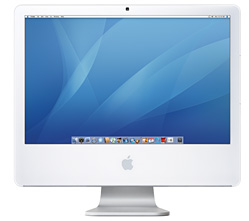 I really, really want one of these puppies.
The new 24-inch iMacs are out. I went and played with one at the Apple Store today. Now, when I first saw the 20-inch iMac, I thought, this thing is huge. But the 24-incher puts its 20-inch sibling to shame. For a minute there, I almost thought I was looking at Apple’s 30-inch super-luxury monitor; even knowing the size difference, I still walked over to the 30-inch display to compare. You can tell the difference, of course, but it doesn’t feel like much. Maybe the iMac’s large white facade makes the screen look bigger, but really, I don’t think it needs any help. In MS Word, a 2-full-page display of a document left the pages displayed more than large enough to read comfortably and had lots of screen space left over. Unfortunately, there was no full-screen, high-quality video on the machine to test, though in hindsight I now realize that I could have downloaded an HD trailer from the Apple movie trailer site.
The specs for the $2000 (base price) desktop are pretty impressive. The new Core 2 Duo chip (2.16 GHz, option for 2.33 GHz for an extra $250) has a 4MB L2 cache (that’s good, take my word for it if you don’t know what I’m talking about), and a fast NVIDIA graphics card. 250 GB HDD, Superdrive with DVD+R DL/DVD±RW, Built-in Bluetooth 2.0 & WiFi-g, built-in iSight camera, and the ability to use S-Video out to the TV (Apple does a good job of high-quality video out) in case the 24-inch monitor just ain’t humongous enough.
I decided some months back that I would get an iMac as my next computer purchase, but not until next year, after OS X v. 10.5, Leopard, is released. My last computer, this PowerBook I’m using now, I bought just a few months before Tiger was released, and I had overlooked the extra money it’d cost me to buy separately–one downside of Apple’s no-upgrade-option policy on software purchases. But when I decided to wait, I thought Leopard was coming in January (now March or even later seems more probable), and the 24-inch model hadn’t been released. And with the iMac line being refreshed now, it’s likely that I’d just see another iMac speed bump occur just a few months after getting one in Spring–which would make me want to wait a bit more, and I’d get caught up in the eternal wait-for-the-next-better-model game. Now it’s beginning to seem a bit silly to wait six months or more to buy a computer just because I don’t want to pay $130 for a new OS–especially when, as an educator, I have the academic discount that puts Leopard at $70.
There is one nit I have, though: Apple sells the iMac with 1GB of RAM, which is nice, but I of course want to upgrade to 2GB at least. The problem: the on-board 1GB is really two 512MB RAM chips which occupy both of the iMac’s only slots–no empty slots to add RAM. Which means that if I wanted to upgrade, I’d either have to pay Apple $175 for what should be a $120 upgrade, or I throw away perfectly good RAM chips, which in the end would be even more expensive. Bad form, Apple. The 1GB of RAM should absolutely have been a single GB chip–but maybe that was their idea, to make you buy from them up front. (One other nit for Apple: running Windows natively on a Mac is a huge plus point; why not demo it in Apple stores? You may well have lost a sale today when my Japanese friend couldn’t see it at work when we visited the Shibuya store.)
Japan pricing, usually higher than American, would add $140 to the total; however, I luckily am eligible for the 7% educational discount from Apple Japan, which would set it back down to $2000. But I’d have to shell out the full $200 for Windows XP–due to their system of educational sales, I would not be able to buy it without going through massive headaches with my school’s home campus, thousands of miles away (unless anyone out there knows differently?). The whole shebang, including XP, the 2GB Apple RAM, and the option for wireless keyboard and mouse, would set me back about $2400. Oh, wait, I forgot that I’d want to buy Windows virtualization software–almost certainly Parallels. Add another $80, call the whole deal $2500. Add another $170 (total of $2650) if I want to opt for the extra 2 years’ AppleCare warranty.
Partly I’m writing this to work out for myself whether to buy it now or wait. I have this personal rule where I don’t buy anything expensive until I’ve considered it for at least two weeks. However, that’s more for impulse buying something that I wouldn’t really use and don’t truly want (like the five hundred bucks I shot on a Sony Clie PDA years ago, virtually unused all this time). I know I would use the iMac, though.
Any thoughts?
Via C&L: Salon.com editor Joan Walsh was on Real Time with Bill Maher, says she’s seen the miniseries, and says that the movie is “worse than you think.”
“They make him out to be a buffoon, there are several points where they juxtapose bad decisions that actually weren’t real decisions, didn’t happen, where they juxtaposed those with Clinton saying, ‘I did not have sex with that–‘ the thing you heard a million times, they make him out to be completely ineffectual, and bumbling, and distracted.”
Even the anti-left guest, P. J. O’Rourke, who said he’d love it because it bashed Clinton, harped in on the “why completely make stuff up about recent history” question, which is as far as some right-wingers will go on this one if they have anything critical to say about the movie. Well, maybe conservative Libertarian O’Rourke wasn’t paying attention to what the right wing is like when it comes to recent political history lately.
But another recent revelation indicates that Democrats aren’t the only ones slandered (‘libeled’? It’s both spoken and published…) in the movie. According to AmericaBlog, American Airlines is defamed as well. In the movie, Mohammad Atta is shown going up to the American Airlines counter at Boston’s Logan Airport, where a security warning pops up. Despite one airline worker’s disbelief that Atta is not even searched, another senior employee waves Atta through.
Except that (a) the warning appeared in Maine, not Boston; (b) there was no call in the warning to search people on the list; and (c)–the big one–Atta flew on U.S. Airways, not American.
But, if AmericaBlog is accurate (and it seems to be; though I can find no official confirmation of all the details, The New York Times does quote the film as showing Atta checking in at an American Airlines counter), then AA is made to look like their own carelessness and incompetence allowed Atta to walk onto the plane, when they could have nailed him right there.
Another scene for Disney/ABC to cut if they don’t want their fannies sued off.
Update: BTW, the movie’s ad claims that it features “Everything that might have prevented [9/11].” I would bet you a lot that it doesn’t.
Update 2: Apparently, Bush has scheduled a speech that will interrupt part 2 of the miniseries–the part that includes the small bits that showed his administration ignoring terror (although from reports, the movie doesn’t come close to showing Bush’s true negligence). No interruptions from the White House for part 1, of course.
I went to a barbecue party with people from work yesterday (great party, lots of fun), and to get there, I took the train and had four transfers–quite a few escalators and staircases along the way. Not to mention a few new train lines. One of them was the Tsukuba Express Line, which had an interesting feature common to most new train lines: a platform guard wall, pictured below.


When the train stops, the gate doors open with the train doors. Japanese trains have always stopped at exact locations relative to the platforms (locations marked on the floor of the platforms for waiting passengers to line up at), which is necessary anyway for this to work.
Considering the tendency of many Japanese suicides to use jumping off railroad platforms as a tool for demise, this seems a prudent measure–though I suppose someone determined enough, and in good enough shape, could easily vault the fence anyway. However, this being Japan, I wouldn’t be too surprised if even suicides decided that it would be too uncouth to do so.
One other feature of the train line is, from what I could determine without my computer along to test it, is an on-train wireless Internet connection. Most of the articles I read seemed a bit unclear about whether it was free or not, but a few said it was only available to DoCoMo users. Still, it seems a new thing, and if it spreads and is opened up to anyone for free, it’d be a big new reason to take the train–if you can get a seat, of course.
Right now, however, I don’t take the train much for a few different reasons. First, I have never been comfortable with the sanitation of being crammed together in those cars with so many people with god alone knows what viruses and so forth. I’d wear a surgical mask, but they don’t make one here that works effectively with a nose as big as mine, not that I think it’d make that much of a difference. And on cold days, one can see the windows not just fogged, but dripping with precipitation–which, when one considers it, is really saliva exhaled in mist form from all the passengers on the train, dripping down the sides of all the glass surfaces. Ewww.
Second, there’s the footwork involved. I live in a place where I have to walk five minutes to a bus station, then take a seven minute ride to the train station, then walk for about 400 meters up and down several levels to transfer to the subway line to get to my school, and then walk from the station. The wait between the bus and the train is usually long, as the bus arrives at the station just as the every-20-minutes express train leaves; it’s a choice between taking the local and transferring to a crowded express halfway there, or waiting almost 20 minutes for an express I can sit down on. Coming home, I can get a seat–if I am willing to stand in line an extra 10-15 minutes to get on a subsequent train.
Relative to that, taking my scooter has too many advantages to give it up. A guaranteed seat, door-to-door transport, and taking into consideration the walking, buses, and transfers, it’s actually quite a bit faster than taking the train. Disadvantages include inclement weather (though the scooter is lovely in hot weather), and the dangers of driving in Tokyo. But for the time being, at least, I’ll take the bike. At 35 kpl (83 mpg), gas doesn’t cost too much–but then there’s one last disincentive: my school only reimburses travel by train and bus. Despite it being cheaper by about half, even with wear-and-tear costs factored in, they don’t pick up that particular tab. Ah well. Who said life was perfect?
It just occurred to me: there might be one unique source of pressure to make Disney decide to yank “Path to 9/11” from TV: Apple.
Consider: Steve Jobs recently joined Disney’s board, as a powerful new force. Jobs has never been outwardly political, to my knowledge at least, and seems to be more focused on business. But on September 12, just one day after the controversial movie is supposed to be broadcast, Apple is expected to make a very important announcement about a new movie download service–and it is expected that Disney will be their primary, if not their only, initial source of media.
This could be a huge turning point for Apple, a very important event, and for their major partner to be disgraced in a media scandal the day before the unveiling–well, Jobs might very well want to avoid that. And that could very well lead to pressure on Iger to do the right thing–or at least the right thing for good business.
Via DKos, more reports of protests against the “Path to 9/11” fictionalization, this time including historians and even right-wingers. Fox News host Chris Wallace calls the movie “slanderous” and “defamatory,” and even Bill Bennett says there’s “no reason to falsify the record” and that Disney/ABC should “correct those inaccuracies.”
In addition, ten high-power historians led by Arthur Schlesinger have published an open letter to Bob Iger protesting the “flagrant falsehoods” in the miniseries.
Media Matters points out that Disney’s defense of “Path to 9/11” is in stark contrast to their abandonment of “Fahrenheit 9/11” two years ago.
TPM Muckraker also has more evidence of the right-wing and even religious bias of the director of the farce. And even Harvey Keitel, star of the movie, says that it is not “factually correct,” and should be.
And finally, Disney is at least considering yanking the movie: “Sources close to the project say the network, which has been in a media maelstrom over the pic, is mulling the idea of yanking the mini altogether.” With just a few days to go, it’ll be interesting to see what happens.
This story in the Mainichi Daily is a bit of a curious one, about a film coming to Japan where for a brief moment, female genitalia are visible. The story, titled “Film That Dares to Flash the Flange All in the Name of Art,” describes the offensive film and the fact that Japan’s censors are letting it slip by–as, so the story says, they let male genitalia appear on screen in Kinsey. (And, I observed, they let the same go uncensored in Schindler’s List on cable TV.) This time it’s an Austrian film about artist Gustav Klimt, which otherwise would have passed by unnoticed in small art theaters here.
A lot of people in Western countries assume that Japan and the Japanese are pretty blase about nudity, with the whole “nudity is often seen but never looked at” idea. Japan lacks privacy, as Mariko-san said in Shogun, and so nudity is not something Japanese mind so much.
Ha! Maybe in pre-Meiji Japan, or maybe even pre-WWII, but that is sure as hell not the case today. Modern Japan has kind of strange takes on nudity, probably a mix of Japanese mores and conservative censorship imposed by the US military during the occupation.
I remember the first time I visited Japan, back in 1983, and my tour group was in a countryside inn. The group leader told us that if we felt adventurous, we could all go together to the local bath house. Clearly everyone expected mix bathing, but when we arrived, to our collective disappointment and relief, it was a segregated bath–something which is very much the norm in Japan. Mixed bathing is rarely found in this country, mostly infrequent cases in the deep countryside, and is probably more common in California than it is in Japan. And even in segregated baths, people still carry small cloths which have little other purpose than to act as a fig leaf.
Outside of bath houses, nudity is not seen in public very much at all in Japan. One might see a flash now and again in terms of imagery, like in a manga cartoon book read by an oyaji (old guy) on a train, or in a poster outside a porn theater. Other than that, it tends to be restricted to pornographic materials. You certainly don’t see even a suggestion of private parts in public. Women always wear bras with sufficient padding so that nipples never stand out. On the beach, women almost always wear one-piece bathing suits, and I’ve never heard of a nude beach in Japan (though they might exist). In fact, you never even see shirtless men in Japan outside of beaches and swimming pools–or the odd festival where men might even wear fundoshi. Japan can be very puritanical in regards to clothing.
Pornography tends to strange contrasts here, on the other hand. The subject matter can get wild very easily (I’d rather not get into details), but because of the laws, genitalia cannot be shown. In fact, even pubic hair is usually covered with digital mosaics, though maybe a decade ago censorship laws relaxed enough to make showing “artistic” pubic hair legal, creating a boom of “hair nudes.”
There has also been a more conservative trend in terms of nudity on television. Back in the 80’s and early 90’s, nudity was pretty rampant on TV. Late-night shows featuring nudity were common, and by channel-skipping after 11:00 at night, one could almost always find some T&A going on. Um, so I heard. It was always very careful to restrict the view to boobs and bums, but it was common. One could even see the occasional women’s bath scene on daytime TV. Today, the trend is definitely away from that. Nudity on television is much more scarce, for reasons I do not understand.
So the next time you hear someone sagely explaining about how Japanese are nonchalant about nakedness, bring them up to date.
The New York Times is reporting that Madeleine Albright, Sandy Berger, and Bruce R. Lindsey have all sent letters to Disney (ABC) head Robert Iger complaining of egregious fabrications in the “Path to 9/11” fictionalization.
…former Secretary of State Madeleine K. Albright, said in her letter … that although she had requested a copy of the film, ABC had not given her one. But, Ms. Albright said, she has been told by people who have seen it that it “depicts scenes that never happened, events that never took place, decisions that were never made and conversations that never occurred.” … “Sept. 11 is not ‘entertainment,’ it is reality,” Ms. Albright wrote Mr. Iger. “Before you air your broadcast, I trust you will ensure you have the facts right.”
Sandy Berger wrote that the movie “flagrantly misrepresents my personal actions” and will serve “only to grossly misinform the American people.”
However, Disney executives probably won’t listen to any of it; a right-wing blogger claims (via Think Progress) that he has been assured by ABC that only extremely minor, barely noticeable changes will be made. ABC “left the door open” to last-minute changes, the Times reported, but I think it’s highly unlikely they’ll do so. The “Reagans” miniseries got dropped by CBS entirely, to be shown only on pay cable; if indeed the right-wing smears and lies in this new miniseries is allowed to be broadcast uncorrected (not to mention nearly commercial free), it’ll be just that much more evidence that the media is decidedly right-wing, not left.
Update: via Tom Tomorrow, from the New York Post:
A furious Bill Clinton is warning ABC that its mini-series “The Path to 9/11″ grossly misrepresents his pursuit of Osama bin Laden – and he is demanding the network “pull the drama” if changes aren’t made.Clinton pointedly refuted several fictionalized scenes that he claims insinuate he was too distracted by the Monica Lewinsky sex scandal to care about bin Laden and that a top adviser pulled the plug on CIA operatives who were just moments away from bagging the terror master, according to a letter to ABC boss Bob Iger obtained by The Post.
The former president also disputed the portrayal of then-Secretary of State Madeleine Albright as having tipped off Pakistani officials that a strike was coming, giving bin Laden a chance to flee.
“The content of this drama is factually and incontrovertibly inaccurate and ABC has the duty to fully correct all errors or pull the drama entirely,” the four-page letter said.
Additionally, Richard Ben-Veniste, a member of the 9/11 commission upon whose report the ABC miniseries is allegedly based, strongly disputed the accuracy of the movie as well.
I am still astonished that any state allows Diebold machines to be used. Wholly apart from the fact that Diebold’s president was a Bush campaigner who promised to deliver Ohio for the president, Diebold’s machines have always been known for (a) a lack of a paper trail, and (b) the ability to be hacked. Now that ability is demonstrated as being very, very easy to do. This post gives step-by-step instructions on how to hack a Diebold machine in four minutes, using only $12 in materials, without leaving a trace of manipulation (link via Engadget).
And with the hotly contested race in San Diego, where “Duke” Cunningham lost his seat due to corruption, the Democratic challenger lost by only 4% of the vote. Diebold machines were among those used in the election, and controversy erupted when it became known that election workers were taking the Diebold machines home for “sleepovers”–though with the machines being open to hacking with only 4 minutes’ work, it is likely that even a sleepover wouldn’t be necessary to throw the Diebold machines’ results into question.
That elections results, however, are now moot, because the GOP leadership in the House illegally usurped San Diego’s right to certify the election by swearing in the presumed Republican winner before local officials approved the election results. So, corruption and election-stealing all around–the Republican Party has this down to an art.
Well, the rumors of a 23-inch iMac were wrong. It’s a 24-inch iMac. While the 20″ iMac now goes for $1500 ($200 less than before), for an extra $500, or $300 more than a 20″ iMac cost last week, you get the considerable extra screen real estate in addition to an advanced graphics card (the 20″ has an ATI Radeon X1600, the 24″ an NVIDIA GeForce 7300 GT). The entire iMac line was also furnished with the new Core 2 Duo chips, and the Mac Mini line was made Core Duo across the board. The cheapest iMac, the 17″, now sells for $1000, or $300 less than before.
But that’s not what this entry’s title is about. Rather, it’s about September 12th, when Apple has a big media event, which they are touting with the logo at right, proclaiming that “It’s Showtime.” Most everyone figures this means that Apple is going to release their movie download service, a reasonable interpretation.
But the really interesting thing is that the 24″ iMac and CPU upgrades were no small deal; usually, they’d get a show of their own. Instead, just a week before an Apple media event, the iMac and Mac Mini upgrades were quietly announced, with no great fanfare. That suggests that whatever Apple is going to release on the 12th, it’s big enough not to leave room for today’s upgrades… and that’s saying something.
Expectations: aside from the movie download service, people are talking about the long-awaited iPhone, with sources saying that it’s finally ready. Others say a video iPod, but probably just because the video service seems ready to go. However, others say that Apple has a whole new media center solution (maybe hardware) ready to go, and the movie downloads may be of DVD quality, not iPod-sized. It could even be a new kind of video download service altogether, with perhaps the TV downloads also going higher-resolution.
In any case, we’ll know the answers in a week.
Update: Via MacRumors, Variety and AP are already talking about the movie downloads as a certainty, noting that Apple will probably only have Disney on board at first, as the studios are balking at Apple’s low, fixed price structure.
