Archive

Archive for September, 2007

Filibuster, Filibuster, Filibuster…

September 19th, 2007 1 comment

Senate Republicans are still filibustering everything in sight. Today’s lineup:

Giving Washington D.C. residents representation in Congress. Washington D.C. has more people in it than the state of Wyoming (D.C.: 581,000; Wyoming: 493,000), but Wyoming has full representation in Congress. The people of D.C. don’t get that privilege. They are effectively living under the equivalent of colonial rule–taxation without representation. Democrats want to give those people a vote. Republicans oppose for a simple reason: D.C. would vote Democratic. If they would vote Republican, the GOP senators would vote for the measure in a heartbeat. But they’re not, so the GOP wants to continue denying them their fair representation. With a filibuster, no less.

Senator Webb of Virginia wants to give U.S. troops–you know, the ones we’re supposed to be supporting?–enough leave time back home so they won’t be as over-stressed and overburdened. Bush has repeatedly extended their tours of duty, bringing them back to Iraq again and again, forcing them to stay longer and longer each time. The strain is showing. Suicide rates among veterans and soldiers are climbing. So Webb–a decorated Marine officer whose son is also a Marine and is serving in Iraq–introduced an amendment to a defense funding bill that will require our troops to get as much time at home as they serve abroad.

So how do the Republicans in the Senate respond? With a filibuster, forcing our troops to serve beyond all reasonable expectations, and get burnt out. Way to support the troops!

Fox Misp
Somebody buy Fox News a dictionary! Or a spell checker.

And then there’s Habeas Corpus (which, apparently, Fox News can’t even spell–see inset at right), which Democrat Chris Dodd is trying restore after Bush and Gonzales denied Americans has any such right. Guess what Republicans are planning to do to keep Americans from enjoying that right? Yep. Filibuster time!

Apparently, Republicans feel that since the Democrats used the filibuster in a strictly limited fashion to block far fewer judges than Republicans denied Clinton (Bush got through more nominees than any president in recent history), it is now OK for Republicans to filibuster everything in sight. As always, taking things to extremes.

Democrats blocked bat-guano crazy extremist judges that one could easily choke on. Republicans are filibustering your Constitutional right to Habeas Corpus, leave time for extremely overburdened soldiers, and the right for Americans to have representation in Congress. You know, commie liberal stuff.

Republicans are living up to their promise to Americans: burn out the troops and wreck the military, strike down your Constitutional rights, and deny minority voters the right to representation in Congress, using the very same means they themselves called “unconstitutional” and “undemocratic.”

These guys deserve to lose everything in the next election. Let’s see that they do.

Taser Incident at Kerry Speech

September 19th, 2007 15 comments

If you haven’t seen it yet, below is the YouTube of that incident where Kerry was making a speech.

Alas, this is probably going to reflect badly on Kerry, despite the fact that he had no control over or responsibility for the event–unless one wants to suggest that speakers like him at events like that must wade into the center of frays like that and micromanage the situation. What we’re seeing here is something that ever-present videotaping and unrestricted video presentation on the web have made possible–in short, we see all the idiots in the world acting like idiots and then the aftermath that follows. This one incident is now heading the news leads only because it happened in front of Kerry.

One might be tempted to call the campus police on the charge of excessive force, but when you think about the alternatives and what they could have or should have done, I can’t really find myself faulting them too much.

It’s not just that this guy was a complete jerk-off who was obviously enjoying making a spectacle of himself and ruining the event for others (one can be fairly confident that this self-promoting clown is ecstatic over the attention the story is generating). As un-Buddha-like as it may be, one tends to enjoy seeing bozos like that carted off.

Rather, you have to look at this from a crowd-control perspective. This kid had hogged the mic well beyond his allotted time–he was allowed to go over time once at Kerry’s behest–and it was pretty clear that he was not asking a question, but rather that he was making speeches. This was pretty clear not only from his diatribe, but from the fact that when his time was more than up and someone tried to stop him, the student angrily shot back at the woman trying to talk him down, “He’s been talking for two hours, I think I can have two minutes!” and then went on about how he was going to “inform people” before asking his questions.

In short, he had broken the rules allowed in the forum, had already been asked politely to step down, and he refused to cooperate. True, after his mic was cut, he was not given an additional chance to quietly leave–instead two uniformed campus policemen started to escort him from the auditorium–but one could easily argue that he had used up his allotment of good will.

As the police are taking him out by the arms, the audience starts applauding; one can only guess that it’s because they approve of this loudmouth being taken off (a pretty safe guess, though). However, as he’s being carried away, some students can be heard saying that “he just wants to ask a question,” as if his diatribe were reasonable in the context of the town hall. That’s when he starts becoming a real showboat, screaming “HELP! HELP!” as if he’s being beaten up or something, and starts wrestling away from officers, jumping and jerking away.

Controlling someone who is out of control like that is never pretty. In this case, it was apparently the judgment of the police that he had to be tasered before he could be safely taken away. This video, which includes a segment cut from the video above, makes it a bit more clear:

In it, you can see that as the police were about to take him out the doors, he tore away from them, and they had to tackle him to subdue him. Before tasering him, they were trying to handcuff him, and he was pretty clearly resisting arrest–and frankly, by this time, he pretty much deserved to be arrested. He was not allowing the officers to cuff him, so they did what they had to.

A student or two around the action started becoming a bit hysterical, but if you discount the gross hysterics of the guy being subdued and think of what the police could be expected to do, it doesn’t really leave much room for second-guessing. They had already tried to take him out of the auditorium peacefully, and he had already torn away from them and flailed at them, several times. They had excellent cause to handcuff him, and he was not allowing them to do that.

Kerry deserves credit for at least trying to deal with the student peacefully at the outset of events, trying to let him have his say, trying to answer the question. Like I said, what was Kerry supposed to do? Sadly, Kerry’s people released a statement to the press with the wrong angle–pointing out that Kerry didn’t know the guy had been tasered until after the incident. Right-wing blogs, generally approving of what the police did, nevertheless took every chance to poke at Kerry, and jumped on Kerry’s statement, as if it were unimaginable that Kerry didn’t know what was happening. Frankly, I can fully believe it. The student was screaming theatrically throughout the whole arrest, and Kerry did not have the close-up camera view that everyone else had–he was just trying to get on with the town hall, likely doing his best to ignore the fracas. But everyone else does have the close-up camera angle, and might have difficulty divorcing themselves from that point of view and understanding that Kerry’s view was far different.

As I said, this is what you get when cameras are pretty much everywhere. Sometimes people act like idiots, and sometimes you see the police doing an uncomfortable but necessary task.

Categories: People Can Be Idiots Tags:

Uh-oh

September 18th, 2007 Comments off

Now Republican Senator Larry Craig is really in trouble. Sure, pleading guilty to disorderly conduct in a public-restroom gay-sex-solicitation sting was really bad, especially where his state’s governor is a Republican so his seat will be safe either way. And deciding not to retire quietly but instead to challenge the guilty plea and get it reversed, well, that didn’t win him much praise in right-wing circles either–they just want him to quietly bow out.

But now Craig’s challenge has brought him utter disaster: the ACLU is backing him.

As far as conservatives are concerned, he may as well have just joined the Nazi Party and been done with it. Let’s see how quickly Craig’s staff can make a public spectacle of refusing any ACLU assistance or association.

Categories: GOP & The Election Tags:

Tasty Seal

September 17th, 2007 2 comments

Saw this yesterday at a Seibu department store meat shop, in the basement food arcade.

0907-Seal Meat1-450

0907-Seal Meat2-450

In case you’re wondering, all the other signs like this in the display case said “SALE.” This was the only one with the misprint.

And yes, it was a misprint. I asked.

Tax the Rich?

September 17th, 2007 2 comments

Okay, let me start out by saying that Economics is a subject I know little about. All I have to go off of here is common sense, so this post is more of a question than a statement. But I wanted to bring up and question a conservative principle that I have heard for some time and always thought was fallacious.

I was reminded of all this after reading an article which talked about yet another loophole which allows wealthy people to reduce their tax burden to a point lower than many in the middle class have to pay.

Laffer Curve
Neolaffer

The conservative argument is: taxes on wealthy people should be low because if you raise them, people will have less motivation to make money. This argument is based upon the Laffer Curve, which in basic principle is a respectable argument–if taxes are set at 0% or 100%, then the government collects nothing (at 100% no one has any incentive to work). Somewhere in between is the optimum taxation rate.

The problem is, it is not as simple a curve as it is expressed at right, especially in a progressive tax system. For example, let’s say you tax a $50,000 salary 20% so the earner takes home $40,000, and you tax a $1,000,000 salary 96%, so the earner takes home $40,000, the return on the greater salary is zero, giving one no incentive to earn more. Such effects don’t fit so neatly on the curve. And when you get out of the extremes, other variables creep so strongly into the equation that it collapses into the snarl seen below Laffer’s curve at right, as illustrated by Martin Gardner.

The argument I am referring to never actually applies to extremes as high as 90%+; while such brackets may have existed in the past, current discussion centers on whether such brackets should be in the 15~50% range. And as Gardner points out, within that range, Laffer’s curve fails to serve as an accurate predictor.

First of all, taxes are never as simple as conservatives portray them in public discussion. You often hear about how people “pay” the top tax amount. However, the top earners never pay 35%, the top bracket today. There is a difference between tax brackets and net taxes paid. People talk about the 35% tax rate, but that doesn’t mean that every dollar of your income is taxed at 35%. You get the first chunk tax-free (deductions), then the next chunk is taxed at 10%, then the next chunk gets taxed at 15%, and so on. And then we have other loopholes, shelters, and dodges, like capital gains tax, which tops out at 15%; a lot of wealthy people make huge portions of their income this way.

But let’s ignore all that for now, and simply focus on the principle itself.

Let’s say that I propose raising taxes so that a person earning more than a million dollars would pay half of their whole income in taxes.

According to the conservative argument, many people would throw up their hands, say “what’s the use?” and not work so hard to make more money. As a result, incomes would drop, and therefore tax revenues would drop.

Somehow I just don’t buy this. I don’t think that people give up money so easily just because they’re not making a bit more more money.

Let’s say that you make $2 million a year and you have, say, 30% taken away in taxes, so you come home with $1.4 million. Then I raise your taxes to 50%; at the 50% tax level, if you make $2 million, then you take home $1 million. You don’t like that, but let’s say you can’t avoid it. Your only choice is to work less or to work more. Will you really be tempted to cut your work levels so that you make $1.8 million and take home $900,000 instead?

I strongly doubt that. Or, if you do, then I think the cause is not the 50% tax bracket, but the desire for less work–that cutting a certain portion of the workload would result in less stress, more free time, etc. Under such circumstances, the same person would likely cut their work levels if the tax rate were zero–the motivation to work less is linked to the desire for free time, not because they get a smaller return than in some other imaginary situation.

After all, people get taxed today, and yet they still work their asses off to make a fortune, or make more of a fortune. Why aren’t more people saying, “Hey, I could be making millions more, but the government takes so much–I could get loads more if the tax rate were half what it is now, so why should I work this hard?”

In fact, I would argue that the motivation factor works in the exact opposite direction to what conservatives argue. And this is my central argument: People who make large incomes are usually highly motivated to make more money. They will not be motivated to make less if the tax rates are higher–if anything, they will be motivated to make more money in order to make up for the loss to taxes.

Think about it. Will you really give up on the chance to make an extra million dollars if the take-home is $500,000 instead of $800,000? You would really deny yourself half a million dollars just because taxes ate up $300,000? Or would you say, “damn the government for eating up that $300,000, but I want/need that $800,000,” and try to find a way to get more?

Then there is the fact that people who make that much money–that is to say, more than they need to live comfortably–tend to be motivated by the desire to make as much money as they can, to succeed as much as they can; these people are the ones who will work even harder should tax rates rise.

There is a threshold at work where at some point, higher taxes start to be counter-productive, and to be certain, it starts at a lot lower than 96%. However, I am pretty sure that it also starts at a lot higher than 35%–today’s top bracket, which means actual tax percentages are a lot lower.


Query for information: is there any resource which lists the actual average tax payments as a percent of total income based on income levels? Say, a list which shows what percent of total income an American taxpayer shells out when making $50,000, $100,000, $500,000, $1 million, and so on? Not just straight-out, assuming standard income only and no application of loopholes or other dodges, but a real-world view? As far as I can tell, that doesn’t exist.

I would think that for any informed debate on tax levels, such a chart would be essential, and well worth the effort it would take to research and calculate it. Which makes me wonder why there might not be one.

Categories: Economics Tags:

Vista Sales 60% lower than XP’s

September 16th, 2007 4 comments

Surprise, everyone. Vista sales suck. It’s now official, and Microsoft can’t sham people about it any more:

Standalone unit sales of Vista at U.S. retail stores were down 59.7 percent compared with Windows XP, during each product’s first six months on store shelves, according to NPD Group.

Well, I’ll be. Who could have predicted that?

In terms of revenue, sales are also down, but the drop has been less steep, at 41.5 percent.

This is probably due to the new tiered version plan–the “Vista Home Basic” version which they use to tout how “cheap” Vista is, is so cut-down that it is effectively a piece of crud. It has few of the features that Vista is actually sold on. When XP was sold, there was only the “Home” version, not versions of the Home version. People have to pay more now for the basic package–ergo the relatively higher revenues on fewer sales.

Microsoft also agreed that an analysis of boxed copy sales is not representative of Vista’s momentum, noting the trend of people getting a new operating system with a new PC has further accelerated with Vista.

Like Bush and Iraq, Microsoft is trying to apply lipstick to a pig. Read the above statement again. They are effectively saying that more people are getting Vista only when they buy a new computer. However, there is one possibility in that trend that might indicate higher Vista sales: Vista is such a resource hog that people realize that they must buy a new PC in order to use it. If that’s happening a lot, then Vista might be doing relatively well. Otherwise, Vista sales are tanking.

PC sales doubled between 2001 and 2006, before Vista was released, so Microsoft can’t take credit for that. If there was a sudden spike in PC sales after Vista, Microsoft could claim credit for it, but I’m pretty sure that such an increase, if it happened, was not so great. The last fig leaf that Microsoft can hide behind is that a lot of people want Vista, and they just happen to be buying new PCs anyway. But it’s getting harder for them to cover up the fact that Vista just plain sucks.

Last semester, I had one student in my Computer class who has Windows Vista. I asked him if he liked it, and his response, purely physical, was unmistakable–the entire class giggled and laughed, as did the poor, sheepish Vista victim. This semester, I have more students who have Vista, and the reaction is still the same. I have not heard one positive thing from any of them yet, though I have asked. Some report frequent crashes, others complain of hardware and software incompatibilities. Others could not even find much-ballyhooed new features, like the Sidebar with Gadgets–Microsoft hid that one within several layers of sub-menus in the Start Menu. One of my students let out a startled yelp when I activated it in a demo.

When I visit Bic or Yodobashi, the Vista section is deserted, while the iPod sections are lively. Yes, I know, it’s hardly scientific. But the overall signs are pretty hard to miss.

Microsoft’s great hope for revitalization lies in Vista SP1, which in theory will fix most of those bugs everyone is complaining about. My students’ ears pricked up when I mentioned it–and they were just as disappointed when I passed on the information that it was due out “sometime” next year. Most corporations are taking a similar wait-and-see attitude with Vista SP1.

News on the retail front is brighter for Office, which was released to stores the same day as Vista.

Retail sales of Office products from January through June were roughly double those of Office 2003 during its first six months on the market and up 59.6 percent from Office sales for the first six months of last year. (Sales of Office 2003 at retail continued to grow over the life of the product.)

Now this I can understand. I have been remaking my Computer class web site because my school switched from Office 2000 to Office 2007. The intermediate upgrade to 2003 was OK, but not all that impressive. 2007, however, is a huge step forward. The live format previews, much-improved graphics, and the easy-access Ribbon are all significant steps forward, in my opinion; I think Microsoft did a great job with this one, and I can easily see sales of it performing well.

But here’s an interesting twist:

While much of the sales were for the new Office 2007, Swenson said just over 20 percent of all boxed copies of Office were Office for Mac. Swenson credited the large number of people switching to Macs as part of the reason for the spike in Mac Office sales.

That’s credit for how good Office 2004 for the Mac is. Office 2008 for the Mac is due out in January, but if 2004 is selling that well, it’s good news for Microsoft’s Office unit–not so well for their Vista unit, though. The news is mixed for Apple–good news on market share, but it also shows that people aren’t fully aware of the iWork suite.

One last ray of hope for Vista:

Just because boxed Vista sales are down doesn’t mean they won’t pick up, he added. He noted that XP sales peaked a few years after its 2001 launch.

“My hypothesis as to why is that there were a lot of people that bought PCs running 2000 or ME before the XP launch, and thus when they decided to upgrade they opted for the XP upgrade awhile after their initial purchase,” Swenson said. “There is a possibility that we might see a similar trend with Vista.”

A weak hope, at best–people who bought XP within the last year who will hang on to it just because they don’t feel like upgrading so soon. Can we shoot that one down?

But given the fact that only relatively new PCs can be upgraded to Vista, and with standalone sales not showing signs of improving, Swenson said, “it’s looking less and less likely that this will happen.”

Good point. The hope is that Vista would be like XP–but the main point of this whole news article is that Vista is sucking relative to XP. Add the fact that Vista often requires a major hardware upgrade, and that hope dims further. It’s not that people are waiting to upgrade to Vista, it’s that they can’t upgrade to Vista. Big difference.

Here’s where one of the advantages of PCs over Macs boomerangs on Microsoft. While Macs are priced competitively to PCs when you buy Macs and PCs with similar feature sets, you can buy super-cheap, stripped-down PCs, while you can’t get Macs like that. This is what perpetuates the PCs-are-cheaper-than-Macs myth. The problem: people who bought PCs even a year ago, not too long before the Vista release, still can’t upgrade to Vista because a Celeron running with 256 MB of RAM won’t cut it with Vista.

Without a “killer app” motivation to upgrade, a lot of people are going to be content to stay with XP. And if they decide to buy a new computer, more and more often the Mac will gain attention as a possible replacement.

Categories: Computers and the Internet Tags:

Out the Window

September 16th, 2007 3 comments

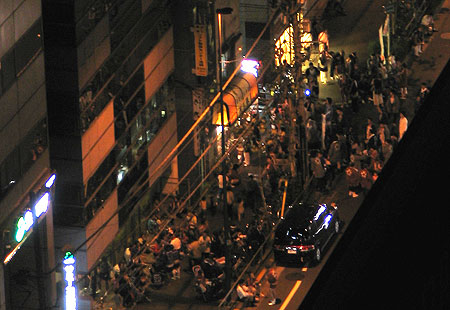
One thing I’ve noticed looking out our window here in Ikebukuro is that you ca see more than I cold see before in Inagi. Sure, you can see farther, but there is also more happening. As Sachi and I sat down for dinner tonight, we heard something, a sound that could have been anything, like a dog barking… but it was much too regular, far too rhythmic. So I opened the balcony door, looked out, and saw a small, local temple festival on the street less than a block from our place.

0907-Wasshoi-450

You know, nothing special. Just another local festival.

It’s a nice view, even if you get tired of the city lights, which I haven’t.

Categories: Ikebukuro Tags:

Missed Opportunity

September 15th, 2007 Comments off

On the train home from the school barbecue picnic, I saw a guy on the train. He was reminiscent of Natsume Soseki, though his mustache was bushier and more narrow–kind of bulged out of his upper lip like a large, hairy plum or something. He was wearing a T-Shirt that had pretty good Engrish on it. The perfect photo, except I didn’t have the nerve to take a shot of him or ask him to pose.

The T-Shirt read:

ABSTINENTLY PLEASURE

Somewhere crying out for help

In between the two lines, there was more text about dogs trained to save people’s lives.

Sometimes I am so tempted to risk annoying people by taking their photos.

Categories: The Lighter Side Tags:

Freaky Trick

September 15th, 2007 5 comments

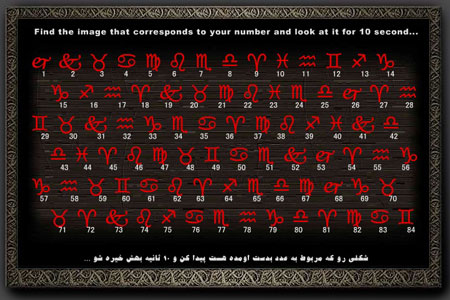
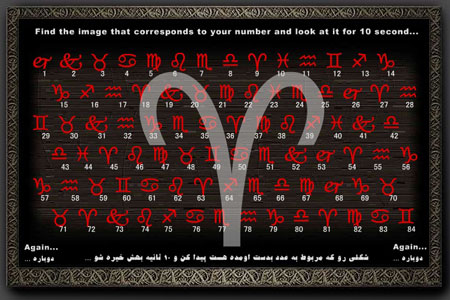
Cosmic Buddha pointed out this freaky puzzle/game on a web site. You are asked to pick a two-digit number. You then add the two digits of the number together (for example, if your number was 87, then you add 8+7), and then you subtract that sum from the original number. Then they show you a chart where each number is matched to a symbol. You find the number with your symbol, wait a moment… and then the web site magically displays an enlarged version of the symbol you are looking at!

0907-Chart1

0907-Chart2

Seriously, it’s kind of freaky at first. You start to wonder how they know what number/symbol you’re looking at. At first I thought it might have something to do with where your mouse is–that most people might hover their mouse over the symbol. But that wasn’t it. The game worked every time I tried it honestly. If I cheated and chose a symbol at random, it didn’t work.

Go ahead and check it out. If you can’t figure out how they manage to do it, then click through to see below the fold and I’ll explain…
Read more…

Categories: The Lighter Side Tags:

Hey, I Guessed Right

September 15th, 2007 3 comments

As to Bush’s “36 Nations” fib, my own speculation was that they were including the NATO training mission:

Perhaps he is counting the ten extra countries involved in NATO’s training mission, a non-combat affair–where none have more than 15 people involved?

And it turns out that was the case. Of course, the accounting is still bogus even if you accept the NATO mission as “troops on the ground.” In the list of countries the White House released, Canada (1 “liasion officer”) and Tonga have withdrawn–Tonga, in fact, withdrew almost three years ago. Other problems with the “36” count are detailed in the TPM Muckraker article, but suffice to say that the Bush nation count has always been bogus in some form or another, like counting Costa Rica, which has no military.

The problem is, this count is so bogus it makes me wonder why they included it. Were they so careless that they just used an old number from somewhere? Are they so desperate for the illusion of international support that they’ll say anything no matter how blatant? Or were they so deeply engaged in lying throughout the speech that they figured, “hey, we don’t fact-check anything else in this speech, why fact-check this?”

Or did they throw this lie in intentionally so that people would focus on what is really an inconsequential statistic, and give less attention to the whopping huge lies in the speech, like “things are improving in Iraq,” “the surge is a success,” or “you can trust me on this”?

Bonus material: Here’s a fun geography game to play. Assuming you have basic country-on-the-map identification skills (and you’re not one of those poor schlobs who can’t fine the U.S. on a map), then look at the list of nations that have “troops on the ground” according to the White House. See the list? OK, now go to an unmarked map of the word, and see if you can correctly identify all those nations on a map.

The point: the list of 26 nations not in the NATO mission, even people with reasonably good geographical skills would have trouble locating even half of those on a map. At least one of the countries most people could get–Japan–withdrew a year ago. I imagine that most people would only find five or six. The NATO list is far easier–but then again, these are not actually “troops on the ground” in the sense that they’re fighting the war.

Categories: Iraq News Tags:

Selling Iraq, Part CXXVII

September 14th, 2007 1 comment

So Bush spoke on Iraq today, which is to say that he lied. Six of one.

Once again, Bush attempted to strengthen the idea that Iraq=al Qaeda, Iraq is a direct result of 9/11, that if we leave Iraq, then 9/11 will happen again like it happened before. All in all, Bush mentioned al Qaeda twelve times:

Last year, an intelligence report concluded that Anbar had been lost to al Qaeda. … The local people were suffering under the Taliban-like rule of al Qaeda, and they were sick of it. … Today, a city where al Qaeda once planted its flag is beginning to return to normal. … They pledged they would never allow al Qaeda to return. … They show al Qaeda that it cannot count on popular support…one of the brave tribal sheikhs who helped lead the revolt against al Qaeda was murdered. … One year ago, much of Diyala Province was a sanctuary for al Qaeda and other extremist groups, and its capital of Baqubah was emerging as an al Qaeda stronghold. … A free Iraq will deny al Qaeda a safe haven. … Al Qaeda could gain new recruits and new sanctuaries. … We should be able to agree that we must defeat al Qaeda… It is never too late to deal a blow to al Qaeda.

As if al Qaeda were the only, or even the predominant, enemy. As if even the element that identifies itself as al Qaeda in Iraq is the same “al Qaeda” that wants to “follow us home” and attack the U.S., when in reality, al Qaeda is more of an idea in Iraq than an organization, and those who subscribe to it have no interest in following us anywhere.

But Bush claims that leaving Iraq not only would be abandoning Democracy itself, but that it would pose a clear and present danger to the people of the United States in their homes. He punctuated it with a blatant 9/11 reference:

We would leave our children to face a far more dangerous world. And as we saw on September the 11th, 2001, those dangers can reach our cities and kill our people.

Of course, Bush is not saying that Iraq had anything to do with 9/11, right? He’s only stating things in a way that will make uninformed listeners believe that such is the truth.

In making his case, Bush had all the sincerity of a farmer smearing lipstick on a pig: the Anbar leader who Bush lauded was assassinated today. Bush emphasized that remaining leaders pledge to push on, but the news was a blow to the success of the province, which is anything but stable. Despite its relative security, Anbar remains the second most violent province in Iraq today, after Baghdad itself. More lipstick included the oil-revenue-sharing Bush lauded has been deadlocked for a long time now and has less chance to succeed than it has to fail.

In his speech, Bush pushed idea that Anbar Province is proof of success of the surge. The problem with that statement? Anbar started turning around only because of internal Sunni politics. The leader who was killed today decided to turn last September–months before even the idea of the surge was known. And the violence started dropping in Anbar last year in November. The “Surge” was announced in January, and the full force of the surge did not arrive in Anbar until later. All Bush did here was move the “Surge” into an area where local politics was fueling success, then went on a PR trip there to claim the success as his own.

Bush continued his speech by building on the Anbar “success” and suggested that this “success” is spreading throughout Iraq. “Ordinary life is beginning to return.” Rosiness all around, everything is going peachy. Except that it’s not. Bush simply chose one or two bright spots in Iraq and ignored the dark areas, the places that have gotten worse, like Kirkuk, Tikrit, Samarra, Diyala, Balad, Basra, Mosul, and Amarah. As so many have pointed out, Iraq–like most insurgencies–is a whack-a-mole situation, where violence will ebb in one place only because the insurgents have moved on to easier grounds elsewhere to spread their violence.

And then there is the claim that Bush is “pulling troops out of Iraq,” when really what he’s planning is to bring troop levels back down to pre-surge levels–and even then, not until the summer of 2008–which, by coincidence, is just before the elections. Surprise!

You know when you go to a store and see an item marked down “50%”? And you know that the item was probably assigned a retail price by the manufacturer that was lower than you’re looking at, but the store then pasted their own ridiculous “retail” price to it, and then “slashed” that price to give you the illusion of a bargain? That’s what we’re getting sold to us here–a troop draw-down which is really just a restoration to what we had before.

Actually, Bush is probably pulling down those numbers more because of resource constraints than anything else: he has so crippled our military that we simply cannot maintain the “Surge” numbers beyond the timelines he has set down.

When it comes down to it, when Bush leaves office, two years after the American people gave the clear and undeniable message that they wanted out of Iraq, we will have about the same presence in Iraq that we had before the 2006 midterms. By using the “Surge” and throwing in all these delays (“just wait a little longer… and then longer after that… and then we’ll reveal that all that is needed is to wait a little longer!”) and tweaking troop levels, he will have successfully played Americans for fools and completely ignored their clearly-stated demands.

At the end, Bush could not help but to shamelessly use the sacrifice of a soldier and the grief of his family to paint a poignant facade on his incompetence. Once again, he tied the utter failure of his administration in Iraq to the honor and sacrifice of the troops, as if the two had any connection whatsoever. This continues to strike me as the most reprehensible of all political maneuvers. If Bush wants to honor the troops for their sacrifice, great; if he wants to make his case about Iraq, let him. But to honor the sacrifice of the troops only as a selling point for his miserable failure that caused the needless sacrifice that the soldiers bravely supplied, this is contemptible beyond expression.

After Bush’s speech, politicians were given the mic and more or less gave their standard stump speeches. Barack Obama said, “The bar for success has been lowered so far that it is almost invisible” (a variation on the statement he’s made in the past day, “The bar for success is so low that it’s almost buried in the sand”).

John McCain, on the other hand, expressed an interesting new twist in rationalizing the “Surge” which he helped author: blame Rumsfeld. He characterized everything bad that happened as the “Rumsfeld strategy,” and painted himself as having heroically fought against that since the beginning–as if there was nothing wrong with the invasion or with the administration’s management of the war aside from Rumsfeld, and McCain only suggested stuff that worked. As with Obama, McCain cribbed from his stump speech, he’s been on a “blame Rumsfeld” kick for a week or so now.

Michael Ware on CNN had an excellent sum-up of how Bush’s claim that “ordinary life is beginning to return” is full of it.

If the president means by ordinary life, families essentially living locked up in their homes, in almost perpetual darkness, without refrigeration, or perhaps constantly struggling — struggling for ever more expensive gas to run generators, if he means waiting in their homes, wondering if government death squads will drag them off and torture and execute them, if he means living in sectarian, cleansed neighborhoods where people who were your friends have had to flee, if he’s talking about living in communities that are protected by militias, then, yes, life has returned to ordinary.

Ware painted a very bleak picture of “ordinary life” in Iraq today. He may have emphasized the despair too much, but I would bet good money that his assessment of life in Iraq today is far more accurate than Bush’s.

One last nitpick: Bush said in his speech that “We thank the 36 nations who have troops on the ground in Iraq….”

Thirty-six? According to Wikipedia, there are 22 countries with troops on the ground in Iraq today (21 by the count of the Center for American Progress), including the United States. There were 18 other nations that sent troops (if you include Iceland’s 2 soldiers and several other nations, like Japan, who sent troops for strictly non-combat duties). Perhaps he is counting the ten extra countries involved in NATO’s training mission, a non-combat affair–where none have more than 15 people involved? Even with that, it doesn’t add up to 36.

So, where is he getting the number 36? The best I can tell, there were by some counts 36 nations in the Coalition with troops on the ground when the invasion of Iraq began–but Bush used the present tense, “have troops on the ground,” not “had.” That’s written in the pre-released transcripts as well.

Edit: I started writing this just after Bush finished his speech–but it looks like I’m not the only one who caught the “36 nations” lie.

Bush can’t even tell the straight truth about how many countries are helping us–or he is in extreme denial over the countries who have lost faith in the mission and have pulled out.

For Bush, Iraq continues to be one colossal, bloody lie.

Categories: Iraq News Tags:

You Can Trust the Generals, Right?

September 13th, 2007 2 comments

A great deal of the credibility of the Petraeus report is based upon the idea that since he’s a general, he is therefore respectable and we can trust us to give it to us straight.

The problem, of course, is that by this time, any high-level Iraq War posting is more likely than usual to attract a general who is more oriented towards political ambition than would be otherwise. The good generals have resigned over this in principle. Among what we have left are the kind of people who gravitate to the top in an administration like this one.

Evidence of the fact: Petraeus, it seems, has presidential ambitions.

The US commander in Iraq, General David Petraeus, expressed long-term interest in running for the US presidency when he was stationed in Baghdad, according to a senior Iraqi official who knew him at that time.

Sabah Khadim, then a senior adviser at Iraq’s Interior Ministry, says General Petraeus discussed with him his ambition when the general was head of training and recruitment of the Iraqi army in 2004-05.

“I asked him if he was planning to run in 2008 and he said, ‘No, that would be too soon’,” Mr Khadim, who now lives in London, said.

General Petraeus has a reputation in the US Army for being a man of great ambition. If he succeeds in reversing America’s apparent failure in Iraq, he would be a natural candidate for the White House in the presidential election in 2012.

Which means that Petraeus is a political animal as much as, if not more than, a clean-cut military man, and what he does now is very likely colored by what he believes will serve him in a political campaign not too far in the future.

I know what the knee-jerk right-wing response will be: what about Wesley Clark? Well, his service in the military gives him the same basic standing as Petraeus. Because we know Clark has presidential ambitions, we weigh his words with those ambitions in mind. The exact same applies to Petraeus. Both generals must be considered not to simply give the straight story, but rather the story that serves them best as far as a political campaign is concerned.

The difference is, Petraeus is active, still serving in the military, and so should be above such things. That is precisely the image the White House is depending on: this report comes not from a politician, but from a general, and we can trust them.

Petraeus, as it turns out, however, is just another politician. And his performance in spinning the data to political advantage certainly gives us no reason to doubt this.

Categories: Iraq News Tags:

You Can Insult Anyone in America Except Christians

September 12th, 2007 3 comments

Kathy Griffin won an Emmy last and created a bit of a stir with her acceptance speech:

“A lot of people come up here and thank Jesus for this award. I want you to know that no one had less to do with this award than Jesus,” an exultant Griffin said, holding up her statuette. “Suck it, Jesus. This award is my god now.”

Asked about her speech backstage a short time later, an unrepentant Griffin added, “I hope I offended some people. I didn’t want to win the Emmy for nothing.”

Christians were livid:

The speech drew fire from a leading Roman Catholic group, the Catholic League for Religious and Civil Rights, which condemned Griffin’s remarks as “obscene and blasphemous.”

Some went even further:

The comedian’s remarks were condemned Monday by Catholic League President Bill Donohue, who called them a “vulgar, in-your-face brand of hate speech.”

Okay, remember two posts ago, where I mentioned that Christians in America were among those who exulted in victimhood?

I mean, let’s get real here: “hate speech”? “Obscene” and “vulgar” are pushing it pretty far already, but “hate speech”? If you said, “Christians are all despicable people and should be rounded up,” or suggested violent acts against Christians, that would be hate speech. But “Suck it, Jesus”? To call that “hate speech” is greatly exaggerated–not to mention, aren’t these the same people who scoff at the idea of “hate speech” when it’s directed at gays, women, or minorities?

Not that this reaction is really unexpected. At this point, I would be surprised if Christians didn’t react that way. Take Christmas, for example–Jesus and Christianity are everywhere, permeating the culture, songs about Jesus saturate the airwaves, it’s virtually Jesus 24/7 for all of December–but if shops start saying “Happy Holidays” instead of “Merry Christmas,” if they simply fail to join in the near-universal obeisance to Christianity and instead remain neutral, then suddenly there is a “War on Christmas” and Christians everywhere are victims of it.

Similarly, Christianity was wormed its way in to our legal system to an un-Constitutional extent, with religious oaths and iconography; it has encroached unacceptably upon government, with religious tests for office and Christian sentiments on money and in schools and other public places. And yet if we dare deny the Christians the ability to enshrine the Ten Commandments in a large granite monument in a courthouse so as to proclaim it a house of worship, implying unfair treatment to unbelievers, then Christians take that as an attack on their religion, as persecution, as part of a “long war on Christianity.” It is perceived as discrimination, and Christians, in reaction, throw themselves prostrate on the ground, in agony over their suffering.

Like I said, Christians, like right-wingers, revel in their perceived victimhood.

Despite Griffin’s probable truth-saying about it being her accomplishment and not Christ’s, what she did was clearly a gag. She did what a lot of comedians have been talking about for some time. I think it may have been Bill Maher who did a bit not long ago where he tired of sports players crediting Jesus for every victory, and hoped for one someday to pronounce that Jesus didn’t do anything, it was all me. That’s what Griffin did, the comic’s dream come true.

In short, it was a joke. Lighten up, Christians.

Categories: Religion Tags:

Wait on That iPhone Unlock…

September 12th, 2007 1 comment

If you were considering paying $100 for that iPhone unlock from iPhoneSIMfree, hold on to your wallet for a little bit. There are people who are studying what iPSf are doing and are working to duplicate it for free. They may be very close to a solution.

Now here’s an ethical dilemma: is it unethical to reverse-engineer from people who reverse-engineer?

Categories: Mac News Tags:

Ghosts of 9/11 Past

September 11th, 2007 4 comments

I am taking this opportunity to look back at my 9/11 comments from years past in this blog. It is not surprising that the same ideas still apply, more than ever before. It is depressing that things have only gotten worse, that we have not learned, that we have embraced the authoritarian rule that has brought us only poverty and self-ruin. Had we simply been brave, bold, and determined after 9/11, had we scoffed at the terrorists instead of accepting the official instigation to cower in fear, then we could still be strong today, still be standing tall, the stoic and admired leader of the world, not the bully who would be pariah if his power ebbed.

Terrorists are not the threat we are told they are; they have no new powers they did not have in the past; we are in no more danger from terrorism than we were before, in fact we are probably safer than before. You are in greater danger from traffic than from terrorists. Fear is the enemy, and fear is now used by the politicians to make us cowed and pliable. Our Constitution, the very core of America, is being whittled down to make way for a new order, a perfect world by the lights of conservative and neo-conservative dreamers, who in the past could never have made these dreams real because the Constitution prevented them.

The threat is not from without, it is from within. Fight against fear, fight for your rights and freedoms. Be an American: fear not, accept risk, and hold liberty as more dear than life itself.

Over the past six years, we have done the exact opposite. We have trembled in fear, bought wholesale the lies of those who want us to fear, and applaud when they remove more and more liberties, foolishly believing that we are “safer,” meekly believing that such imagined safety is worth losing our liberty over. We have been addled cowards, undeserving of the proud name “Americans.” We have let manipulative fascists control us.

Yes, fascists, and do not dare suggest that the use of that word is ridiculous or makes the one who points to it a conspiracy nut, as if fascism could not possibly exist today.

Do you really believe that Americans are not living in a fascist state today? Consider the dictionary definition of fascism: “an authoritarian and nationalistic right-wing system of government and social organization.” How could that possibly not apply to the past six years?

Fascism is when individual and societal interests are considered less important than the needs of the state. How could that possibly not apply to the past six years?

“The Anatomy of Fascism” describes what we are experiencing to a T; fascism flourishes with and is marked by:

  1. a sense of overwhelming crisis beyond reach of traditional solutions;
  2. belief one’s group is the victim, justifying any action without legal or moral limits;
  3. need for authority by a natural leader above the law, relying on the superiority of his instincts;
  4. right of the chosen people to dominate others without legal or moral restraint;
  5. fear of foreign “contamination.”

Look at that list. Every one of these is true today in the U.S. We feel a sense of crisis (terrorism) beyond traditional solutions, hence the policy of pre-emptive war and the abrogation of civil rights and liberties.

We believe we are victims of 9/11, victims of terrorism; this on top of the long-held and long-cherished right-wing tradition of being the ultimate victim despite having the greatest privilege and power. White males are victims. Christians are victims. Right-wingers are victims of the “liberal media” and vicious left-wing conspiracists attacking from dark corners and even coffee cups.

Bush has been considered by the fearful as a natural leader, allowed to lead by instinct instead of fact or reason.

We consider ourselves a chosen people, above all others in the world: note our insistence that other countries join our military ventures under our command, but that it would be unthinkable that any of our forces fall under the command of anyone else; note the dismissal of the Geneva Convention and the easy acceptance of torturing and imprisoning people of other countries without a thought; note our willingness to kill hundreds of thousands in other lands, and then either pretend they love us for it, or wonder incredulously why they do not.

And finally, we fear foreign contamination: we “suffer” from a “crisis” of illegal immigrants, we have to accept the idea of English-first and English-only or be labeled un-American; and many right wingers dread the fact that within the next half-century, Hispanics will form the majority, and whites will lose their privileged status.

It is hard to not see fascism, not creeping in, but flowing in freely through the gaps in our core principles that have been gouged out by our fear.


The following are excerpts from my comments on 9/11 from 2003, from the now-defunct expat.org:


Two important truths after 9/11 are still not widely accepted by Americans: first, we are no more likely to be the targets of terrorism today than we were before 9/11, and second, the “War on Terror” has been abused to rework the political landscape and take actions that Americans would never have approved of in times of peace and calm.

The terrorists have not magically acquired new powers, and now that we are aware of the possible threat, our security is tighter than before (although far too much has been spent in foreign ventures which could much more productively have been spent on security at home). The likelihood of something as spectacular or widely devastating as 9/11 happening again is less than it was two years ago. Instead of feeling less secure, we should feel more secure.

Bush did not squander the reflexive, fear-based popularity 9/11 gave him, and immediately found it reason, as well as a smokescreen, to launch every conservative motion that could be rammed through Congress. What is telling is that almost all of what has been accomplished is pretty much identical to what conservatives have wanted all along: greater police powers and diminishment of civil rights in criminal investigations, growing the military, taking on foreign ventures in oil-rich countries, and pronouncing the protection of America and the safety of its people a Republican domain. All of these have been installed under the guise of “national security,” and Democrats have felt enormous pressure to go along: the Bush administration has made it very clear that dissenters will be labeled enemies of the homeland; Anyone who dissents is depriving us of security and giving aid and comfort to our enemies. Hermann Goering would have been proud:

“Why of course the people don’t want war … But after all it is the leaders of the country who determine the policy, and it is always a simple matter to drag the people along, whether it is a democracy, or a fascist dictatorship, or a parliament, or a communist dictatorship … Voice or no voice, the people can always be brought to the bidding of the leaders. That is easy. All you have to do is to tell them they are being attacked, and denounce the pacifists for lack of patriotism and exposing the country to danger.”

Our liberties were among the first to suffer. “Homeland” security (a name eerily evocative of mid-twentieth century European fascism), with provisions to violate personal freedoms to an extent never dreamed of a few years ago, was passed almost without question. All Bush had to do was to proclaim, “An Evil exists that threatens every man, woman and child of this great nation. We must take steps to ensure our domestic security and protect our homeland.” Sounds reasonable, right? The only problem is, those words were spoken by Adolf Hitler. Bush simply paraphrases.

This is not to say that Bush is Hitler. It is, however, to point out that the formula for using fear to control a populace and lead them into war has not changed.


Three years later I wrote the following, in 2006:


The damage done to our country over the past five years has been immeasurable. Our economy has been gutted where it once stood on the edge of hope, and now may never recover as it could have only a few years ago. We are now mired in a meaningless war that has so drained and torn apart our military that it is questionable as to whether we could sustain ourselves in a serious conflict. Our freedoms and civil liberties are endangered as never before. What once was a news media that worked to a degree has now been subverted and dragged down into a mud that makes anything that comes from it suspect. The arena of politics, in even worse shape when this started, is now so degenerate that it is hard to see anything constructive coming from it again.

It is easy to lose hope. But there is a way out. And one prerequisite of finding the way out is that we recognize the source of the problem. And the source is not the terrorists.

The terrorists were a spark. They are still a danger, but not the greater danger, to be certain. The majority of plagues that we now suffer were created by those who hijacked the power created by the fear the terrorists instilled in us. So let me suggest some tools that could be used to fight the real danger:

  1. Resolve not to fear. Our present leader tells us to be afraid, where past leaders taught us to avoid fear. We have terror alerts, terror arrests, we are told that enemies abound in the world and unless we do as we are told by the government, they will slaughter us. Criticize the government, we are told, and you embolden the enemy.

    Do not be afraid of terrorists. They are not that great of a threat, not enough to allow what has been done to us in the name of fear. There will always be attacks. We simply have to live with that, just as we live with the possibility of traffic accidents, natural disasters, and crime. 50 times more people have died in traffic accidents in American since 9/11 than died in terror attacks. Be vigilant, have good investigative police work, have good international cohesion and support, and we can deal with terrorism as well as it can be dealt with. Terrorists were here before, and they will always be here. We must protect against terrorism just like the other threats, but it should not control us or allow others to control us.

  2. Fight for liberty. By “liberty” I do not mean “against terrorists”; such a mindset empowers those who truly threaten us now. By “liberty” I mean the principles that our country was founded upon, the principles so threatened at this time. The principles that so many conservatives hate so fiercely and would wish to destroy. The principle of separation of church and state. The principle of individual rights. The principle of limited governmental power. It is not our personal safety which is at stake here, it is our liberty. And it is not terrorists who threaten us, it is our own current government and those who support it.

  3. Appeal to reason and fact. Do not allow others to think for you, and truly study and understand what is happening. Almost all the conservatives I have observed visit this site have come armed with nothing more than arguments they heard others make, their arguments as shallow as the punditry they absorbed. It is usually easy to shatter the arguments simply by digging just a little bit past the copied-and-pasted propaganda; what is harder is to shatter the presumption of righteousness that goes beyond facts, information, and truth. These are the extreme examples of people who have surrendered their ability to rationally observe a set of facts in order to instead appease their desired perception of reality. If you surrender your reason to sate your desire, you are terribly easy to control, like a cigarette smoker instantly believing a study that says smoking is not harmful, disregarding the fact that the study is a fraud paid for by the tobacco companies.

    Most people are not yet too deep in that abyss yet. To keep from being dragged in, you must never allow your desire for a thing allow you to believe it. I believed in the Killian National Guard memos too easily and for far too long, only because I wanted to; that caused a weakness in my ability to argue and debate, and probably caused those who read what I wrote to believe my words less. Don’t be afraid to question what you want to hear. Study the information. Reason for yourself instead of simply following the crowd you have chosen. Don’t be afraid to come to a conclusion, but allow the facts, and not your fears or desires, to inform that conclusion.

    A tangent to this is the need to keep the media honest. Do not accept the words of those whose bias overrides their dedication to the facts and honest appraisals of a situation; do not accept the idea that opinion rates as strongly as fact. The truth does not compromise; if a contention or representation is not supported by fact, then it is not acceptable. The truth, the whole truth, and nothing but the truth should be the standard, and if a media entity giving the impression that it relays facts does not live up to this standard, it should be duly and strongly scorned and disrespected. Somehow, along the way, too much opinion crept into factual reporting. There is a place for reporting, but the core of a healthy news media is stark, bare fact.

  4. Be willing to sacrifice. Desire can be all too compelling a weakness for others to control you with. You want money too much, and so others use that desire to rob you. You want safety too much, so others use that to steal your freedom. We are far too easily manipulated because we crave more than we think. We crave tax cuts and so vote for them, only to find we’ve been shaken down and tossed aside. We think we can get things without paying for them, so we end up with education and health care in a shambles, and still believe the impostors who tell us that “throwing money at the problem won’t fix anything,” even as they throw trillions of dollars at rich people because that will “fix” the economy.

    As Robert Heinlein said, TANSTAAFL: There Ain’t No Such Thing As A Free Lunch. Don’t vote for a tax cut because you’d like an extra few bills in your pocket; be willing to sacrifice for better schools and hospitals. And instead of whining about how politicians can’t be trusted to spend, try to actually monitor how your representatives vote and control their actions like you should be doing. In a democracy, the citizen is supposed to be the boss. So act like one. Be informed, responsible, and manage. Surrender that control, and expect to be cleaned out by con men.

    And one more thing: if you think a war is necessary, be prepared to enlist and fight. If even half the conservatives of fighting age who spend their days vehemently arguing the ‘rightness’ of the war in Iraq were to actually enlist and serve, there would be no problems with the shortage of troops.


And then there is this, from September 1, 2002, almost one year after 9/11, and before I started the blog in earnest:


Perhaps the reason why [we accept the erosion of liberties] has to do with that confidence that it “won’t happen to me.” After all, I’m not a terrorist. I will never even be accused of being so much as a suspect (or, more insidiously, a “person of interest”). And the people they take away, they will certainly be bad people; we don’t arrest and detain innocent people, after all. And it will make me safer.

Will either error or corruption ever reach you? Does it matter? Should you allow this even if you are guaranteed that you, personally, will never fall to such a fate? Are you willing to sacrifice the freedom, liberty, and even lives of innocent people so long as your hide is a bit safer?

There’s a word for people who act in that manner: cowards.


This is George W. Bush’s legacy: he turned the United States into a nation of cowards, trembling fearfully at shadows, so that we could become more pliable and easily manipulated.

America as a set of core principles still exists; it cannot, in fact, be destroyed. But more and more each day, the United States ceases to be that country.

I await the day when America returns.

Categories: 9/11 News, Political Ranting Tags:

Well… That’s Not Very Impressive…

September 11th, 2007 Comments off

The iPhone unlock is going on sale today… for a cool hundred bucks. If that’s not enough to make you think twice, then read the disclaimer which says that if Apple happens to re-lock your iPhone via a software upgrade or something, they will charge you again to re-unlock it.

A hundred bucks and no guarantee that you won’t have to shell out another unspecified sum more times in the future? The one-time high price one could get past, but after that, you’re kind of at the mercy of the winds of fate to pay open-ended amounts of money to keep what you might think is already yours.

I kind of expected this to go for fifty bucks with a promise to do their best to re-unlock for free if Apple re-locked it. But then again, we’re talking about getting away from a 2-year commitment to AT&T. When you think about it, why should AT&T be able to lock you in for that long when they aren’t even subsidizing the phone’s cost? If you can get into a cheaper plan without the long-term commitment and possibly better service, then the $100-plus-who-knows-what might be a deal… especially if AT&T doesn’t even serve your area.

Categories: Mac News Tags:

Site Down

September 11th, 2007 2 comments

Sorry, the site was down for somewhere between 5 to 10 hours. Don’t know why, and if the web host acts like all web hosts do, I will probably never know. One of those glitches, and life goes on. Apologies to those who tried to access the site and could not.

Categories: BlogTech Tags:

1500 Days

September 10th, 2007 1 comment

Just another meaningless milestone. But like so many others, I do like to see the odometer click over to at least a few zeroes. 1500 days of nonstop blogging.

Categories: BlogTech Tags:

Yes, Let’s Trust These People

September 10th, 2007 3 comments

Last month, I discovered how a web host could come close to shutting you down because your site uses more server resources than it is supposed to. In fact, that wasn’t my doing–it was a combination of hotlinkers, image search engines, and spammers all hitting my site at once. But at least the web host contacted me with specific guidelines about what was going on, what levels of use were acceptable, and general guidelines as to how to achieve those goals.

It seems that in the U.S., the Telecoms are starting to crack down on users for using their Internet connections “too much.” The punch line: they won’t tell customers how much “too much” is.

Comcast has punished some transgressors by cutting off their Internet service, arguing that excessive downloaders hog Internet capacity and slow down the network for other customers. The company declines to reveal its download limits.

“You have no way of knowing how much is too much,” said Sandra Spalletta of Rockville, whose Internet service was suspended in March after Comcast sent her a letter warning that she and her teenage son were using too much bandwidth. They cut back on downloads but were still disconnected. She said the company would not tell her how to monitor their bandwidth use in order to comply with the limits.

“You want to think you can rely on your home Internet service and not wake up one morning to find it turned off,” said Spalletta, who filed a complaint with the Montgomery County Office of Cable and Communication Services. “I thought it was unlimited service.”

It looks like we’re talking about Internet over cable TV lines, where bandwidth is shared between many homes in a neighborhood. A few users could potentially be using huge amounts of bandwidth and spoiling things for their neighbors.

However, the real crock here is that Comcast is refusing to specify what the bandwidth limits are. The article does not state what Comcast advertises when it sells the product, or what is specified in contracts about bandwidth use. But they do note:

Companies have argued that if strict limits were disclosed, customers would use as much capacity as possible without tipping the scale, causing networks to slow to a crawl.

Frankly, I find that hard to believe. Companies almost always advertise a certain speed for their service, and cable companies are well-known for advertising limits far beyond what can reasonably be accessed–you sign up for a service touted to be 10 Mbps, but find you’re not able to get better than 1 Mbps.

But not specifying the cutoff point, where you could lose your service entirely? Imagine that the electric company calls you and tells you, “you’re using too much electricity; stop that or we’ll shut your power off.” And when you ask how much you should cut or how to do it, they say they can’t tell you. What are you supposed to do? The only way to be safe is to almost stop using power except for the bare essentials.

I am not a computer engineer, but I imagine that it would not be very difficult or expensive to install a bandwidth choker in homes that abused bandwidth limits. After all, there are Ethernet hubs which cut off at 10 Mbps, and they can probably be produced for very cheap–less than $10, I imagine. There must be even simpler ways of restricting bandwidth–the 10BASE-T Ethernet hub is simply an example that it can be done. So why doesn’t Comcast do this instead of cutting people off?

Probably because it’s easier, and because they can.

Not to mention that some years back, Comcast and the others promised everyone high-speed, fiber-optic networks in exchange for raising their rates. We said yes, they raised their rates… and now they not only don’t have those promised networks, but they are actually cutting off customers’ service for using more than an unspecified amount of bandwidth.

These are the people we’re supposed to “trust” by abolishing Net Neutrality and giving them complete control over our Internet experience. Yeah, good idea.

“Adventurers” and “Thrill Seekers” Should Pay in Advance

September 10th, 2007 2 comments

I don’t want to sound cold, but I have issues with the search for Steve Fossett.

First, this guy’s rich. Second, he failed to submit a flight plan–apparently he couldn’t be bothered.

As a result, the search for him is extremely hard–and the public is picking up the tab for a lot of it, as much as $110,000 so far, probably more. The question is, why? If Fossett had filed a flight plan–this being one of the main reasons we do that sort of thing–I’d have a bit more sympathy. But when some rich old fart who thinks the rules don’t apply to him goes off and gets himself killed, I’m not so sure that the taxpayers should pick up that particular bill. If I were a Nevada taxpayer, I’d want the estate to pay for every cent spent on the search.

This also brings up how much public money should be used rescuing “adventurers” and “thrill seekers” when they get into trouble. Some rescue efforts there are no questions about–people who went camping and got lost in the forest, someone who got lost driving in the countryside and got caught in a blizzard–in other words, people in situations we would consider relatively ordinary and reasonable.

The threshold might come when you cross that “ordinary and reasonable” line. People climbing mountains in national parks under reasonable conditions would be on the safe side of that threshold, for example. But we don’t classify them as “thrill seekers.” No, it’s the people who do crazy sh*t under radical circumstances. Like these old-fart millionaires and billionaires who do stuff fly fly around the world in hot-air balloons, though they’re the extreme examples. People who throw themselves off of cliffs, climb high mountains, or try to kayak across the Pacific solo or whatever–these people are doing what they do solely for self-gratification, for the adrenaline rush or for personal vanity.

Mind you, I have no problem with them going off and killing themselves if that’s the risk they want to take; it’s their life, they should be able to do with it what they wish. What I object to is the idea that we’ve got to then go out of our way to care for them, and to pay for the inevitable search and rescue, and probably, in the cases of those without a lot of money, their hospital bills.

Like I said, I don’t want to sound cold, but if these people want to risk breaking their necks just so they can get an adrenaline rush, and come back saying “Am I a badass or what??” then they should pay for their own search-and-rescue, or else be satisfied with knowing that there won’t be one.

Categories: People Can Be Idiots Tags: