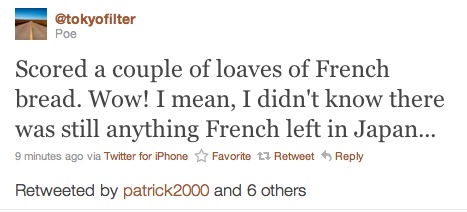
Is that like “Tosh.0”? Maybe the “N” is like n, a variable.
Out of the realm of language, I saw this recently:
In case you can’t make it out, that’s a crow’s nest–made almost entirely of clothes hangers. Talk about your city birds.
Finally, when we went to see War Horse, they were also showing Star Wars: Episode 1 (the 3-D version), and had loads of Star Wars gear. Aside from the R2D2 trash can (at more than $130, way too expensive), the only thing that appealed to me was, I thought, a very clever item: lightsaber chopsticks.
Each one was associated with a character, the handles modeled carefully after the ones in the movies. Note the handles on Dooku’s:
I was tempted to buy a pair, then I imagined how I’d look using them.
That’s Romney’s new line. Apparently he can’t pretend that a recovery isn’t happening–it is, however slowly, with job growth doing well enough and likely to continue until election day. Romney would lose if he said the economy was bad and yet people kept on getting hired. And it’s possible that his polling indicated that people still remember that Bush got us into all this, every effort of conservatives to blame Obama notwithstanding. If he tried to claim that Obama was the guy who caused the recession, a few simple charts would dispel that claim pretty fast, and again Romney would look the fool.
So now the strategy is to say that, OK, Obama may not have caused the recession, and OK, he may be overseeing a recovery–but it’s not a good enough recovery!
One problem: Republicans are more to blame for that than Obama. Obama may not have proposed the perfect stimulus, but he proposed something a lot better than what Republicans shaved it down to. And while Obama caved to Republicans far too quickly and often, that only belies the point that Republicans were driving us in the opposite direction. And when you think back over the past three years, you see Obama proposing various job and economic initiatives, while Republicans offered nothing. Their only “jobs” proposal was to do away with laws preventing corporations from polluting us half to death. If that’s too hard to express, then all Obama has to do is play the video of Republicans saying that their chief priority was to make Obama fail.
Romney is also trying to argue that “bureaucrats are insinuating themselves into every corner of the economy,” and regulators “are multiplying like the proverbial rabbits.” He also said that “this economy’s struggling because our government is too big, too intrusive, too invasive of our economic freedoms.” Which sounds nice and all, but is rather abstract–and Obama can react by showing that he has cut government jobs (more than a half million), even more than Reagan did. Kind of hard to argue Obama is for big government when he’s pushing to merge agencies and shrink government. And if Romney wants to argue that even with fewer government jobs, Obama is being too regulatory, All Obama has to do is point out that less regulation is a big part of what has caused a lot of the pain we’ve been suffering over the past several years.
Which leaves Romney with little else to say except, “I would have done a better job.” At which point, all Obama has to do is hold up Romney’s editorial about letting Detroit go bankrupt, and he doesn’t even have to hint at Bain Capital, people will remember–oh yeah, Romney’s the guy who likes to fire people. Really, Romney would be reduced to saying that Republicans in Congress won’t be so destructively obstructionist under a Republican president, which is a bit too much like a bully saying that if you pay him protection money, his boys will stop beating you up.
After that, all Romney has left is lies. A strategy he’s probably best at, and has really never left.
On his show a few weeks ago, Bill Maher defended Rush Limbaugh. Not what he said, nor of course Rush himself, but Rush’s right to say outrageous crap. Maher pointed out that he himself had been the victim of exactly such a national furor and subsequent sponsor pullout, and he didn’t like that. For all the vileness Rush spews, Maher reasons, Rush should have the freedom to say it.
Now, I don’t believe Limbaugh should be yanked off the air for his political opinions. However, at the same time, I find myself in full approval of the sponsor pullout, and I believe it is quite consistent with the basic principle Maher intends to promote–Maher was, I believe, simply not specific enough in defining that principle. Maher’s removal was wrong because he was pilloried for a political opinion on a forum intended to promote open and free discourse, not to mention the fact that his statement was misrepresented. Rush’s case has nothing to do with any of that.
My line of thought came from Limbaugh’s excuse for an apology. He tried to use his familiar dodges to avoid responsibility–I’m a pundit, I’m a satirist, I’m a comedian. He loves these dodges, revels in them like a kid pulling a fast one on his parents. When a columnist used the two words “Magic Negro” in the context of thoughtful analysis, Limbaugh jumped all over it; his show was practically non-stop about “Barack the Magic Negro” for a week or two. His dodge: a columnist said it in a respectable newspaper and didn’t get criticized for it, so I can use it all I want, in whatever context I want.
Limbaugh tried the same thing in defending what he said about Ms. Fluke. He attempted to create several contexts, in fact, in which it would be acceptable to say what he said. That’s how we judge things, by their context. So, why, to me, did Rush’s context, which even Bill Maher viewed as acceptable, not sound right? Was it simply because I am a liberal and didn’t like what he said? Sometimes that’s what it boils down to and I withhold my criticism, and I wondered if this is such a case.
So I considered what context there was, and as such, had to figure out first–what is Rush? He claims that he’s a comedian, that’s one of his favorite dodges. Conservatives even used Maher as a defense, noting that Maher had used some pretty ugly epithets about people like Sarah Palin in his act. If you’re a comedian, then you can get away with it.
But Rush isn’t a comedian. Comedians tell jokes. They have setups, they deliver punch lines. They record albums or do live specials or go on tour. Rush doesn’t do any of this. He has what could be called a “monologue,” but it’s not a comedian’s monologue–nothing like it. What he has is more like a tirade. Maher himself even commented on this, pointing out that Limbaugh cannot stand on a stage for an hour and make people laugh through it. He’s not a comedian.
So, what about satirist? Rush hinted at this by noting that he was indulging in the absurd, which is what a satirist does–to take a point made by others and extend it to a ridiculous extreme, thus pointing out its absurdity. But that’s also not what Rush was doing. His tirade on Fluke did not really have a point, not one based upon the issue in question, at least.
If you were to satirize the fact that an issue like contraception was given significance at the presidential level, the point Limbaugh claimed he was satirizing, you would do something like suggest that the president would next concern himself with smegma. Rush could have done at least a whole show on it, reporting that Obama had set up a week-long International Smegma Conference; that Democrats had “put smegma into every new law coming out”; that the U.N. had jumped on the bandwagon by issuing a resolution against smegma; that the animal rights activists has jumped on calling for Dog Smegma (a great name for a rock band, by the way) to be put on the agenda, with Obama immediately bowing to their will. He could pillory those he wanted to criticize on the right wing, talking about how they took the bait and came to the defense of smegma, and how religious groups were called to testify on the issue–all while nobody paid attention to the economy.
In short, Rush had a huge field of satire he could have engaged in–frankly, I would have found the whole smegma thing funny myself–and he could have worked in jabs against virtually every group he doesn’t like, making valid points about the political system. It was a gold mine of material he could have wallowed in.
But that is not what he did. Instead he went on a multi-day rant about how Ms. Fluke has non-stop sex, wants us to pay her for it, and should give us a sex tape for our tax dollars (which, by the way, were not involved). Focusing on a young woman who spoke on the importance of contraception and calling her a slut and a whore is not “satire.”
So that leaves pundit, which most people accept as the correct designation. But after reviewing what I’ve heard Limbaugh say over the years–including listening to his full show from time to time, much to my discomfort–I would challenge even that designation. Punditry is when you opine on political matters with at least a fair amount of knowledge on the subject, which is what it seems Rush is doing much of the time. However, Rush commonly ignores the facts of the matter; he is usually about invective and rage than fact and mere opinion. Rush is not a pundit. It is a part of what he does, but it does not suffice to describe all that he is. He does some punditry, some satire… but none of these are central to his theme. So, what is he?
One clue to that is something that kind of confused me (while also sickening me) some years ago, when Rush didn’t like something that Democratic Senator Daniel Inouye had said or done. I forget what the issue was, because it is not what stood out in Limbaugh’s rant. What stood out was the puerile name-calling. Throughout the show, whenever he spoke of the senator, he made a point to call him “Senator In No Way.” Now, say that once, and it’s a joke, albeit a weak pun. But one can understand the usage, at least. But Rush didn’t do that. He repeated it. Again, and again, and yet again. He went out of his way to use the name, In No Way, In No Way, In No Way, pausing for effect before each repetition, ad nauseam. That wasn’t comedy, satire, or punditry. It was similar to how Rush went off on his “Barack the Magic Negro” campaign. Neither was handled like a joke for comedic effect; instead, they were pounded home. You don’t do that with comedy or satire.
So it struck me what Limbaugh is. He is a demagogue. Now, this won’t surprise anyone, really. But it is relevant. Because not only is he a demagogue, but he is the worst kind of demagogue: he is a demagogue who builds political support by dehumanizing those he opposes.
That’s why I couldn’t understand why Limbaugh kept using “In No Way” far beyond any comical effect–I didn’t see what he was really doing. He wasn’t really doing commentary; what he says about the politics is just window dressing, it’s not important. That’s why most of the criticism of his lack of rationality misses the mark. Demagogues don’t give a crap about making sense.
Limbaugh must giggle every time his critics point out that birth control doesn’t work by taking more of it every time you have sex. That was completely irrelevant to what Limbaugh was saying. His thesis statement was not “this is how birth control pills work.” His thesis statement was, “this Fluke woman is not human, she’s a slut and a whore, so you can disregard anything she says.” It’s the same reason why Limbaugh went on about “Barack the Magic Negro”; it didn’t matter that Obama did not fit the fictional archetype, criticism to that effect again missed the mark. Limbaugh sang that song for a week or more because its effect would be to dehumanize Obama.
When Michael J. Fox spoke eloquently about the need for stem cell research, his tremors speaking as loud as his words, Rush did not speak about stem cells in the context of people who are suffering, but instead ridiculed him and tried to claim that he was faking the tremors, going off his meds–even mimicking the tremors on video. Limbaugh was not trying to make people laugh, he was not satirizing anyone, he wasn’t commenting on the issue: he was attacking the message bearer, trying to strip him of human decency and integrity.
This is what Limbaugh does. He demagogues, doing so by dehumanizing those who say things he does not like, people he wants to discredit. He scapegoats, telling you things you should believe you should feel victimized about, and then tells you who to blame for it.
This is not public discourse. This is not the statement of opinion. And since he is not in fact a satirist, he cannot justify the libel he spews as tools of his trade. Calling Fluke a slut and a prostitute crosses that line, not that a lawsuit would be unjustified or successful.
All that said, outside of actual libel, I still approve of Rush’s general freedom to speak, if he can sell it. But here’s the thing: he has the right to say it, but he has absolutely no guarantee that he can make money from it. Rush is no more entitled to a radio program than is anyone else. If he can support it, fine; if not, then also fine.
So the question becomes, is it OK to run a campaign to scare off his sponsors so that he can no longer support his radio show?
This is where the comparison to Bill Maher becomes apt. Maher was run off the air a decade ago because he noted the fact that Bush’s using the word “coward” to describe the 9/11 hijackers was incorrect. Maher was not respecting the hijackers, nor was he trying to demagogue. He was simply making an objective comment which had a salient point. The problem was, he said something that was easily misconstrued–he was stating, in reference to President Bush, that it is cowardly to attack someone by lobbing missiles at them from a safe distance. No reasonable person, knowing Maher and understanding the context, could take that as an attack on soldiers. But it was easily presented that way, which the demagogues of the day instantly jumped on, and Maher fell before the onslaught.
That was the principle: it is wrong to silence someone for airing a political opinion. Maher generalized too much when he defended Limbaugh, reacting perhaps viscerally to the idea of anyone being pulled off the air by scaring off sponsors. But it was not the method which was wrong, only the reason.
Rush’s case is virtually the opposite of Maher’s in a qualitative sense. Limbaugh was clearly attacking a person, and had no salient point in doing so. Nobody criticized his opinions on contraception, or where public attention was focused; the furor was about the vicious personal attack. He was not being objective, and what he said was not misconstrued in the least. It was not an “opinion” he was expressing. He was not engaging in “discourse.” And he was not taken down by demagogues. He was the demagogue.
And I have no problem trying to yank a demagogue off the air, particularly one whose bread and butter is to empower himself politically and financially by dehumanizing others, in particular when he goes over the line in doing exactly that.
Frankly, Limbaugh has been around for far too long. He is an overcooked ham, dry and foul. His legacy is that he was instrumental in polarizing our political system, making demagoguery the order of the day–and in so doing, he played no small part in bringing about the ruin from which we now suffer. Although he deserves the same rights and basic decency that any human deserves, despite his own savage disregard for the same in others, he has no entitlement to a national pulpit for it, and there is nothing wrong in recognizing this or acting on it.
It’s been a day and a half since I got the “New iPad” (which, hereafter, I will refer to as the “iPad 3,” as “New iPad” is subject to confusion). Unfortunately, that does not mean I have had much chance to play with it–I got it at 9:30 a.m. and immediately had to leave for work, which ran from about 11:00 to 8:00 yesterday. Today was our anniversary, so much of it was dinner and a show (much better, but not iPad-intensive, naturally!), much of the rest reserved for caring for Ponta and doing some work.
Nevertheless, I have already used it enough to get a few basic impressions.
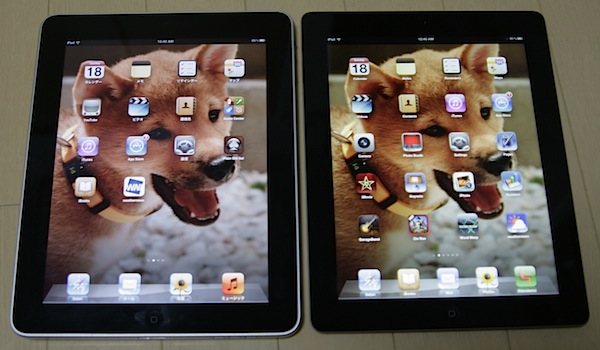
First of all, at least some of my comparison is based on two years of daily use of the first iPad, pictured above; I have barely even held an iPad 2 for more than a few seconds, so the design was fairly novel for me. The difference was immediately apparent in details like the bezel being far less visible. The iPad 3 comes across as noticeably thinner and lighter, something which an iPad 2 user will likely not feel at all. As you can see as well, the colors on the iPad 3 are more saturated; what does not show as well in the photo above is the fact that the iPad3 also comes across as having a brighter screen.
But what about the iPad 3 itself? How does it perform, especially in light of expectations? Well, let’s start with the negatives.
Maybe it’s just the first run before a full recharge, or perhaps it’s only the machine I got (or my prior iPad was exceptional), but my impression is that the battery life sucks. I was expecting a stronger battery, not a weaker one. I recharged it last night, and have only used it for a short time this morning, and already the battery’s down to 90%. My old iPad 1, even with all-day use, never got as low a battery reading as the iPad 3 got yesterday. Keep in mind that I am using the WiFi version, so there is no 3G or LTE to suck the battery dry. Nor was I using any graphics-intense software–just normal, everyday apps. I took a handful of photos and maybe ten seconds of video, and did not watch any video at all.
So, what the hell? I’ll keep my eye on this as I use the iPad daily, but if this keeps up, then maybe I should consider taking it to the Genius Bar at Ginza and asking for a replacement. I know people who get iPhones with the same issue–my iPhone lasts more than all day on a single charge, but others report that their batteries drain within a few hours of off-and-on use.
Next, Siri is a notable omission in the new tablet–for what reason I can only guess at. Maybe Apple’s servers are overloading, or they want to sell more iPhones, but there should be no reason that they leave Siri off of the iPad. Again, what the hell. They do have dictation, but I had to dig through preferences to figure out how to activate it–it is not on by default. It also needs a live WiFi connection to work, and that’s not always available. For example, I wanted to try it out in class yesterday to get a transcript of what I taught, but I was not able to get WiFi in the classroom.
When I was able to try it out, it was fairly good when I intended to make a transcription; I didn’t get a chance to test it out under natural conditions. However, I did try to use it to transcribe a video clip–I held it up to the speakers on my Mac as an interview played.
Did it work? No, not really. At least, not at a practical level. Even not counting the lack of punctuation (you can speak it to make it appear, though), the transcription was pretty bad, requiring a ton of correction. Not as bad as transcribing by hand, but not a whole bunch better, either.
Another problem: the transcription only works in 40-second chunks, and does not reveal in real time. So, when you are transcribing, you see nothing but a blank screen, and then after two-thirds of a minute, it snaps off, waits for a few seconds, then shows what it got.
40 seconds in not nearly enough for most transcription needs; to do anything meaningful, you’ll be needing to constantly be stopping as you get interrupted by the end of the time limit (they could at least include a countdown!), then having to restart when you activate it, and then go back and edit out the sentences which were cut off. Certainly, this will be useless for transcribing stuff like class lectures. Currently, I can’t think of any use for it considering the time limit.
Finally, that hot corner everyone has been talking about? It’s for real, all right. Yesterday, in fact, it felt like a good half of the unit was warming up. It’ll be great in winter, but I can imagine getting sweaty palms in summer.
Okay, that’s the bad news. Now for the good stuff.
The hardware is definitely far better… than the iPad 1’s. Again, I have no iPad 2 experience to reference against. However, I have one game (Civ Rev) that gets stuttery at times on my old pad, and almost goes too fast on the new one. The speed bump–and maybe the 1 GB of RAM (compared to the iPad 1’s 256 MB)–is immediately noticeable to be. I am even considering dropping six bucks or so on one of those HD-graphics games, just to see what it looks like…
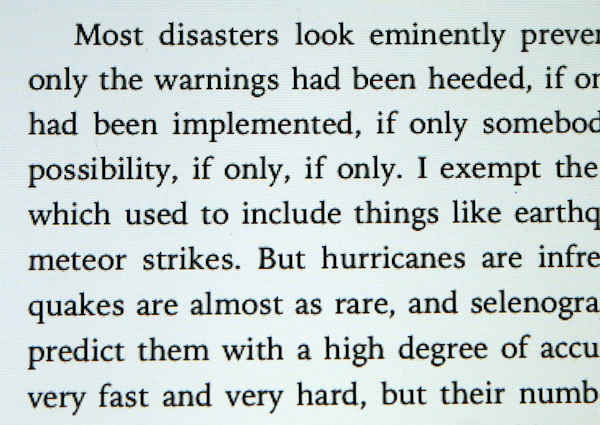
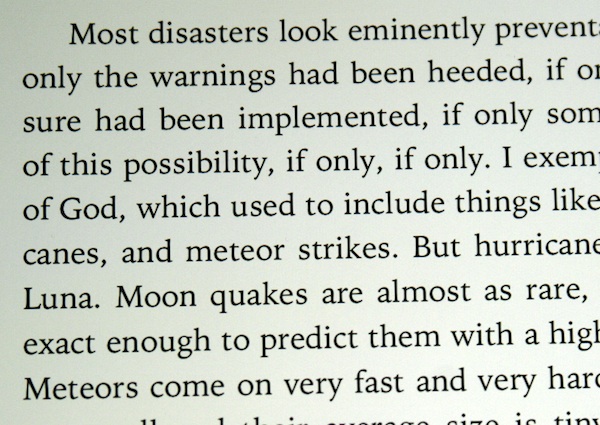
The screen is indeed really, really good. I don’t necessarily agree with the reviews saying it is “awesome” or “eye-popping,” but it is definitely noticeable, and is noticeably improved. Here are some photographs of the two screens, taken with my digital SLR, showing the difference as well as I can represent it.
First, here’s an icon–and immediately you can see a huge difference:
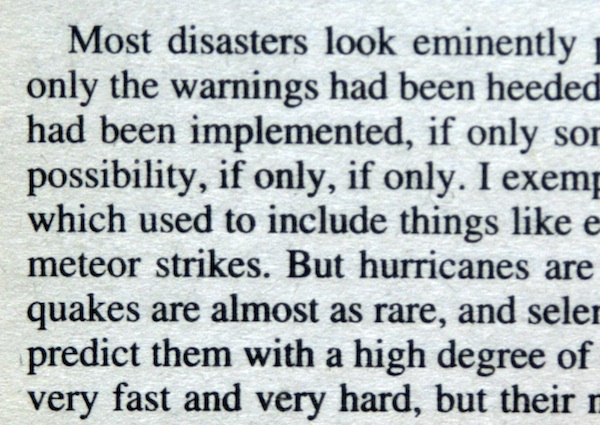
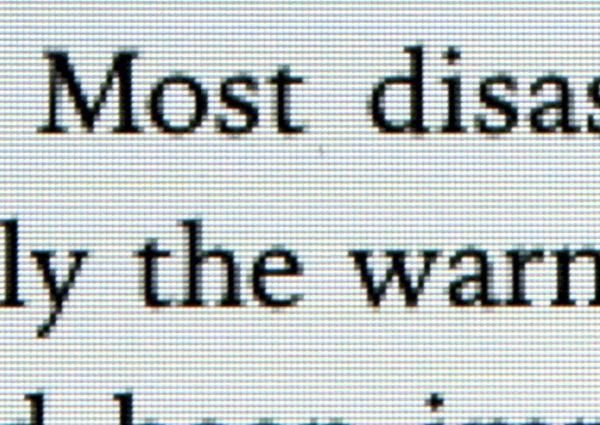
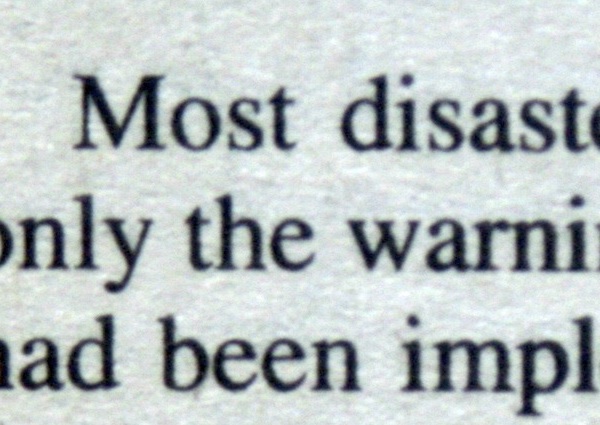
Text in iBooks is remarkably more clear; for fun, I even added the same text from the same book in its paper form:
The iPad 3 gives even a paper book a run for its money in terms of clarity and readability; only those who, for whatever reason, cannot tolerate a backlit screen will not find the iPad 3 a reasonable replacement. Here is a closer look:
Note that in the extreme closeup of the iPad 3, the pixels begin to become visible–but this is only due to the camera’s detail. Unless you have excellent vision, chances are you’ll see no more than the barest hint of pixels, and that only by bringing it right up to your face and straining a bit.
Here are comparisons with video, in this case, using the trailer from “Brave”
To be fair, the iPad 1 images use the 720p trailer, while the iPad 3 images use the 1080p version–but this is fair, since the iPad 1 cannot even load 1080p video (I tried), and 720p on the iPad 3 is less meaningful considering the available resolution.
One downside to the new screen: old stuff looks worse than before. While text in old apps displays sharply, and some graphics get smoothed out, some apps show marked pixellation when used full-screen. As someone noted, it’s kind of like watching old standard-definition TV shows on a new HD TV–the old stuff, which looked nice and sharp on an older TV, now looks really bad, as if it’s all out of focus. The effect is not quite as pronounced on the iPad, but it’s certainly something that stands out.
Other than that, everything about the new tablet feels excellent. Now that I have enough RAM to run it, iCloud works for me and is running on all my devices, finally. I don’t have to shut down and start up the device under iOS 5 like I did my old pad. As I mentioned above, the iPad 3’s screen comes across as brighter as well, with more saturated colors and slightly better contrasts. Compared to the iPad 1, the iPad 3’s look and feel are much superior–though the beveled edges take a bit of getting used to–it feels a bit like it’ll slip out of my fingers sometimes.
Overall, I am quite pleased, but hope that the down points will be helped over time. Maybe my battery’s performance will improve, maybe Apple will improve the dictation feature or even enable Siri, and possibly Apple will update the iOS to cool down that corner a tad. We’ll see.
In the meantime, I look forward to using the iPad 3 in earnest.
I’ll get to the new iPad review soon, but before that, I just wanted to say a few things about Apple and Foxconn.
It turns out, according to new reports today, that most of the outrageous abuses people have believed about Apple have been largely fabricated.
Now, over the past several months, there has been a great deal of attention focused on Foxconn, a contractor for many electronics firms, including Apple. It started with what was reported to be a cluster of suicides a few years ago. People were outraged; surely this was a result of oppressive conditions at the plant, an impression fueled by the general image of Asian factories being inhumane sweatshops with workplace conditions right out of the industrial-revolution era.
Added to that was a case of “Apple Outrage,” generally resentment from detractors of Apple, who, annoyed by the computer giant’s good press, enjoy jumping on any of its faults. The story was further driven by a media which loved the ironic contrast of the popular consumer-friendly company, run by a supposedly spiritually-tuned Steve Jobs, hiding potentially dark, cruel secrets.
In short, it got attention. At the time, the suicide “cluster” was more easily explained; on the story, I wrote:
Since then, there has been a lot of focus on Foxconn and suicides. Many are reporting a “cluster” of suicides, insinuating that Apple’s secretive nature is somehow linked to an oppressive work environment at the contractor. Note this Huffington Post article titled “Apple Supplier Foxconn Reports Eighth Suicide THIS YEAR,” with “THIS YEAR” in all caps, as if it is a shocking number. That sets the tone for the article, which, typical for articles like this, otherwise insinuates a shadowy, oppressive, iron-fisted horror chamber with Apple somehow tied in.
Terrible, right? Apple’s policies are killing these poor, oppressed workers, we’re led to believe. Except that, as stated above, Apple is just one of their clients; why put “Apple Supplier” at the start of the headline? And in fact, instead of the suicides being a sign of terrible stress, the opposite may actually be true. A few more responsible writers actually looked at the larger context and applied the Chinese national suicide rate–13.0 per 100,000 for men, 14.9 for women–and found that for the 300,000 workers at Foxconn’s Shenzhen plant, there should be between 39 and 43 suicides per year. So by now, by mid-year, we should have seen about 20 suicides at the plant so far. Instead there have been 8. In that context, one can hardly make an argument about workers being horribly oppressed.
So the attention is not new–but it did flare recently. One thing that made it flare up were visuals–Foxconn installed nets to deter people from jumping off the tops of buildings, adding to the false impression that it was practically raining employees. More irony, with art this time–the media loved it.
But another thing that made people irate were the reports of horrible abuses. There’s a guy named Mike Daisey who does a stage show called The Agony and the Ecstasy of Steve Jobs, who re-ignited the controversy by reporting on his trip to China, where he claims to have met with workers and saw first-hand the crippling effects of employer abuse–this is from Ed Schultz’s show:
SCHULTZ: We are joined tonight Mike Daisey. Great to have you with us. His monologue called “The Agony and The Ecstasy of Steve Jobs.” And it’s performed at the public theater in New York City. For 18 months you have been doing this, 19 cities across the world. First of all, I’m intrigued, congratulations. I have not seen your performance, but you come to us tonight with absolute rave reviews. I’ve talked to people who have seen you. And you just sit down at the desk and you tell it like it is about what you saw in China. And I’m intrigued what motivated you to do that?
DAISEY: I have always loved technology. I have loved Apple, actually. I loved the devices. And I knew a lot about them, because I’m kind of a tech geek that way. I realized on day that I didn’t actually know — I knew how to take my computer apart, but I didn’t know how it had actually been made. And I started researching it. And a lot of these stories that are coming out now, human rights groups have been reporting on them for the better part of a decade. So none of this is actually controversial. This is actually how things are done across the electronics industry. So I felt compelled to go to China and actually dig in the story.
SCHULTZ: And you went there in 2010, correct?
DAISEY: Yes.
SCHULTZ: OK. What did you see?
DAISEY: I saw all the things that everyone has been reporting on. I saw under-age workers. I talked to workers who were 13, 14, 15 years old. I met people whose hands have been destroyed from doing the same motion again and again on the line, carpal tunnel on a scale we can hardly imagine.
SCHULTZ: Making Apple products?
DAISEY: Yes. And making products across the electronics industry. All our electronics are made in this fashion.
…
SCHULTZ: What do these people get paid in China to do this? What does Apple pay them? I mean, this is all about cheap labor, isn’t it?
DAISEY: It is. Cheap labor is the engine that fuels this entire enterprise. It should be said that there is a different standard of living. And it’s one of the reasons that all this industry goes to the area. That said, it’s still true that the amount people are being paid is low enough that they feel like they need to work that incredibly excessive amount of overtime. And then they’re practically required to do it until they drive themselves into the ground.
Daisey went all over the media, spreading this story. Telling people about how workers were being crippled regularly because of the unsafe conditions, driven into the ground by forced shifts lasting more than a day. He told of one worker who, while Daisey was in China, worked a 34 hour shift until he died. He painted a picture where people were being driven to kill themselves over the horrific conditions.
This created a furor, sparking protests against Apple. However, it didn’t exactly ring true to me, mostly for the same reason the suicide story did not. I not only remembered that, but I also remember two times in my own experience where there were union actions against different places where I worked, and the claims made by disgruntled workers were, for the most part, a concoction of wild accusations, specious rumors, and speculation based upon the worst imagined conditions, but then expressed as the gospel truth. The kernel of truth tends to get buried beneath all of the hyperbole. So I know that things can get distorted even more than Steve Jobs himself was capable of.
In addition, Apple has not been–contrary to rumor–either complicit in nor apathetic about such matters. For years, Apple has performed their own checks on contractors to make sure they are not committing worker abuses, and they have made these reports public, even though they are often used to unfairly vilify Apple.
This also irritated me about Daisey’s claims–he said that he was glad that Apple is “actually starting to react,” when it had been working to stem any such abuses for years, a fact Daisey either didn’t know about or didn’t care to look up.
When a co-worker brought up these issues with me and asked my opinion (knowing my affinity for Apple products), I said what I felt: that probably Apple was taking advantage of cheap labor and that the workload and conditions would be ones we ourselves would not enjoy… but that most of the accusations being made were likely not true. I figured that this guy Daisey was predisposed to believe the worst, took at face value everything that he was told–and then exaggerated further for effect, being so passionate about it.
What I did not know is what was just revealed by a journalist, who, with the producer of This American Life, confronted Daisey on his reports. The show that broadcast Daisey’s account has now retracted their episode because Daisey was making most of this crap up:
Cathy Lee, Daisey’s translator in Shenzhen, was with Daisey at this meeting in Shenzhen. I met her in the exact place she took Daisey—the gates of Foxconn. So I asked her: “Did you meet people who fit this description?”
“No,” she said.
“So there was nobody who said they were poisoned by hexane?” I continued.
Lee’s answer was the same: “No. Nobody mentioned the Hexane.”
I pressed Cathy to confirm other key details that Daisey reported. Did the guards have guns when you came here with Mike Daisey? With each question I got the same answer from Lee. “No,” or “This is not true.”
Daisey claims he met underage workers at Foxconn. He says he talked to a man whose hand was twisted into a claw from making iPads. He describes visiting factory dorm rooms with beds stacked to the ceiling. But Cathy says none of this happened.
When confronted with all of this, Daisey pulled a Limbaugh, claiming to be an entertainer and not a journalist:
“Look. I’m not going to say that I didn’t take a few shortcuts in my passion to be heard. But I stand behind the work,” Daisey said. “My mistake, the mistake I truly regret, is that I had it on your show as journalism. And it’s not journalism. It’s theater.”
Yes, I am sure that he regrets it now that he is completely disgraced. I am sure that he did not make the rather cold calculation that if he presented it as “theater,” then he would not have received a millionth of the attention that he did.
And I am sure we can take him at his word now, when he tells us that he “stands behind his work.” A galling claim, considering how much he lied, and in the midst of that lying, he accused Apple of dishonestly influencing a labor group who were investigating the Foxconn plant.
Worse, calling it “theater” when he made the direct claim, on news shows, not at all “in character,” after having been introduced as “telling it like it is,” as a factual report of what he personally saw… that’s not theater, that is out-and-out fraud.
How did he defend that? Like this:
Rob Schmitz: Cathy says you did not talk to workers who were poisoned with hexane.
Mike Daisey: That’s correct.
RS: So you lied about that? That wasn’t what you saw?
MD: I wouldn’t express it that way.
RS: How would you express it?
MD: I would say that I wanted to tell a story that captured the totality of my trip.
Ira Glass: Did you meet workers like that? Or did you just read about the issue?
MD: I met workers in, um, Hong Kong, going to Apple protests who had not been poisoned by hexane but had known people who had been, and it was a constant conversation among those workers.
IG: So you didn’t meet an actual worker who’d been poisoned by hexane.
MD: That’s correct.
So he meets some disgruntled workers who tell second-hand tales about people they heard about who were poisoned by chemicals, and believes that it is OK to represent this by telling that he himself saw these people firsthand.
Frankly, Apple should sue the crap out of this liar and give every penny he dishonestly earned spreading those lies to Foxconn employees.
Because, in the end, this is not about Apple using Foxconn workers for they enrichment–it was Daisey who was doing exactly that. He used them to sell his one-man show, to gain fame and fortune.
Once again, this does not mean that there are none or never have been any abuses. There may be–but we don’t know. Apple may be bullshitting us as badly as Daisey was–but we have no evidence to support that. Workers at Foxconn may be abused and oppressed–but we have nothing but rumors, mostly now discredited thanks to Daisey, to back up that suspicion.
Foxconn could just as well be what they present themselves as being–an above-average workplace for China, treating its workers as well as can be expected, in conditions that the workers find appealing enough to apply for jobs in massive numbers. Again, we just don’t know for sure. There’s no convincing evidence either way.
By the way, it came… I just haven’t had much time to do much with it yet (it came just before I left for work). Still, I was able to get the basics set up.
Quick impressions: battery seems to be going faster than I expected, maybe a bit faster than the old one… The thing does in fact warm up around the edge… The dictation feature was not turned on when I got it and I had to figure that out….
But: the screen is indeed excellent (though I can easily see myself getting so used to it that I’ll take it for granted), and the camera seems to work very well (though it is kind of ‘zoomed in,’ especially in video mode). And most of all, it’s snappy as hell. Very nice after limping along on the 2-year-old iPad 1.
When I woke up a few minutes ago, I had a vague feeling there might have been a quake during the night. Turns out there had been–a 5.2, in fact, centered just 17 km, barely over ten miles to the north of us. Sachi said that it was pretty scary, but all I did was check the time on my iPad (it was 4:20 a.m.) and fell right back to sleep.
I ordered one of the new iPads (32 GB WiFi model) early in the morning Japan time after it was announced, and from March 10 I got tracking info from Yamato Takkyubin that the package had been registered in China (and left China on the 13th). After a few days of no movement, suddenly this showed up:
The “ADSC” is apparently the “Apple Delivery Support Center” in Shinagawa (not far from here in Tokyo), which the tracking page claims the unit left at the same time it arrived. Not that it’s out for delivery–Apple undoubtedly has strict orders that nothing is delivered until 8 am tomorrow morning (late afternoon on the 15th, U.S. time), but at least I know that it’s in town and ready to go. So it’s probably headed for a local distribution node to stand by for delivery tomorrow.
I will be slightly peeved if it doesn’t get to me before I leave for work; usually I get woken up by deliveries I don’t care about one way or the other. To have this one be late would be a tad annoying.
Gingrich claims he can bring the price of gas down to $2.50 a gallon.
Experts say that this is only possible if oil prices drop from $126 a barrel to $50 a barrel.
The experts also say that “Only a depression would bring oil prices down that much.”
Gingrich claims that he can achieve this through drilling, but the experts retort that it just ain’t so–no amount of drilling in the U.S. can move the oil markets that much.
So, either Gingrich is lying, or he’s planning to crash the world economy. Frankly, I think he’s lying, and would unintentionally crash the world economy. But that’s just me.
Last year, it was a Friday, and like today, we were emerging from winter, still cold but warming. I was at school, on the 6th floor of my college’s building with other faculty members, preparing for my afternoon classes.
When the quake started at 2:46 pm, we felt a slight shaking. It was so similar to quakes commonly felt–Tokyo gets them all the time–we simply noted it at a level where we wondered whether or not to even say anything, to note, “hey, there’s a quake.”
This is also where you stop what you’re doing and pause, knowing that it could get bigger. And it did.
After a few seconds, the quake intensified to the level where we thought, “Wow, this one is a bit bigger than we normally feel.” Again, we felt it was nothing big, but at the same time, remained paused and alert should it grow.
And it did. By the third increase, we were all beginning to fear that this was a large one. I think somebody said that, something like “this could be big!”; it might even have been me, I don’t remember.
I think it was about at the time of the fourth surge that we got the distinct impression that it was big. A free-standing divider wall started shaking more than we’d seen it in even the strongest quakes. Things we’d never seen move before started moving.
And then it got intense. Books and stacks of paper started shifting across desks and shelves. You could hear the structure of the building beginning to complain. Furniture on casters, like chairs and the copy machine, started moving around. People started to scramble for cover, moving under desks; I got under a desk chair well myself.
And then we hit the strongest stage. Things started flying around; desk drawers flew open. Most items on the desks were dumped onto the floor. Under the desk, I re-evaluated the wisdom of being there as the damn thing kept moving back and forth, in the process banging the side of my head every beat of the quake.
It was at this point that everyone started to fear that the building itself would collapse. We were all thinking, “this is the big one.” However, I remember also realizing at the time that if it had been centered in Tokyo, or nearby, it would likely by more vertical in the shaking, and probably would not build as slowly as it did. It struck me that, as bad as this was, we were not even close to the epicenter. And yet, this was a huge quake, stronger than anything I’d ever felt–and I lived all of my life in either the San Francisco Bay Area, a few miles from the San Andreas fault line, or in Tokyo, near the convergence of four major tectonic plates (North American, Eurasian, Filipino, and Pacific).
A geologist who lectured on the event at LCJ later told me that the quake was actually a series of events, each one triggered by the last, this being the reason for the stages of intensification, rather than all the force hitting at once.
Eventually, after what seemed like five minutes but was more likely two or three, the quake started dying down. We came out from our hiding places and it began to sink in what had happened. The office looked exactly like this:
We evaluated and then acted. After something this big, we knew we could not stay in the building. We had no idea if an aftershock could send the structure tumbling down or not. After taking a few photos like the one above, I started going down through the building, telling people to make their way down to the street, where we’d organize and move to an evacuation area. When I got to the library, it was a mess. Books were literal everywhere. Thanks to the librarian’s foresight in having special braces on the stacks, however, none of them had fallen, and our students were spared injury from that, at least.
We got down to the street, really unprepared for what was going on. Few thought to bring their things with them, and some were without sufficient layers in the still chilly air. Everyone was outside chatting, people trying to figure out what happened, speculating on where the earthquake had been centered. Phones were out, but 3G Internet connections were still going (they slowed after the quake, but never stopped), and within a 10-15 minutes, we started seeing reports on news services, reporting a 7.9 quake.
We were hardly the only ones outside. Everyone was. I never knew, for example, how many dogs lived in the area, but walking around, you could see all the tenants of local buildings, gathered with family and pets. Workers from all nearby offices wandered around or clustered together.
Aftershocks hit frequently. There was a 40-story high-rise under construction nearby, still with four cranes at the top of the building, each with a crow’s nest control booth. We could still see them swaying widely. I can only imagine what it must have felt like to be in one of those when the quake hit. It must have been a nightmare.
There was surprisingly little damage. A few ceramic roof tiles falling to the street and breaking was as bad as it got in most places. The worst I saw that whole day was near the evacuation center, where a retaining wall for a temple and cemetery broke and spilled earth down on to the street below.
We eventually migrated to a nearby school yard designated as a post-disaster gathering place. We had established the fact that no one was hurt in the actual quake–very few were in Tokyo, surprisingly. Students began grouping and talking. I remember one student mentioning that they had family up in Tohoku, where by this time we knew the quake had struck. He was worried about them, worried about a tsunami. I believe that was our student from Ishinomaki, one of the towns most devastated by the tsunami.
After an hour or two, it was apparent that everything was under control. The staff were organizing what to do, and most teachers had no way home and were set to stay with the students in the same situation. Some students were already filtering out, especially those who lived not far away. Others had gone to local train stations and had come back–the lines were out and not likely to start running anytime soon.
Two to three million people commute into Tokyo every day, and now they had nothing but their feet to take them back. Good luck getting a taxi. I don’t even know if buses were running, but if they were (traffic was actually rather normal), they were bound to be overflowing.
I was in a special situation. Usually, I take the train like everyone else, as I have since we moved out to West Tokyo. However, that day, by pure chance, I had my scooter. I needed to get some documents from city hall for our house purchase, and I had decided on the spur of the moment to use my scooter and pick up the documents on the way.
Luckily, while everyone was being taken to the evacuation area, I decided to go to a gas station and fill up. I say it was lucky because after that afternoon, gas became incredibly scarce (due to refinery fires and broken distribution lines). When I got to the gas station–an expensive one, being in downtown Shinjuku–business was surprisingly light. I was even more surprised that the gas station was still operating after such a huge quake. I filled up my tank–the last gas I would be able to get for another two weeks.
However, after everything was getting squared away, I was beginning to worry about Sachi. Phones were out, and I could not get in touch with her by text messaging. I felt guilty leaving the school and the students, and stuck around for as long as I felt I could be useful, but eventually, could not take it any more. People were already striking out to walk home–some of them 5-15 kilometers away–and enough faculty and staff were staying on that there would be no lack of supervision. As everyone prepared to head back to the school for shelter for the oncoming evening, I took my scooter and headed home, traveling with a regularity few enjoyed that day.
Traffic was normal, and damage along the way was very hard to notice. Some emergency vehicles were out and about, but on my way home, things looked surprisingly normal. I got home, and Sachi was OK. Nothing was damaged. Later that day, I rode my bicycle to the house we would later buy, and it all checked out–no damage there, either.
So we watched the news, and learned of the tsunami, and learned of Fukushima. There is a gravity to such things as they unfold, a terrifying slowness, a feeling of falling, out of control, and nothing to do but watch. We saw the eastern coastal cities washed under water, we saw the buildings at the nuclear plant literally explode. We began to study wind patterns and find web sites to monitor radiation levels.
With Fukushima, everything was clouded by politics and secrecy. Neither TEPCO nor the Japanese government were telling the public what they needed to know. People in the nuclear industry reported that things were not nearly as bad as they were. People in the anti-nuclear realm regularly forecast major disasters, some saying that it was inevitable that much of Honshu would be uninhabitable. You feared the worst, hoped for the best.
The people hardest hit were in fact in the path of the tsunami. At least 20,000 people died. Entire towns were wiped out, erased with a graceless swath of ocean. It will take years before anything like normalcy will return for most of them. They still need help today.
Distribution lines were cut, suppliers temporarily out of business. Instant noodles, toilet paper, and batteries disappeared the most quickly, but for at least 10 days, half the shelves at most markets were empty. You could get food well enough, but at that point, we weren’t sure how long any of this would last, so there was some insecurity. Bread, milk, and other perishable goods returned to market shelves in Tokyo after a little less than two weeks. Some brands and products never returned, making us wonder why they didn’t.
My school shut down operations, switching to online mode, with teachers handling students from a distance. Aftershocks, large ones, hit regularly. In the days following the quake, they hit every hour or two, or so it seemed.
Fukushima, however, overshadowed everything. The tsunami, as terrible as it was, was over; the plight of those who had lost everything was drowned out by the drama of the nuclear power plants.
Foreign media and governments tended to react badly, If the Japanese government played their cards too closely, the foreign reaction was the equivalent of a meltdown on its own. TV reporters tried to sensationalize everything, suggesting that Tokyo was gripped by panic and fear. People were “evacuating” the capital city, and the streets were deserted by a fearful populace.
The truth, however, was far from that. The only people I saw panicking were some foreign residents, primarily the ones who paid too full heed to the alarmists warning that Japan was effectively a death trap waiting to explode. Most Japanese people I knew took the whole thing as calmly as you could expect anyone to. People were uneasy, but there was nothing much anyone could do about it, so life went on. The empty streets reporters highlighted as evidence of panic were in fact empty because businesses were shut down and trains were not running regularly. Expecting people to mill around as usual in a downtown area which had been more or less shut down was a ridiculous proposition at best.
Because of the sensationalist hair-on-fire attitude of the foreign media, a lot of people left, many never to return. Many of the rest of us who stayed were less than respectful, I will admit. One person I knew, who commonly freaked out at things like the health hazards of WiFi base stations, left Tokyo for good out of fear of the radiation–and relocated, in all places, to Poland. This person had roots there, but I am not sure if they were aware that Chernobyl was not far away and probably represented just as serious a radiation threat as Fukushima did to Tokyo.
Foreign reporters covering the tsunami would either stay in Tokyo to avoid traveling anywhere near Fukushima, or else would take incredibly circuitous routes to get around the radiation plumes–apparently unaware that their flight to Japan exposed them to more radiation than they could possibly be exposed to by anything less than being close up and personal with the nuclear plant itself.
It’s a year later, and while Fukushima is pretty much screwed, we seem to be doing just fine here in Tokyo.
As I said, the victims of the tsunami were the ones who actually deserved the attention. And far from running around in a panic, they held up as gallantly and as well as one could hope. Here’s an excellent example of a man coming out of his ruined house, in the midst of a destroyed town. At age 72, he looked out cheerfully and said, “Let’s rebuild again!”
That was more like how Japan reacted.
A year on, the region is still devastated, but people are resilient. Life goes on. You want to see how things have happened, see if you can catch this movie, Pray for Japan, which documents what happened in Ishinomaki. That town, by chance, is where one of my college’s students came from, and which my school has focused on helping since then.
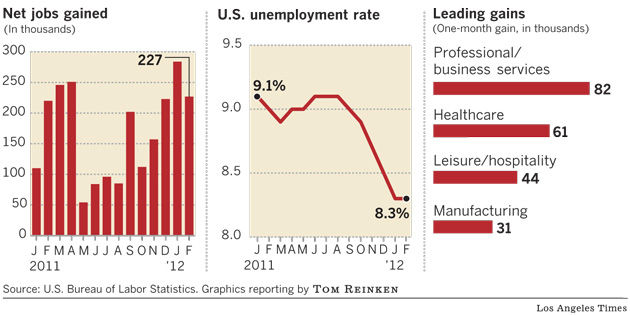
The jobs report is out, and it’s great news: solid growth for the third straight month in a row. Krugman:
OK, definitely a better jobs report than we have become used to. And terrific news for Obama; another six months of news like this and he’ll be in very good shape for reelection.
Krugman goes on to warn that we’ll need a lot more of this–31 months at this level or better to get to “full employment”–but still, the current news is good. A look at recent economic news shows this up:
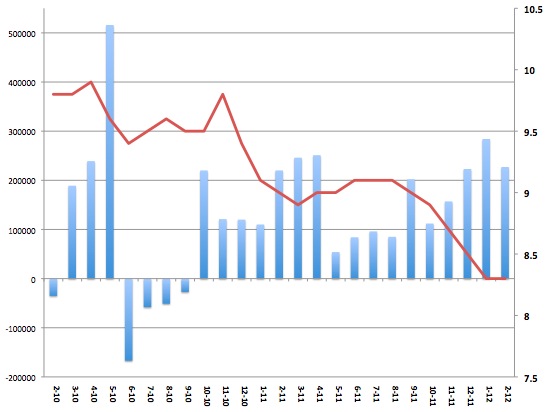
The job growth is, at least currently, getting better month-by-month; the trend since a year ago is for more jobs created every month, and if it continues, we’ll be seeing better and better job reports as time goes on.
Fox News, of course, was first out of the gate to paint all this as bad news. Amongst all the good news, they point to the unemployment rate standing still for a single month, and claim that “unemployment is not likely to fall much further and may rise again.”
There’s a reason why they are always pointing out unemployment in particular: talking points. The Republican strategy to deflect good economic news and to try to push the economy’s head underwater–which they have been trying to do since Obama took office–currently is focused on touting unemployment, primarily because it’s the easiest thing to make look bad. They start by ignoring the fact that unemployment rocketed from 4.8% to 8.2% (a 3.4% gain) in Bush’s last year in office, and instead make huge noises about how Obama unforgivably drove the unemployment rate up from 8.2% to 10%–despite that being a far lesser increase (1.8%) than under Bush. Forget the past, they argue; it’s no longer relevant.
They therefore come to the specious conclusion that Obama was responsible for unemployment going to 10%. It is completely false because, as I have pointed out several times before, the unemployment rate is a lagging indicator, meaning that it shows what happened three quarters–nine months–earlier. Meaning that the unemployment rate reflecting what Obama started doing the moment he walked into the Oval Office was not in January 2009, but in October 2009–meaning that the real rate when Obama started was 10%–at its peak.
That, of course, means that Bush drove it up from 4.8 to 10%–more than doubling unemployment–and that Obama, far from driving it up, stopped it cold and drove it back down to 8.3%, a decrease of almost two percent. That is the actual assessment of what happened.
Now, keep that in mind when you look at the above charts. Then consider Fox’s claim that a one-month stall means it will never go down again and may in fact rise–and let’s see if we can debunk that. If unemployment is a lagging indicator, that means we should look back nine months to see what was happening, and… whoa, look at that. About nine months ago, job growth stalled. Whaddaya know.
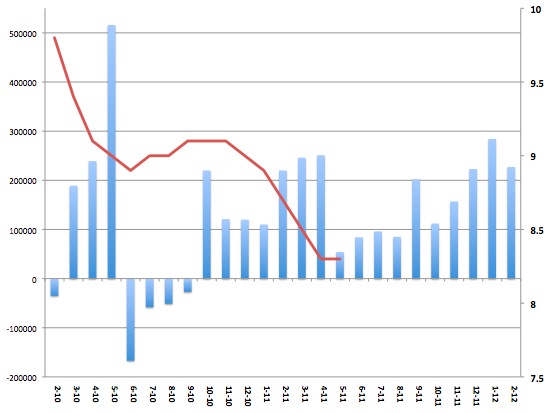
Doesn’t seem to line up, does it? But then, it hasn’t been adjusted to reflect reality–remember the nine-month lag? Look what happens when we move the unemployment data back nine months:
Well, look at that–the rate falls when jobs are added, and the rate rises when jobs are lost. The current stall reflects the fact that new jobs stalled nine months ago.
Who’da thunk?
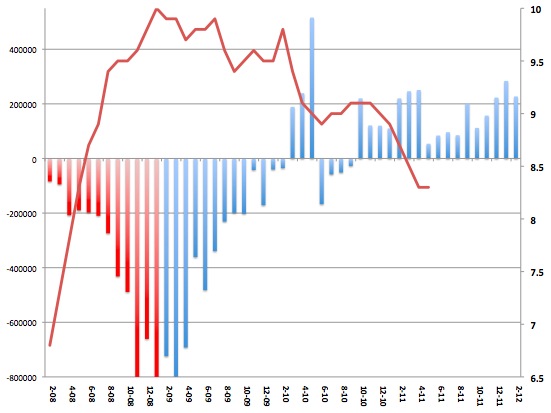
How does this work over the long run, though? Fairly well, as it turns out:
The bad news for Obama is that, for the next 4-6 months, unemployment will not be so hot–it may drop a point or two over the next 4-6 months (numbers might show a drop in June or July more than other months), but may not really start to change again until just before the election–which is the good news for Obama. The rate should start dropping regularly come September, when we see the numbers for August.
Based on nothing but a guess, I would say that the unemployment rate will probably be between 7.6% and 7.8% come November. The last three months, all good gainers, will show up in the unemployment rate in the three months leading up to election day. Not stellar, certainly the recovery is slow, but definitely pointing to a recovery. If Obama gets re-elected, then he’ll almost certainly surf the recovery back up, to the outrage of the right wing–who will find a way to claim it was all to their own credit. If Democrats are able to hang on to the Senate and get back the House, it’ll be a disaster for the Republicans, who will be in the back seat when the recovery starts gaining steam.
So, let’s see how I do against Fox News. Who do you think will be better at predicting the economic future–a major news network claiming expertise, or a nobody like me with zero Econ training?
So, Rush Limbaugh realizes that he stepped over a line, and instead of attacking his critics as he usually does when he’s guilty of something, he does the reasonable thing, and apologizes. Or, I should say, he “apologizes.”
This is the kind of situation where you see what a person is made of; whether they are truly penitent and seeking to right a wrong, or if they are just reluctantly taking back something they fully meant, and still mean, and are not really taking any true responsibility for it.
A real apology should hurt. It should hurt you more than it hurt the person you insulted in the first place. It should be unequivocal, should accept full responsibility, and should not include self-exculpatory language. Most of all, it should not continue the attack on one’s critics or be a platform to expound your views.
Here’s Limbaugh’s statement:
For over 20 years, I have illustrated the absurd with absurdity, three hours a day, five days a week. In this instance, I chose the wrong words in my analogy of the situation. I did not mean a personal attack on Ms. Fluke.
I think it is absolutely absurd that during these very serious political times, we are discussing personal sexual recreational activities before members of Congress. I personally do not agree that American citizens should pay for these social activities. What happened to personal responsibility and accountability? Where do we draw the line? If this is accepted as the norm, what will follow? Will we be debating if taxpayers should pay for new sneakers for all students that are interested in running to keep fit?In my monologue, I posited that it is not our business whatsoever to know what is going on in anyone’s bedroom nor do I think it is a topic that should reach a Presidential level.
My choice of words was not the best, and in the attempt to be humorous, I created a national stir. I sincerely apologize to Ms. Fluke for the insulting word choices.
Right off, we see that the middle paragraph has absolutely nothing to do with an apology. I teach academic writing; when I see a student spend a whole paragraph writing about something which does not support the thesis (in this case, “I was wrong and I am sorry”), I tell them to strike the paragraph. Limbaugh should have done that here; it means that most of his statement is not, indeed, an apology. Reading the paragraph, you can in fact see that he is re-stating his disagreement with Fluke, and saying that he thinks what she did was wrong. That’s not just off-topic, that’s contradictory.
What remains is equivocal and self-exculpatory at best. “I chose the wrong words, did not mean a personal attack, my choice of words was not the best.”
What does it say about the college co-ed [Sandra] Fluke, who goes before a congressional committee and essentially says she must be paid to have sex? What does that make her? It makes her a slut, right? It makes her a prostitute. She wants to be paid to have sex. She’s having so much sex she can’t afford the contraception. She wants you and me and the taxpayers to pay her to have sex. What does that make us? We’re the pimps — the johns. No, that’s right — pimp is not the right word.
After that, he said:
OK, so she’s not a slut, she’s round-heeled. I take it back.
That’s not a personal attack? Sure sounds like one to me. He’s not discussing the absurdity of this being an issue discussed at the presidential level; he was calling this woman a slut and a whore. He was not saying it in the context of, “hey, I’m just kidding.” He may have been lunging into the absurd, but it was expressed as a heartfelt insult which he did not step back from. Quote the opposite.
If we’re going to have to pay for this — then we want something in return, Ms. Fluke, and that would be the videos of all this sex posted online so we can see what we’re getting for our money. …
Now what did I say? I said if we’re paying for this, it makes these women sluts, prostitutes. What else could it be? We are buying it.
So, for two straight days, in the face of a storm of criticism, he continued to call Ms. Fluke a slut and a whore. Then he added that she should publish a sex tape so we could all enjoy it. So much for “not meaning a personal attack.”
As for the rest, Limbaugh was suggesting it was an instance of poor “word choice”–but even that is not an apology, because he is clearly saying that he intended the meaning, he just chose the wrong words for his insult.
Apart from that, he claims that he was just was trying to be funny (the “I’m not a commentator, I’m a comedian” dodge he uses but never actually means), and he regretted the “national stir” as much as he did the insult. So he says, and I don’t think anyone buys that for a millisecond.
Surrounded by all of that bullshit, his words “I sincerely apologize” ring hollow at best.
Now, you want to see what a real apology looks like? Try looking at the other side of the political spectrum. Look at Ed Schultz. Back in May last year, he said this on the radio:
Rain, thunderstorms, winds getting whipped into tornadoes of horrific proportions. Hot weather, all of this stuff. And what are the Republicans thinking about? They’re not thinking about their next-door neighbor. They’re just thinking about how much this is going to cost. President Obama is going to be visiting Joplin, Missouri, on Sunday. But you know what they’re talking about? Like this right-wing slut, what’s her name, Laura Ingraham? Yeah, she’s a talk slut. You see, she was, back in the day, praising President Reagan when he was drinking a beer overseas. But now that Obama’s doing it, they’re working him over.
That was just an offhand comment. He didn’t also call her a whore, did not demand a sex tape, and one could even convincingly argue that he did not mean “slut” in a sexual meaning, but rather a metaphorical one, that Ingraham was loose in her morals in terms of talking about politics and society.
Schultz did not attempt to make that argument. He did not equivocate. He did not excuse himself. He did not use an apology as an opportunity to further expound his views. He did not come back the next day and double down, he did not apologize only after a protracted battle to maintain what he said. He, in a word, apologized.
Read this. Just read it. Through and through. And then just try to imagine Limbaugh saying it.
Good evening, Americans and welcome to The Ed Show from New York tonight. Thomas Roberts will be here tonight anchoring the program, but first I want to take some time to offer an apology. On my radio show yesterday I used vile and inappropriate language when talking about talk show host Laura Ingraham. I am deeply sorry, and I apologize. It was wrong, uncalled for and I recognize the severity of what I said. I apologize to you, Laura, and ask for your forgiveness.
It doesn’t matter what the circumstances were. It doesn’t matter that it was on radio and I was ad-libbing. None of that matters. None of that matters. What matters is what I said was terribly vile and not of the standards that I or any other person should adhere to. I want all of you to know tonight that I did call Laura Ingraham today and did not make contact with her and I will apologize to her as I did in the message that I left her today.
I also met with management here at MSNBC, and understanding the severity of the situation and what I said on the radio and how it reflected terribly on this company, I have offered to take myself off the air for an indefinite period of time with no pay. I want to apologize to Laura Ingraham. I want to apologize to my family, my wife. I have embarrassed my family. I have embarrassed this company.
And I have been in this business since 1978, and I have made a lot of mistakes. This is the lowest of low for me. I stand before you tonight in front of this camera in this studio in an environment that I absolutely love. I love working here. I love communicating with all of you on the radio and the communication that I have with you when I go out and do town hall meetings and meet the people that actually watch. I stand before you tonight to take full responsibility for what I said and how I said it, and I am deeply sorry.
My wife is a wonderful woman. We have a wonderful family. And with six kids and eight grandkids, I try to set an example. In this moment, I have failed. And I want you to know that I talked to my sons especially about character and about dignity and about the truth. And I tell you the truth tonight that I am deeply sorry and I tell them every day that they have to live up to standards if they want to be a successful human being in life. And I have let them down. I have never been in this position before to the point where it has affected so many people. And I know that I have let a lot of people down.
To the staff here at MSNBC, I apologize for embarrassing the company and the only way that I can really make restitution for you is to give you a guarantee, and the only way that I can prove my sincerity in all of this is if I never use those words again. Tonight, you have my word that I won’t. Laura Ingraham, I am sorry. Very sorry. I’ll be back with you in the coming days.
Next to Schultz’s apology, Limbaugh’s comes across as what it is: not an apology, but a self-serving, insincere, pathetic, contemptible excuse for an attempt to escape responsibility for what he did mean and still wants to say but can’t because he’ll lose too much money and stature.
Limbaugh should get no credit–none, zero–for what he said. If he wants to apologize, he should study Ed Schultz’s apology, and then come back and do it even better than that, if such a thing is possible.
But he won’t. He’s toed the line, but only toed it for form, like a spoiled, reluctant child making a sullen apology after being forced to by Mommy and Daddy, and he won’t be back unless taken out to the woodshed again.
He can never say anything as sincere as Schultz said, because you can tell Schultz meant it, and Limbaugh just as certainly does not.
Limbaugh gets no break for this. He was an ass, and still is one. He may be no good at apologies, but he’s good at getting away with stuff.
Beck also seemed like a right-wing media giant, albeit not as long-lived as Limbaugh. However, after Beck started telling people to leave their church if they heard the words “social justice.” Christian groups never forgave him for that, and he lost sponsors and support until he finally got kicked off of Fox.
Until now, Limbaugh was the undisputed king of conservatism; any time he stepped over a line and a Republican disavowed his comments, Limbaugh fired back and within hours, the Republican started licking Limbaugh’s feet in desperate acts of prostration.
Not this time. Sponsors are pulling their ads as they did with Beck, and Republicans are criticizing Limbaugh, this time with much less chance they’ll take it back like they have before.
That said, it’s probable that Limbaugh will survive this just fine. After all, he just horrifically insulted women, who right-wingers are not really very concerned about (hence the entire situation that prompted this episode). Beck, on the other hand, insulted the church. Those guys are not quite as forgiving.
All original content on this site is owned by and copyrighted by the author. If you wish to reproduce beyond Fair Use provisions, you must leave a comment and ask for permission.