They Gotta Be Going Somewhere

July 7th, 2008 Comments off

It’s not entirely clear how accurate it is, but a survey (PDF) done by the Ponemon Institute (yeah, I know) for Dell claims to have found that on average, about 10,300 laptops go missing at the 36 biggest airports in the U.S. each week. Averaged out, that’s about 40 laptops lost at each major airport every day. The frequency of reported loss is not equal, though; LAX has the highest, reporting about 1200 lost each week, or about 170 per day. 69% of those lost at major airports are never recovered.

Even stranger, the place where people lose their laptops most is at security checkpoints–airports report that 40% are lost there. 23% are lost at the departure gate, 9% in restrooms, 7% at food service, 6% at clubs or lounges, 6% on transport systems, and 4% each at retail shops and ticketing counters.

Something sounds fishy here. Assuming the data is accurate, then even accounting for intentional theft being higher at airports than elsewhere, that still sounds like a very high number. Even people who carry laptops belonging to their companies understand how expensive they are; I don’t know of many people who treat the things casually. A laptop is not exactly something that you just put on the seat next to you and then forget about, like a dog-eared paperback.

Some of the locations sound strange too. Why 40% at security? It’s not as if the laptops are out of your sight for very long. Even if you account for people in front of you “accidentally” picking up your computer, it still sounds high; again, it’s a place where people tend to be wary of stuff like that. And restrooms? How the hell does that happen?

So, being the cynic that I am, I have to wonder exactly how many of those “lost” laptops are actually stolen by the people claiming to have lost them, using the airport as a convenient excuse? Seeing as how large companies most likely reclaim such losses via insurance, it seems likely that employees might consider such theft “covered” and therefore more attractive.

But there’s another possibility: the survey was commissioned by a computer company selling a security system> I am always suspicious of “research” released by people trying to sell you something.

Six Lesser Known Great Films

July 6th, 2008 1 comment

You may not agree–as usual, YMMV warnings apply–but here is a list of movies which I consider to be excellent, but which are either considered mediocre or passed under most people’s radar and are not very well known–or both. Suggested viewing when you have the chance.

Pleasantville: written by a former Clinton speechwriter, this movie starts out like a sitcom running a really good gag into the ground–but then slowly transforms into a masterpiece of social and political commentary. Randy Newman’s score is magnificent, and accordingly, the DVD has a special track dedicated to the score, with commentary.

Gattaca: It looks like a pretentious art film, but this story about a genetically defective man in a society obsessed with genetic perfection says volumes about the human spirit overcoming seemingly insurmountable odds. You’ll get over the stylistic strangeness and unlikely arrangements when you realize they are in themselves metaphor and imagery designed to forward the story’s themes. A brilliant, touching movie.

Blast from the Past: an enormously pleasing comedy with Brendan Fraser playing to perfection a 30-year-old kid who grew up in a bomb shelter and is completely ignorant of the real world. His parents, played superbly by Christopher Walken and Sissy Spacek as delightfully loopy characters, went into their bomb shelter during the Cuban Missile Crisis and thought nuclear war destroyed the Earth when a plane crashes on their house. Fraser’s character is born there, and is raised with 1960’s Leave-It-to-Beaver sensibilities. He is forced to emerge in Los Angeles in the 1990’s, believing it is a post-apocalyptic world. Delightfully wacky.

What Dreams May Come: Robin Williams plays a man who is killed in a car accident after his children died in an accident themselves. He experiences the wonders of the afterlife, while his wife, already in a precarious state after losing her children, is destroyed when she loses her husband as well. William’s character is jolted from his heavenly bliss when he learns that his wife has committed suicide, and because of this, has condemned herself to the depths of what could be called Hell, a self-afflicted void of spirit. Williams must journey to those depths in the hope of rescuing her, potentially at the risk of becoming lost himself. Incredible cinematography and production design.

Sneakers: A funny techno-spy-adventure with a brilliant ensemble cast, where a hacker who recreated his identity after a college-days hack gone terribly awry leads a team of security consultants who specialize in testing and uncovering weaknesses in their clients’ technological defenses. The hacker finds his freedom is threatened when he is approached by government agents who would put him in prison unless he agrees to work for them–but would forever assure his safety, only if he steals a powerful new decryption key from a mathematician who could sell it on the black market. His team goes along with him and they arrange to steal the device–and then the bottom drops out from under them. Not high art, but wonderful acting you don’t want to miss, and a quirkily funny misadventure.

12 Monkeys: A film by Terry Gilliam, with Bruce Willis pounding out a good performance, but Brad Pitt unexpectedly stealing the show with an unforgettable performance. Willis plays a hapless worker in a post-plague future who happens to be suited for time travel. His mission is to go back before the epidemic begins and obtain a sample of the plague before it mutated, so the people of the future can devise a way to beat back the virus and reclaim the Earth. Time travel, however, tends to break the mind to a certain degree, and Willis finds himself institutionalized, treated by a doctor, played by Madeline Stowe, who slowly realizes with horror that her patient may not be as crazy as he seems. The story is hard to follow, and might be better watched more than once in order to understand and catch everything that’s going on, but once you “get it,” it’s a brilliant movie.

Categories: Entertainment Tags: by

From Windows to Mac: Three Biggest Tips for Switchers

July 5th, 2008 10 comments

Having helped several people make the switch from Windows to Macs, I have seen pretty clearly some common problems people have when making the switch. Walt Mossberg wrote a short article on this, and his observations are pretty spot-on, albeit abbreviated and limited. I just figured I’d do my own long-winded version.
Kab01
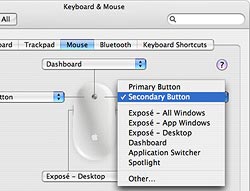
First, and Mossberg touches on this, you should get used to right-clicking. This is less a tip and more an important preparatory step. Your Apple mouse can do a right-click even if there is no apparent second button–just press or rock the mouse on/to the right side. If that still results in a left-click, then go to System Preferences (in the Apple menu at the far left of the menu bar) and select “Keyboard & Mouse”; click the “Mouse” tab at top (illustrated here), and make sure that the right side of the mouse is set to “Secondary Button.” Also, keep in mind that you can buy and use almost any 3rd-party mouse with the Mac. Alternately, a right-click can be simulated by holding down the Control key and clicking the left mouse button. On a trackpad, holding two fingers on the trackpad and then clicking also activates “right-click” (contextual menu).

That out of the way, for anyone who is using their first Mac after years of Windows dependency, here are some tips that’ll make it much easier:

1. Quitting programs: Mossberg puts this somewhere in the middle of his tips, but I find it’s the #1 difficulty Windows users have getting used to. Windows users are used to quitting everything by clicking the red “X” button at the top right of the window. The problem with that system is that it’s not consistent: sometimes by clicking the “X” you’re closing a window, sometimes you’re quitting the program. And in some apps, a double set of buttons appear, the top ones for the program, and the bottom ones for the document being viewed.
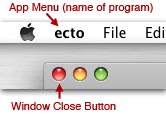
App-Mb01On the Mac, you don’t quit the program by closing the window; clicking the red button on the top left (Window Close Button) will not close the program, only the window the button is on. The program itself is based in the menu bar–which, on the Mac, is always at the top of the screen, and is not part of the window. Switchers will close the window they’re working on by clicking the red button, and think they’ve quit the program–but will not notice that the menu bar for the program is still active (you can tell by looking at the “App Menu,” the boldface menu just to the right of the Apple menu). At this point, the menu bar is all that is “left” of the program. Since Switchers usually click on something else and, in so doing, switch the menu bar’s attention to the new program, they don’t realize that the previous program is still running and taking up valuable memory space. I have often discovered Switchers who think they’ve got no programs running, but in fact they have more than half a dozen still open.
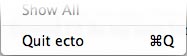
QappmIf this happens with you, then you should learn a few easy things that will help you avoid this problem. First, learn to quit by using the keyboard: Command (Apple key) + Q. It’s an easy left-thumb-and-forefinger move, much easier than reaching for your mouse and aiming it at the little button. It will not only quit the program, but it will close all windows which are active, meaning you don’t have to click the red buttons for multiple windows if you’ve got them open. As an added bonus, some programs, like Apple’s Mail app, will remember the windows you had open, and will re-open them in just the same way as you had before when you open the program the next time.
Docklt-1
Next, take a closer look at your Dock, that strip of icons at the bottom of your screen. If you’re using Leopard, you’ll notice that the open program icons have a little, blue-ish indicator light under them (on older versions of the Mac OS, it was a back triangle). This is a quick and easy way to check which programs are still running.

CmdtabAnd finally, master the Command + Tab shortcut, which allows easy switching between programs. Although this is one of the few features that Apple stole from Microsoft, it’s one that few Switchers seem to know about–most Windows users I have encountered don’t know about Alt + Tab on Windows. On the Mac, Command + Tab (you should keep the Command key depressed while repeating the Tab key until you’ve picked out the app to bring forward) will by its nature show you which apps are still open. As an added feature, you can hold down the Command key, hit Tab until you get to the app you want to quit, and then type “Q” with the Command key still depressed (easy, as the Tab and Q keys are adjacent); this will allow you to quit programs without even making them active.

Get used to those three points and you’ll not only fix your problem, but you’ll be navigating and quitting much faster and more efficiently than you ever did in Windows.

2. Switching Between Windows: Another problem I have seen Switchers deal with is getting from one window to another. I’ll watch a Switcher do this by moving the active window over to one side, then clicking on the window below it. While this works, it’s messy and is generally not an efficient way of doing things.

As I described before, using the Command + Tab shortcut can be a quicker and easier way to switch between apps. Another way is to use the Dock–just click on the icon of the program you want to switch to. If the program has several windows open, and you want to switch to a specific window within the program, just right-click on the Dock icon, and you’ll see a menu appear above it with a list of all open windows in the app, as well as other options.

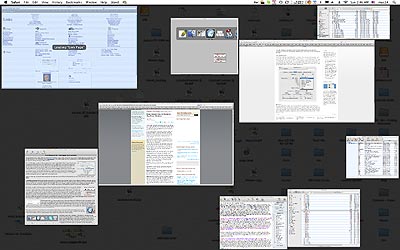
But the best way to switch between windows–especially from within a single program–is to use Exposé. Not found on Windows, Exposé is a very cool tool that makes life easier. By using a few easy keystrokes, you can spread out all your windows and choose the one you want, keeping everything neatly in place.
Expsbg
Out of the box, the shortcuts are: F9: spreads out all non-hidden windows for all open programs (pictured at right); F10: spreads out all open windows in the current app you’re using; and F11: clears all open windows to the sides so you can temporarily see the Desktop, until you hit F11 again to bring the windows back.

With F9 and F10, the windows spread out so that all are visible in reduced form (with the background darkened out to make the windows more visible); as you pass your mouse over each one, the window’s title appears; when you click a window, they all fall back into place, with the window you selected on top and ready to use.

The F11 (Show Desktop) feature is the best: it allows you to sweep aside the open windows, grab an icon from the Desktop, sweep the windows back in, and drop the icon into the desired window.

There’s more you can do with this feature, but mastering those basics will save you a ton of time and trouble.

3. Customizability: The Mac is highly customizable. This includes more than just wallpaper. While themes (or “skins”) are available only with special software, most everything else is changeable.

You can add or subtract icons to and from the Dock, including programs, folders, and documents (apps go to the left, folders and files to the right), and “stacks” of icons which spread out in an arc can also be added. Folders added to the dock can be right-clicked to expose a hierarchical menu of its contents.

OS X windows can also be customized. Aside from the view (which includes an iTunes-like Cover Flow), you can activate or deactivate the toolbar and left sidebar by clicking on the white button at the top right of the window. You can control exactly what shows in the sidebar at left; either open “Preferences” under the “Finder” menu and click on “Sidebar” (to turn on or off basic sidebar items), or simply drag-and-drop folders, files, or programs into the sidebar under “Places.” If you click on a folder in the sidebar, that folder will open into the existing window. Clicking on a document will open the associated app, while clicking on an app in the sidebar will simply open the app (kind of like a Quick Launch or substitute Dock).

Wintlbar

Furthermore, the window toolbar (pictured directly above) can be customized (right-click on the toolbar) to add or delete buttons and features; even outside of this mode, one can always drag files, folders, or apps into the toolbar for another quick-launch style of shortcut. Once added, these shortcuts will appear in every Finder window.
Kbscsc
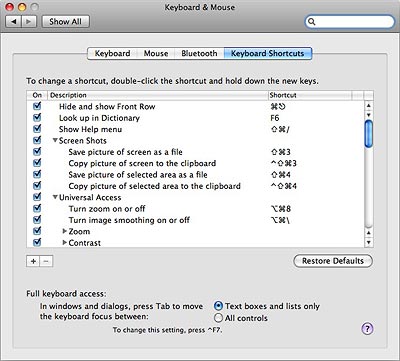
However, a key point of customization is with keyboard shortcuts. Many people don’t use these, and might not even feel comfortable with them–but I strongly urge such people to try to get used to them. It is the same kind of difference in efficiency as you would see between hunt-and-peck and touch-typing; knowing your keyboard shortcuts can make you fly through stuff that you used to take a long time with. But what’s nice about the Mac is that you can customize just about any keyboard shortcut–and not just with the OS, but with any program. Go to the Apple Menu, System Preferences, and Keyboard & Mouse. Then click on the “Keyboard Shortcuts” tab at top left. This will not only tell you what the existing shortcuts are, but it will allow you to change them–any of them.

The immediate list will show you all of them main Finder shortcuts, which you can change by clicking on the shortcut and then typing your own (conflicts will raise flags). But in addition to these, you can set your own by clicking on the little “+” button at the lower left. In the dialog box it brings up, select the application you want to change (or else let it default to all applications), then type the menu command and the shortcut. The next time you open the app, the shortcut will be active (and will show up in the menu listing for the command).

There is a lot more which can be customized–just look around the system preferences and the preferences for any app or for the Finder–but what I have just described should give you an idea of how much you can change how the OS responds to you.

A few key shortcuts: Command + Delete (the delete key next to the “+” key) will put selected items into the trash; Command + Shift + Delete will empty the trash. Command + “?” will open Help; Command + “,” will open Preferences; Command + “.” will often stop a process in action. Command + Shift + S is usually “Save As…”. Command + E will eject a selected disk.

Extra Stuff: I just wanted to add a few things you should know about:

Dropping icons: while Windows is limited as to where you can do this, in Mac OS X you can drop just about any icon anywhere to open or add it to what you are doing. Drop a document onto an icon on the Desktop, the Dock, the Sidebar or toolbar, and it open the file in the app to which the icon belongs.

Easy Uninstall: Want to “uninstall” an application? Except for special circumstances, it’s easy: just drag the icon into the trash. This will leave behind related preference files in Library folders, but they are usually small in size and not a trouble to leave behind. Uninstalling will not risk screwing up your system like it does in Windows.

Spring-loaded folders: Drag an icon over a folder (anywhere, including in the Sidebar) and hold it there for a moment; the folder will open for you. This can be done for as many folder levels as you like. After you drop the icon, the various folders will snap shut, except for the one you dropped the icon into.

Quick Look (Leopard only): select any icon, then hit the space bar; if it’s a supported file type, then a preview will open up. If the content is more than just one page, you’ll be able to scroll through the whole thing. Music and movies will play.

PDF: Mac OS X has always been PDF-friendly. You don’t need Adobe Acrobat, Apple’s “Preview” app will open them OK. And any app can create PDF’s in OS X: just go to Print in the File menu, click the “PDF” button, then select “Save as PDF…” and you’ll have a PDF of whatever file you’d otherwise be printing. Excellent for sharing docs between computers.

There’s lots more, but that should be enough for one sitting.

Categories: Tutorials Tags: by

Flipper Flapper

July 5th, 2008 2 comments

Would someone please explain to me how McCain gets away with complete policy reversals,often within just a few weeks or months (drilling is/is not the answer, social security privatization, tax cuts, torture, etc. etc.–even flip-flopping ten times in two weeks) and the press completely ignores the multiple and radical 180-degree turns–and yet whenever Obama changes something (he calls it “refining”; and while that sounds too much like “evolving,” some say that Obama has a rational basis for his claim), like how he would handle the withdrawal from Iraq (when everyone suspected he would do this for a long time, so it’s hardly “news”), not a reversal but a modification at worst–suddenly the entire media goes into a frenzy about it?

Maybe he should throw them a barbecue or two and they’ll become tame lap dogs for him as well.

Late thought: is the media purposefully trying to turn Obama’s supporters against him? Seeing the effect his FISA decision had, are they not consciously playing up any news that suggests that he’s turning on his followers?

Categories: "Liberal" Media Tags: by

All Set for ID

July 4th, 2008 4 comments

Went down to Samezu today, which for Tokyo is the Mecca of driving: that’s where most people in central Tokyo go to get their driver’s license. Mine was just a few days away from expiring (you get one month after your birthday). As it turns out, this has been my year for renewals–American and Japanese driver’s licenses, and my “gaijin card.”

I really expected a longer ordeal at Samezu. I used to go to Fuchu, out in the less-crowded western Tokyo area, and that would take quite a bit of time, mostly waiting for this and waiting for that. You always have to take a 2-hour lecture if you get a ticket for anything. I’ve been 20 months without a ticket, but it has to be for the whole three years. I remember having to wait a while for that lecture in Fuchu–a long time, in fact, if you came too close to the lunch break–but even if you came early, you had to wait for a while before your session started. It could easily take more than half the day.

At Samezu, though, at least for today, it went quick & slick. Walked in the door at 8:50 am, swept through the lines for vision test, photograph (a much better one this time), payment, and a few other formalities, and was waved into the 9:00 lecture. After the lecture, go up to the 3rd floor and pick up your license. In Fuchu, just that would take up to a hour; here, they fed us through the room in about 5 minutes.

The lecture itself wasn’t too bad–usually these things are practices in boredom and futility, teaching us virtually nothing of importance. Today’s maintained the “useless” tradition, but in a slightly more interesting way. Much of the subject matter was more than just useless, it was so useless it was almost weird. These were all drivers who were forced to attend this lecture because they received citations (even parking tickets). But they spent a full twenty minutes on bicycle safety. I don’t mean tips on how drivers can avoid hitting bicycles–I mean twenty minutes on how to responsibly ride your bicycle. You know, don’t go too fast, stop at stop signs, walk your bike across crosswalks. I started wondering if I was in the right room.

They spent a good ten minutes or so on fatality numbers, and the more usual patter about traffic stuff wholly unrelated to traffic violations, a lot of which I just can’t figure out. But in a surprise move, they spent the last 40 minutes or so showing us a TV drama. Not made for the department, but an actual drama. And strangely, it was probably the most effective part of the lecture. It was about a normal, nice guy who felt he had to drive for some reason even though he was drunk, and he runs over two little kids and flees the scene. He gives himself up out of guilt, goes to prison, and his family falls apart. His daughter becomes so depressed that she won’t go to school; the son gets colored hair and rebels, cutting his father out of all the family photos. His wife has to go scrape and bow and receive endless abuse from the victim’s family; after paying damages, she has to work days as a cook and nights as a construction-site wand-waver. But the shame, the stress, the hard work, and the kids going nuts drives her to throw herself in front of a train. Cut to the guy getting the news in prison.

Most of the film, obviously a tragedy, was spent watching various people writhe in agonizing emotional torment. So, in short, loads of fun, the feel-good movie of the summer and all that. Or, more to the point, the kind of morbid melodrama so deeply loved here in Japan (right after the yo-yo-wielding high school girl-police detective cliche). But you did come out of it feeling like, “well I don’t want to go through that!” And as such, probably did loads more to address the supposed theme of the lecture than anything else, especially the part about not riding your bicycle on crowded sidewalks.

One other note: the guy giving the lecture (probably a retired cop) strangely resembled Takakura Ken, and wasn’t a complete bore. He probably would have served as a better actor than many of those in the TV drama.

One interesting change: licenses in Japan are now equipped with IC chips, complete with a PIN number. They sold it as a way to more effectively renew your card next time, protecting against identity theft or something, but you know the real reason: they want to make it easier to give you traffic citations. Instead of the cop having to laboriously write out the ticket, he can just swipe your card, and presto! He’s off to ticket three times as many people as before. It might even mean that motorcycle cops can ticket people on rainy days, as there wouldn’t be much paper to get wet. But I have the feeling that the cops stay indoors during the rain for other reasons.

Which, of course, leads me to my usual gripe: that most tickets handed out in Tokyo have one purpose only–to generate income. Japanese cops leave the most dangerous places unmonitored, instead setting up ticket traps in places where people break traffic laws which are wholly unreasonable, in completely safe and innocuous ways–but where it’s dead easy to catch them in numbers. I have zero respect for these guys; they obviously don’t give a rat’s ass about safety. If they did, they would be acting in completely different ways. As they are now, they’re just pompous, self-righteous fee collectors.

Case in point: When I lived in Inagi, I went “mentei,” which means you got so many tickets that you went on a kind of probation–I had to stop driving for a month (not so bad, as I was in the U.S.–and driving–for three weeks of that). As of now, as I pointed out, I have not gotten a single traffic ticket in 20 months. Why? Not because of safety–I drive as safely now as I did in Inagi, which is pretty safely–but simply because I now live downtown, where the cops don’t ticket people nearly as much. Most of my tickets before were for “speeding” on long, lonely, deserted, straightaway stretches of country road where the safe speed is at least 50 mph, but the posted speed limit is 25 mph. I usually got caught going a “dangerous” 40, naughty me. Since they stay on your record until you go ticketless for a whole year, they added up over time.

Maybe continued city living (if I can keep on evading the even-more-fee-generating motorbike parking ticket squads) will allow me to go ticketless for the next three years, so for once I can get a renewal without the worthless, time-wasting lecture.

Categories: Focus on Japan 2008 Tags: by

McCain Throws Tantrum, Then Fakes Integrity Again

July 3rd, 2008 2 comments

McCain throws a hissy-fit on his bus when a reporter has the temerity to ask him a pertinent question:

McCain bristled at the comments on "Face the Nation" last weekend by an Obama supporter, retired general Wesley Clark, who belittled the relevance of McCain’s wartime experience as a qualification for the Presidency.

"I think it’s up to Sen. Obama now not only to repudiate him but to cut him loose," McCain said.

McCain became visibly angry when I asked him to explain how his Vietnam experience prepared him for the Presidency.

"Please," he said, recoiling back in his seat in distaste at the very question.

McCain allies Sen. Lindsey Graham stepped in to rescue him. Graham expressed admiration for McCain’s stance on the treatment of detainees in US custody.

"That to me is a classic example of how his military experience helped him shape public policy in a way no other senator could have done,’’ Graham said.

Sen. Joseph Lieberman, also traveling on the trip, expressed admiration for McCain’s wartime service as well.

McCain then collected himself and apologized for his initial reaction.

"I kind of reacted the way I did because I have a reluctance to talk about my experiences," he said, noting that he has huge admiration for the "heroes" who served with him in the POW camp and said the experience taught him to love the U.S. because he missed it so much.

"I am always reluctant to talk about these things," McCain said.

Um, yeah. The service he wrote his memoirs about, that he bases his campaign ads on, that he constantly makes opportunistic jokes about, and that he talks about all the time. That’s the thing he’s so “reluctant” to talk about.Mccain 07 Header 01

Look at his campaign logo: see the military star? Even the Optima font is reminiscent of military style–it’s the font used on the Vietnam Veterans’ Memorial, for example. McCain’s campaign is based upon his military service, and upon playing it up, all the way up to the hilt. This latest round of tantrums about Clark is simply the latest salvo in this long-running military campaign.

And, oh yeah, didn’t he vote for torture, in yet another of his long list of flip-flops policy “evolutions”?

Categories: Election 2008, McCain Hall of Shame Tags: by

We Do Crazy

July 3rd, 2008 Comments off

The story out today:

Iran plays downs talk of attack, says another Mideast war would be ‘crazy’

NEW YORK — Iran’s foreign minister Wednesday dismissed talk of a U.S. or Israeli attack against his country, calling the prospect of another war in the Middle East “craziness.”

Ummm… do they not know who’s running the White House now? Where have they been for the past seven years?

Categories: Foreign Affairs & Policy Tags: by

Feigned Aggrievement to Play Up the War Record Some More

July 2nd, 2008 1 comment

Have you ever seen those soccer games where one player barely brushes against another, and the other player immediately collapses onto the ground, clutching their limb as if it had been severely mangled, all so they can wrangle a penalty shot?

That’s McCain right now. Bob Schieffer–not Wes Clark–used the words “gotten shot down,” and Clark simply said that that wasn’t a qualification for being president. That in a conversation where Clark (a) was clearly framing the entire discussion as a matter of strict qualifications and not an attack on McCain’s character, and (b) Clark had just gotten through laying effusive praise upon McCain, admiring as being a “hero.”

Sullivan’s antics aside, anyone who seriously considers this anything more than a blip is overreacting to the extreme. Even if you do take offense at the language, it was Schieffer’s language, and Clark’s statement did nothing more than mirror it.

But this is what the McCain campaign has been reduced to: making incredibly exaggerated claims at injury whenever even the slightest brush involving McCain’s wartime record is perceived.

There has been this meme going around that McCain, in his dignity and humility, has never used his war record to his political advantage. This is wholly untrue: McCain has always used his war record, mentions it all the time, and plays it up to ultimate effect–which is one reason it is the most-known thing about McCain. If he were truly humble, we wouldn’t know much about it. Bob Dole is more the humble type–people would comment on that pen he holds to hide his disability, but Dole himself doesn’t tout it much, just as Senator Inouye doesn’t bring up his Congressional Medal of Honor all the time; this is why fewer people know about these things.

But McCain? He almost like Rudy Giuliani–not quite using a noun, a verb, and “I was a POW” in every sentence, but sometimes it seems like it. He constantly drops a joke at the slightest hint of inconvenience, saying that “I haven’t had this much fun since I was in Hanoi.” The whole “I’m offended by aspersions cast on my war record” act is nothing more than yet another attempt to capitalize on this whole thing.

You know what I wonder about most in this whole charade? Why the hell was Bob Schieffer acting so angry and offended when Wes Clark, after lauding McCain as a hero, simply stated that McCain’s service did not give him experience or expertise that would translate into talents of use to a president? Watch the video–Schieffer comes across as almost scandalized.

Why?

Categories: Election 2008, GOP & The Election Tags: by

Mac Market Share

July 1st, 2008 1 comment

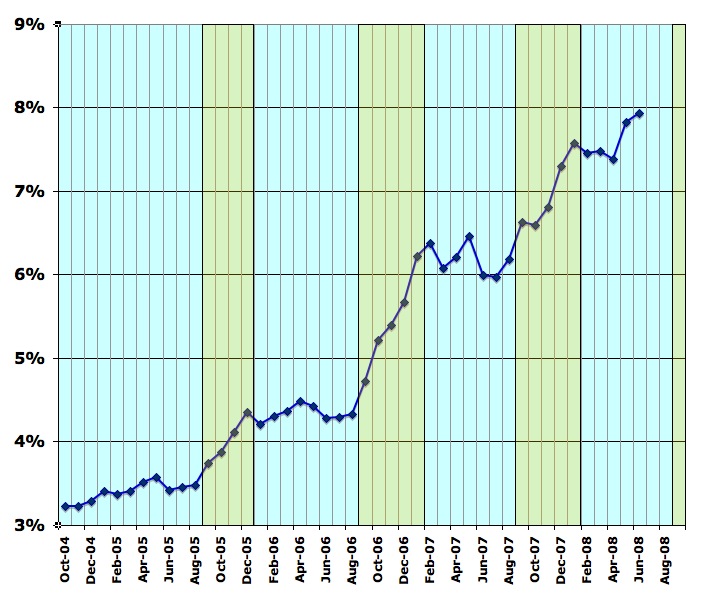
There’s a story hitting the news wires: the Mac has hit an all-time high of 7.95% market share, more than ever before, with the impression being of an immediate upward trend for Apple. Last year at about this time, some clueless tech writer at Computerworld wrote that the Mac OS was flailing while Vista showed robust growth, using the exact same source of stats that the new story uses (Net Applications’ tracking data). I wrote a blog post explaining in detail why this guy was full of it. Both stories–the one that was negative about Macs last year and the one which is positive about Macs this year–are wrong, and for similar reasons.

Yes, a new all-time high about Mac use is nice to hear, but not impressive to me right now. The reason: it’s not Mac season yet. I have noticed a pattern over the past three years–here’s the data over that period of time:

Macuse-Na

The areas filled in with green show sustained growth. See a pattern? Every year, starting in September, there is a sustained growth burst that continues until January. Between February and August, there are minor fluctuations, but the market share generally remains static.

The growth spurts are dramatic–less than 1% growth in terms of total market share in late ’05 (but that was bigger in terms of percentage of growth over the existing brand market share), 2% in late ’06, and close to 1.5% in late ’07. But right now we’re in the lull period.

Not to mention that the larger rise took place in May, not June (which was only a slight uptick from May), which was not really reported on. And if you look back, for some reason, there has always been a peak around April or May, so this is not a surprise. The safe bet is that the number will fall again in July and/or August, but then take off again in September, as always–probably representing back-to-school sales which create the growth spurt which lasts into Christmas sales, dying out soon afterwards.

Now, I’ll be surprised if the numbers continue to grow before September; that would be unusual, and could signal a bigger-than-usual surge in the latter third of the year. But right now, it’s not clear how big that surge will be. Yes, the iPhone 3G is making waves, but the original iPhone was making even bigger waves a year ago. While the current spurt trend–only two data points long–shows a slowing increase (2% to 1.5%), that’s less a trend than it is just a couple of data points. The surge this year could be anywhere from a 1% increase up to about 9%, or a 2% increase again up to 10%.

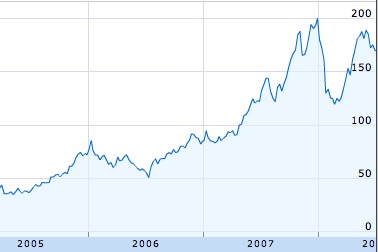
The only thing I’m pretty sure of is that there will be a surge–that’s the safe bet. And if you take a look at Apple stock, you’ll see a similar trend: a general pattern of big increases in the latter half of the year, with slower growth, decreases, and/or volatility in the first half.

Appl05-08

That graph is less clear-cut, but you’ll notice that the biggest increases, especially when you discount the drop-and-recover beginning of 2008, always fall in the second half of the year, peaking over the new year, and then dropping or at least slowing. But since 2003, there’s never been a value drop between June and December.

Those seem pretty clearly to be the golden months for Apple.

Categories: Corporate World, Economics, Mac News Tags: by

Clark and McCain’s Military Record

July 1st, 2008 1 comment

Some are already calling it “Swift-boating,” which is a ludicrous charge. Swiftboating specifically refers to the slimy smear tactics taken against John Kerry in 2004, and requires several components: (1) people who served in the military and claimed to have served with the candidate or have some special knowledge of the candidate (2) making claims about having witnessed or otherwise having direct knowledge of specific events, and (3) saying that the candidate wasn’t heroic, or going so far as to denigrate the candidate, claiming he was cowardly, a liar, or worse.

So what did Wes Clark say?

Schieffer: Well you, you went so far as to say that you thought John McCain was, quote, and these are your words, “untested and untried,” And I must say I, I had to read that twice, because you’re talking about somebody who was a prisoner of war. He was a squadron commander of the largest squadron in the Navy. He’s been on the Senate Armed Services Committee for lo these many years. How can you say that John McCain is un- untested and untried? General?

Clark: Because in the matters of national security policy making, it’s a matter of understanding risk. It’s a matter of gauging your opponents, and it’s a matter of being held accountable. John McCain’s never done any of that in his official positions. I certainly honor his service as a prisoner of war. He was a hero to me and to hundreds of thousands and millions of others in Armed Forces as a prisoner of war. He has been a voice on the Senate Armed Services Committee, and he has traveled all over the world. But he hasn’t held executive responsibility. That large squadron in Air- in the Navy that he commanded, it wasn’t a wartime squadron. He hasn’t been there and ordered the bombs to fall. He hasn’t seen what it’s like when diplomats come in and say, ‘I don’t know whether we’re going to be able to get this point through or not. Do you want to take the risk? What about your reputation? How do we handle it publicly.’ He hasn’t made those calls, Bob.

Schieffer: I have to say, Barack Obama has not had any of those experiences either, nor has he ridden in a fighter plane and gotten shot down. I mean-

Clark: Well, I don’t think riding in a fighter plane and getting shot down is a qualification to be President.

Schieffer: Really?!

Clark: But Barack is not, he is not running on the fact that he has made these national security pronouncements. He’s running on his other strengths. He’s running on the strengths of character, on the strengths of his communication skills, on the strengths of his judgment. And those are qualities that we seek in our national leadership.

YouTube of the interview here.

Sorry, but this doesn’t even come close to swiftboating. Clark made no claim that he had special personal knowledge of McCain, did not say that he had witnessed anything McCain had done, and did not make disparaging statements about McCain–quite the opposite, he lauded him as a hero. He simply made an objective observation that nothing McCain had done qualified him for an executive position, that his wartime actions, while heroic, don’t translate into any qualifications for presidential office. That’s not swiftboating, and any claim–even the suggestion–is in itself an unfair attack against Wes Clark. Not swiftboating against Clark, just an unfair and unjust accusation.

The McCain campaign, however, sees a great opportunity here: they can play the victim, claim they’ve been unjustly maligned, embarrass Obama, trash Clark, all the time while playing up the “War Hero” card. It’s a huge win-win for them.

The irony here is that Clark did not say one bad thing about McCain’s war record–this is so obviously not swiftboating that the media should be playing it as McCain’s campaign trying to make hay out of it (which they have no trouble saying about Obama’s campaign in such situations). But as far as I can see, the media is totally buying into McCain’s narrative.

Another observation: the GOP is extremely fickle about how wartime service plays into a campaign. On a variation of IOKIYAR, it can be said that their attitude is, “YAWHOIYAR”–“You’re a War Hero Only If You’re a Republican.” A reader at Talking Points Memo lays it out accurately:

Continues to boggle my mind what a difference 4 years can make to the conservatives.

1996: Bob Dole is a war hero! Clinton is a draft dodger! WORSHIP THE WAR HERO!

2000: Forget the war! Ignore the potential Vietnam-era AWOL-ness of our candidate, and his complete lack of foreign policy knowledge! He’s got integrity!

2004: So what your candidate actually fought and was injured in the same war during which our candidate was so very much NOT AWOL! We mock his service and question the legitimacy of his injuries! Have a purple band-aid to wear at our convention!

2008: Only a certified war hero can lead this country! WORSHIP THE WAR HERO!

Apparently, McCain’s war service is completely untouchable. When it comes to Democrats and war service, not only is the matter not untouchable, it apparently requires touching. Gore served in Vietnam? Yeah, but he was a photographer, so he must have used family connections (despite an utter lack of evidence) and besides, he was a coward and yadda yadda yadda!“ Bush, meanwhile, was actually lauded for his ”military“ service, defended for his flight-suit antics, and was considered entirely cleared of any AWOL or draft-dodging actions simply because of the Dan Rather story, as if that completely erased the massive piles of evidence unrelated to that story. And forget about the right’s treatment of Kerry–that’s where the whole swiftboating thing came from.

But even dare to suggest that a Republican who served in war should not be able to fully translate his service into presidential authority, and you’ve crossed a line. You don’t even have to say one bad word about his record–you can even call him a hero–but suggest that what he did during the war is not the stuff of great presidents? Heretic!

On a disappointing note: Andrew Sullivan sees Clark’s words as swiftboating. For shame, Andrew; I know you’re not exactly one of the most objective voices out there, but I had more faith in your reasoning skills than this. Maybe he was so busy blogging every five minutes that he didn’t listen carefully enough.

Update: Sullivan seems to be saying that the offense was not in the actual claim made by Clark–which he admits is ”technically true“–but rather the tone of the statement. He cites a reader who points to Clark’s statement: ”Well, I don’t think riding in a fighter plane and getting shot down is a qualification to be president,“ and says it is unacceptable even despite the fact that Clark was simply parroting Schieffer’s language. He further quotes another commenter who said that what Clark said was ”bad manners on Clark’s part, given the suffering McCain endured.“

I understand Sullivan’s reasoning here, but I simply can’t get behind it at all. Sullivan seems to have more of an issue with Schieffer than Clark, as it was Schieffer’s language that he claims set him off. Otherwise, Sullivan seems to be claiming that military service is completely off-limits here–which is a bogus claim to make, as McCain is mentioning his service and his years of torture all the time, as if they qualified him for the presidency. That alone makes an objective rebuttal fair game, unless you want to suggest that McCain can go around saying ”I was a hero! I was tortured for five years! That qualifies me for president!“ and Democrats aren’t allowed to touch it. Claiming that the wording they pointed out–even if the word’s were completely Clark’s–is denigrating to McCain is a highly subjective judgment, and goes way beyond the level of tempering wording than is reasonable.

I can only ascribe Sullivan’s reaction to his apparently congenital hatred and willingness to judge poorly anyone who was ever a Clinton supporter.

Categories: Election 2008 Tags: by

This Boar Ain’t Very Cool, Benny Lava

June 30th, 2008 4 comments

Via Andrew Sullivan, if you haven’t seen it, you gotta:

It’s an Indian (?) music video, or maybe a musical segment from a movie. The kind that baffles Americans even more than our own musical numbers do–you just can’t figure out what the heck they’re thinking. But the person who made this video noticed that the language spoken in the video sounded a lot like English words, so they went to the trouble of transcribing it and adding the English version as subtitles. Not a translation, mind you, but just what the words sound like if they were English.

It is, in a word, hilarious. Turns out there’s quite a few videos like this, the original guy seems to have started a trend. Some are pretty funny.

Go Benny Lava!

Categories: The Lighter Side Tags: by

I Wish We Had

June 30th, 2008 2 comments

The latest drivel from Lieberman:

“I hope Barack Obama goes to Iraq,” Joseph Lieberman, an independent U.S. senator from Connecticut, said on the CBS program today. “And frankly I hope he changes his position. Because if we had done what Senator Obama asked us to do, for the last couple of years, today Iran and al-Qaeda would be in control of Iraq. It would be a terrible defeat for us and our allies in the Middle East and throughout the world.”

“If we had done what Senator Obama asked us to do”? Well, let’s go back a few more years, shall we? If we had done what Senator Obama asked us to do back in 2002, which is not to start a “dumb war,” then we wouldn’t be in Iraq right now. Yes, Saddam Hussein would probably still be in power, but face the facts: under Hussein, Iraq was a more stable and peaceful place. Al Qaeda never would have seen its ranks swell, we could have concentrated on Afghanistan, probably would have captured bin Laden long ago and beaten back the Taliban, hundreds of thousands of Iraqis would not be dead, millions of Iraqis would not be refugees, Iran would not have any chance of influence in Iraq like they have now, there would be no civil war; as for the United States, we would not have 4113 dead American soldiers or tens of thousands wounded or so many suicides and broken lives, 150,000 or so American soldiers would be at home with their families, we would not have pissed away a few trillion dollars, and our reputation and influence in the world would be far, far stronger than it is now.

Yeah, Joe, let’s not listen to barack Obama.

Categories: Election 2008 Tags: by

Breaking News: The McCains Failed to Pay CA Property Taxes For Four Years

June 29th, 2008 Comments off

Newsweek has the story. Apparently, the McCains own a beachfront condo in San Diego, and have not paid property taxes on it in more than four years. The media may have saved them an even greater embarrassment–the condo could have gone into default soon, and would have been auctioned off to pay the bills. The McCains have already sent in a check to correct the issue, but they’re still short by close to two thousand dollars.

This is less a matter of greed or corruption, more simply one of sloppy management:

San Diego County officials, it turns out, have been sending out tax notices on the La Jolla property, an oceanfront condo, for four years without receiving a response. County records show the bills, which were mailed to a Phoenix address associated with Mrs. McCain’s trust, were returned by the post office.

I’d put good odds on the bet that the media does not make much a deal about this. Already, the story has been out for several hours, and yet none of the major media outlets have this story on their front pages. It’ll probably be more of a page-two story, when and if they cover it at all.

In truth, it’s not really a big deal–the McCains let an address get out of date and didn’t notice one less bill for property taxes on their numerous real estate holdings. A little sloppy, but hardly criminal or even all that interesting. However, this is an election year, and McCain is running for president, so the rules say that this story has at least one day’s worth of play time as an embarrassment for the candidate, while people make jokes and titter over the matter. Worse for McCain, it will play up the fact that he married a rich beer heiress, that this “man of the people” is embarrassingly wealthy, with at least seven homes in the couple’s possession.

Even more to point is the fact that–as the old yardstick shows–if this were Obama, it’d be a bigger story, people would take it a lot more seriously, and it would play a lot longer in the media, being remembered and mentioned more down the line.

But the reason for this is not just that the media is more willing to take swipes at Obama than they are at McCain–something the media has clearly, in fact unmistakably demonstrated over the past several months. A big part of this is the fact that Republicans are far more willing and certainly more adept at taking such a non-issue and spinning a web of lies, misconceptions, and smears to damage the opposition. Democrats will try to make an issue of this, but they’ll stick pretty closely to the facts. Were this on Obama’s plate, the GOP would surely put out a legion of talking heads opining on how this shows Obama’s “elitism,” how he believes he doesn’t “have” to pay taxes, how he holds himself above the law, how he is a hypocrite, etc. etc. etc.–all the time pressing hard on how this is a “serious” matter and should be “looked into” much more closely.

Democrats, for all their faults, can’t make themselves descend to that level of dishonesty; for Republicans, it’s practically a reflex.

Categories: Election 2008 Tags: by

Another Possibility in the FISA Matter

June 29th, 2008 Comments off

When a commenter came here to drop a quick stink bomb-and-plug to his site trashing Obama, I followed him back home, and tried to debate on the issue. The blogger simply pejoratively dismissed my arguments without offering anything of substance to explain the dismissal, but it nevertheless gave me a chance to work out some new ideas. One thing I reflected on was the sense of betrayal, as if Obama had suddenly demonstrated antagonism for civil rights in general, or even just the impression that Obama had made a policy shift at all.

My own conclusion is that Obama’s FISA decision was meaningless in terms of policy or effect, and was purely a calculated political movie for the sake of the election. The key comes in looking at the bill in the Senate: a vote to filibuster the new bill was defeated, 80-15. Just to filibuster would have required moving the votes of 25 senators. Defeating the bill would have taken another ten. A similar attempt to block telecom immunity lost in the Senate by about twenty votes.

Even for a powerful, influential, seated president, shifting that many votes in the Senate would be a virtual impossibility; for a newly-minted nominee, it would be simply impossible. Obama is not the messiah, nor is he a magician. If he were to lead a fight on the FISA bill, he would surely lose. And in an election year, to put up a fight and then lose it–most likely by a wide margin–while the other candidate wins and can claim the mantle of national security as a result, well, that would be bad. No matter how viscerally satisfying such a display would be for we who see this as a very important issue, such a battle could have a disastrous effect on the chances of our party top retake the White House. So those who are disappointed that Obama did not make a battle out of this are perhaps not seeing the big picture on this issue.

Still, that doesn’t explain why Obama doesn’t simply vote “no” and make a statement of principle more in alignment with what the netroots want to hear. One thing that should be kept in mind here is that such a stand would have no practical effect in our favor; his vote and his statement would be purely symbolic. There could, however, be a negative practical effect in that McCain could use this issue to beat him over the head. As I stated before, I truly doubt that McCain could make so much of this as to actually make a dent in the campaign, but it nevertheless could explain Obama’s thinking on the matter.

In the end, by saying what he did, Obama did not make official any policy shifts away from what we thought; he made a statement of his opposition to the telecom immunity, and what he said on other matters were either a matter of balancing pros and con, or were at best inferred policy statements, not solid, actual ones. Slippery, perhaps, but again, this is usual for election-year politics.

The point I am trying to make here is that this entire matter does not have to be a policy or principle betrayal by Obama, but instead nothing more than a calculated political move in an election year on an issue where the candidate was damned if he did and damned if he didn’t anyway, so he chose to be damned in a way that could help him get elected.

I still think that it was the wrong move, and he’ll probably wind up being hurt in fundraising more than he would have if McCain could use this against him. But like I said, it’s probably not the huge deal that many purists seem to be taking it as.

Categories: Election 2008 Tags: by

A Long Five Years

June 28th, 2008 2 comments

I figure five years is not all that long to wait for a new music player, right? Or for a new cell phone?

As it happens, it has been five years since I bought either one. I got the cell phone in August 2003, and the iPod 3G in October 2003. Note that I actually seemed to like the cell phone, partly because it had a messy–but workable–kludge to import the address book from my Mac. At the time, it was actually fairly impressive for a phone that I was able to get for a fairly cheap price. And I really liked the iPod, which, as I pointed out at the time, was easy to figure out, unlike the cell phone.

But now, both are fairly junky, the cell phone more than the iPod. The cell phone seems positively chintzy. The camera is so bad that after I had taken a photo of a landmark along the route to our wedding hall, neither Sachi nor I were able to make out any details in the image later. The phone book is a bit of a joke, the thing doesn’t ring out loud half the time when people call, and the other features the phone has are so hard to figure out that I just ignore them. When I am able to figure out the email, inputting text using the keypad is so freaking monotonous I can’t stand it.

The iPod, while old, at least still works as advertised, and I have no trouble accessing its features; it’s just old and has none of the newer features, is all. No color, no video, just the Chicago-font menus. I still use it regularly; these days, it’s my exercise companion, playing music to help keep me going on the elliptical trainer.

It’s a 20 GB iPod, so will actually have slightly more memory than the new iPhone I’m getting. After 5 years and no battery exchange, the lifetime of the battery is still surprisingly long–several hours at least–though if I leave it for more than a week, it gets dangerously close to dying after a half-hour of use. The cable is beginning to fray where it meets the body, and the plastic cover of the firewire connecter broke loose some time ago. I have no idea what I’ll do with it when I get the iPhone; put it in a drawer, maybe. It works fine, but I think that if I tried to sell it, people would just laugh. I paid $450 for it new, by the way.

Usually, I don’t wait that long for new devices. Three years is how long I wait between laptop purchases (I am due for a new one, waiting for the next MacBook/MacBook Pro models to come out), about the same for desktop computers (I am on my third desktop since 1998, only two of them Macs). I guess one of the reasons I have not gotten a new cell phone or iPod is because I have been waiting for the all-in-one device since August 2006, when rumors started getting more copious about the iPhone. Since then, it’s been a waiting game for the thing to come out in Japan. After all this time, I’m pretty antsy to switch over to something that isn’t five years old and devoid of any new features. I mean, just look at what I’ve got now above, and what’s coming soon below. Can you blame me?


Categories: Gadgets & Toys Tags: by

Apple Stock

June 27th, 2008 2 comments

Great news from all around for Apple: analysts have raised their target share price to more than $50 above the current price and rate it a strong buy; Apple is on the eve of the release of their biggest-hit product ever, the iPhone 3G, which is raising massive interest around the world–in Spain and the UK there are already 300,000 pre-orders, two weeks before the actual release. Apple has increased its orders for production up to 15 million units from ten million units, and plans to hit it’s sales goal which observers once called fantastically optimistic but have now changed to saying Apple will probably sell even more. A new report says that Apple should make more profit from each new iPhone than they have ever made before. And the App Store promises to be just as much a hit, generating billions as a brand-new source of income for Apple. In other news, Apple sells its five billionth music track at the iTunes Store, and its line of personal computers continues to hit record sales marks (dominating the high-end market) and continues it’s skyrocketing trend in market share, while OS rival Microsoft wallows in mediocrity as its creator, Bill Gates, retires. Overall, every bit of news out there is highly positive for Apple.

The market’s reaction: Apple stock plummets $9.13, 5.15% of its total value.

Why? Frakking speculators.

Categories: Economics, Mac News Tags: by

Coming…

June 27th, 2008 1 comment

Just a month ago I laid out what would be needed for ebooks to catch on. The list included:

the book feel would be greatly enhanced by a fold-out screen, like a real book; two screens hinged to oppose each other, just like a real book. Not one screen and a solid cover.

Looks like I was right, and here is a prototype:

Ebook Dual

Thank you, thank you.

Categories: Gadgets & Toys Tags: by

Recreating the Second Amendment

June 27th, 2008 8 comments

The Supreme Court did what pretty much everyone expected today: for the first time in history, they deemed the Second Amendment an individual right and denied the ability of the government to ban all possession of guns. Most likely due solely to the influence of Justice Kennedy, they did not go so far as to say that there could be no control or restriction, opening the door for gun control laws so long as they do not amount to a gun ban.

Personally, I’m okay with this–I don’t like guns, and am a strong proponent of gun control which is rationally designed to maximize the restriction of illegal gun sales, possession, and use, while minimizing any obstruction to law-abiding citizens to possess arms; I am also a strong proponent of requiring safety training and testing. All of this is allowed under the new decision, which is why I am okay with the results.

What I am not okay with is the route they took. In arriving at their decision to individualize gun rights, the Wingnut Four essentially rewrote American history, claiming that the Second Amendment had no military basis, was always intended for personal/home defense, and so is an individual right. In short, in classic Scalia fashion, they ignored history and made up whatever baloney suited their personal beliefs–reigned in only be Kennedy’s relative moderation.

Scalia concluded his opinion, “what is not debatable is that it is not the role of this Court to pronounce the Second Amendment extinct.” No, it is just your opinion that it is the role of the court to pronounce every other amendment extinct. Just the other day, the Wingnut Four of SCOTUS tried vehemently to expand the use of the death penalty. Previously, Scalia railed that he was in the minority in trying to abolish the establishment clause of the First Amendment. Via their role as strict constructionists, the Wingnut Four have–by the definition of former Chief Justice William Rehnquist (“a strict constructionist judge is one who favors criminal prosecutors over criminal defendants, and civil rights defendants over civil rights plaintiffs.”)–vowed to decimate the Fourth through Eighth Amendments. And they have assiduously ignored the Ninth Amendment, which, after all, completely and utterly negates their beloved Wingnut-code-word philosophy of strict constructionism. Ergo, Judge Bork called the Ninth Amendment an “inkblot,” and Scalia has argues that Congress has the power to decide which rights the people possess, despite the Ninth Amendment clearly stating that the people must be protected from that same Congress to ensure these rights.

To me, the Ninth Amendment is what truly assures an individual right to keep and bear arms; the Ninth reaches back in history for pre-established rights, covers the rights so basic and vital that they need not even be named, and protects other rights that can be inferred from the others which are enumerated. And in this decision, Scalia actually cites all of these reasons, but does not apply them to the Ninth Amendment–he instead sees them as support for the Second Amendment. But there’s a reason he and the other members of the Wingnut Four have this blind spot: recognizing the authority of the Ninth Amendment would inevitably lead to full recognition of a right to privacy, which they absolutely do not want to recognize.

If you read any part of the decision, read the dissent by John Paul Stevens; he tears the majority a new one, pointing out in surprisingly simple and bitingly accurate language how their rationale for seeing the Second Amendment as an individual right is shoddy, at best. He notes that the designation of the right of “the people” in the Second Amendment is indeed not as universal as that in the First Amendment or the Fourth Amendment, as the right to keep and bear arms can be limited and even revoked in ways that the other amendments cannot be; then he quite rightly points out that the preamble to the Second Amendment (“A well regulated Militia, being necessary to the security of a free State”) is not just flowery decoration, but actually means something.

I was also very pleased that Stevens pointed out something else which is blindingly obvious: that the Second Amendment was not drafted so as to allow people to protect their homes from criminal trespass or otherwise for self-defense, but instead was drafted purely as a way to ensure that the people secure the right to maintain small, local armies. He points out what I have pointed out, what people who support the Second Amendment as an individual right pointedly ignore: that until the second-to-last draft, the Second Amendment contained a clause guaranteeing conscientious objection–that is, people who do not wish to fight because of their religious beliefs could be exempt from the obligations of the Second Amendment. One does not have to be exempted from a purely individual right to possess arms if one wishes–but one does have to be exempted from militia service.

The original bill had the added clause, “…but no person religiously scrupulous of bearing arms shall be compelled to render military service in person.” Does that sound like a call for an individual liberty? Of course not. It is not even consistent with that.

But, as I said, the end result of this decision is not as disastrous as one may fear, as it does not put an end to gun control–in fact, one criticism of the majority decision in the dissent was that the ruling left determinations on specifics of what restrictions may or may not be allowed an open issue for future courts to resolve. But for now, there is nothing keeping cities, states, or the federal government from enforcing a broad range of gun control laws, in addition to banning some forms of guns, such as fully-automatic “machine” guns and other weapons which go beyond normal definitions of self-defense.

To take the most optimistic view, this decision may even help gun control, as the main reason most Americans oppose them is that they fear such controls would evolve into gun bans. Now that the Supreme Court has ruled that such a thing is unconstitutional, that fear should now evaporate, making it possible for people to express outright favor for restrictions they agree are reasonable, but before feared would lead to gun bans.

You can read the decision in PDF form here. I have not had the chance to read as much of it as I would like to due to time constraints (it’s late at night as this story breaks, and I have a ton of work to do through Saturday).

Comments?

Categories: Social Issues Tags: by

Obama and FISA

June 26th, 2008 6 comments

There’s very little to like here. I can’t explain why Obama is caving so completely on FISA. Simply put, this should not be happening; Obama has no really good reason to do this. He could even make an issue of fighting the current bill, stressing the importance of security in some parts of FISA, but railing against the complete sop to the Telecoms (for which, as you should know from reading this blog, I have no love for whatsoever).

Even if he fought against the immunity and lost, he would still be taking a popular stand. Let’s face it, few voters, especially the ones who would ever vote for Obama, really approve of Telecom immunity–the issue is either so obscure or removed from the idea of terrorist threats that few people are out there marching for the Telecoms to be given immunity. And frankly, I doubt that McCain could say “Obama’s weak on security because he failed to support making Telecoms immune from civil suits based on their violation of customers’ civil rights!” There’s just not much of a ring to that.

The worst Obama could have suffered was to have the Republicans able to say that he opposed the FISA bill altogether, and thus hurt national security, smearing him with the broader brush; in this sense, Telecom immunity is not a hot button issue, it’s a poison pill. And maybe this really is the key to it: maybe Obama, who is concerned about McCain hitting him on security issues, feels it necessary to cave on this in order to prevent those kinds of attacks. If that’s it, then it’s not a very smart move (in addition to being a weak move), as McCain will attack Obama on security no matter what, and having FISA to throw at him won’t make that much of a difference.

There is one half-way positive scenario for understanding this. Maybe Obama, in his wonkish and both-sides-of-the-aisle fashion, simply made calculations based upon considerations of each of the issues involved, and came to the conclusion that Telecom immunity simply wasn’t that big a fish in the overall picture. We do know that Obama tries to see all sides on most if not all issues, and takes opposing views into account–this could simply be the down side to that attribute. After all, if the man considered all sides and took opposing views seriously but then always came down on the liberal side, never compromising–well, that wouldn’t mean very much, would it? It would make such bipartisan consideration rather hollow. Perhaps this is the price we pay for someone willing to consider all sides of an issue: he may sometimes be swayed by the other side.

But then there’s the less positive scenario: maybe Obama really just doesn’t care about this. Maybe he genuinely believes that national security trumps civil rights. We tend not to see him that way because of his decision on the Iraq War, but more careful thinking would reveal that the two are not really related. Opposing a dumb war does not mean you value civil rights over security. Of course, there are Obama’s positions on civil rights, his insistence that the Constitution must be respected more than it is now. But there are shades and versions of this, and Obama might not be on the same page as many of us on these issue. I very much hope that this interpretation is not the right one.

Then there’s the “maybe he’s holding back” scenario, which some, including Keith Olbermann, seem to believe in. In this scenario, Obama is caving on the civil suits because he’s planning to go after the Telecoms on criminal grounds once he gets into office. However appealing this idea is, it does not feel right. Somehow I just don’t see a President Obama starting that kind of charge, unless he felt so strongly on the issue that it overrode all other considerations. But this whole idea simply smacks of a desperate desire to believe completely in the candidate, instead of a reasoned analysis. I hope it’s true, but I don’t expect it is. And it still would not really explain why not fighting against this FISA bill is a good idea.

In the end, we’re simply left with the fact that our candidate did something we didn’t like. And, let’s face it, it was bound to happen–and it will likely happen again. No surprises there. I don’t think Obama lost any votes here–even those passionately opposed to the FISA bill still see him as the best candidate. McCain is all the way for this bill, and so there’s no sense in pretending that this somehow puts Obama across a line. And Obama’s other good qualities did not simply vanish with this decision; he’s still the far-superior candidate.

But Obama might take a hit in vital areas, such as fundraising: the passionate support which has driven a lot of his fundraising probably got rained on pretty bad this week–just as Obama made official his decision to forego public financing, he also made a decision which could seriously hurt his ability to raise large amounts of cash from small donors. I kind of cringe a little when I read about people wondering how Obama is going to spend the hundreds of millions he’s going to raise. I hope the passion re-ignites, I hope he makes that tidal wave happen–but it’s not as sure a thing to me now as it once was.

Categories: Election 2008 Tags: by

The “Wow” of Vista’s Failure

June 26th, 2008 4 comments

WownowwreckWindows Vista just took another hit: Intel decided not to upgrade 80,000 of its workers to Windows Vista. This after the OS has been available for businesses for 19 months, and SP1 is now available. The reason: it just wasn’t worth it. And that pretty much says it all.

If you look at the market stats, you’ll see that Vista continues to rise anemically, gaining only 1% of computer users per month, a gain which can be explained perhaps almost completely by people who are simply buying new computers and either don’t have the option of getting XP, or who don’t know that such an option might exist. I have a student who bought a Windows machine, hated Vista, and tried to install XP–but then found, sadly, that her computer needed drivers which the maker ironically does not provide for Windows XP. That’s ironic because one of Vista’s weaknesses is a lack of drivers; the poor student was screwed either way.

With people using Vista only when given no other choice, it really is hard not to see Vista as an unmitigated disaster. Microsoft is in such bad condition that Apple has seen fit to let their next OS version to be “featureless,” to consist almost purely of under-the-hood improvements–suggesting a ramp-up to something even bigger down the line. This while the iPhone 3G is waiting to explode its market share (currently at 8%, likely to jump to 10% by the end of this year), and perhaps bring more and more people to the Mac.

Categories: Computers and the Internet Tags: by